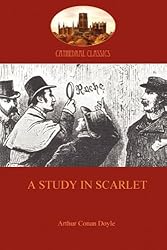
A Study in Scarlet by Sir Arthur Conan Doyle

This is the first Sherlock Holmes and Dr Watson mystery, published in 1887. A Study in Scarlet is a novel in two parts. The first, narrated by Dr John Watson, begins in 1881 with Watson on nine months convalescent leave from the army, having been shot in his shoulder whilst in Afghanistan, followed by an attack of enteric fever. As a result he was weak and emaciated – ‘as thin as a lather and as brown as a nut.‘ He was looking for lodgings when he met a friend who introduced him to an acquaintance who was working in the chemical laboratory at the hospital – Sherlock Holmes, who he described as ‘a little too scientific for my tastes – it approaches to cold-bloodedness. … He appears to have a passion for definite and exact knowledge.’ 

They get on immediately and take a suite of rooms in 221B Baker Street, after Holmes astounded Watson by deducing that Watson had served in Afghanistan. Holmes describes his occupation as a ‘consulting detective‘ solving crimes for both private individuals and the police, using his intuition, observation and the rules of deduction. Tobias Gregson and Lestrade both Scotland Yard detectives regularly ask Holmes for his help.

Very soon they are involved in investigating the murder of Enoch J Drebber, an American found dead in the front room of an empty house at 3 Lauriston Gardens, off the Brixton Road,  with the word “RACHE” scrawled in blood on the wall beside the body.

A Study in Scarlet is a superb story introducing Conan Doyle’s characters – Holmes reminds Watson of

… a pure-blooded well-trained foxhound as it dashes backwards and forwards through the covert, whining in its eagerness, until it comes across the lost scent.

Holmes is his brilliant best, leaving the police officers behind as he discovers the killer. And there then follows a flashback, narrated in the third person, to Part II The Country of the Saints to America in 1847, specifically to a Mormon community, explaining the events that led up to to the murder, where John Ferrier and his adopted daughter Lucy are first rescued from death in the desert and then subjected to the community’s rules, specifically with regard to Lucy’s marriage. At first I just wanted to get back to the murder inquiry and find out how Holmes discovered the murderer’s identity, but soon I was engrossed in the American story. Eventually the two parts come together in Chapter VI as Watson resumes the narrative and  Holmes reveals how he solved the problem by reasoning backwards and from a ‘few very ordinary deductions‘ was able to catch the criminal within three days.

I thoroughly enjoyed this story, written in a straightforward style with enough description to visualise both Victorian London and the American Wild West. I’d watched the TV version A Study in Pink in the Sherlock series, which although very different in some respects is surprisingly faithful to the book in others. I like both versions.

Sir Arthur Conan Doyle was born in Edinburgh in 1859 and died in 1930. He studied medicine at Edinburgh University, becoming the surgeon’s clerk to Professor Joseph Bell said to be the model for Sherlock Holmes’ methods of deduction. He gave up being a doctor with his success as an author and became involved in many causes – including divorce law reform, a channel tunnel, and inflatable life jackets. He was instrumental in the introduction of the Court of Criminal Appeal and was a volunteer physician in the Boer War. Later in life he became a convert to spiritualism.

See Fantastic Fiction for a list of works by Sir Arthur Conan Doyle.

Challenges: Read Scotland 2014, the Colour Coded Challenge, Mount TBR 2014 and My Kind of Mystery.
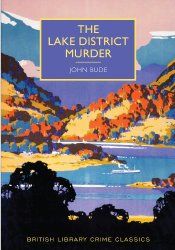
The Lake District Murder by John Bude

I first came across John Bude’s books nearly a year ago on Martin Edward’s blog Do You Write Under Your Own Name and thought they looked very interesting. His books are amongst those published by the British Library – reprints of unknown and undiscovered murder mysteries written in the thirties.  John Bude, whose real name was Ernest Carpenter Elmore, was writing in the Golden Age of detective fiction in the years between the two world wars. In 1953 he became one  of the founding members of the Crime Writers’ Association.

Anyway I made a mental note about the name and it lodged in the back of my mind until this September when I was in the Lake District and came across The Lake District Murder in the tourist information office in Glenridding on the shores of Ullswater. It has a striking cover, reproduced from a London & North Eastern Railway travel poster dating from the 1920s, showing a small steamer boat sailing on Ullswater, surrounded by the hills and mountains of the Lake District.

The LD mystery

The artist was John Littlejohns, who was born in Devon in 1874. He was a painter, illustrator, writer and teacher. As we had just been on a boat trip on Ullswater, in the Lady of the Lake (originally a steamboat), this immediately caught my eye.

The Lake District Murder as Martin Edwards writes in the introduction is ‘a world away from the unreality of bodies in libraries and cunningly derived killings on transcontinental trains.’ It is a police procedural, showing in intricate detail how the detectives investigate a crime. In this case a body is discovered in a car outside a lonely garage on a little used road. At first it appears that Jack Clayton one of the garage owners had committed suicide, but there are a couple of clues pointing to murder and when Inspector Meredith discovers that Clayton was planning to marry and move abroad it turns into a murder investigation. But what is the motive for murder and as everyone seems to have an alibi, who had the opportunity to kill Clayton? 

This book really takes you back in time. It was first published in 1935, which means that police methods of investigations particularly in rural areas was very different. Inspector Meredith uses buses or trains or travels the local roads on a motor cycle with a side car and pops into the local post office to use the telephone. It’s a slow process.

Having recently visited the Northern Lakes, I was fairly familiar with the landscape and could follow the action quite easily, but what I did find difficult was following the calculations Meredith and his colleagues carried out to work out petrol deliveries to the local garages, the lorries’ loads and the petrol storage capacities at the various garages. Inspector Meredith is a likeable character, with a happy home life, although his wife thought the police force made more than enough demands on his time  and tried to discourage their son’s interest in police affairs.

The Lake District Mystery is Bude’s second mystery novel. His first was The Cornish Coast Mystery,  and the third is The Sussex Downs Mystery (due to be released 27 October) both also reprinted by the British Library.

First Chapter, First Paragraph: Cauldstane

First chapterEvery Tuesday Diane at Bibliophile by the Sea hosts First Chapter First Paragraph Tuesday Intros, where you can share the first paragraph, or a few, of a book you are reading or thinking about reading soon.

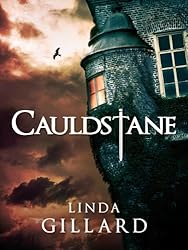
My choice this week is Cauldstane by Linda Gillard. It begins:

Sometimes I think I can still hear – very faintly – the strains of a harpsichord. Impossible, of course. There’s been no harpsichord at Cauldstane for over a year now. Meredith’s has never been replaced. Never will be replaced.

As the cover shows Cauldstane is set in a castle – a Scottish castle, a remote and decaying 16th century castle, the family home of the MacNabs. Ghostwriter Jenny Ryan is commissioned to write the memoirs of the current Laird, Sholto MacNab. There are secrets, sins to be revealed – and an ancient curse.

If you want to know more about Linda Gillard’s books here is the link to her website.

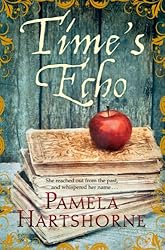
Time's Echo by Pamela Hartshorne


As I wrote in a First Chapter post  Time’s Echo mixes time as Grace Trewe is drawn into Hawise Aske’s life, four and a half centuries earlier in York, 1577. I saw this book in the library and although I hadn’t heard of Pamela Hartshorne I thought the title was interesting, and from the description on the back cover and the opening paragraphs, I thought it was worth borrowing.

It’s a good choice for Carl’s R.I.P. IX challenge, a time-slip story with an element of mystery and suspense in both time periods. Grace is staying in York to sort out the sale of her late godmother’s house when she experiences unnerving episodes in which she appears to be reliving the traumatic events in Hawise’s life beginning in 1577.  Grace likes to travel and although she survived the Boxing Day tsunami she is suppressing her memories of what happened. 

I think the suspense is somewhat diluted because right from the opening chapter it’s revealed that Hawise was drowned on All Hallows’ Eve, with her thumb tied to her toe – ie as a witch. But as Grace’s episodes continue she learns what happened in Hawise’s life to bring her to her dramatic death and this is interwoven with events in Grace’s life. It gets to the point where she dreads slipping out of current time into not only Hawise’s past but also into her own as what happened to her in the tsunami breaks through her mind.

What does add to the suspense is the unpredictability of the time-slips and the sense of malice and evil. So much so that the sceptic in me was unable to decide whether this was a question of whether Grace was suffering from post-traumatic stress disorder or was she really being “possessed” by Hawise, as she believed, feeling Hawise clamouring to be let into her mind. I found the historical sections more interesting than the modern story, which I think often happens when I read time-slip stories.

Pamela Hartshorne explains how she came to write this book in the Author’s Note at the end of the book. It grew out of her research on the wardmote-court returns of early modern York. These records dealt primarily with nuisances, things that affected the quality of life for the neighbourhood – such as noisy neighbours, blocked sewers. potholed streets etc (I note that local life hasn’t changed much over the centuries!). Some of the minor characters were real people, but this book is a work of fiction and Hartshorne is not intending this to be an accurate historical account, although she has tried to make it as convincing and as authentic as she could – I think she succeeded.

I thought the book was rather drawn out in parts, slowing the story down a bit too much for my liking. But, I like the fact that the book has a factual background, even though there are some liberties with the evidence – eg there was no plague in York in the 1570s or 1580s as featured in the book. So, on the whole I enjoyed Time’s Echo primarily because of its historical elements and I’ll look out for more books by Pamela Hartshorne. I see from her website that she has just published another time-slip book, The Memory of Midnight.

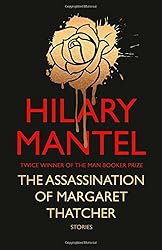
The Assassination of Margaret Thatcher and Other Stories by Hilary Mantel

When I first saw The Assassination of Margaret Thatcher I wasn’t sure I wanted to read it – not because of the controversy over the title story, but because I’m not especially keen on short stories. But Hilary Mantel is one of my favourite authors and after seeing her talk with James Runcie on The Culture Show I decided I definitely wanted to get the book.

I enjoyed this collection of stories,  which are brooding, somewhat melancholic, dark, disturbing and full of sharp and penetrating observations – brilliant! The title story is the last one in the book and is the only new story, the others having first appeared in other publications. I don’t find it easy writing about short stories, especially the very short ones, and so I’m not going to attempt to write about each of the ten stories in this book.

The first one, Sorry to Disturb, describes the dilemma of a British woman living in Jeddah in Saudi Arabia when she finds herself befriended by a young Pakistani businessman – a situation that was ‘ripe for misunderstanding‘. This is one of my favourites in the collection. It has a claustrophobic atmosphere, as feeling trapped in her flat, yet ‘always observed: overlooked, without being precisely seen, recognised’ she was unable to refuse a friendship, wondering if Jeddah had left her ‘for ever off-kilter in some way‘.

This view of life from a slightly different, skewed perspective and of being trapped is there in all these stories. The children in Comma, for example, spend their days during a long hot summer, ‘each day a sun like a child’s painted sun burned in a sky made white with heat’, drawn to watch what was happening at the Hathaways’ house, the house of the rich, built of stone, with a lofty round tower. In both this and Sorry to Disturb, there is an element of distinct class/cultural difference, of being outsiders.

Winter Break is one of the shorter stories, but complete in itself, unlike so many short stories I’ve read. A childless couple are taking a winter break, the husband trying to convince his wife she wants a child – she’s reluctant as she ‘had reached that stage in her fertile life when genetic strings got knotted and chromosomes went whizzing around and re-attaching themselves.’ A moment of anxiety on the journey to their hotel ends in horror.

How Shall I Know You is a much longer story. I often wonder what it’s like for authors going to venues and talking about their books and this story gives an insight into how it can be a dispiriting experience, staying in obscure and dingy places, feeling forlorn, exposed and generally insufficient. It has a grimly humorous side and underneath there is a darkness and bleakness. As with the other stories in this collection it is superbly written – you are there with the narrator, seeing the scenes, meeting the people and understanding their feelings and emotions.

And then the last story – The Assassination of Margaret Thatcher. Mantel sets the scene – of the ‘place where she breathed her last‘ – a ‘quiet street, sedate, shaded by old trees: a street of tall houses, their façades smooth as white icing, their brickwork the colour of honey.’  Waiting for the plumber to arrive, a woman lets a man into her flat, only to find out he has a gun and wants to shoot Margaret Thatcher from the flat window, as she leaves the hospital behind the flats. Far from being horrified or scared the woman sympathises with the gunman – her first reaction is that she should get a fee for the use of her premises. This too is a dark tale told with a dark sense of humour, and with depth of feeling.

Overall then this is a compelling book, brilliantly written, keenly observed, with the power to chill and shock me. It is one that I will re-visit.

  • Hardcover: 256 pages
  • Publisher: Fourth Estate (25 Sep 2014)
  • Language: Unknown
  • ISBN-10: 0007580975
  • ISBN-13: 978-0007580972
  • Source: I bought it

Almost Invincible by Suzanne Burdon

Almost InvincibleMary Shelley’s life and relationship with the poet Percy Bysshe Shelley was truly remarkable, a story of scandal, love and loss. And Suzanne Burdon using letters and diaries has written a remarkable novel, Almost Invincible, about her.

Mary ‘s parents were two radical writers, William Godwin and Mary Wollstonecraft, the advocate of women’s rights. At the age of sixteen she met Shelley, who was already married. They fell in love, abandoned their families and eloped, but significantly they took Mary’s step-sister, Claire with them. It was disastrous because Claire was in love with Shelley too and almost constantly in conflict with Mary.

The novel begins in Geneva in 1816 as Mary reads the opening pages of her novel, Frankenstein to Shelley, Lord Byron and their friends:

It was barely five on a summer afternoon but already eerily dark. The candles were lit and shivered in response to the wind and rain pounding against the panelled windows. Mary took up her scribbled pages and found her voice.

From then on the novel goes back to Mary’s meeting with Shelley in St Pancras churchyard in London two years earlier and follows their tempestuous lives until Shelley’s death in Italy in 1823. Mary went through so much; social outcasts they spent their time moving houses from France, England, Switzerland and Italy. She had two miscarriages and suffered the deaths of two of her children. Her father’s description of her shows her spirit:

She is singularly bold, somewhat imperious, and active of mind. Her desire of knowledge is great, and her perseverance in everything she undertakes, almost invincible.

But above all, it was her love for Shelley that sustained her. I found this a very moving book as it weaves its way through the tangled and often turbulent relationships of Mary, Shelley, Claire and their friends and acquaintances. At times Claire’s behaviour was so manipulative and destructive that Mary could not bear to be with her. Yet through all the sadness, grief, illnesses, and financial difficulties she found solace in her writing.

Suzanne Burdon has written a most impressive story. She has done extensive research, using original letters and stories in the Abinger Collection in the Bodleian Library in Oxford and the Carl Phorzheimer Collection of Shelley and His Circle in the New York Public Library. Almost Invincible is her first novel, based on fact but conveying the emotions, thoughts and feelings of her characters so convincingly. I was entranced.

  • Paperback: 340 pages
  • Publisher: Criteria Publishing
  • Language: English
  • ISBN-10: 0992354005
  • ISBN-13: 978-0992354008
  • Source: review copy from the publishers