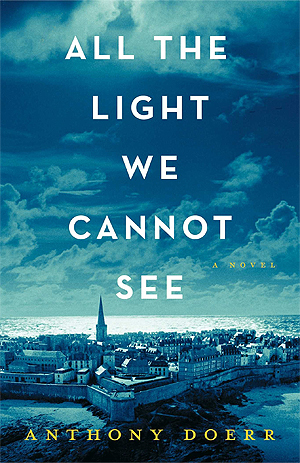
All the Light We Cannot See by Anthony Doerr

All the Light We Cannot See

Synopsis:

A beautiful, stunningly ambitious novel about a blind French girl and a German boy whose paths collide in occupied France as both try to survive the devastation of World War II

Marie-Laure has been blind since the age of six. Her father builds a perfect miniature of their Paris neighbourhood so she can memorize it by touch and navigate her way home. But when the Nazis invade, father and daughter flee with a dangerous secret.

Werner is a German orphan, destined to labour in the same mine that claimed his father’s life, until he discovers a knack for engineering. His talent wins him a place at a brutal military academy, but his way out of obscurity is built on suffering.

At the same time, far away in a walled city by the sea, an old man discovers new worlds without ever setting foot outside his home. But all around him, impending danger closes in.

Doerr’s combination of soaring imagination and meticulous observation is electric. As Europe is engulfed by war and lives collide unpredictably, ‘˜All The Light We Cannot See’ is a captivating and devastating elegy for innocence.

I have just finished reading All the Light We Cannot See by Anthony Doerr. I’m not going to write a review but want to jot down some thoughts:

  • It began well and I liked it straight away – see this Friday post.
  • There are three story lines – that of Marie-Laure, of Werner, and of a diamond that has magical powers.
  • But my overall picture of the book is of a blur, of confusion as it moved not only between characters but also backwards and forwards in time and I couldn’t work out the time sequence. I kept going back to the contents list to try to work it out was I in 1944 when the book began or in 1942, or 43. Had I met this character before in the future, or in the past and where was I -in France, Germany, Vienna or Russia? How did the characters relate to each other? I was hopelessly puzzled for quite a large portion of this book. For a while the fog in my mind cleared and I thought I’d got it, only to find a few chapters later I was lost again.
  • So I gave up trying to work out dates; places and people became clearer to me and I did (I think) follow the story, but it wasn’t easy as Marie-Laure’s and Werner’s time-lines were so fragmented.
  • The writing in parts is beautiful, great descriptions giving me some insight into what it was liked for ordinary people from both sides during the 2nd World War and what it must be like to be blind.
  • I liked all the detail of the model of Saint-Malo that Marie-Laure’s father made to help her find her way around, models of the buildings and roads.
  • The title refers (I think) to the how the brain, which is enclosed within the scull – ie in darkness – is yet full of light, brimming with colour and movement. And also to the light transmitted by radio wavelengths; light caught from the sun within plants and within gem stones such a diamonds; light beyond our ability to see it within the electromagnetic spectrum.
  • I was glad to get to the end. I think it is over-long, and very slow. But overall, mainly because of its descriptive prose; the way it conveys what being involved in war is like; and the character of Marie-Laure, I liked it and gave it 3 stars on Goodreads.

A book for Bev’s Mount TBR Reading Challenge, a book I’ve owned since 2016.

My Friday Post: Harriet Said by Beryl Bainbridge

Book Beginnings Button

Every Friday Book Beginnings on Friday is hosted by Gillion at Rose City Reader where you can share the first sentence (or so) of the book you are reading, along with your initial thoughts about the sentence, impressions of the book, or anything else the opener inspires. Harriet Said...

My opener this week is from Harriet Said by Beryl Bainbridge. I’ve enjoyed all of Beryl Bainbridge’s books that I’ve read so far, so I’m keen to read this one – the first book she wrote and submitted for publication in 1958. However, it was rejected because of its content and was not published until 1972. It is set just after the war in a Liverpool suburb near the Formby sand dunes where Beryl Bainbridge grew up.

It begins:

When I came home for the holidays, Harriet was away with her family in Wales. She had written to explain it was not her fault and that when she came back we would have a lovely time.

Also every Friday there is The Friday 56, hosted by Freda at Freda’s Voice.

30879-friday2b56

These are the rules:

  1. Grab a book, any book.
  2. Turn to page 56, or 56% on your eReader.
  3. Find any sentence (or a few, just don’t spoil it) that grabs you.
  4. Post it.
  5. Add the URL to your post in the link on Freda’s most recent Friday 56 post.

Page 56:

We rode the roundabouts, shrieking among the painted horses, riding endlessly round and round, waiting for the Tsar to come.

Blurb (from Goodreads):

Two schoolgirls are spending their holiday in an English coastal town: Harriet is the older at 14 and the leader of the two. The 13-year-old unnamed narrator develops a crush on an unhappily married middle-aged man, Peter Biggs, whom they nickname “the Tsar.” Led by pretty, malevolent Harriet they study his relationship with his wife, planning to humiliate him. Their plan quickly goes wrong, however, with horrifying results.

Eyes Like Mine by Sheena Kamal

Eyes Like Mine is an excellent psychological suspense novel. I loved it.

Blurb:

It’s late. The phone rings.

The man on the other end says his daughter is missing. Your daughter.

The child Nora Watts gave up for adoption 15-years ago has vanished and the police are labelling her a chronic runaway. No one is looking for the girl, she’s not blonde or white enough.

Once a starving artist herself, transient, homeless, left for dead in dark forest, Nora knows better than anyone what happens to girls that are lost to the streets. To the girls that the police don’t bother look for.

As she begins to investigate, she discovers a dangerous conspiracy and embarks on a harrowing journey of deception and violence that takes her from the rainy streets of Vancouver to the snow-capped mountains of the interior and finally to the island where she will face her greatest demon’¦

Intuitive, not always likeable, and deeply flawed, Nora Watts is a new heroine for our time.

My thoughts:

Eyes Like Mine is Sheena Kamal’s debut novel. She was inspired to write it by the plight of missing and murdered indigenous woman in Canada – an issue that kept cropping up during her research for the Canadian TV documentary looking into missing and murdered women along a 724 kilometre stretch of highway in northern British Columbia.

Everything about this book fascinated me from the characters and in particular the main character, Nora Watts, the gripping storylines that kept me racing through the book, to the atmospheric, gloomy setting in Vancouver and in beautiful British Columbia with its snow, mountains and plush ski resorts.

The plot is intricate, complicated and fast moving, highlighting various issues such as mixed race inheritance and differences in treatment based on skin colour, homelessness, and environmental issues. These never overpower the story, but form part of the book as a whole.

It’s narrated by Nora, in the first person present tense, interspersed by short chapters written in the third person, also present tense. I’m often irritated and distracted by the use of the present tense but I was hardly aware of it – I think it works well in this book, giving an insight into Nora’s mind and feelings.

Nora is a conflicted character, a recovering alcoholic, who works as a receptionist and research assistant for Seb Crow and his partner, Leo Krushnik, who runs a private investigation firm. Nora’s speciality is that she can tell when people are lying. Nora lives in their office basement with her dog, Whisper. There are plenty of interesting and well-drawn characters and I liked Nora, despite her somewhat suspect actions, and Whisper, who also has her own issues.

The main focus of the book is Nora, her traumatic background and her search for her daughter, Bonnie, now a teenager, who she gave away as a new-born baby. Nora is shocked by her reaction when she sees a photo of Bonnie – there is no doubt that she is her daughter, with her dark hair and golden skin. But it is her eyes that clinch it for Nora; Bonnie has the same eyes, dark and fathomless. And Nora feels as though she is in a nightmare.

Nora, working for Leo is also searching also for the witness to a murder, who has since disappeared, and for the killer of an investigative journalist, Mike Starling, the man from her past who had been investigating corruption in the mining industry. Her search takes Nora into many dangerous and heart-stopping situations. I was almost breathless as I read Eyes Like Mine.

My thanks to the publishers, Zaffre, for an advanced review copy of Eyes Like Mine, to be published tomorrow, 9 February.

  • Paperback: 320 pages
  • Publisher: Zaffre (9 Feb. 2017)
  • Language: English
  • ISBN-10: 1785762567
  • ISBN-13: 978-1785762567

Six Degrees of Separation from Fates and Furies to The Graveyard Book

Six Degrees of Separation is a monthly link-up hosted by Kate at Books Are My Favourite and Best. Each month, a book is chosen as a starting point and linked to six other books to form a chain. A book doesn’t need to be connected to all the other books on the list, only to the one next to it in the chain.

Fates and Furies

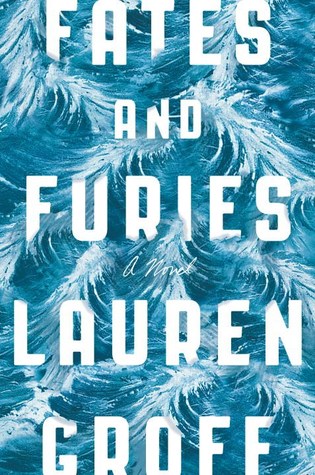
This month’s chain begins with Lauren Groff’s Fates and Furies.  I haven’t read it but apparently it is a novel about a marriage.

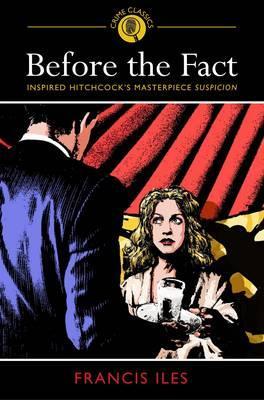
14486772So my first book in the chain is also a book about a married couple. It is Before the Fact by Francis Iles. First published in 1932 this is a Golden Age crime fiction novel that is a psychological character study of its two main characters, Lina and Johnnie.  ‘Some women give birth to murderers, some go to bed with them, and some marry them. Lina Aysgarth had lived with her husband for nearly eight years before she realized that she was married to a murderer.’
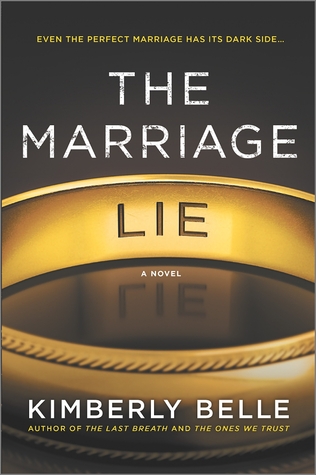
The Marriage LieThe Marriage Lie by Kimberly Belle is another psychological thriller and is also about a marriage. Iris thought her marriage to Will was perfect until a plane en route to Seattle crashed. Everyone on board was killed and, according to the airline, Will was one of the passengers – but he had told her he was going to Florida. Why did he lie? This is one of those books that gripped me and kept me guessing all the way through. It has one of the most convoluted and complex plots I’ve read in a while. The pace is terrific and the tension just builds and builds.

WreckageWreckage by Emily Bleeker is also about a plane crash. Lillian Linden and Dave Hall spent two years on a deserted island in the South Pacific after their plane crashed into the sea. Like The Marriage Lie, this book revolves around lies. After their rescue Lillian and Dave are desperate to keep what really happened on the island a secret from their families. This is also a book about marriage.


The Sea DetectiveWreckage
leads to the next book in the chain in which the sea and an island play a major role. It’s The Sea Detective by Mark Douglas-Hume (a Scottish author) set on the fictional island of Eilean Iasgaich. Cal McGill uses his knowledge of tides, winds and currents to solve mysteries, which helps in the investigation of the appearance of severed feet in trainers that had been washed on shore on islands miles apart.

The Ghosts of Altona (Jan Fabel, #7)The Ghosts of Altona is also by a Scottish author – Craig Russell. It’s the 7th book featuring Jan Fabel, the head of Hamburg’s Murder Commission and is set in Altona, one of the city boroughs. It’s a modern Gothic tale as well as being a crime thriller. Fabel’s first case as a detective is resurrected when the body of Monika Krone is found under a car park, fifteen years after she disappeared. And then there are more murders which Fabel thinks are linked to the discovery of Monika’s remains, all of men who were in the same Gothic set at university.

The Graveyard BookGhosts are the last link in the chain with The Graveyard Book  by Neil Gaiman. This is the story of the baby who escapes a murderer intent on killing his entire family, and who stumbles into the local disused graveyard where he is rescued by ghosts. He is named by the ghosts, Nobody Owens, or Bod for short, and he grows up looked after by his adoptive parents Master and Mistress Owens who had been dead for a few hundred years and numerous other occupants of the graveyard. It’s scary and creepy, but never gory.

The links are that they are all mysteries of different types, with three of them about marriage. They are all about life and death and the fight between good and evil. And I had no idea when I began the chain that it would end in a ghostly graveyard.

Next month (March 4, 2017), the chain will begin with Nick Hornby’s memoir (or love letter to soccer), Fever Pitch – I think I have this book, but haven’t read it.

My Friday Post: All the Light We Cannot See

Book Beginnings Button

Every Friday Book Beginnings on Friday is hosted by Gillion at Rose City Reader where you can share the first sentence (or so) of the book you are reading, along with your initial thoughts about the sentence, impressions of the book, or anything else the opener inspires.

18143977

This morning I began reading All the Light We Cannot See by Anthony Doerr (one of the TBRs on my Kindle) and already I think I’m going to like it very much.

It begins:

Zero

7 August 1944

Leaflets

At dusk they pour from the sky. They blow across the ramparts, turn cartwheels over rooftops, flutter into the ravines between houses. Entire streets swirl with them, flashing white against the cobbles. Urgent message to the inhabitants of this town, they say. Depart immediately to open country.

A dramatic opening, immediately alerting me to the danger that is to come.

Also every Friday there is The Friday 56, hosted by Freda at Freda’s Voice.

Friday 56

These are the rules:

  1. Grab a book, any book.
  2. Turn to page 56, or 56% on your eReader.
  3. Find any sentence (or a few, just don’t spoil it) that grabs you.
  4. Post it.
  5. Add the URL to your post in the link on Freda’s most recent Friday 56 post.

Page 56:

All day Marie-Laure lies on her stomach and reads. Logic, reason, pure science: these Aronnax insists, are the proper ways to pursue a mystery. Not fables and fairy tales.

Synopsis:

A beautiful, stunningly ambitious novel about a blind French girl and a German boy whose paths collide in occupied France as both try to survive the devastation of World War II

Marie-Laure has been blind since the age of six. Her father builds a perfect miniature of their Paris neighbourhood so she can memorize it by touch and navigate her way home. But when the Nazis invade, father and daughter flee with a dangerous secret.

Werner is a German orphan, destined to labour in the same mine that claimed his father’s life, until he discovers a knack for engineering. His talent wins him a place at a brutal military academy, but his way out of obscurity is built on suffering.

At the same time, far away in a walled city by the sea, an old man discovers new worlds without ever setting foot outside his home. But all around him, impending danger closes in.

Doerr’s combination of soaring imagination and meticulous observation is electric. As Europe is engulfed by war and lives collide unpredictably, ‘˜All The Light We Cannot See’ is a captivating and devastating elegy for innocence.

The Eagle of the Ninth by Rosemary Sutcliff

149405

Rosemary Sutcliff was one of my favourite authors when I was a child and I particularly loved Brother Dusty Feet, about a boy who joined a group of strolling players set in Elizabethan England. I bought The Eagle of the Ninth in a library book sale several years ago because I remembered my love of Brother Dusty Feet and had meant to read it well before now. I got round to it this month and thoroughly enjoyed it, so it’s one of my TBRs for Bev’s Mount TBR Reading challenge.

The first half of the book tells of how Marcus Flavius Aquila, a young Roman officer arrived in Britain as a centurion and was injured in a battle and then, unfit for duty, was discharged. Some years earlier, sometime in 117 AD, the Ninth Hispana Legion, led by his father had marched north from its base at Eburacum (York) into the mists of Northern Britain to deal with a rising among the Caledonian tribes and was never heard of again – their Eagle Standard was also lost.

Marcus then sets out to discover the truth about his father’s disappearance, what had happened to the Legion and if possible, to recover the Eagle, and thus to redeem his father’s honour. For an Eagle standard taken in war meant so much:

To the Outland tribes it must seem that they have captured the god of the Legion: and so they carry it home in triumph, with many torches and perhaps the sacrifice of a black ram, and house it in the temple of their own god to make the young men strong in war and help the grain to ripen.

If trouble were to break out again in the north, a Roman Eagle in the hands of the Painted People might well become a weapon against us, owing to the power it would undoubtedly have to fire the minds and hearts of the Tribes. (pages 121 – 122)

He disguises himself as a Greek occulist, and with his freed ex-slave, Esca, travels beyond Hadrian’s Wall. The rest of the book is about their search through the wild borderlands north of the Wall in what was then the province of Valentia and over the Northern Wall (the Antonine Wall), into Caledonia, along the shores of Loch Lomond to the base of Ben Cruachan overlooking Loch Awe.

Rosemary Sutcliff was a wonderful storyteller, bringing Roman Britain to life  in beautifully descriptive prose, so vivid that it’s easy to picture the scenery and the characters. It’s a powerful adventure story, full of detail particularly about Marcus and Esca – their friendship and courage in the face of danger and hardship. There is plenty of suspense as they fight their way through mountains and bogs, pursued by the hostile tribes. It’s also a novel about honour, duty and love.

She based The Eagle of the Ninth on two facts. First, the disappearance of the Ninth Legion. And second, the discovery of a cast bronze figure of an eagle found in the Basilica of the Roman town of Calleva, near Silchester. The eagle’s original wings are missing and its origin is unknown. Although it was not a legionary eagle, it inspired Rosemary Sutcliff to write her book.

File:Silchester eagle.JPG
Silchester Eagle Cast in Reading Museum

There is a map at the front of the book showing the route Marcus and Esca took and some of the places described, including Trinomontium (Melrose), Luguvalium (Carlisle), Segedunum (Wallsend) and Borcovicus on Hadrian’s  Wall (Housesteads Roman Fort) and the Northern Wall.

I loved all the detail of the mix of peoples living in Britain, their religious beliefs and ceremonies and their social and cultural background. It’s described as a children’s/YA book but I think it’s suitable for adults too – the writing style is certainly not simplistic and the vocabulary is extensive.

It is quite simply a gem of a book.

  • Paperback: 304 pages
  • Publisher: OUP Oxford; Revised edition edition (7 Oct. 2004)
  • Language: English
  • ISBN-10: 0192753924
  • ISBN-13: 978-0192753922
  • Source: my own copy

About Rosemary Sutcliff (1920 – 1975), born in Surrey

At the age of two she contracted Still’s disease and spent most of her life in a wheelchair. At 14 she left school having made little progress in anything except reading and went to an art school, specialising in miniature painting, becoming a member of the Royal Society of Miniature Painters just after the Second World War. She wrote very many books, both fiction and non-fiction, and won several awards.