My Week in Books: 2 May 2018

This Week in Books is a weekly round-up hosted by Lypsyy Lost & Found, about what I’ve been reading Now, Then & Next.

IMG_1384-0

A similar meme,  WWW Wednesday is run by Taking on a World of Words.

The Three Ws are:

What are you currently reading?
What did you recently finish reading?
What do you think you’ll read next?

Currently reading: Blacklands by Belinda Bauer, one of the books I got last week from Barter Books.

Steven Lamb is 12 when he writes his first letter . . .
to a serial killer

Every day after school, whilst his classmates swap football stickers, twelve-year-old Steven digs holes on Exmoor, hoping to find a body. His uncle disappeared aged eleven and is assumed to have fallen victim to the notorious serial killer Arnold Avery – but his body has never been found.

Steven’s Nan does not believe her son is dead. She still waits for him to come home, standing bitter guard at the front window while her family fragments around her. Steven is determined to heal the widening cracks between them before it’s too late – even if that means presenting his grandmother with the bones of her murdered son.

So Steven takes the next logical step, carefully crafting a letter to Arnold Avery in prison. And there begins a dangerous cat-and-mouse game between a desperate child and a bored psychopath . . .

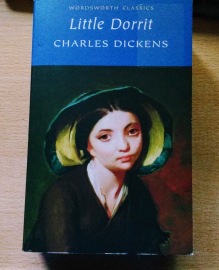
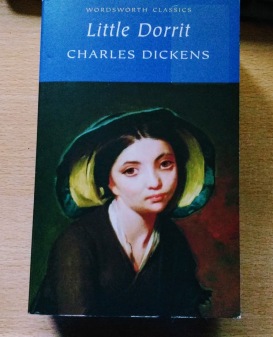
I didn’t finish Little Dorrit, my Classics Club spin book by 30th April, the Club’s deadline, but I’m carrying on reading it. I shan’t include it in later My Week posts until I’ve read a lot more of it.

Little Dorrit
Yesterday I finished Why We Sleep by Matthew Walker, one of my NetGalley books that have been stopping me from reading my TBRs.

This book extols the benefits of getting a full eight hours sleep each night and warns of the dire consequences if you don’t. I shall write more about it in a later post.

What do you think you’ll read next: I do enjoy deciding what to read next but the thing is that I often change my mind. At the moment I’m leaning towards reading The Summer before the War by Helen Simonson. But it could be something else when the time come to decide.

The Summer Before the War
My copy has this cover

It is late summer in East Sussex, 1914. Amidst the season’s splendour, fiercely independent Beatrice Nash arrives in the coastal town of Rye to fill a teaching position at the local grammar school. There she is taken under the wing of formidable matriarch Agatha Kent, who, along with her charming nephews, tries her best to welcome Beatrice to a place that remains stubbornly resistant to the idea of female teachers. But just as Beatrice comes alive to the beauty of the Sussex landscape, and the colourful characters that populate Rye, the perfect summer is about to end. For the unimaginable is coming – and soon the limits of progress, and the old ways, will be tested as this small town goes to war.

Have you read any of these books?  Do any of them tempt you? 

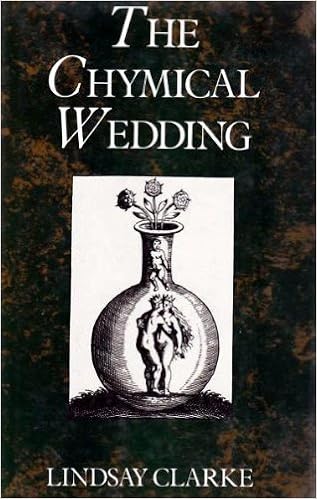
My Tuesday Post: The Chymical Wedding by Lindsay Clarke

Every Tuesday First Chapter, First Paragraph/Intros is hosted by Vicky of I’d Rather Be at the Beach sharing the first paragraph or two of a book she’s reading or plans to read soon.

Teaser Tuesdays is hosted by The Purple Booker. Post two sentences from somewhere in a book you’re reading. No spoilers, please! List the author and book title too.

I’ve been looking at some of my TBRs this week, wondering whether or not I really want to read all of them. One of the books I’ve had for a long time is The Chymical Wedding by Lindsay Clarke, a long book of over 500 pages. It won the Whitbread Prize for fiction in 1989.

It begins:

In that part of the world the sky is everywhere, and the entire landscape seems to lie in abasement under its exacting light. It gets into church towers and between the narrow reeds along the river’s edge. It glances across undulant acres of barley and beet, and takes what little the flints have to give. Everything there feels exposed, so keeping secrets is hard. It’s not the easiest place in which to hide.

Here is a teaser from page 98. 

‘How did you meet?

‘I was a student at a crazy college in Connecticut. Edward was visiting professor.’

‘Creative writing?’ I tried to keep the distaste from my voice. In the light of his remarks the previous night, it seemed an unlikely profession for the old poet. ‘Is that what you were studying?’

‘Parapsychology,’ she corrected, and smiled at my frown. ‘I told you it was a crazy college.’

Description from inside flap:

In the early 1980s Alex Darken retreats to the isolation of a Norfolk village only to become increasingly intrigued by Edward Nesbit and the extraordinary project on which this ageing poet and Laura, his young American lover, are working. in 1848 a new Rector, the Revd Edwin Frere, and his wife Emilia are welcomed to the same village by the querulous Henry Agnew and his devoted and brilliant daughter, Louise Anne.

Though set more than a century apart, these two stories are on a collision curse as both the Victorians and their latter-day researchers are caught up in the rites invoked across time by their enquiries into ‘the great experiment of Nature’.

The Chymical Wedding is a novel in which human passion and intellectual obsession reverberate through two interwoven narratives, a compelling work of imagination which establishes Lindsay Clarke as one of the most provocative and gifted authors writing in Britain today.

If you have read it I’d love to know what you think about it. If you haven’t read it, would you keep reading? 

Major Pettigrew’s Last Stand by Helen Simonson

Major Pettigrew's Last StandThere are some books that I read and really don’t want to write much about them: Major Pettigrew’s Last Stand by Helen Simonson falls into this category. (See this post for the opening sentence, an extract from page 56 and the description on Amazon)

The quotations on the back cover all praise this book as ‘charming’, ‘funny’, ‘heart-warming’, ‘refreshing in its optimism’, ‘jolly’, ‘a delight’, ‘quirky’, and ‘lovely’.

I think this last one from the Daily Mail is probably closest to my reaction to the book – ‘A book to make you think, laugh, and ultimately cheer – the perfect holiday read’, except it didn’t make me laugh or cheer. But it did make me think.

It’s set in an English village and at times I could imagine it was during the 1950s when in reality it’s set in the present day. Major Pettigrew is a retired army officer, living on his own after his wife had died six years earlier. The death of his younger brother knocks him for six and he finds himself attracted to Mrs Ali, the owner of the village shop whose husband had also died not long before. Their friendship deepens much to the concern of his family and friends.

What follows is a story about the difficulties of cultural differences, colonialism, racial prejudice, and class snobbery. It’s also about family relationships – the attitude of young people towards the older generation and also about love and friendship. It’s an enjoyable book even though I thought there were too many sub-plots, one or more verging on the ridiculous (the duck hunt is one example), and too many stereotypes.The Major and Mrs Ali stand out as believable characters.

Major Pettigrew’s Last Stand was Helen Simonson’s debut novel. Her second is The Summer Before the War, set in 1914 and I have the e-book edition waiting to be read on my Kindle.

  • Paperback: 400 pages
  • Publisher: Bloomsbury Paperbacks; First Edition edition (4 Jan. 2011)
  • Language: English
  • ISBN-10: 1408809559
  • ISBN-13: 978-1408809556
  • Source: I bought the book
  • My Rating: 3.5*

Amazon UK link
Amazon US link

New-to-Me Books from Barter Books

On Tuesday it was time for another visit to my favourite bookshop Barter Books, one of the largest secondhand bookshops in Britain. This is where you can ‘swap’ books for credit that you can then use to get more books from the Barter Books shelves.

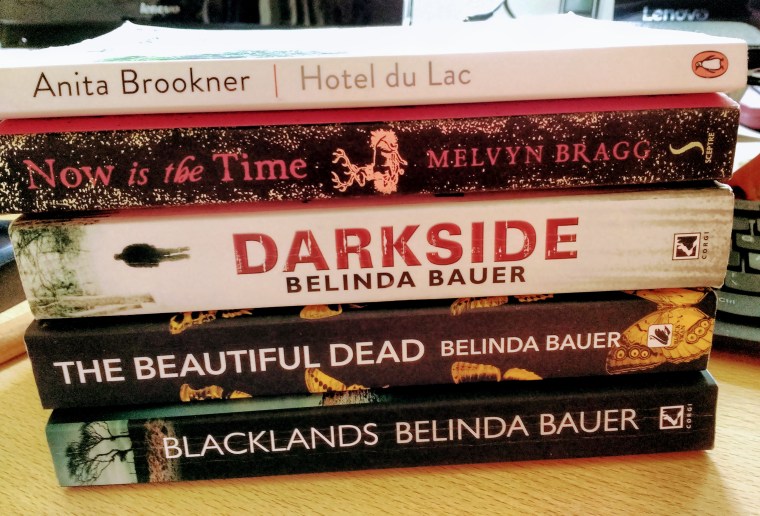
These are the books I brought home:

IMG_20180425_153217932.jpg


Hotel du Lac by Anita Brookner. I first read this many years ago and want to reread it – and hope I still like it as much. It won the Booker Prize in 1984. From the back cover: ‘Into the rarefied atmosphere of the Hotel du Lac timidly walks Edith Hope, romantic novelist and holder of modest dreams. Edith has been exiled from home after embarrassing herself and her friends. She has refused to sacrifice her ideals and remains stubbornly single. But among the pampered women and minor nobility Edith finds Mr Neville, and her chance to escape from a life of humiliating spinsterhood is renewed . . .’ 

Now is the Time by Melvyn Bragg. I loved his Soldiers Return quartet amongst some of his other books, so I’m hoping this historical fiction set in 1381 at the time of  the Peasants’ Revolt will be as good. Richard II was on the throne of England when a vast force of people led by Wat Tyler and John Ball demanded freedom, and equality. 

Then, three books by Belinda Bauer that I’ve been wanting to read for some time now:

Blacklands, her first novel – this tells the story of a game of cat and mouse between a 12 year old boy, Steven, and Arnold Avery, a serial killer and an abuser of children, who murdered Steven’s Uncle Billy, when he was 11 years old, twenty years ago.

Her second book, Darkside is set in the middle of winter time, when the people who live in a peaceful place, Shipcott, are shocked by the murder of an old woman in her bed.

The Beautiful Dead is about Eve Singer, a TV crime reporter, who will go to any length to get the latest scoop. But when a twisted serial killer starts using her to gain the publicity he craves, Eve must decide how far she’s willing to go – and how close she’ll let him get.

I’d love to start all these books straight away but I think I’ll begin with Belinda Bauer’s books, especially as I also have a review copy of her latest book, Snap which is due to be published as an e-book on 3 May 2018, with the hardback and paperback editions coming out later this year.

What do you think? Have you read any of these? Do they tempt you too?

My Week in Books: 25 April 2018

This Week in Books is a weekly round-up hosted by Lypsyy Lost & Found, about what I’ve been reading Now, Then & Next.

IMG_1384-0

A similar meme,  WWW Wednesday is run by Taking on a World of Words.

The Three Ws are:

What are you currently reading?
What did you recently finish reading?
What do you think you’ll read next?

Currently reading: I haven’t made any more progress with Little Dorrit, my Classics Club spin book and there is no way that I’ll finish it by 30th April, the Club’s deadline. But I shall carry on reading it and will finish it later on.

Little Dorrit

I am reading the book I said I might read next in last week’s Wednesday post – Time is a Killer by Michel Bussi, which was published on 5 April 2018 and am enjoying it so far.

Description:

‘One of France’s most ingenious crime writers’ SUNDAY TIMES

‘Bussi breaks every rule in the book’ JOAN SMITH

It is summer 1989 and fifteen-year-old Clotilde is on holiday with her parents in Corsica. On a twisty mountain road, their car comes off at a curve and plunges into a ravine. Only Clotilde survives.

Twenty-seven years later, she returns to Corsica with her husband and their sulky teenage daughter. Clotilde wants the trip to do two things – to help exorcise her past, and to build a bridge between her and her daughter. But in the very place where she spent that summer all those years ago, she receives a letter. From her mother. As if she were still alive.

As fragments of memory come back, Clotilde begins to question the past. And yet it all seems impossible – she saw the corpses of her mother, her father, her brother. She has lived with their ghosts. But then who sent this letter – and why?


Yesterday I finished  Major Pettigrew’s Last Stand by Helen Simonson, the book I wrote about in last Friday’s post. For now I’ll just say that on the whole I enjoyed it and I’ll try to sort out my thoughts and maybe post a review later in the week.

What do you think you’ll read next:

It’ll probably be Why We Sleep by Matthew Walker, one of my NetGalley books that I’ve been meaning to get round to before now.


Description:

Sleep is one of the most important aspects of our life, health and longevity and yet it is increasingly neglected in twenty-first-century society, with devastating consequences: every major disease in the developed world – Alzheimer’s, cancer, obesity, diabetes – has very strong causal links to deficient sleep. Until very recently, science had no answer to the question of why we sleep, or what good it served, or why its absence is so damaging to our health. Compared to the other basic drives in life – eating, drinking, and reproducing – the purpose of sleep remained elusive.

Now, in this book, the first of its kind written by a scientific expert, Professor Matthew Walker explores twenty years of cutting-edge research to solve the mystery of why sleep matters. Looking at creatures from across the animal kingdom as well as major human studies, Why We Sleep delves in to everything from what really happens during REM sleep to how caffeine and alcohol affect sleep and why our sleep patterns change across a lifetime, transforming our appreciation of the extraordinary phenomenon that safeguards our existence.

Or will it be something else? I’m not sure.

Have you read any of these books?  Do any of them tempt you? 

A – Z of TBRs: U, V and W

I’m now up to U, V and W in my A – Z of TBRs, a series of posts in which I take a fresh look at some of my TBRs to inspire me to read more of them, or maybe to decide not to bother reading them after all. These are books I bought full of enthusiasm to read each one – and mainly because I wanted to finish books I was already reading, they have sat on the shelves ever since. And then other books claimed my attention.
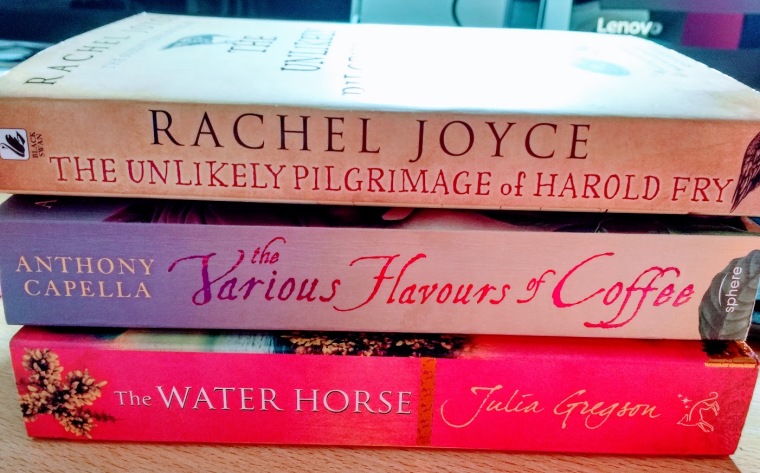
U V W books

– is for The Unlikely Pilgrimage of Harold Fry by Rachel Joycea novel I bought five years ago. It appealed to me because it’s about a man, Harold Fry, who walks from Kingsbridge in South Devon to Berwick-upon Tweed in Northumberland and I liked the idea of following his journey – on paper, that is.

Harold receives a letter from an old friend who is dying from cancer, writing to say goodbye. Feeling he can’t say what he wants to say in a letter he decides he needs to speak to her in person and phones the hospice where she is a patient:

‘Tell her Harold Fry is on his way. All she has to do is wait. Because I am going to save her, you see. I will keep walking and she must keep living. ‘ (page 28)

~~~

Harold Fry was a tall man who moved through life with a stoop, as if expecting a low beam, or a screwed-up paper missile, to appear out of nowhere. The day he was born his mother had looked at the bundle in her arms, and felt appalled. She was young, with a peony bud mouth and a husband who had seemed a good idea before the war and a bad one after it. A child was the last thing she wanted or needed. The boy learned quickly that the best way to get along in life was to keep a low profile; to appear absent even when present. He played with neighbours’ children, or at least he watched them from the edges. At  school he avoided attention to the point of appearing stupid. Leaving home when he was sixteen, he had set out on his own, until one night he caught Maureen’s eye across a dance hall and fell wildly in love. It was the brewery that had brought the couple to Kingsbridge. (page 36)

V – is for The Various Flavours of Coffee by Anthony Capella. I’ve had this book for nearly 10 years and started it not long after I bought it. My book mark is at the start of chapter twenty seven, so I’ve read about a third of the book. I can’t remember now why I stopped reading it. If I am going to read it I’ll have to start again.

It’s historical fiction and a love story beginning in 1896 in London where a struggling poet, Robert Wallis, accepts a commission from a mysterious coffee merchant, Samuel Pinker, to compose a ‘vocabulary of coffees’ that can capture their elusive fragrances. Robert is then dispatched to Africa in search of the world’s finest coffee.

In this extract Robert is considering how to describe black coffee beans:

… ‘these ones over here are as black as despair, whereas these are as golden as virtue -‘

‘No, no, no,’ Pinker interjected. ‘this is far too poetical. One man’s despair is another man’s gloom, and who is to say whether gloom and despair are the same colour?’

I saw his point. ‘Then we shall have to decide on words for several different shades of black.’

‘Exactly, sir – that is my purpose entirely.’

‘Hmm.’ I considered. It was, when one thought about it a rather vexing issue. ‘We shall begin,’ I declared, ‘by fixing the very blackest form of black there is.’

‘Very well.’

A silence fell upon us. It was in fact, quite hard to think of a word to describe the pure blackness of the darkest beans. ‘The pure black of a cow’s nose, I said at last. Pinker made a face. ‘Or the glistening black of a slug at dawn -‘

‘Too fanciful’ And if I may say so, hardly appetising.’

‘The black of a bible.’

‘Too objectionable.’

‘The black of a moonless night.’

Pinker tutted. (page 38)

and so it goes on, until they finally settled for ‘jet’.

W– is for The Water Horse by julia Gregson, a book I’ve had for nine years. This is a historical fiction based on the true story of a young Welsh woman, Jane Evans, a Welsh woman who in 1853 ran off with Welsh cattle drovers and volunteered as a nurse with Florence Nightingale in the Crimea.

The title refers to the story of the Water Horse

‘And God help you if you find the Water Horse,’ said Eleri, ‘he looks so lovely and he’s deadly.’

‘Do you believe in him?’ Catherine was interested at last. ‘I think about him every time I see the sea. ‘

‘No.’ She put down her pipe. ‘No, I don’t. but I do believe he shows us what we fear.’

‘What?’

‘Well, there he is: beautiful, extraordinary. he stands placidly by the water’s edge. We try to mount him, and sometimes you can ride him and feel so powerful, so wonderful, and the next time he bolts back into the sea with you and you die a horrible and frightening death. What could be clearer?’ Eleri’s eyes were shining in the dusk. ‘It’s our fear of being out of control. He’s the one who tells you, stick with the ordinary, don’t move, everything else is dangerous and nothing possible, but the problem is that if you fear everything you can’t control, you’ll never do anything that matters to you.’ (pages 58-9)

Looking at them this morning the one that appeals most is The Water Horse.

What do you think? Do you fancy any of them? Would you ditch any of them?