Two R.I.P. IX Books

So far I’ve read five books that fit into the R.I.P. Challenge categories of Mystery, Suspense, Thriller, Dark Fantasy, Gothic, Horror, or Supernatural. As I’m behind with writing about these books here are just a few notes on two of them:
Wycliffe and the House of Fear by W J Burley. Like the other Wycliffe books this is set in Cornwall. Detective Superintendent Wycliffe is on holiday recuperating from an illness when he meets the intriguing Kemp family and visits Kellycoryk, their decaying ancestral home.  The Kemps’ behaviour is odd to say the least and when Roger Kemp’s second wife, Bridget disappears people remember  that his first wife had also disappeared in what had been assumed was a boating accident. Wycliffe is inevitably drawn into the investigation.

I have yet to read a Wycliffe book and be disappointed and this one is no exception. It’s a complex story with sinister undercurrents and good depiction of a dysfunctional family. It kept me guessing almost to the end. This fits into the ‘Mystery’ category.
The next one I read is the short story (just 27 pages), The Yellow Wallpaper by Charlotte Perkins Gilman, which is definitely a suspense story of a young woman slowly but surely losing her mind – or is it a case of a woman suffering from post-natal depression most cruelly treated by her doctor husband? Her husband believes she has just a ‘slight hysterical tendency‘ and prescribes rest and sleep, scoffing at what he considers are her fantasies.

The un-named woman has just had a baby, which she is unable to bear to be near her. She spends most of her time in an attic bedroom, with barred windows and a bed fixed to the floor. The walls are covered in a hideous yellow wallpaper which has been torn off in places. It’s not a beautiful yellow like buttercups but it makes her think of old, foul bad yellow things – and it smells.  The pattern is tortuous and she sees a woman trapped behind the wallpaper as though behind bars, crawling and shaking the pattern attempting to escape. Definitely a creepy and disturbing story!

It reminded me of Marghanita Laski’s The Victorian Chaise-Longue with a similar sense of claustrophobia and helplessness. But The Yellow Wallpaper is much more horrific and by the end I began to question just what was real and what was imagination – it’s psychologically scary!

These two are both books from my to-be-read piles.
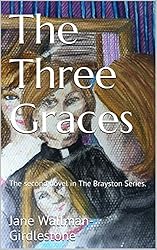
The Three Graces by Jane Wallman-Girdlestone

I’ve read a couple of novels this year that deal with mental illness – The Bell Jar by Sylvia Plath, which I found a bit confusing and disjointed and The Grass is Singing by Doris Lessing. My reaction to both books was that they are bleak and depressing, showing the breakdown of a personality and I struggled to read them. (See my thoughts on Doris Lessing’s book in this post.)

So, I was a bit hesitant about reading The Three Graces when I realised that it was a novel dealing with the subject of schizophrenia. I needn’t have been concerned as it is by no means a depressing novel. This is Jane Wallman-Girdlestone’s description of her book (taken from her website):

… Grace Hunter, the newly appointed Team Rector for the town, turns out to be nothing like people expect.  Nobody suspects that she has a guilty secret.  No one guesses that the local funeral director is the answer to the Rector’s prayers.  No one in their right mind would have thought that workaholic Grace was tormented by imaginary friends who dominated everything she did. 

My view:

Grace Hunter is trying to adjust to her new appointment as Team Rector, but her confusion grows as she begins to have hallucinations. It’s a remarkable book because although told in the third person at times I wasn’t sure that the people she sees were just in Grace’s head. I think it’s a very clever portrayal as the reader sees things through Grace’s eyes and mind whilst she is carrying on with everyday living and her job as Rector. Grace’s behaviour becomes reckless, at times divorced from reality. It clearly demonstrates how difficult/impossible it is for her to distinguish between what is real and what is not.

The Three Graces follows Grace’s life and to a lesser extent that of her family – husband Tom, Josh and Ros her step-children and her father-in-law, Charlie. They are all having to adjust to Tom and Grace’s marriage and the move to St Anthony’s, their third in five years. And they’re all feeling very unsettled. The dominant character in the novel is Grace; it all revolves around her and as her confusion grows it affects them all. It is an engrossing book, the writing is clear and concise, and the characters are clearly defined. It’s a well-structured novel, the tension and emotional atmosphere gradually rising and Grace’s feelings of despair and confusion and are all very evident. The book is certainly an enlightening read for me.

About the author (From Amazon):

Jane Wallman-Girdlestone was born and grew up in Tooting, South London. She began writing about her life experiences at eight. Jane taught briefly before working in theatre as a writer and director. She later worked as a Vicar and chaplain for some years before lecturing in Theology and Spirituality. Jane works with people who are on retreat offering creative and spiritual mentoring and as a counsellor.

Jane lives in the Highlands of Scotland in the UK, where she writes and paints. She is married and has three Newfoundland dogs and a cat.

The Three Graces is the second book in the Brayston series. Sausages and Trash is the first and the third, with the working title Sleight of Hand, will be published on Kindle in December. This will feature some of the characters from the first two books and I’ll be looking out for it.

NB:  The Three Graces is temporarily unavailable on Kindle.

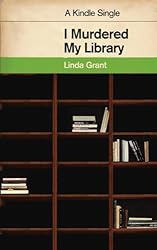
I Murdered My Library by Linda Grant

Following on from yesterday’s post on books I’ve read recently and not reviewed, I have three more I have not written about and here is one of them:

I Murdered My Library by Linda Grant. This is an essay of just 28 pages in which Linda Grant tells about moving house and downsizing her considerable book collection to fit into a small flat. She had had books everywhere:

Books multiplied, books swarmed; they were a papery population explosion. When they had exhausted the shelves, they started to take over the stairs. You cannot have a taste for minimalist decor if you seriously read books.

Well, I know all about that and all about trying to find more space for books or to reduce my book collection, so I really liked this little e-book. Linda Grant can read my mind – and those of many other book-lovers, I’m sure – as she went through her books deciding which ones could go. It could be me saying this too:

I am kidding myself if I think that I am going to reread a fraction of the books I have brought with me or a fraction of those I have never got round to reading.

In my youth, I imagined old age and retirement as the time when one sat back, relaxed and read. There would be all the time in the world for reading. Sixty was so far away, and 80 stretching out into a future not imaginable, that you might as well be talking about living forever. Now time gobbles up my life.

I have tried, but I’ve never managed to be as ruthless as she was, never seen empty bookshelves and I doubt I ever will, because there have been so many books I’ve given away only to realise later that I want to re-read/read them, or to look up a reference. So it’s made me think twice, or even ten times before I actually part with a book. And indeed as Linda Grant looks at her shelves of the books she has kept she mourns the ones she killed off!

Shadows on Our Skin by Jennifer Johnston

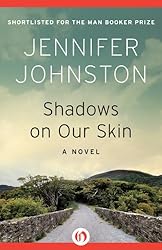
Shadows on Our Skin by Jennifer Johnston has recently been re-issued as an e-book. It was first published in 1977 when it was shortlisted for the Booker Prize. I was pleased to be offered a copy for review as I have enjoyed a few of her books, such as The Illusionist and Two Moons.

This is the story of Joe, living in Derry (Londonderry), Northern Ireland before the Troubles and the Bloody Sunday attack in 1972. Joe is a schoolboy, living with his mother and his alcoholic father, a former war hero who reminisces and feeds on his memories. It’s a violent situation at home, as the father dominates his wife and son, with an even more violent conflict in the streets. To a certain extent Joe lives within his own head, writing poetry, and his mother is keen to keep him indoors once school has finished because she fears he will be shot as the British soldiers patrol the streets. However, he has made friends with Kathleen, a young English teacher and they meet after school. She encourages his writing, enhancing his escape from reality. But when his brother, Brendan returns home his involvement in the IRA brings Joe back to earth with a sharp shock, as the conflict comes closer to home.

Shadows on Our Skin is an engrossing book, the writing is taut and spare and yet poetical, the scenes standing out vividly in my mind. The characters’ interaction is full of emotion, and of tension; their feelings of despair and bitterness are all very evident. The book is certainly an enlightening read for me.

  • Format: Kindle Edition
  • File Size: 515 KB
  • Print Length: 177 pages
  • Publisher: Open Road Media (24 Jun 2014)
  • Sold by: Amazon Media EU S.à r.l.
  • Language: English
  • ASIN: B00KQ6PJZE
  • Source: Review copy

Knavesborough Stories by Dorte Hummelshoj Jakobsen

Recently Dorte Hummelshoj Jakobsen kindly made two of her short stories available to me (e-books) for review. They are both about the Gershwin family in Knavesborough, a fictional village in Yorkshire, namely Ding Dong Bell, the Kitten in the Well and Green Acres. I often find short stories lack the necessary depth to be convincing – either weak plots and/or characterisation, but these short stories are both convincing and satisfying. Maybe it helps that they are continuations of other stories, or in the case of Ding Dong Bell, the Kitten in the Well, a prequel.

Ding Dong Bell, the Kitten in the Well goes back in time to Rhapsody Gershwin’s childhood in the early 1990s. Rhapsody is the vicar’s daughter first featured in The Cosy Knave. In this short story Rhapsody and her sisters are worried about the disappearance of the black kitten they have called Black Pete. The last time they had seen him was when they had played in old Ursula Abbot’s garden and they wondered if he had he got locked in her cottage. Ursula had died but as she was nearly ninety it wasn’t entirely an unexpected death … but she had been in good health. Is Ursula’s death connected to Black Pete’s disappearance?Rhapsody helps to solve the mystery.
Green Acres* takes us to the latest in the Gershwin and Penrose Mysteries series. Green Acres, once a country mansion, has been converted into a home for the elderly. Rhapsody visits Rowan Dougal, a farmer who has broken his hip and is currently living at Green Acres. Lavinia Banbury staying in the room next to Rowan dies in her sleep. Nothing unusual in an old people’s home, but is her death really a natural one?

Green Acres* was originally published in the anthology The Red Shoes. This is a new and longer version.

I like these stories. They’re humorous crime fiction, with colourful characters all with quirky names. There’s no blood and gore and each story has an unexpected twist at the end. In other words, they are cosy crimes (if any crime could really be considered as ‘cosy’, that is).

Dorte Hummelshoj Jakobsen is Danish. After many years as a teacher she is now concentrating on a writing career, publishing in both Danish and English. As well as writing her cosy mysteries she has also written a full length psychological murder mystery novel, Anna Marklin’s Family Chronicles, which I thoroughly enjoyed too – see my post here.

St Bartholomew's Man by Mary Delorme

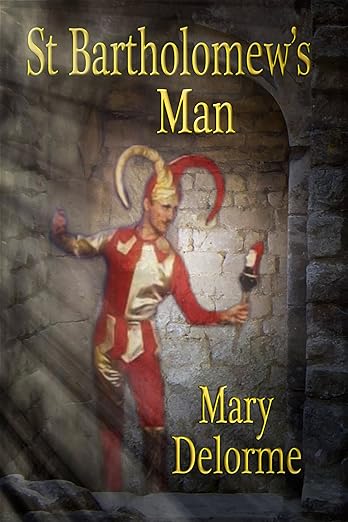
I was intrigued when I was asked if I would like to read Mary Delorme’s book St Bartholomew’s Man, about Rahere, a man who was a court jester to Henry I and who was also instrumental in the foundation of St Bartholomew’s Hospital in 1123. I was intrigued because it seemed an odd combination, that a jester and the founder of St Bartholomew’s should be one and the same person. And I wondered how that had come about.

It is historical fiction but as Mary Delorme clarifies in her Author’s Note it is based on fact with this proviso:

Almost nine hundred years lie between Rahere and myself; enough to blur historical facts, and leave room for doubt. Rahere is often described as a man of lowly origins, and a jester – something I find difficult to accept, bearing his mind his outstanding achievements and experiences. I therefore began my novel assuming that he was more highly born; not of the highest, but still an educated man. (Loc 26)

It seems to me that she has thoroughly researched her material, and managed to incorporate it seamlessly into her book. St Bartholomew’s Man follows the life of Rahere, from his childhood growing up as an orphan in a monastery, where he was one of the singing children, and he helped the monks in their healing work.

It is a book that left me knowing a lot more about the late 11th and early 12th centuries. It tells of the lives of ordinary people, of the monastic life and above all of the dangers and turbulence of life, moving through the oppressive reign of the irreligious William II (William Rufus), the more settled and peaceful reign of Henry I, followed by the violent conflict that ensued with the reign of Stephen and Matilda. I liked the historical setting and the detail both about healing and building methods. The plot kept me interested to read on to find out whether Rahere succeeded, despite all the suffering he endured and the challenges he had to overcome, in fulfilling his vow to build a hospital to care for the poor in London. The characterisation is good and I felt all the main characters came over as real people, who grew and developed throughout the book.

I enjoyed reading this book, which made me want to find out more about Rahere and St Bartholomew’s. St Bartholomew’s Hospital website outlines the history of the Hospital and St Bartholomew the Great’s website gives some information about the founding of the Priory church and Prior Rahere. Rahere’s tomb is in the church.

Then there is Rudyard Kipling’s poem Rahere, based on the legend that Rahere founded St Bartholomew’s Hospital after suffering a bout of depression and seeing a family of lepers in a London street. I also see that Rosemary Sutcliff’s children’s book The Witch’s Brat is set in the reign of Henry I and features Rahere – I’m hoping to read that one too.

My thanks to Jon Delorme for providing a copy of St Bartholomew’s Man for review, a book that entertained me and led me on to other sources of history and literature. I really want to know more about the 12th century. My knowledge is limited to schoolgirl history and Ken Follett’s The Pillars of the Earth!