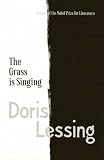
The Grass is Singing by Doris Lessing

I hadn’t read any of Doris Lessing’s books before I read The Grass is Singing, although I’d looked at one or two whilst browsing the library shelves. I wasn’t sure I’d like her books and now I’ve read this, her first novel, I’m still not sure. ‘Like’ is not the right word! How can you ‘like’ the portrayal of the breakdown of a personality, a marriage, a community? The Grass is Singing is a powerful book. Set in Southern Rhodesia (now Zimbabwe) in the 1940s, it’s a novel about failure and depression, disaster, racism, racial tension and prejudice, colonialism at its worst. It’s beautifully written, but so tragic.
Anger, violence, death, seemed natural to this vast, harsh country … (page 19)

It’s hard to write about without some spoilers! My immediate reaction to The Grass is Singing was that it is so bleak and depressing and I didn’t want to read any more of Doris Lessing’s books. It’s now nearly a week since I finished reading it and my reaction has changed as I’ve thought over what to write about it. There is so much in it to take in and whilst my reading is mostly for enjoyment with just a nod towards analysing what I’ve read I really think this book deserves more study than I’ve given it. So what follows just scratches the surface and doesn’t really do justice to the book. I think I may very well read more of Lessing’s books – this edition includes a selection of her other books – The Golden Notebook; The Good Terrorist; Love, Again; and The Fifth Child.

It begins with the newspaper report of the death of Mary Turner, the wife of Richard (Dick) Turner, at Ngesi. She was found on the verandah of their house and their houseboy had confessed to the crime. From there it goes back, recounting all the events that lead up to the murder. It’s deceptively simple story, brimming, overflowing with cruelty and suppressed emotion. What is so tragic about it is that Mary and Dick are unable to communicate with each other – neither understands what the other person is feeling. It is unremitting in portraying their poverty and their helplessness to improve their situation.When you add to this the racial prejudice, colonialism – the contempt that the white farmers had for the natives, and the disintegration of personality – Mary has a mental breakdown – it’s a very hard book to read.

One of its strengths is the atmospheric setting. There is no mistaking the location, the stifling heat adding to the tension, the towns with their ‘ugly scattered suburbs‘, ‘ugly little houses stuck anywhere over the veld, that had no relationship with the hard brown African soil and the arching blue sky’ (page 44), and the farm where Dick and Mary lived, over 100 miles from town, surrounded by trees and the bush, with its tiny rooms, red-brick floor, and its corrugated iron roof, rooms with no ceilings, stuffy and unbearably hot.

… the house was built on a low rise that swelled up in a great hollow several miles across, and ringed by kopjes that coiled blue and hazy and beautiful, a long way off in front, but close to the house at the back. It will be hot here, closed in as it is. (page 58)

What is also remarkable is Doris Lessing’s portrayal of Mary. At the beginning of the novel she is an independent woman, maybe a little different from women her own age, a little aloof and shy. But she hadn’t been married and when she reached thirty, vaguely feeling that maybe there was more to life, she overheard people talking about her, wondering why she wasn’t married and saying there was ‘something missing somewhere’. She was stunned and outraged. Dick seemed to be the answer, but he disliked the town, which she loved and where she felt safe. Marrying him, moving to his farm was the trigger that set off  her eventual inner disintegration. So, by the end of the book Mary has changed almost beyond recognition! Her reaction to the natives is also shocking, swinging from fear to violence and then passive acceptance of the presence of Moses, the houseboy, who kills her.

It’s a disturbing book about an ugly subject, racism; it’s passionate, and dramatic. I couldn’t like any of the characters, but they got under my skin as I read and I wanted it all to end differently – of course, it couldn’t.

The Santa Klaus Murder by Mavis Doriel Hay

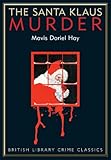
When I saw that The Santa Klaus Murder was available for loan from the Kindle Lending Library I wondered if it was worth looking at. I’d never heard of Mavis Doriel Hay before, but I thoroughly enjoyed reading this book, one of the British Library Crime Classics.

Mavis Doriel Hay (1894-1979) was a novelist of the golden age of British crime fiction. Her three detective novels were published in the 1930s and are now rare and highly collectable books. She was an expert on rural handicraft and wrote several books on the subject.

Summary from the British Library:

A classic country-house murder mystery, The Santa Klaus Murder begins with Aunt Mildred declaring that no good could come of the Melbury family Christmas gathering at their country residence Flaxmere. So when Sir Osmond Melbury, the family patriarch, is discovered€”by a guest dressed as Santa Klaus€”with a bullet in his head on Christmas Day, the festivities are plunged into chaos.

Nearly every member of the party stands to reap some sort of benefit from Sir Osmond’s death, but Santa Klaus, the one person who seems to have every opportunity to fire the shot, has no apparent motive. Various members of the family have their private suspicions about the identity of the murderer, but in the midst of mistrust, suspicion, and hatred, it emerges that there was not one Santa Klaus but two.

My view:

This was first published in 1936 and it is a classic locked room murder mystery. There are lots of suspects, especially as there were rumours that Sir Osmond was about to re-write his will. The story has several narrators, including – Sir Osmond’s daughter, Jennifer and her fiancé, Philip (Sir Osmond has withheld his blessing to their engagement), his daughter Hilda, a widow, Mildred, his sister, Grace, his young and vivacious secretary, and Colonel Halstock, the Chief Constable, investigating the crime. The suspects all seem to have alibis, but are they all telling the truth?

In short, it seems impossible to be sure of anyone’s exact movements during that half-hour.

No one admits seeing anyone enter the study after Oliver Witcombe left Sir Osmond there, until Witcombe returned and found him dead. (page 81)

It is a complicated plot and I enjoyed all the twists and turns. The opening chapters are rather detailed setting out the family background, but the characters all came to life as they arrived at Flaxmere.

There is a map showing the layout of the ground floor of Flaxmere, to help the reader and I kept referring to it as I read, together with the list of characters and their relationships.

To help you even more, if you haven’t worked out who did it there is a Postscript by Colonel Haverstock listing the questions and clues to identify the murderer. So don’t look at the end if you don’t want to know how and why Sir Osmond was murdered.

Hay’s other two murder mysteries Murder Underground and Death on the Cherwell are due to be published in June 2014 – I’ll be looking out for them.

The Sc-Fi Experience: The Midwich Cuckoos

Sci-Fi Experience

Carl at Stainless Steel Droppings is hosting the 2014 Sci-Fi Experience beginning on
December 1st, 2013 and ending on January 31st, 2014. Carl is inviting readers to:

a) Continue their love affair with science fiction
b) Return to science fiction after an absence, or
c) Experience for the first time just how exhilarating science fiction can be.

There are no set numbers of books to read, no pressure, you just get to read what you like, be it one book or twenty: it’s up to you.

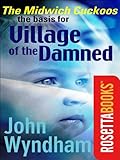
I think I fall into the second category. I used to read a lot of science fiction many years ago but these days I only read one or two now and then. As it happens, now is one of those rare occasions as I’ve recently read The Midwich Cuckoos by John Wyndham, first published in 1957.

Book Description from Amazon

In the sleepy English village of Midwich, a mysterious silver object appears and all the inhabitants fall unconscious. A day later the object is gone and everyone awakens unharmed €“ except that all the women in the village are discovered to be pregnant.

The resultant children of Midwich do not belong to their parents: all are blonde, all are golden eyed. They grow up too fast and their minds exhibit frightening abilities that give them control over others and brings them into conflict with the villagers just as a chilling realisation dawns on the world outside . . .

The Midwich Cuckoos is the classic tale of aliens in our midst, exploring how we respond when confronted by those who are innately superior to us in every conceivable way.

My view:

The story is set in an ordinary village, with a village green and a white-railed pond, a church and vicarage, an inn, smithy, post office, village shop and sixty cottages and small houses, a village hall, and two large houses, Kyle Manor and The Grange. A very ordinary village where not much goes on, which makes what happens there even more extraordinary.

It’s a product of its time and is dated in the way it portrays women – for example, comments about the female mind being empty because of the dullness of the majority of female tasks and focusing on the shame of being an unmarried mother. Maybe there is too much philosophising and discussion about topics about collective-individualism, morality, the nature of God and evolution. But even so the level of tension and fear rose as the children grew and revealed their powers and not having seen the film version I had no idea how it would end.

Actually, I really enjoyed The Midwich Cuckoos more than I thought I would. It’s eerie and very chilling, a story of alien invasion and the apparent helplessness of humanity to put up any resistance.

In a Word: Murder: An Anthology

Maxine Clarke was one of my favourite book bloggers, writing as Petrona. She died last December and there is a blog Petrona Remembered which her friends in the crime fiction community have created in honour of both her memory and in an attempt to keep alive the kind of community spirit she engendered.

Margot Kinberg (another of my favourite book bloggers) has put together an anthology with all proceeds going to the Princess Alice Hospice:

In a Word: Murder


with contributions from: Martin Edwards (Author), Pamela Griffiths (Author), Paula K. Randall (Author), Jane Risdon (Author), Elizabeth S. Craig (Author), Sarah Ward (Author), Margot Kinberg (Editor) and Lesley Fletcher (Illustrator).

Read more about it at Margot’s blog.

Buy from:
Amazon.co.uk
Amazon.com

Waiting For Mr Right by Andrew Taylor

The full title of this collection of three short stories is Waiting For Mr Right & Other Sinister Stories and it is an ideal book to read for Carl’s R.I.P Challenge – reading books of a macabre and fantastical nature .

Andrew Taylor writes in his introduction to this collection that ‘short stories permit concentration, the ability to focus on a single idea,’ I like the good ones for just that reason, but more often than not when I read some short stories I’m left feeling ‘oh, so what’ – they can be trivial and unsatisfying. Not so with this collection, because these are very good stories. Taylor also writes:

Unfortunately, good short stories are also incredibly difficult to write. Each word counts for more than a word in a full-length novel; each word costs more to write. Short stories may be short but they make a author sweat blood.

He has succeeded in my opinion. These cleverly written stories work on two levels – they are works of fantasy that made me both amused and chilled; they present a different form of ‘reality’.

The first story, Waiting For Mr Right,  is set in the cemetery of Kensal Vale where a remarkably well-educated creature lives and is the narrator, telling the tale of Jack and Tracy. Jack is in hiding in the vault of the Makepiece family, which has a Bateson’s Belfry – a Victorian invention that enabled you to summon help if you’d been buried alive. The ending is both horrific and well, amusingly satisfying.

The second slightly less sinister story is perhaps not quite as good as the first one. It is Nibble-Nibble, but it is still an entertaining story about a little boy and his imaginary friend, John – or is he really a ghost? The little boy lives with his Aunt and Uncle. Then his Granny comes to stay and she doesn’t believe in ghosts, but ghosts are like people, or so John says – there are some you like and some you don’t. The little boy realises:

Normally grannies were meant to be nice and ghosts were meant to be scary. Why did it have to be the other way round for me? Why couldn’t I be like everyone else?

I think the final story is the best. It’s called Keeping My Head. It was written for an anthology celebrating the eightieth birthday of the late H R F Keating, a former president of the Detection Club.

The narrator is an old lady looking back over the events of her life – and her death. I can’t write much about it or I’ll be giving away too much. I’ll just say that her husband was having an affair and she decided to kill him, but it all went wrong. When she was fifteen a tinker told her fortune and warned her that although she was going to have a long life and would be known around the world she must always ‘beware of keeping her head‘. She was a heedless girl and soon forgot the tinker.

Broken Voices by Andrew Taylor

I like Andrew Taylor’s books, so when I saw this novella on Kindle I downloaded it anticipating a good read. Broken Voices is a ghost story set in an East Anglian cathedral city just before the First World War when two schoolboys are left at the cathedral school during the Christmas holidays. They lodge with Mr Ratcliffe, a semi-retired schoolmaster, a bachelor now in his seventies who lived with Mordred, his malevolent cat, in a grace-and-favour house granted to him by the Dean and chapter of the cathedral.

Andrew Taylor has drawn both the setting in the Fens and the atmosphere of the times well. The two boys, both upset at being left at school have little to occupy themselves with and are entertained by the ghost stories that Mr Ratcliffe tells them. There was an ancient tragedy connected with the cathedral bells, the tower and a Canon who had been commissioned to write an anthem to mark the occasion when the bells were recast. The cathedral is full of shifting shadows, and the bell tower is haunted by fragments of melody, which one of the boys can hear.

I didn’t find it that chilling, but the story does have a creepy atmosphere and a tension as the boys investigate the tower in the dead of night. It’s suitably ambiguous. It’s not spelled out and you can make your own decision – as one of the boys says at the beginning of the story, looking back forty years to the events he is relating:

Was there a ghost? Was there, in a manner of speaking, a murder?

Ask me these questions and I cannot answer a simple yes or no. I did not know at the time and now, more than forty years later, I am even less able to answer them.

I read this quickly. It may be just a bit predictable, but none the less I enjoyed it for what it is – a ghost story told with eloquence and sufficient pace to build up the suspense and keep me entertained to the end.