A Game of Thrones by George R R Martin

‘When you play the game of thrones, you win or you die. There is no middle ground.’
22740513

When we began watching the HBO TV series, A Game of Thrones, I was hooked and once we finished watching I immediately wanted to read the series, A Song of Fire and Ice. I’d just read The Sunne in Splendour by Sharon Penman, about the Wars of the Roses and had noticed the similarities between that and A Game of Thrones, the battles between the Houses of York and Lancaster paralleled by those between the Houses of Stark and Lancaster for example.

I don’t often read a book after seeing an adaptation, but in this case it proved ideal – the actors and scenery were perfect for my reading of the book, although there are some differences (the ages of the Stark children for example). I loved both the book and the TV series.

Blurb:

Summers span decades. Winter can last a lifetime. And the struggle for the Iron Throne has begun.

As Warden of the north, Lord Eddard Stark counts it a curse when King Robert bestows on him the office of the Hand. His honour weighs him down at court where a true man does what he will, not what he must ‘¦ and a dead enemy is a thing of beauty.

The old gods have no power in the south, Stark’s family is split and there is treachery at court. Worse, the vengeance-mad heir of the deposed Dragon King has grown to maturity in exile in the Free Cities. He claims the Iron Throne.

I was completely immersed in this world inhabited by numerous characters and set in different locations (Seven Kingdoms), all portrayed in meticulous detail and expertly constructed so that all the fantastic creations are credible, and complete with back stories and histories. Beginning with a Prologue the book is then narrated through different characters’ points of view – each chapter is headed by that character’s name making the plotlines easy to follow:

  • Lord Eddard “Ned” Stark, Warden of the North and Lord of Winterfell, Hand of the King.
  • Lady Catelyn Stark, of House Tully, wife of Eddard Stark.
  • Sansa Stark, elder daughter of Eddard and Catelyn Stark.
  • Arya Stark, younger daughter of Eddard and Catelyn Stark.
  • Bran Stark, second-youngest son of Eddard and Catelyn Stark.
  • Jon Snow, illegitimate son of Eddard Stark, mother unknown.
  • Tyrion Lannister, son of Lord Tywin Lannister, called the Imp, a dwarf, brother of the twins, the beautiful and ruthless Queen Cersei and Ser Jaime, called the Kingslayer,
  • Daenerys Targaryen, Stormborn, the Princess of Dragonstone, sister of Prince Viserys, the last of the Targaryens.

Other characters include:

  • King Robert of the House Baratheon, Lord of the Seven Kingdoms, Eddard Stark’s oldest friend, married to Queen Cersei, his son Joffrey, spoiled and wilful with an unchecked temper, heir to the Iron Throne.
  • Robb Stark, oldest true born son of Eddard Stark. He remained at Winterfell when Eddard became the Hand of the King.
  • Tywin Lannister, Lord of Casterly Rock, Warden of the West, Shield of Lannisport.
  • Khal Drogo – a powerful warlord of the Dothraki people on the continent of Essos, a very tall man with hair black as midnight braided and hung with bells.

Locations:
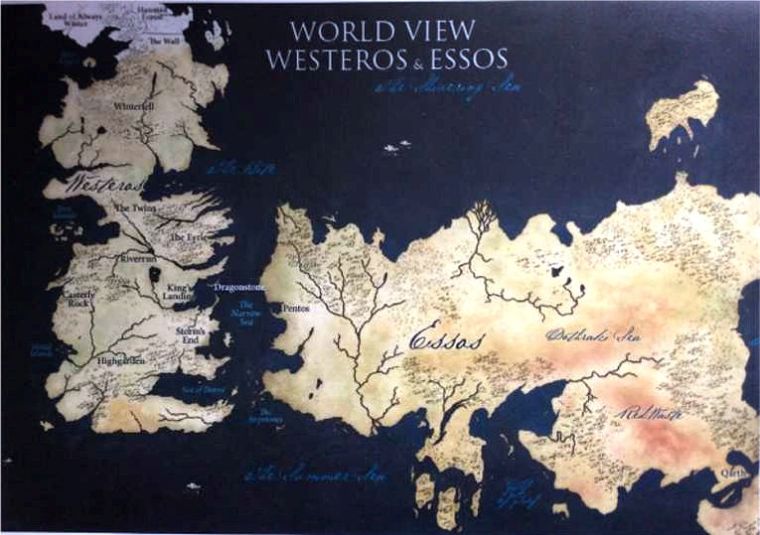
GOT Map1

  • Winterfell: the ancestral castle of House Stark.
  • The Wall: built of stone, ice and magic, on the northern border of the Seven Kingdoms, guarded by the Night’s Watch to protect the Kingdoms from the dangers behind the huge wall from ‘the Others’ and the Wildings.
  • Beyond the Wall: the first book begins Beyond the Wall with members of the Night’s Watch on the track of a band of Wildling raiders.
  • King’s Landing: a walled city, the capital of the continent of Westeros and of the Seven Kingdoms.
  • Essos: across the Narrow Sea from Westeros, includes the grassland known as the Dothraki Sea.

This article in The Telegraph lists the locations used in the TV series.

This is no fairy tale – it’s set in a grim and violent world full of tragedy, betrayals and battles; a tale of good versus evil in which family, duty, and honour are in conflict, the multiple viewpoints giving a rounded view of the conflicts the characters face. It’s a love story too. There are knights, soldiers and sorcerers, priests, direwolves, giants, assassins and bastards.  It’s complex and multifaceted, and it’s full of stories and legends – here for example Maester Luwin tells young Bran Stark about the children of the forest:

“They were people of the Dawn Age, the very first before kings and kingdoms,” he said. “In those days there were no castles or holdfasts, no cities, not so much as a market town to be found between here and the sea of Dorne. There were no men at all. Only the children of the forest dwelt in the lands we now call the Seven Kingdoms.

‘They were a people dark and beautiful, small of stature, no taller than children even when grown to manhood. They lived in the depths of the wood, in caves and crannogs and secret tree towns. Slight as they were, the children were quick and graceful. Male and female hunted together, with weirwood bows and flying snares. Their gods were the gods of the forest, stream and stone, the old gods whose names are secret. Their wisemen were called greenseers and carved strange faces in the weirwoods to keep watch on the woods. (page 713)

I shall be reading the next book in the series soon, A Clash of Kings. The other books are A Storm of SwordsA Feast for Crows, and A Dance with Dragons.

I read the Kindle Edition:

  • File Size: 8515 KB
  • Print Length: 819 pages
  • Page Numbers Source ISBN: 0007448031
  • Publisher: Harper Voyager (23 Dec. 2010)

Reading Challenges: Mount TBR Reading Challenge  – a book I’ve had since October 2015, and the What’s In a Name Challenge – in the category of a book with a piece of furniture in the title.
The Man Who Would Be King by Rudyard Kipling

For me the book chosen for the current Classics Club Spin is The Man Who Would Be King by Rudyard Kipling. It’s a novella, just 60 pages, which first appeared in The Phantom Rickshaw and other Eerie Tales, published in 1888.
Set in India and narrated by a journalist this is a story of two ruffianly-looking adventurers, wanderers and vagabonds, Daniel Dravot and Peachey Carnehan, who announce that they are off to Kafiristan in the mountains of Afghanistan to make themselves Kings. They tell the journalist that when they have got their kingdom ‘in going order’ they will let him know and that he can then come and help them govern it.

But some two years later, on a hot summer’s night, what was left of Carnehan crept into the journalist’s office,

He was bent into a circle, his head was sunk between his shoulders, and he moved his feet one over the other like a bear. I could hardly see whether he walked or crawled- this rag-wrapped, whining cripple who addressed me by name, crying that he was come back. (page 24)

And he had a sorry tale to tell.

I was a bit disappointed with it, mainly because for a novella it took such a long time to set the scene and the opening section was confusing, with references I didn’t understand. After the slow beginning the story picks up when it gets to relating what happened to Dravot and Carnehan. The Kipling Society website (where you can read the story, which is also free on Amazon) has some notes that helped me understand more – Masonic, Biblical and other references and details about the places and people mentioned.

The Kipling Society also gives details of the background to the story and some critical responses to it. Overall the responses are good – that it is a memorable, fantastic tale, some believing it to be a masterpiece, but Kingley Amis stated it was a ‘grossly overrated long tale‘. I was also interested that Edmund Wilson is quoted as stating that the story is “…surely a parable of what might happen to the English if they should forfeit their moral authority.”[Edmund Wilson ‘The Kipling that Nobody Read’, in Kipling’s Mind and Art ed. Andrew Rutherford, Oliver & Boyd, 1964.]

There was a film adaptation in 1975, starring Sean Connery as Dravot and Michael Caine as Carnehan with Christopher Plummer as Kipling, which according to some is much better than the story itself.

Rudyard Kipling was born in Bombay in 1865 and lived there until he was five when he was taken to live in England, returning to India in 1882, where he worked as a journalist. As well as short stories he also wrote poems, including If, and novels, and was awarded the Nobel Prize in Literature in 1907.

My copy is an e-book, which I’ve had for several years, so it counts towards my Mount TBR Reading Challenge.

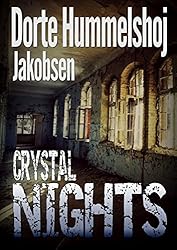
Crystal Nights by Dorte Hummelshoj Jakobsen

I recently read Crystal Nights: a Scandinavian mystery by Dorte Hummelshoj Jakobsen, who kindly sent me an e-version of the ARC of her book. The Danish edition of the book, Krystalnætter, won a national competition in 2013.

Once I started reading Crystal Nights I was hooked. It begins with an extract from Hans Christian Andersen’s The Snow Queen, a fairy tale about the struggle between good and evil, when a magic mirror was smashed into many pieces, which then entered the eyes, hearts and minds of people infecting them with evil.

Crystal Nights moves between events in Germany in 1938 to Kalum, a fictional village in Denmark, in the 1960s. In Berlin in 1938 Jewish families, including the Stein family, Simon, his wife Sara, and Miriam and Isaac, their two young children flee from the events of Krystallnacht, the “night of broken glass”.  Their journey doesn’t get them to safety though and ends with Sara desperate as her son becomes dangerously ill and Simon refuses to get medical help.

Moving on to the 1960s in Kalum, the story divides into the years 1963 and 1967. In 1963 a middle-aged smallholder from Brook Farm, north of Kalum is killed in a road accident. The relevance of this death only becomes apparent towards the end of the book. In 1967 a young boy, Lars-Ole disappears. His mother believes he had gone to stay with his father, but eventually everybody except for his friend Niels, assumes he is dead although his body has not been found. Niels finds Lars-Ole’s notebook, in which he had written some coded messages and sets out to discover what has happened to him, putting himself into great danger.

I particularly liked the comparison between Andersen’s fairy tale and the events of Krystallnicht and I think the characters of both Lars-Ole and Niels are well-drawn, with the village setting in the 1960s particularly convincing. I was carried away by the story, a story of how evil touched so many lives with such terrible consequences and how by patience and perseverance the truth was revealed.

You can see photos and maps showing the area in this picture companion to the book.

  • Format: Kindle Edition
  • File Size: 820 KB
  • Print Length: 187 pages
  • Publisher: Candied Crime; 1 edition (6 May 2015)
  • Source: Review copy from the author

Reading Challenges: Mount TBR Reading Challenge 2016

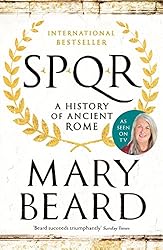
SPQR: A History of Ancient Rome by Mary Beard

Mary Beard is a Professor of Classics at Newnham College, Cambridge and is the Classics editor of the TLS. She is a fellow of the British Academy and a member of the American Academy of Arts and Sciences. And she writes a blog – A Don’s Life, which appears in The Times. I’ve enjoyed watching her TV programmes and so it doesn’t surprise me at all  that SPQR is just as entertaining and informative as the programmes – and very readable, even for someone, like me, who only has a smattering of knowledge about Roman history.
I took my time reading SPQR; some of it covered familiar ground and some was new to me. It’s a fascinating account of how Rome grew and sustained its position for so long, covering the period from the fourth century BCE when Rome was expanding from a small village, up to the moment in 212 CE when the emperor Caracalla made every free inhabitant of the Roman Empire a full Roman citizen.

The title, SPQR, is taken from the Roman catchphrase, Senatus Populusque Romanus meaning the Senate and People of Rome and it is on these two elements – the Senate and the People that Mary Beard concentrates, focussing on the city of Rome, on Roman Italy and also looking at Rome from the outside, from the point of view of those living in the wider territories of the Roman empire.

The book is not strictly chronological and begins with an event I know a bit about through reading Robert Harris’ Lustrum. It’s the Catiline conspiracy in 63 BC, which concerned a plot, or so it was rumoured to overthrow the Roman Empire and Cicero’s part in uncovering the plot and saving the state. Mary Beard begins with this event, because:

it is only in the first century BCE that we can start to explore Rome, close up and in vivid detail through contemporary eyes. An extraordinary wealth of words survives from this period: from private letters to public speeches, from philosophy to poetry – epic and erotic, scholarly and straight from the street.’ (location 143)

She highlights the effect Cicero had, not just on the politics of his own time but also on the language of modern politics. And it is from Cicero’s speeches, essays, letters, jokes and poetry and other Roman writers that we see the Roman world not just in 63 BCE but throughout the city’s history.

For the earlier period however, there are no contemporary accounts and so the early years of the city and of the earliest Romans has to be reconstructed  from individual pieces of evidence from fragments of pottery or letters inscribed on stone.

There are also, of course the myths and stories as well and Beard refers to these, such as the story of Romulus and Remus, who are said to have founded the city, told by Livy and several other Roman writers. Tradition has it that Romulus and his tiny community fought against their neighbours, the Sabines, and erected a temple on the site of the battle, which later became the Forum, but there is no archaeological evidence to identify the remains of this temple. Archaeology, in fact, only sketches what Rome in the earliest period was like and it is very different from the myths. Later Roman writers and modern historians alike have debated intensely the stories of Romulus and Remus, raising the questions of what it was to be Roman. And Beard states:

There is often a fuzzy boundary between myth and history … and … Rome is one of those cultures where the boundary is particularly blurred. … For a start there was almost certainly no such thing as a founding moment of the city of Rome. … Although Romans usually assumed that he [Romulus] had lent his name to his newly established city, we are now fairly confident that the opposite was the case: ‘Romulus’ was an imaginative construction out of ‘Roma’. ‘Romulus was the archetypal ‘Mr Rome.’ (locations 844 – 850)

From that point Beard goes on to discuss the basics of Roman culture, including the nature of Roman marriage, Roman slaves, the Republican system, the principle of freedom, or ‘libertas’, the changing definition of what it meant to be ‘Roman’, Roman domination of the Mediterranean, dictatorship, civil war, taxation, the modern Western system of timekeeping, the emperors and their imperial successes and military victories and the army – and so much more!

SPQR is an immense  achievement, covering 1,000 years of the history of Ancient Rome, and not only the history but also explaining Roman values, what they thought about themselves, and the way of life of both the People and the Senate.

  • Format: Kindle Edition
  • File Size: 22379 KB
  • Print Length: 608 pages
  • Publisher: Profile Books; Main edition (20 Oct. 2015)
  • Source: I bought it

Reading Challenges: Mount TBR 2016 – an e-book I’ve owned since November 2015

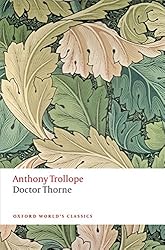
Doctor Thorne by Anthony Trollope

I’ve recently read Anthony Trollope’s Doctor Thorne, which I’d meant to read about a year ago after I finished Barchester Towers! I enjoyed it, although I think it’s a bit too drawn out – I could see where the plot was going very early in the book. The conclusion is predictable.

But that didn’t matter as it’s a book about mid nineteenth-century prosperous country life and the traditional attitudes towards the accepted codes of conduct, of the importance of birth, of wealth and above all about money, class and power. It’s about human relationships and the strength of the novel is in the portraits of its characters and their responses to matters of principle in the face of upper class idiocy and snobbishness. Trollope uses gentle satire in this novel, emphasising the absurdities of the class divisions in society and poking fun at the professions, with the names of doctors, such as Dr Fillgrave, whose name wouldn’t inspire me with confidence, parliamentary agents such as Mr Nearthewind and Mr Closerstil and lawyers called Messrs Slow and Bideawhile.

Doctor Thorne is the third in Trollope’s Barchester Towers books – the first one not set in Barchester, but in Greshambury in East Barsetshire, where the Gresham family and Doctor Thorne and his niece Mary live. As the novel opens nothing is going well for the Gresham family, they are in financial difficulties, the estate is mortgaged and they are heavily in debt. It is imperative that Frank, the son and heir to Greshambury Park and its estate, should marry money – indeed, his mother, Lady Arabella, the sister of the Earl de Courcy insists ‘He must marry money‘, a refrain that is repeated throughout the novel. But Frank has fallen in love with Mary, who has neither money or rank, and is illegitimate and as the story proceeds she is increasingly ostracised by the Gresham family, egged on by their rich relations the De Courcys.

Although the book is called Doctor Thorne, the main character to my mind is Mary Thorne, who shows great strength of character throughout. Mary had been adopted by Doctor Thorne, after her father, his brother had been murdered by her mother’s brother. Her mother had left England for America, where she had married and had a family. The brother, meanwhile had done well for himself after he left prison and made a fortune. Mary knows nothing of her background.

I particularly liked Miss Dunstable, the daughter of ‘the ointment of Lebanon man‘, who had inherited £200,000 when he had died recently. The Gresham family, or rather Lady Arabella, instruct Frank that he is to ask her to marry him – her wealth over-riding the fact that her father was a tradesman.

My only criticism of this book is that the discussions about whether Frank and Mary should or should not be allowed to marry are too drawn out and slowed down the plot too much for my liking. Apart from that I thought it was good, Trollope’s authorial comments were interesting, the dialogue was realistic and lively and the main characters came over as real people. An entertaining novel and now I’m keen to read the next Barchester Towers book, Framley Parsonage; Doctor Thorne also appears in this book!

In his Autobiography Trollope wrote that he had been trying to think up a new plot and he asked his brother to sketch one for him, which he did! He thought it was a good plot and the book was, he believed, the most popular book he had written. He was surprised by its success.

After I finished reading Doctor Thorne I realised that it was a perfect choice for the What’s in a Name? Challenge in the category of a book with a profession in the title. It’s a book I’ve had since before 1 January 2016 and fits into the Mount TRB Reading Challenge too and it’s also a book I identified for the Classics Club Challenge.

I wanted to read Doctor Thorne before the three-part adaptation of the book that starts tonight on ITV at 9 pm, so that my reaction to it wouldn’t be influenced. Now that I have read it I’m not at all sure I’ll watch the adaptation. If there are too many changes I know it will irritate me.

A House Divided by Margaret Skea

One of the best historical fiction books I read last year was Margaret Skea’s debut novel, Turn of the Tide, which captivated me completely transporting me  back in time to 16th century Scotland.  So I approached its sequel, A House Divided, hoping it would be just as good, and it is. Indeed it’s even better. Once more I was whisked back to the world of the feuding clans of Cunninghame and Montgomerie. It is the most gripping story of warring factions in Scotland, the French Wars of Religion, superstition and horrific witchcraft trials.

It’s now 1597, six years after the events in Turn of the Tide. The Munro family are believed to have died in a fire at their home, Broomelaw but Kate Munro and her three children are living at Braidstane in Ayrshire under the protection of the Montgomerie family. They have the assumed the name of ‘Grant’, in hiding from the Cunninghame family, particularly from William Cunninghame, the son of the Earl of Glencairn, head of the Cunninghame clan. Kate’s husband is in France, fighting with the Scots Gardes for the French Henri IV. Meanwhile William Cunninghame has taken possession of Broomelaw and is rebuilding the tower house. And it’s becoming more difficult and dangerous to keep their identity secret; the children are asking questions and the eldest, Robbie, wants to go to join his father in France.

Kate, who has gained a reputation as a ‘wise woman’ from her knowledge and skill in the use of herbs and plants for healing and as a midwife, is called to help Margaret Maxwell, the wife of Patrick, a Cunninghame supporter, with the birth of her baby. When Patrick meets Kate and her daughter, Maggie, he is suspicious. thinking they look familiar, reminding him of Munro’s wife, and so the danger begins. And it increases as Kate’s reputation grows and she is summoned to the Scottish court as Queen Anne (James VI’s wife), having heard of Kate’s expertise, needs her advice in carrying a baby to full-term.  She had been advised to try a number of methods to avoid a miscarriage:

I have eaten crushed orchid leaves, powdered fox’s lungs and crab’s eyes; drunk wolf oil and tincture of foxglove; been bled and leeched till I think I have little blood left; told to lie on my side and on my stomach, even upside down. Few treatments convenient and none effective. (location 3242)

It’s no wonder they failed and a wonder she survived!

There is so much I loved in this book – first of all the story itself, expertly narrated, full of tension and surprise, and then the characters, some based on real historical figures and others fictitious, such as the Munro family. The story is well grounded in research and based on facts – James VI, whilst waiting to inherit the English crown, wanted to bring peace to Scotland and to put an end to the wars between the clans. His interest in, or rather his obsession with witchcraft comes to the fore in this novel as Kate is accused as a witch and brought to trial as part of the Great Scottish Witch Hunt of 1597. Also historically accurate is the Scots involvement in France as under the terms of the ‘Auld Alliance’ they had citizenship rights in France as well as trading agreements and the Scots Gardes were an elite Scottish regiment whose duties included the provision of a personal bodyguard to the French King.

But it’s the personal touches that brought home to me what life was like in the 16th century, what their houses were like, the food they ate, the dangers that faced them in their daily lives, as well as the growing interest in science and medicine as opposed to superstition and religious bigotry and fervour.

This is an excellent book, one of the best I’ve read this year. Not only is the story absolutely fascinating, but it is also well written and well paced. The historical facts all blend seamlessly into the narrative, with beautiful descriptive passages not just of the landscape and the Scottish Court, but also of the grim details of warfare, of the horrors of the witch trials and of sickness, typhoid and plague, of wounds, of childbirth and of death. It’s strong, compelling reading, a book that made me keen to find out what would happen next and at the same time one I didn’t want to end.

  • Format: Kindle Edition – also available as a paperback
  • File Size: 1017 KB
  • Print Length: 480 pages
  • Publisher: Sanderling Books; 1 edition (15 Oct. 2015)
  • Author’s website: Margaret Skea, Writing yesterday, today

Margaret Skea is currently working on her third novel – I’m looking forward to reading it!

Reading Challenges: Read Scotland 2016