Caedmon’s Song by Peter Robinson

Peter Robinson writes the Inspector Banks books, but he has also written short stories and a couple of standalone books including Caedmon’s Song, described as a psychological thriller.

Summary (from Peter Robinson’s website)

One warm June night, a university student called Kirsten is viciously attacked in a park by a serial killer. He is interrupted, and Kirsten survives, but in a severe physically and psychologically damaged state. As the killer continues, leaving a trail of mutilated corpses, Kirsten confronts her memories and becomes convinced not only that she can, but that she must remember what happened. Through fragments of nightmares, the details slowly reveal themselves. Interwoven with Kirsten’s story is that of Martha Browne, a woman who arrives in the Yorkshire coastal town of Whitby with a sense of mission. Finally, the two strands are woven together and united in a startling, chilling conclusion. 

My thoughts

Overall I liked Caedmon’s Song, but I wouldn’t describe it as a thriller, even though the attack on Kirsten is particularly vicious. It is set mainly in Whitby a seaside town in Yorkshire. The ruins of Whitby Abbey, Bram Stoker’s inspiration for Dracula, stand on the East Cliff overlooking the North Sea, with St Mary’s Church and Caedmon’s Cross nearby. I wondered as I began reading whether Martha’s visit to Whitby had any connection to Dracula, but although these places are described as she finds her way around the town they are just incidental to the plot.

Then I began to wonder about the connection between Kirsten and Martha because Robinson drops in quite a few clues early on in the book, which become explicit in the second half of the book. So, the links between them are quite easy to see, which disappointed me at first and lessened the tension. I wasn’t too convinced either by how Kirsten discovered her attacker’s identity and even considering the horrific details of her injuries I didn’t really feel sympathetic towards her as she comes across as rather cold-blooded. But as the narrative developed I began to enjoy the story and to wonder how it would end.

Kirsten considers whether she is a ‘born victim‘ or not, questioning her actions on the night of the attack, and wondering whether she had been inviting destruction. Her conclusion is that she wasn’t at all clear about it, but felt that it was her destiny, that she had been chosen as her attacker’s nemesis. All she knew was that she had to find him and face him. The ending is dramatic, but what would happen next is left open.

In his afterword Peter Robinson (written in 2003 when a new edition was published) explains that he had the idea for writing Caedmon’s Song in the late 1980s after he had written the first four Inspector Banks novels. He had felt he needed a change and wanted to write a novel in which the police played a subsidiary role. Then in September 1987 when he saw Whitby as he approached it on the coast road the idea for the setting and opening of the book came to him:

There lay Whitby, spread out below. The colours seemed somehow brighter and more vibrant than I remembered: the greens and blues of the North Sea, the red pantile roofs. Then the dramatic setting of the lobster-claw harbour and the two opposing hills, one capped with a church, the other with Captain Cook’s statue and the massive jawbone of a whale. I knew immediately that this was where the story had to take place, and that it began with a woman getting off a bus, feeling a little travel-sick, trying the place on for size. (pages 326-7)

I feel a trip to Whitby coming on – a place I’ve been wanting to visit for some years now.

Amazon UK link

  • Paperback: 336 pages
  • Publisher: Pan; Reprints edition (1 Aug. 2013)
  • Language: English
  • ISBN-10: 1447225473
  • ISBN-13: 978-1447225478
  • Source : I bought the book
  • Rating: 3*

Reading challenges: Mount TBR Reading Challenge 2017

See What I Have Done by Sarah Schmidt

Lizzie Borden took an ax
And gave her mother forty whacks
When she saw what she had done,
She gave her father forty-one.

Or did she?

On the 4 August 1892 Andrew Borden and his second wife, Abby, were brutally murdered in their home at 92 Second Street in Fall River, Massachusetts and Andrew’s daughter, Lizzie, was charged with the murders. She was tried and was acquitted in June 1893 and speculation about the murders and whether Lizzie was guilty or not continues to the present day. See What I Have Done by Sarah Schmidt is a work of fiction based on true events using various resources.

File:Lizzie borden.jpg
Lizzie Borden c.1890

Lizzie was thirty two at the time of the murders but in this fictionalised account she seems emotionally much younger, more like a teenager than a mature woman.

The narrative is shared by Lizzie, her sister Emma, Bridget their maid and Benjamin, a ‘friend’ of Lizzie’s Uncle John, and moves backwards and forwards in time, before and after 4 August 1892. Lizzie’s account is the strangest and it takes you right inside her mind. She is a disturbed and unstable character to say the least and I had the most unsettling feeling as I read that I was right inside her crazy, demented mind.

The writing is ambiguous in parts, lending enough credence to cast doubt on Lizzie’s guilt – and then in other parts I was convinced that she had committed the murders. It’s the introduction of Benjamin, a fictional character, a vicious and violent man, that provides an explanation of what happened to the murder weapon, that the police were unable to find.

Sarah Schmidt’s prose highlights the senses – the sights, sounds, smells, and tastes are aroused. The tension is palpable, and the fear and feverish atmosphere in the Borden’s house comes to a climax in the gruesome murders. It is indeed eerie and compelling, a mesmerising book.

I received this as an ARC from the publisher, the Atlantic Monthly Press, via NetGalley. And it is published in the US on 1 August 2017 in hardback.

Amazon US

  • Hardcover: 324 pages
  • Publisher: Atlantic Monthly Press (August 1, 2017)
  • Language: English
  • ISBN-10: 0802126596
  • ISBN-13: 978-0802126597

See What I Have Done is also published in the UK today, 2 May 2017, as an e-book by Tinder Press

Amazon UK

See What I Have Done

  • Format: Kindle Edition
  • File Size: 1571 KB
  • Print Length: 336 pages
  • Publisher: Tinder Press (2 May 2017)

Maigret!

I was delighted and so lucky to win these five books in Sarah’s Giveaway at Crimepieces blog! Thank you Sarah!

They are from the new Penguin translations of Georges Simenon’s Maigret novels:

Years ago I enjoyed the TV series Maigret with Rupert Davies in the title role and have recently watched the latest series with Rowan Atkinson as Maigret. I think he is excellent in the role and so is Lucy Cohu as Madame Maigret.

Last Sunday  I enjoyed watching Maigret’s Night at the Crossroads and was pleased to see the book was today’s Kindle Deal of Day.
The Night at the Crossroads (Maigret #7)I shall be reading them very soon!

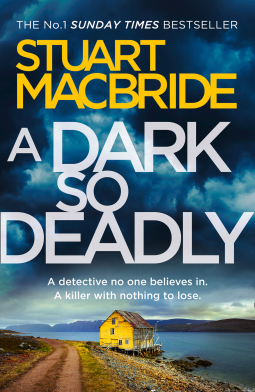
A Dark So Deadly by Stuart MacBride

Stuart MacBride has written many books, including the Logan McRae and Ash Henderson novels, but A Dark So Deadly is the first one of his that I’ve read. It’s a standalone thriller, due to be published on 20 April 2017 by HarperCollins.

I wasn’t at all sure that I would like it thinking it might be too ‘noir’ for me, but whilst it is dark with some violent and disturbing scenes I was soon hooked into the mystery, the setting, the characters, some of them pretty weird, sordid and really nasty characters and the humour. It’s grisly rather than gory. It’s also long, over 600 pages, but the strength of the writing and the pace carried me effortlessly along. It’s a gripping page-turner that kept me glued to the book – I didn’t want to put it down.

It has quite a large cast of characters, but each one is so individually described that I had no trouble distinguishing them. It’s set in Oldcastle, a fictional town in the north east of Scotland (there is a detailed, coloured map) where it seems to rain all the time. DC Callum MacGregor had taken the blame for cocking up a crime scene to protect his pregnant, crime-scene tech girlfriend and so had been moved to join ‘Mother’s Misfit Mob’.

The ‘Mob’ is made up of the officers no one else wanted. ‘Mother’ is DI Flora Malcolmson and the team consists of DS Andy McAdams, who speaks in rhyming verse and is dying from bowel cancer, DS Dorothy (Dot) Hodgkin in her wheelchair called ‘Keith’, grumpy DC John Watt and the newest team member, DC Franklin, big, black and beautiful who had punched a superintendent. I became very fond of this team of ‘misfits’. They made me laugh and exasperated me at the same time as they interacted, sometimes with friction rather than as a well-run team. They may be ‘misfits’ but they’re dedicated and caring police officers, Callum most of all. Their back history comes out naturally as the novel proceeds, without interrupting the narrative.

The plot is, needless to say really, complicated with plenty of unexpected and definitely strange episodes, as the team investigate mummified bodies found in the local rubbish tip. It’s told mostly from Callum’s point of view and as well as investigating what turns out to be a serial killer Callum, who was brought up in care from the age of 5, is trying to discover what had happened to his parents and twin brother.

A Dark So Deadly is a fantastic book. It’s complex, compelling and it kept me guessing right to the end. I shall definitely read more of Stuart MacBride’s books, beginning with Cold Granite, the first in his Logan McRae series.

My thanks to the publishers and NetGalley for my copy of this book.

  • Format: Kindle Edition
  • File Size: 5003 KB
  • Print Length: 608 pages
  • Publisher: HarperCollins (20 April 2017)

My Friday Post: Caedmon’s Song

Book Beginnings ButtonEvery Friday Book Beginnings on Friday is hosted by Gillion at Rose City
Reader
 where you can share the first sentence (or so) of the book you are reading, along with your initial thoughts about the sentence, impressions of the book, or anything else the opener inspires.

I’ve been rather neglecting my TBRs so far this year, so I’ve been going through them deciding which one to read next and came across Caedmon’s Song by Peter Robinson, one of his standalone books.

Caedmon's Song

It begins:

Martha Browne arrived in Whitby one clear afternoon in early September, convinced of her destiny.

Also every Friday there is The Friday 56, hosted by Freda at Freda’s Voice.

Friday 56

These are the rules:

  1. Grab a book, any book.
  2. Turn to page 56, or 56% on your eReader.
  3. Find any sentence (or a few, just don’t spoil it) that grabs you.
  4. Post it.
  5. Add the URL to your post in the link on Freda’s most recent Friday 56 post.

Page 56:

Kirsten looked away towards the window. Outside, beyond the flowers, and the get-well cards on her table, she could see the tops of trees swaying slowly in the wind and a distant block of flats, white in the July sun, ‘I don’t know if I want to remember,’ she whispered. ‘I feel so empty.’

Blurb:

On a balmy June night, Kirsten, a young university student, strolls home through a silent moonlit park. Suddenly her tranquil mood is shattered as she is viciously attacked.

When she awakes in hospital, she has no recollection of that brutal night. But then, slowly and painfully, details reveal themselves – dreams of two figures, one white and one black, hovering over her; wisps of a strange and haunting song; the unfamiliar texture of a rough and deadly hand . . .

In another part of England, Martha Browne arrives in Whitby, posing as an author doing research for a book. But her research is of a particularly macabre variety. Who is she hunting with such deadly determination? And why?

I’ve enjoyed reading some of Peter Robinson’s Inspector Banks books. Caedmon’s Song, described as a ‘psychological thriller‘ looks a bit different and I’m wondering about Martha’s research – is it connected to Dracula? after all Whitby Abbey was Bram Stoker’s inspiration for his novel, Dracula.

The Kill Fee by Fiona Veitch Smith

The Kill Fee (Poppy Denby Investigates #2)

The Kill Fee is the second book in the Poppy Denby Investigates series. I haven’t read the first book, The Jazz Files, but I had no difficulty reading this second book as it reads well as a standalone, with enough detail of previous events for me to follow the story.

It is set in London in 1920 with flashbacks to Russia in 1917. Poppy is the Arts and Entertainments Editor at the Daily Globe and whilst she is covering an exhibition of Russian Art at the Crystal Palace a guard is shot and injured and one of the Fabergé Eggs on display is stolen. It’s not just an extremely valuable Egg, one that had been owned by a member of the Tsar’s family, but one that is said to contain a secret that could threaten royal families throughout Europe.

This is reminiscent of the Golden Age crime fiction as Poppy sets about finding who stole the Egg and there are plenty of suspects. The theft is followed by a couple of murders and a poisoning, and a secret passageway as Poppy chases around London in hot pursuit of the killer.

Its an enjoyable read that kept me entertained with a mix of fictional and historical characters and a look at 1920s’ society. I particularly liked the Russian connection and the information about White and Red Russians and the Russian Revolution of 1917 – by 1920 this was coming to a head in the Crimea. The book begins with an episode in Moscow in 1917 as an unnamed man in a bearskin coat enters the house of an aristocratic family to find a scene of carnage. Most of the family have been murdered, but he rescues a small girl, her little dog and her English nanny. How this fits into the rest of the book only gradually becomes clear.

There is a map of 1920s London that helps to follow the action and a list of the fictional and historical characters that I found useful. Fiona Veitch Smith explains in her historical Note at the end of the book how she got the idea for The Kill Fee and how she blended fact with fiction. Apart from a few ‘tweaks’ she has stuck to the historical timeline, as far as she is aware, moving the Russian Embassy to Kensington Gardens seven years earlier than it really did and bringing forward the selling of paper poppies by one year – these were launched by the British Red Cross in 1921. The plotline of the theft of the Fabergé Egg and the exhibition at the Crystal Palace is a figment of her imagination. She apologises for ‘any unintentional errors you may find.’

Well, I did find another anachronism. At one point (page 209 in my paperback copy) Poppy and Daniel are arguing as he drives across London approaching the Victoria Embankment when he had to slow down ‘to allow a family to cross the road at a pelican crossing.‘ I think this must be a typing error as although pedestrian crossings existed more than 2000 years ago, (as can be seen in the ruins of Pompeii), pelican crossings weren’t introduced in the United Kingdom until 1969.

None of this affected my enjoyment of the book as the world of London in the 1920s came to life and the complex plot and fast pace kept my brain ticking over, keeping track of the different sub-plots and characters. The kill fee in the title refers to the money offered to Rollo, the Daily Globe owner and editor-in-chief, to stop him from publishing the story concerning the theft of the Fabergé Egg.

My thanks to LibraryThing Early Reviewers for my copy of this book.

  • Paperback: 320 pages
  • Publisher: Lion Fiction (16 Sept. 2016)
  • Language: English
  • ISBN-10: 1782642188
  • ISBN-13: 978-1782642183

This is my 10th book for the Mount TBR Challenge.