My Friday Post: Black Water Lilies by Michel Bussi

Book Beginnings Button

Every Friday Book Beginnings on Friday is hosted by Gillion at Rose City Reader where you can share the first sentence (or so) of the book you are reading, along with your initial thoughts about the sentence, impressions of the book, or anything else the opener inspires.

Last week I bought Black Water Lilies by Michel Bussi and I can’t resist starting it even though there are plenty of books in my TBR piles that I ‘should’ be reading. 
 
Black water lilies

Three women lived in a village.

The first was mean, the second a liar, and the third was an egoist.

Their village bore the pretty name of a garden, Giverny.

Also every Friday there is The Friday 56, hosted by Freda at Freda’s Voice.

30879-friday2b56These are the rules:

  1. Grab a book, any book.
  2. Turn to page 56, or 56% on your eReader. If you have to improvise, that is okay.
  3. Find any sentence (or a few, just don’t spoil it) that grabs you.
  4. Post it.
  5. Add the URL to your post in the link on Freda’s most recent Friday 56 post.

Pages 56 -7:

He used to be an art teacher in the United States, he tells her. He never stops saying that she talks all the time, and even though she’s very gifted, she needs to be able to concentrate more. Like Monet did.

I’ve read one other book by Michel Bussi, Time is a Killer, which I really enjoyed and so I thought I’d like this one. It’s the story of a mystery, of thirteen days that begin with one murder and end with another. Jérôme Morval, a man whose passion for art was matched only by his passion for women, has been found dead in the stream that runs through the gardens at Giverny, where Monet did his famous paintings.

Have read this book? What did you think about it? And if you haven’t, would you keep on reading?

The Vanished Bride by Bella Ellis

Vanished Bride

Hodder & Stoughton|12 September 2019|352 pages|e-book|Review copy|5*

From the Sunday Times-bestselling author of The Memory Book, Rowan Coleman, comes a special new series featuring the Brontë sisters, written under the name Bella Ellis

Yorkshire, 1845

A young woman has gone missing from her home, Chester Grange, leaving no trace, save a large pool of blood in her bedroom and a slew of dark rumours about her marriage. A few miles away across the moors, the daughters of a humble parson, Charlotte, Emily, and Anne Brontë are horrified, yet intrigued.

Desperate to find out more, the sisters visit Chester Grange, where they notice several unsettling details about the crime scene: not least the absence of an investigation. Together, the young women realise that their resourcefulness, energy and boundless imaginations could help solve the mystery – and that if they don’t attempt to find out what happened to Elizabeth Chester, no one else will.

The path to the truth is not an easy one, especially in a society which believes a woman’s place to be in the home, not wandering the countryside looking for clues. But nothing will stop the sisters from discovering what happened to the vanished bride, even as they find their own lives are in great peril…

My thoughts:

When I first came across this book I wasn’t at all sure I wanted to read it, as I’m never very keen on books about famous authors solving crimes. However, the Brontë sisters books have been amongst my favourites for years and I was curious find out what this book was all about. So, I was delighted to find that I thoroughly enjoyed The Vanished Brideand that it is not all a flight of fancy, although of course the story of how they became ‘detectors’, or amateur sleuths, is pure imagination.

‘Bella Ellis’ is the Brontë inspired pen name for the author Rowan Coleman, who has been a Brontë devotee for most of her life. I haven’t read any of her other books but I’ll be looking out for them now. The Vanished Bride is historical fiction that brings the period (1845) and the setting vividly to life, Charlotte, Emily and Anne and their brother, Branwell becoming real people before my eyes in their home in the Parsonage at Howarth.

I think it helps that is not all pure fiction – in the Author’s Note she explains that it is based on biological facts or inspired by them. The book begins with a short passage in 1851 when Charlotte is alone in the Parsonage her sisters, brother and father had all died and she looks back to the year 1845 when they were all together. That is fact – and in the following September they began to consider writing for their living.

The mystery whilst it is well plotted is not to difficult to solve and I had predicted the basics of it quite early on in the book, although  I didn’t guess the full detail until much later on. But the real joy of the book is in the historical detail and the depiction of the characters and the insights given to their personalities through their conversation. The story is told through each of the sisters eyes, each one clearly distinctive, whilst Emily is the standout character. All three are clearly individuals, women caught in a society dominated by men and each wanting to lead independent lives. 

The book ends as a letter arrives for the sisters presenting a new case for them to investigate. Their curiosity is immediately ‘taking flight’ – and so is mine!

My thanks to Hodder & Stoughton for an e-book review copy via NetGalley

Ruling Passion by Reginald Hill

Ruling passion

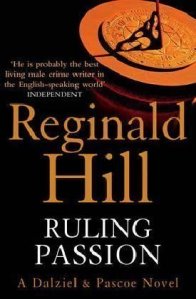
HarperCollins|1993|388 pages|Paperback\ my own copy| 3.5* (rounded up to 4*)

Ruling Passion is Reginald Hill’s third Dalziel and Pascoe novel, first published in 1973, in which Pascoe finds his social life and work uncomfortably brought together by a terrible triple murder. Meanwhile, Dalziel is pressuring him about a string of unsolved burglaries, and as events unfold the two cases keep getting jumbled in his mind.

Peter Pascoe is the main character with Dalziel, his boss playing a minor role. Moving on from the second book where Pascoe had renewed his relationship with Ellie Soper, they are now a couple and friends from their university days, Colin and Rose Hopkins have invited them to stay for a weekend in the country at their cottage in the village of Thornton Lacey. They hadn’t seen them for more than five years and the other guests were also old friends, Timothy Mansfield and Charles Rushworth. (References here to Jane Austen’s Mansfield Park)

However, Peter and Ellie didn’t arrive until the Saturday morning when they found a terrible scene – Timothy and Charles lying on the dining room floor in a pool of blood, dead from wounds caused by a shotgun fired at close range, and Rose was in the back garden lying dead at the base of a sundial in the centre of the lawn, her face pressed into the grass. Colin was nowhere to be seen – and the police, headed by Superintendent Backhouse, immediately assume he is the murderer. Peter for once is faced with being a witness rather than a detective and he doesn’t find it easy. He and Ellie are both convinced that Colin didn’t commit the murders – it’s a matter of finding him and proving Backhouse wrong.

As in the previous book, An Advancement of Learning, the plot is by no means straight forward and I found it rather confusing for a while, trying to remember who was who and where they fitted into the mystery. It’s not helped by the fact that the action moves between Thornton Lacey, Yorkshire and Scotland. It wasn’t only Peter who muddled the murder mystery with his unsolved burglaries – I did too. But it all became much clearer towards the end of the book as the connections between the storylines were made.

It’s the main characters though that interested me most and the development of their characters – Peter and Ellie in particular. Their relationship has moved on and during the course of the book they realise how deep their feelings for each other are – leading them into considering getting married. Peter recognises that he can be a very solitary man:

Solitariness was not far from loneliness and this he feared. He believed he could recognize similar characteristics in Ellie, but how good a basis for marriage this common area would be he could not speculate. Equally far from contemplation, however, was a life without Ellie. Which is as good a definition of love as I’m likely to get in a police station, he told himself. Motives for marriage are at least as varied and unexpected as motives for murder. That sounded like the kind of cold comfort Dalziel would doubtless offer! (page 325)

Whereas Peter and Ellie have now become more developed characters Dalziel still remains more of a caricature, rude, coarse and insensitive. But as Ellie gets to know him more so he becomes more human – and more likeable, with more understanding than she had previously thought. By the end of the book Peter, having passed his exams, is promoted to Inspector.

Reginald Hill wrote 24 Dalziel and Pascoe novels. I’ve now read the first and the last and some in between. Currently I’m reading my way through the rest of them – so book 4 is next on my list – An April Shroud.

Nothing Ventured by Jeffrey Archer

‘This is not a detective story, this is a story about a detective’

Nothing ventured

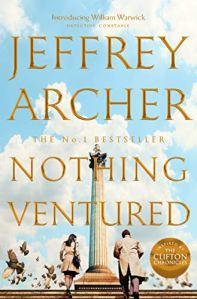
Macmillan|5 September 2019|337 pages|e-book|Review copy|3*

Years ago I enjoyed reading a few of Jeffrey Archer’s books, including Not a Penny More, Not a Penny Less and Kane and Able. Archer is a prolific author, but I haven’t read any of his later books or his diaries about his time in prison. But I was interested when I saw that he had started a new series about William Warwick – Nothing Ventured. It is the first in the series of books following William’s progress from detective constable to the commissioner of the Metropolitan Police.

It is indeed, a story about a detective, rather than a detective story and as such it is rather episodic, following William Warwick’s career.

William joins the Metropolitan Police force, against his father’s wishes. Sir Julian Warwick QC, had hoped his son would join him in chambers and train to be a barrister, like his sister Grace. He works on the beat in Lambeth before transferring to the Art and Antiques Squad at Scotland Yard, where he becomes involved in a number of cases of fraud and theft, including tracing the whereabouts of a phial of the moon dust brought back from the Apollo 11 mission by Neil Armstrong, and arresting an old man who had forges the signatures of famous authors in first editions. Whilst investigating the theft of a Rembrandt painting, the Syndics of the Cloth Makers Guild, from the Fitzmolean Museum in Kensington, he meets Beth Rainsford, a research assistant at the gallery and they fall in love almost at first sight – but Beth has a secret that she keeps from him. 

The premise is promising, but it’s written in a very straight-forward and factual style and my overall impression, despite the crime elements, is that this is a rather mundane and bland novel. William does this, does that, goes here, goes there, often at a break-neck pace that gives impetus. But the characters are drawn very sketchily with little depth – William is an intelligent young man, precocious and naive, eager to please and to learn, his father, Sir Julian, a suave, elegant and successful QC and Grace, his sister, an up and coming young barrister, and so on.

I suppose it is the base for the rest of the series but I found it too predictable. However, I thought the court scenes and the final little twist at the end enjoyable and I’m wondering if I want to go one to read the next book in the series which focuses on William’s time as a young detective sergeant in the elite drugs unit. I’m not sure that I do want to – there are so many more enticing books to read.

My thanks to Macmillan for an e-book review copy via NetGalley

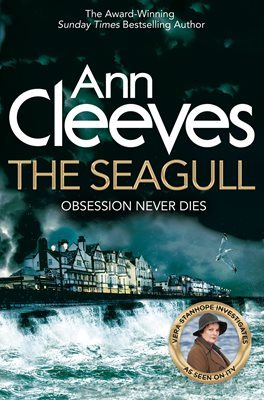
The Seagull by Ann Cleeves

Seagull

Macmillan| September 2017|print length 416 pages|e-book| 5*

The Seagull is Ann Cleeves’ eighth novel in her Vera Stanhope series, set in Northumberland. It begins as Vera visits the prison where ex-Superintendent John Brace is serving time for corruption and his involvement in the death of a gamekeeper. He had been one of the so-called ‘Gang of Four’ – Brace, Robbie Marshall, a man known simply as ‘The Prof’, and Vera’s father, Hector Stanhope. Brace tells Vera that Robbie, who had disappeared years ago, is dead and that he will tell her where his body is buried if she will visit his daughter Pattie, who has mental health problems.  She does so, but when the police investigate the location Brace gave her they find not one skeleton, but two. 

Opening up this cold case brings back memories for Vera of her past when she was living at home in a remote cottage in the Northumberland countryside, with Hector, after her mother had died.  The Gang of Four had met at Hector’s cottage when Vera was a teenager. They had traded in rare birds’ eggs and sold raptors from the wild for considerable sums. They were regulars at the (fictional) classy Seagull night club, a sleek Art Deco building built in the thirties in Whitley Bay,  during the town’s glory days. Brace and Marshall had also run a recruitment service providing muscle for hire. And Vera wonders just how much Hector had been involved in the Gang of Four’s illegal activities. 

And just as Vera and her team, Joe, Charlie and Holly – Vera’s own ‘gang of four’ – investigate Robbie’s murder they are faced with a present day murder that looks very much as though it links in with their cold case.

I enjoy watching Vera on TV, but I enjoy the books even more. Brenda Blethyn is very good in the role of Vera, but the Vera in the books is not the same as the TV Verashe is more down to earth, a large woman who wears tent-shaped dresses, has bare legs, wears size seven sandals with rubber soles and Velcro straps and she is none too fussy if her feet are dirty. She is a big woman with a big personality and she knows she is a brilliant detective:

‘Oh, I’m interested in everything, Joe. That’s why I’m a bloody brilliant detective’. She gave him her widest smile, ‘That’s why I’m in charge and you’re sitting there, doing as you’re told.’ (page 45)

She still lives in the cottage in the hills (not on Lindisfarne as in the TV series), which she had inherited from Hector along with a freezer full of animal corpses (Hector had done a bit of taxidermy), but most of the action takes place in Whitley Bay and at St Mary’s Island, a small rocky tidal island, linked to the mainland by a short, narrow causeway which is submerged at high tide.

I thoroughly enjoyed The Seagull and loved the way it reveals Vera’s past and her relationship with her father. At the same time the plot kept me guessing almost to the end and the location, well known to Ann Cleeves as it used to be her home town, is superbly described.

I see on Ann Cleeves’ website that ITV have confirmed that there will be a tenth series of VERA, based on Ann’s characters and settings and starring multi-award-winning Brenda Blethyn. The cast have been filming in the North East through the summer. Four new episodes will be broadcast in 2020.

And she has recently published a new  book, The Long Call, the first in a new series, Two Rivers. It is set in North Devon, where Ann grew up, and introduces the reserved and complex Detective Inspector Matthew Venn, estranged from the strict evangelical community in which he grew up, and from his own family, but drawn back by murder into the community he thought he had left behind.

The Long Call was published in Australia on 27th August, in the US on Tuesday 3rd September and in the UK on Thursday 5th September 2019.

Reading challenges: Mount TBR, Calendar of Crime

An Advancement of Learning by Reginald Hill: Mini Review

An Advancement of learning

An Advancement of Learning is Reginald Hill’s second Dalziel and Pascoe novel, first published in 1971. It’s much better than the first one, A Clubbable Woman and I thoroughly enjoyed it. It’s set in a college, Holm Coultram College, where Dalziel and Pascoe investigate the discovery of a body found as an eight foot high bronze statue of Miss Girling, a former head of the College in the grounds is being moved. As the base of the statue is lifted earth falls away together with a shin bone followed by part of a rib cage and then a skull, still with a mop of dark red hair attached. Miss Girling had red hair – but she had died in an avalanche in Austria – so whose body was buried under the statue?

The plot is by no means straight forward and for most of the book continued to puzzle me, even though I thought the ending was rather weak. But the strength of this book is in the writing and the characterisation. It is a character-driven murder mystery, with a cast of characters including Girling, Halfdane, Fallowfield, Cockshut, and Disney, known as ‘Walt’, of course and I had no difficulty in keeping who was who clearly in my mind. It’s interesting to see the early relationship between Dalziel, shown as a rude, boorish character, and Pascoe, the university educated young DS. Dalziel is very much out of his comfort zone with the academic staff and looks to Pascoe to understand how the college operates, whilst mocking him. Pascoe renews his relationship with Ellie Soper, an ex-girlfriend from his university days – a feisty young woman, but a minor character in this book. 

Written in 1971 it is very much a book of its time. I read it quickly, as the two detectives uncover plenty of disagreements and power struggles in both the staff and student bodies – from rivalries to revelries on the beach, and more dead bodies turn up before the mystery is solved.

And reading it has made me keen to get on the next book in the series, Ruling Passion, which I’ve started almost straight away! I’ve been reading this series totally out of order, beginning with some of the later books – much more detailed and complex than the first books.

  • Paperback: 352 pages
  • Publisher: HarperCollins (25 Jun. 2009)
  • Language: English
  • ISBN-10: 9780007313037
  • ISBN-13: 978-0007313037
  • Source: I bought it
  • My Rating: 4.5*

Reading challenges: Mount TBR, Calendar of Crime, 20 Books of Summer