WWW Wednesday: 12 February 2020

IMG_1384-0

WWW Wednesday is run by Taking on a World of Words.

The Three Ws are:

What are you currently reading?
What did you recently finish reading?
What do you think you’ll read next?

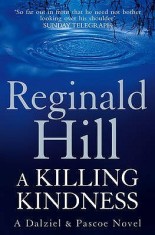
A killing kindnessSaving MisseyCurrently reading: I’m reading A Killing Kindness, a murder mystery, the 6th Dalziel and Pascoe book by Reginald Hill and enjoying it very much.  I’m also reading Saving Missy by Beth Morrey, which I’m also enjoying. It’s a feel good story and very different from A Killing Kindness. Missy Carmichael’s life has become small. Grieving for a family she has lost or lost touch with, she’s haunted by the echoes of her footsteps in her empty home; the sound of the radio in the dark; the tick-tick-tick of the watching clock.

Happy Old Me

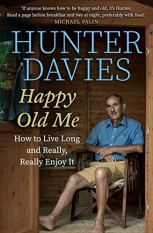
Recently Finished: Happy Old Me: How to Live a Long Life and Really Enjoy It by Hunter Davies. This is an account of one year in his life after his wife, Margaret Forster died – poignant, moving and very interesting. I’ll write more about later on.

Reading Next: This is a movable feast, as I rarely decide until the time comes.

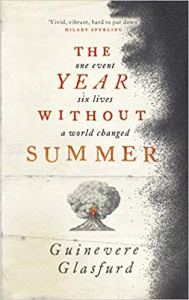
It could be The Year Without Summer by  Guinevere Glasfurd. 

Year without summer

Blurb:

1815, Sumbawa Island, Indonesia
Mount Tambora explodes in a cataclysmic eruption, killing thousands. Sent to investigate, ship surgeon Henry Hogg can barely believe his eyes. Once a paradise, the island is now solid ash, the surrounding sea turned to stone. But worse is yet to come: as the ash cloud rises and covers the sun, the seasons will fail.

1816
In Switzerland, Mary Shelley finds dark inspiration. Confined inside by the unseasonable weather, thousands of famine refugees stream past her door. In Vermont, preacher Charles Whitlock begs his followers to keep faith as drought dries their wells and their livestock starve.

In Suffolk, the ambitious and lovesick painter John Constable struggles to reconcile the idyllic England he paints with the misery that surrounds him. In the Fens, farm labourer Sarah Hobbs has had enough of going hungry while the farmers flaunt their wealth. And Hope Peter, returned from the Napoleonic wars, finds his family home demolished and a fence gone up in its place. He flees to London, where he falls in with a group of revolutionaries who speak of a better life, whatever the cost. As desperation sets in, Britain becomes beset by riots – rebellion is in the air.

The Year Without Summer is the story of the books written, the art made; of the journeys taken, of the love longed for and the lives lost during that fateful year. Six separate lives, connected only by an event many thousands of miles away. Few had heard of Tambora – but none could escape its effects.

Or it could be one of my TBRs – I simply don’t know yet.

Have you read any of these books?  Do any of them tempt you? 

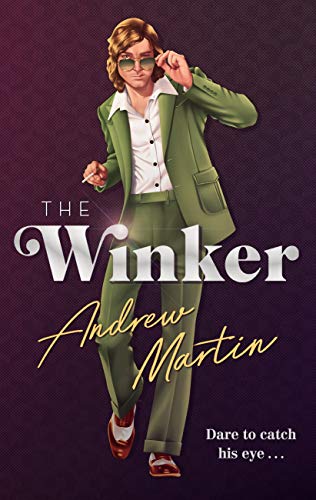
The Winker by Andrew Martin

The Winker

Corsair| 6 June 2019| 272 pages| e-book| review copy via NetGalley|4 stars

I haven’t read anything by Andrew Martin before and as I began reading The Winker I found it decidedly odd and a bit creepy. I don’t like the cover at all and the title didn’t appeal to me either. But the description interested me:

London, 1976.

In Belgravia in the heat of summer, Lee Jones, a faded and embittered rock star, is checking out a group of women through the heavy cigarette smoke in a crowded pub. He makes eye contact with one, and winks. After allowing glances to linger for a while longer, he finally moves towards her.

In that moment, his programme of terror – years in the making – has begun.

Months later, the first of the many chilling headlines to come appears: ‘Police hunting winking killer.’

Meanwhile in France.

Charles Underhill, a wealthy Englishman living in Paris, has good reason to be interested in the activities of the so-called Winking Killer. With a past to hide and his future precarious, Charles is determined to discover the Winker’s identity.

In the overheating cities of London, Oxford, Paris and Nice, a game of cat and mouse develops, and catching someone’s eye becomes increasingly perilous. But if no one dares look, a killer can hide in plain sight . . .

From ‘a master of historical crime fiction’ (The Guardian), The Winker is a gripping thriller that won’t let you look away.

My thoughts:

I like the structure of this book. It is set in 1976 with flashbacks to 1951, in several locations, mainly London and Nice and sometimes in Paris and Oxford. Each time and place is clearly highlighted. The book is largely character-led. Lee Jones, a failed pop singer and psychopath is working on a ‘project’, nothing to do with music, aiming to achieve world-wide fame. He calls it a ‘programme’ and involves something he calls a ‘folder’ and his ‘trademark’. He is living in a fantasy world, accompanied by Abigail a journalist who intermittently interviews Lee. It was all a bit ambiguous at first and it took me a few pages to decide what I thought about Abigail and her role in the book. 

Then there is Charles Underhill, a man of about fifty,  living a self-imposed exile in France, because of an event in Oxford whilst he was a student there. He lives a very routine life in Paris with his mother Syl, except for his annual holiday in Nice. His routine is upset when he receives a postcard with a picture of the river at Oxford showing a boat full of university rowers, but no message on the back. When more unsigned postcards arrive he is worried that they are from Pat Price who was at the university with him in 1951.

In Nice Charles meets Howard Miller, a crime fiction writer. His first novel wasn’t a great success and he is looking for inspiration for his next novel, to prove to his father he wasn’t wasting his time. These three men are now set on a collision course as Charles offers to pay Howard for a couple of days work in Oxford to find out who had sent him the anonymous postcards. From that point onwards everything fell into place for me and I was hooked.

This is psychological crime fiction, you know right from the beginning who the ‘Winker’ is, but the precise method of the murders is not clear (at least not to me) until later in the book. And Charles’ secret is revealed quite early in the book. Neither Lee nor Charles are pleasant characters and this is decidedly a creepy tale, but it’s also a compelling one. Howard, on the other hand, is rather a naive character, who nevertheless gets to the bottom of the mystery. I loved the settings – they are so vivid and evocative of the 1970s; the places, the intense heat of the summer  of 1976, the people, their clothes, the hairstyles, sunglasses, cars, exotic cigarettes, and especially the music of the 70s, bring it all to life in technicolour. I think this is ripe for being made into a film.

Andrew Martin, a former Spectator Young Writer of the Year, grew up in Yorkshire. He has written for the Evening Standard, the Sunday Times, the Independent on Sunday and the Daily Telegraph, among others. His weekly column appears in the New Statesman and he is the author of numerous articles and books – of both fiction and non-fiction. For more information see his website.

I received a copy of this book from the publisher, via NetGalley, for review.
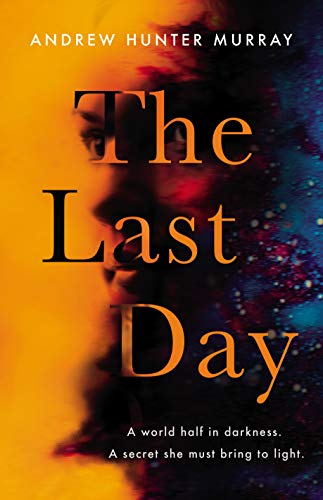
The Last Day by Andrew Hunter Murray

A thriller set in a world which has spun to a halt, bringing civilisation to the brink of collapse

The last day

Cornerstone| 6 February 2020| 432 pages| e-book| review copy via NetGalley| 5 stars

It’s not often I read dystopian fiction, a bit wary that I won’t like it, but I’m glad to say that I was fascinated by The Last Day by Andrew Hunter Murray. I’m not sure about the plausibility of the concept but I was gripped by the story of a world coming to an end and the effects that had on the planet and the population.

A white dwarf star, the size of earth but two hundred thousand times as dense had barrelled through space, and travelling at two thousand kilometres a second its trajectory and gravity had dragged the earth backwards. The earth’s rotation had gradually slowed and eventually came to a full stop. Chaos followed, earthquakes, volcanic eruptions and gales swept the earth’s surface, but gravity still functioned as the planet was still the same mass and exerted gravitational force. As the planet stopped on the dawning of the last day in 2029 the boundaries of day and night were locked in place, with a slender ring of borderlands that varied between total darkness and a fractional glimpse of light. Europe was in the constant light of the sun with an isolationist Britain on the warm side far enough in to raise crops but far enough out to still be habitable.

Set in 2059, thirty years after the earth had finally stopped spinning The Last Day presents a totalitarian world, and gives such a vivid picture of what life has become for the people who live on the burning sun side of the planet. There is, of course, no night, but there is a curfew during the ‘night’ hours.  I warmed to Ellen Hopper, a scientist working on a rig two hundred miles off the south-west coast of England in the North Atlantic, where it is always dawn, as she studies the ocean’s currents. She receives a letter from Dr Edward Thorne her old college tutor at Oxford who is dying. He has something important to tell her, information that would ruin the British government and that they would do anything to keep hidden. Prior to his appointment at Oxford he had  been a scientist and an adviser to the British Prime Minister, Richard Davenport, until he had been ignominiously sacked. 

What follows is Hopper’s search to discover the details of this secret, interspersed with flashbacks to her past and her family history, in particular about what happened to her parents, her relationship with her brother, who works in security, her fears that she shouldn’t trust him, and her ex-husband David. It is full of political intrigue and danger with a high body count and builds to a dramatic conclusion. I thoroughly enjoyed it, was glued to the pages and by the end of the book I was convinced of the reality of this implausible world (at least I hope it is). 

Andrew Hunter Murray, is a writer and journalist from London. The Last Day is his first novel. when he’s not writing fiction he works for the TV show QI, as one of the ‘Elves’ finding out Quite Interesting facts about everything under the sun. He also co-hosts the podcast No Such Thing As A Fish, and write jokes and journalism for Private Eye, the UK’s leading satirical magazine. No Such Thing As A Fish has also led to a spin-off TV series, No Such Thing As The News, and three books co-written with his colleagues on the show – the Book Of The Year, The Book Of The Year 2018, and the Book Of The Year 2019.

He is already working on his next novel idea. I definitely want to read it when he’s finished it!

Many thanks to Cornerstone for a review copy via NetGalley.

Six Degrees of Separation: from Fleishman is in Trouble to …

I love doing Six Degrees of Separation, a monthly link-up hosted by Kate at Books Are My Favourite and Best. Each month a book is chosen as a starting point and linked to six other books to form a chain. A book doesn’t need to be connected to all the other books on the list, only to the one next to it in the chain.

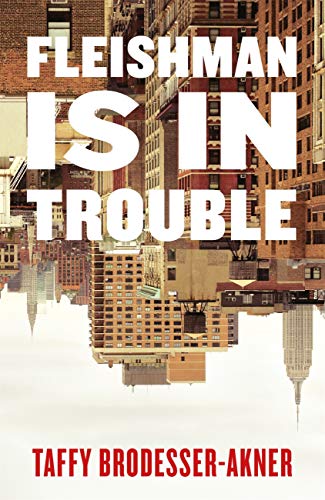
Fleishman

This month the chain begins with Fleishman is in Trouble by Taffy Brodesser-Akner,  a novel described as ‘a blistering satirical novel about Marriage, Divorce and Modern relationships‘. It’s a book that so many people declare is incredibly wise, a powerful feminist book, with depth, wit, nuance and life, shrewdly observed and and utterly of this moment. It is a book I have not read and also one that I doubt I will read.

Where to go from there? I had trouble deciding!

In the end I decided to go with the word ‘trouble‘ and that made me think of Bill Bryson’s book Troublesome Words, a book about the use of words, which is probably as far removed from Fleishman is in Trouble that you could get. It’s arranged like a dictionary, so a book to dip into rather than one to read straight through. For example if you want to know the difference between ‘that’ and ‘which’ this is the book to go to. And how about starting a sentence with the word ‘and’?  I was taught at school that you should never do that, not so says Bryson.

From Troublesome Words my mind jumped to The Sentence is Death by Anthony Horowitz, as a sentence is made up of words. Rosemary, the wife of wealthy George Barton dies suddenly at her birthday party at a West End Restaurant, the Luxembourg, after drinking a glass of champagne laced with cyanide.

And so onto Sparkling Cyanide by Agatha Christie. Rosemary, the wife of wealthy George Barton dies suddenly at her birthday party at a West End Restaurant, the Luxembourg, after drinking a glass of champagne laced with cyanide.

A birthday party features in Nicola Upson’s Fear in the Sunlight, the fourth novel featuring Josephine Tey. Summer, 1936. The writer, Josephine Tey, joins her friends in the holiday village of Portmeirion in Wales to celebrate her fortieth birthday. Alfred Hitchcock and his wife, Alma Reville, are there to sign a deal to film Josephine Tey’s novel, A Shilling for Candles.

So, my next link is to another book set in Wales, but in the Brecon Beacons not the coast. It’s Do Not Disturb by Claire Douglas. It also links back to Fleishman is in Trouble in that it’s about the trouble caused when Selena, Kirsty’s cousin, arrives at their new guesthouse and murder follows.

Finally, another troublesome character called Selena appears in Sweet Tooth by Ian McEwan. She was a spy whose mission failed – a story of deception, about writers and writing and readers and reading, with multiple stories within stories.

My chain begins and ends with a book about trouble, linked by a book about troublesome words, and murder mysteries involving the use of cyanide, birthday parties, books set in Wales and books with even more troublesome characters – a real mixed bag of connections.

Next month (7 March 2020), we’ll begin with Lucy Treloar’s Wolfe Island, a book that I know nothing about. (Bryson says it’s OK to end  sentence with a preposition).

Latest Additions at BooksPlease

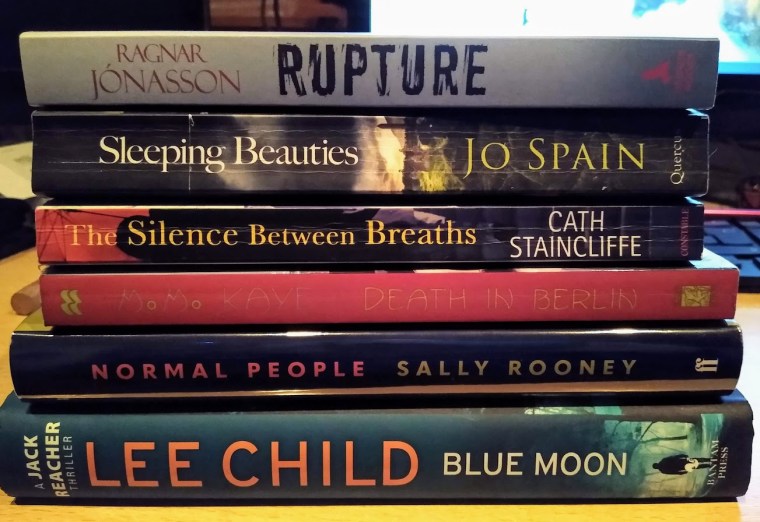
Yesterday I brought this little pile of books home from Barter Books in Alnwick, my favourite bookshop. (This is where you can ‘swap’ books for credit that you can then use to get more books from the Barter Books shelves.)

BB bks Jan 2020

From top to bottom they are:

Rupture by Ragnar Jónasson, the fourth book in the Dark Iceland series. Two young couples move to the uninhabited, isolated fjord of Hedinsfjordur. Their stay ends abruptly when one of the women meets her death in mysterious circumstances. I’ve read one of his Hidden Iceland series, The Island which I thoroughly enjoyed.

Sleeping Beauties by Jo Spain, who is one of my favourite authors. It’s the third book in the Inspector Tom Reynolds Mystery series. A young woman, Fiona Holland, has gone missing from a small Irish village. A search is mounted, but there are whispers. Fiona had a wild reputation. Was she abducted, or has she run away?

The Silence Between Breaths by Cath Staincliffe. I’ve seen some of her books reviewed on other book blogs and thought I’d look for one of hers. It’s set on a train travelling from Manchester to London, where one of the passengers is carrying a deadly rucksack. Cath Staincliffe is a Manchester based crime writer, the creator and scriptwriter of ITV’s police series, Blue Murder and writes the Scott & Bailey books, based on the ITV1 police series.

Death in Berlin by M M Kaye. Years ago I read The Far Pavilions and it is only in recent years that I discovered she wrote the Death in … series. This is the 2nd book in the series first published in 1955. A murder mystery set in post-war Berlin.

The last two books are hardbacks that look brand new – Normal People by Sally Rooney. This is a not the usual type of book that I read, and a bit out of my comfort zone. It’s described on the dust jacket as a story of mutual fascination, friendship and love in which a couple try to stay apart but find they can’t.

And finally  – Blue Moon by Lee Child, a Jack Reacher thriller. I’m not sure this one is my cup of tea either, as two rival gangs are competing for control in the city – maybe too violent for me.

Have you read any of these books?  Do any of them tempt you? 

WWW Wednesday: 29 January 2020

IMG_1384-0

WWW Wednesday is run by Taking on a World of Words.

The Three Ws are:

What are you currently reading?
What did you recently finish reading?
What do you think you’ll read next?

Currently reading: I’m still reading, very slowly, The John Lennon Letters edited by Hunter Davies and The Windsor Story by J Bryan III and Charles V Murphy.

 And I’m also enjoying Hunter Davies’ memoir Happy Old Me: How to Live a Long Life and Really Enjoy It. This is an account of one year in his life after his wife, Margaret Forster died – poignant, moving and very interesting.

Recently Finished: Death Has Deep Roots: a Second World War Mystery by Michael Gilbert. Set in 1950 it’s a mix of courtroom drama, spy novel and an adventure thriller. Victoria Lamartine, a hotel worker, and an ex-French Resistance fighter is on trial for the murder of Major Eric Thoseby, her supposed lover, and alleged father of her dead child. My full review is in this post.

Silence between breathsReading Next: This is a movable feast, as I rarely decide until the time comes.

Yesterday I picked up several books in Barter Books, and am itching to read The Silence Between Breaths by Cath Staincliffe – Passengers boarding the 10.35 train from Manchester Piccadilly to London Euston are bound for work, assignations, reunions, holidays or new starts, with no idea that their journey is about to be brutally curtailed.

I did begin reading it whilst having a cup of coffee in Barter Books and the opening chapters make me want to read more.

Or it could be one of my TBRs – I simply don’t know yet.

Have you read any of these books?  Do any of them tempt you?