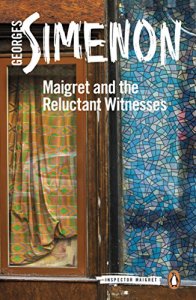
Maigret and the Reluctant Witnesses by Georges Simenon

This week the theme for Novellas in November is Literature in Translation and I’ve chosen Maigret and the Reluctant Visitors by Georges Simenon translated from the French by William Hobson, a novella of 172 pages.

This is the 53rd Inspector Maigret book, originally published in 1955.

It is November and Maigret, nearing retirement, is in a melancholy, nostalgic mood. He has been called out to the home of the Lauchaume family where Léonard, the eldest son has been shot dead. The name Lachaume brings back memories of his childhood in the countryside where the village grocer sold Lachaume Biscuits. But the family is now in dire straits, living in a large house on the Quai de la Gare, Ivry and their biscuit factory is failing. Their house was once an impressive three storey building but is now in a state of decay, cold and damp. The rest of the Lachaume family, his younger brother Armand, Paulette Armand’s wife and his elderly parents, are not only reluctant to talk to the police, they don’t appear to be grieving.

It looks initially that the murder may have been part of a burglary, although only a wallet is missing, but Maigret is suspicious right from the start. His attempts to question the family are held up by their lawyer and also by the Examining Magistrate, Angelot who insists on taking charge of the case. But he makes headway when he visits Véronique Lachaume, Léonard’s estranged sister and eventually Paulette reluctantly talks to him.

The book as a whole has a nostalgic feel, the sense that the world is changing – the Lachaume family has been left behind. Their business has only been kept afloat by the money from the sons’ wives, but they are still proud and reluctant to face the true facts of their situation. Maigret, too, is beginning to realise that his world is changing. for one thing he is getting older, the new magistrates are the younger generation bringing in new methods and he is aware that he only has two years left before his retirement. However, he solves the case mainly through his own intuition, and so he casts off his melancholy.

I’ve now read several of the Maigret books totally out of order, so now I’ve decided it’s time I read the first book, Pietr the Latvian first published in 1931.

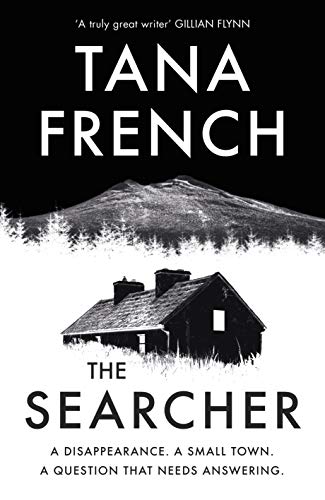
The Searcher by Tana French

Penguin| 5 November 2020| 400 pages| Review copy| 5*

I enjoyed The Searcher very much. For the most part this standalone mystery novel moves quite slowly, but it held my attention right from the beginning. It certainly isn’t a book to rush through, rather it’s one to savour. The main characters are Cal Hooper and thirteen-year old Trey Reddy living in Ardnakelty, a remote Irish village. After twenty five years in the Chicago police force, Cal has recently moved to the village, wanting to build a new life after his divorce. He is a loner and wants a quiet life in which nothing much happens. But he finds himself getting involved in the search for Brendan, Trey’s older brother who had gone missing from home.

Cal is a methodical man, slowly doing up his run-down cottage and getting to know the locals – his neighbour Marty, Noreen who runs the village shop, her sister Lena and above all, Trey. I liked the slow build up to the mystery, and I loved Tana French’s beautiful descriptions of the Irish rural landscape. It’s the sort of book I find so easy to read and lose myself in, able to visualise the landscape and feel as if I’m actually there with the characters, watching what is happening.

But this is no ‘cosy’ crime fiction novel. Trey is like a dog with a bone and won’t let Cal give up when it looks as though they will never discover why Brendan left and what had happened to him. I realised after a while what could have happened to Brendan, but I hadn’t foreseen the twists and turns in this book, one of which really surprised me. The ending is terrific. The tension builds and builds as Cal and Trey find themselves in danger. Above all, it is about family relationships, responsibility and friendship. It is atmospheric, spellbinding, and compelling reading. Tana French is a great storyteller.

Many thanks to the publishers and NetGalley for my review copy.

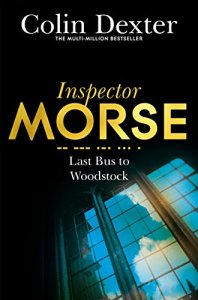
My Friday Post: Last Bus to Woodstock by Colin Dexter

Every Friday Book Beginnings on Friday is hosted by Gillion at Rose City Reader where you can share the first sentence (or so) of the book you are reading. You can also share from a book you want to highlight just because it caught your fancy.

As I’ve nearly finished reading Daniel Defoe’s A Journal of the Plague Year I’ve been wondering what to read next. I had thought I might read Moon Over Soho by Ben Aaronovitch, which is the second Rivers of London book. But this morning I picked up The Last Bus to Woodstock by Colin Dexter and began reading and just carried on. It’s the first Morse book in which Morse and Lewis first met and worked together. Morse thought they would get on well together.

It begins:

‘Let’s just wait a bit longer please,’ said the girl in dark-blue trousers and the light summer coat. ‘I’m sure there’s one due soon.’

This is a scene at a bus stop where two girls are waiting for the next bus to Woodstock. One of the girls doesn’t want to wait, wanting to hitch a lift and they both left the bus stop – it was the wrong decision.

Also every Friday there is The Friday 56, hosted by Freda at Freda’s Voice. *Grab a book, any book. *Turn to Page 56 or 56% on your  ereader . If you have to improvise, that is okay. *Find a snippet, short and sweet, but no spoilers!

These are the rules:

  1. Grab a book, any book.
  2. Turn to page 56, or 56% on your eReader. If you have to improvise, that is okay.
  3. Find any sentence (or a few, just don’t spoil it) that grabs you.
  4. Post it.
  5. Add the URL to your post in the link on Freda’s most recent Friday 56 post.
  1. Grab a book, any book.
  2. Turn to page 56, or 56% on your eReader. If you have to improvise, that is okay.
  3. Find any sentence (or a few, just don’t spoil it) that grabs you.
  4. Post it.
  5. Add the URL to your post in the link on Freda’s most recent Friday 56 post.

She pointed to a large volume, also lying open on the carpet in front of the TV set. ‘Mary’s started to read it.’ Morse picked it up and looked at the title. Who was Jack the Ripper?

‘Mm.’

‘I’m sure you’ve read that.’

Morse’s moral began to sag again. ‘I don’t think I’ve read that particular account, no.’ (page 56)

Blurb:


The death of Sylvia Kaye figured dramatically in Thursday afternoon’s edition of the Oxford Mail. By Friday evening Inspector Morse had informed the nation that the police were looking for a dangerous man – facing charges of wilful murder, sexual assault and rape.

But as the obvious leads fade into twilight and darkness, Morse becomes more and more convinced that passion holds the key . . .

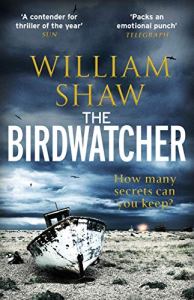
The Birdwatcher by William Shaw

I read The Birdwatcher by William Shaw in the summer and didn’t get round to reviewing it. So, this is a short post summarising what I thought about it.

I enjoyed this book, set in Dungeness on the Kent coast. Sergeant William South is a birdwatcher a methodical and quiet man. Very much a loner, South is not a detective and has always avoided investigating murder. But he does have one friend, a fellow birdwatcher, Bob Rayner and one morning he finds Bob has been brutally beaten to death. DS Alexandra Cupidi, a new CID officer, is leading the investigation and Shaw is reluctantly assigned to her team. Having recently moved from London she relies on William for his knowledge of the area.

Alternating with the present day story is the story of Billy, a thirteen year old living in Northern Ireland during the ‘Troubles’. And hidden within that story is the reason for South’s reluctance to investigate murders. Life becomes uncomfortable for South as Cupidi takes over his house for the base for their investigation and also lands him with the responsibility of entertaining her troubled teenage daughter, Zoe after school – he introduces her to birdwatching.

Shaw is an excellent storyteller and I liked his writing style. This is very much a character-driven mystery as the suspense builds to a climax and his description of Dungeness, with its wind-swept shingle beach close to the Nuclear Power Station and Romney Marsh provides an atmospheric and vivid backdrop. I liked William, and was irritated by Alexandra. So I’m pleased to discover that this is a prequel to Shaw’s DS Alexandra Cupidi series. Currently there are five books, with the sixth to be published next year, so I have plenty more to read.

  • File Size : 3045 KB
  • Print Length : 337 pages
  • Publisher : Riverrun (19 May 2016)
  • Source: I bought it
  • Rating: 5*

My Friday Post: Deadland by William Shaw

Every Friday Book Beginnings on Friday is hosted by Gillion at Rose City Reader where you can share the first sentence (or so) of the book you are reading. You can also share from a book you want to highlight just because it caught your fancy.

Today my book beginning is from Deadland by William Shaw, one of the latest books I’ve bought.

The first time they tried stealing a phone, it went arse-tit. The second time was worse.

Also every Friday there is The Friday 56, hosted by Freda at Freda’s Voice. *Grab a book, any book. *Turn to Page 56 or 56% on your  ereader . If you have to improvise, that is okay. *Find a snippet, short and sweet, but no spoilers!

These are the rules:

  1. Grab a book, any book.
  2. Turn to page 56, or 56% on your eReader. If you have to improvise, that is okay.
  3. Find any sentence (or a few, just don’t spoil it) that grabs you.
  4. Post it.
  5. Add the URL to your post in the link on Freda’s most recent Friday 56 post.
  1. Grab a book, any book.
  2. Turn to page 56, or 56% on your eReader. If you have to improvise, that is okay.
  3. Find any sentence (or a few, just don’t spoil it) that grabs you.
  4. Post it.
  5. Add the URL to your post in the link on Freda’s most recent Friday 56 post.

Stark and white against the grey sky, the gallery made Cupidi think of a cathedral built by missionaries.

Margate had once been a grand place, an elegant curve of Georgian houses facing a bay with sand the colour of honey. The town had been sliding downhill for decades.

About the book:

YOU CAN RUN

The two boys never fitted in. Seventeen, the worst age, nothing to do but smoke weed; at least they have each other. The day they speed off on a moped with a stolen mobile, they’re ready to celebrate their luck at last. Until their victim comes looking for what’s his – and ready to kill for it.

YOU CAN HIDE

On the other side of Kent’s wealth divide, DS Alexandra Cupidi faces the strangest murder investigation of her career. A severed limb, hidden inside a modern sculpture in Margate’s Turner Contemporary. No one takes it seriously – not even the artwork’s owners, celebrity dealers who act like they’re above the law.

YOU CAN DIE

But as Cupidi’s case becomes ever more sinister, as she wrangles with police politics and personal dilemmas, she can’t help worrying about those runaway boys. Seventeen, the same age as her own headstrong daughter. Alone, on the marshes, they’re pawns in someone else’s game. Two worlds are about to collide.

Kent and its social divisions are brilliantly captured in Deadland, a crime thriller that’s as ingeniously unguessable as it is moving and powerful.

~~~

This is the second book in the DS Alexandra Cupidi series. I’ve read the first Salt Lane, which I thoroughly enjoyed, so I’m hoping this one is just as good.

The Secret of High Eldersham by Miles Burton

Rating: 4 out of 5.

The Secret of High Eldersham by Miles Burton was first published in 1930. Miles Burton is a pseudonym. His real name was Cecil John Charles Street (1884 – 1964) and he also wrote under the names of John Rhode and Cecil Way. I like these names – variations on the word ‘street’. This edition was published by the British Library in 2016 and is one of my TBRs.

It’s not an easy book to write about. There is a murder – that of the landlord of the Rose and Crown Inn in the village of High Eldersham. He was found dead slumped in a chair, having been stabbed in the neck. The local police don’t feel able to deal with the murder so call in help from Scotland Yard.

But when Detective Inspector Young arrives he discovers that there is something very strange about the village and its inhabitants. Like a lot of small and remote villages the local people keep themselves to themselves and are very wary of strangers – they’re not made welcome and they don’t stay very long. But it’s more than that. Strange things are happening, and Young’s theory to account for the queerness of the place seemed to him (and to me) ‘so impossible, so utterly fanciful, that to entertain it was to doubt his own sanity.’ It concerns ancient legends and customs with a supernatural element. And this is what makes it difficult to write about because to say anything more about this ‘queerness‘ would be to give away a major part of the plot.

Young decides he can’t deal with this on his own and he contacts his friend, Desmond Merrion, a brilliant individual from the intelligence branch of the Admiralty, he had met during the war. He writes to Merrion inviting him to the inquest into the Inn’s landlord death, where he meets a war-time acquaintance, Laurence Hollesley.

From that point on the novel branches into two stories – the murder mystery and a thriller full of danger, drama and pace, plus a damsel in distress and spot of smuggling thrown into the mix. I enjoyed it. It’s easy to read, even if I find it difficult to write about, with clearly identifiable characters and a good sense of location. There’s suspense and the tension rises as the mystery reaches its climax.

Merrion also appears in the one other book I have by Miles Burton – Death in the Tunnel, which I hope to read soon.