Not the End of the World by Christopher Brookmyre

Not the End of the World

Not the End of the World by Christopher Brookmyre is a crime thriller set in Los Angeles at the end of the last century when people were in the grip of ‘1999 Syndrome’:

1999 Syndrome took plain old Things Are Getting Worse and changed it into Things Are Getting Worse Because The End Is Nigh. Crime used to be seen as instances of anti-social behaviour, sins against society. But now there was this resigned attitude at large that it was indicative of a greater, inexorable process of decay. Each crime now had to Mean Something, each new atrocity held up as the next marker on our descent into uncharted depths of stygia. (page 37)

Synopsis (from Christopher Brookmyre’s website):

The crew of an oceanic research vessel goes missing in the Pacific along with their mini-submarine.

An evangelical media star holds a rally next door to a convention in LA devoted to ‘nubile’ cinematic entertainment.

The cops know there’s going to be trouble and they are not disappointed. What they didn’t foresee was the presence in their state of a Glaswegian photographer with an indecipherable accent and a strong dislike of hypocrisy or of a terrorist who seems to have access to plutonium as well as Semtex.

My View

I became absorbed in this book as I read it. The plot is tightly constructed but the novel is interspersed with details of the main characters’ backgrounds and how they came to have their beliefs and personality traits, which slows down the action somewhat. However, this does flesh out the characters – the tension and drama slowly comes up to boiling point.

Larry Freeman of the LAPD is overseeing security at the Pacific Vista Hotel where the American Feature Film Market is being held. Just over the road the Evangelical Festival of Light is being held, including the Mission of Purity and the American Legion of Decency, led by the TV evangelist and ex-Presidential candidate Luther St John. St John has predicted that time is running out, the countdown has begun and a tidal wave is going to hit LA as God’s punishment for all the evil man has committed. St John’s wrath is also aimed at the ‘Whore of Babylon’, the porn actress Madeleine Witherson, whose father is a Republican Senator. Steff Kennedy is a Scottish photographer who falls in love with Maddy and gets mixed up in the whole scene and the result is chaos. Add into this mix diatribes against fundamental religion and this is the book in a nutshell.

I enjoyed it, but could have done with less detail about the characters’ backgrounds. Brookmyre’s style is snappy, cynical and wise-cracking, although in places I thought it was too wordy. I really liked the ancient history references to the Minoan eruption of Thera (Santorini), one of the largest volcanic eruptions of all time, a ‘devastating caldera eruption’, resulting in one of the largest seismic waves in history. I’d like to find out more about that!

Not the End of the World is Christopher Brookmyre’s third book. He is a Scottish novelist whose novels mix politics, social comment and action with a strong narrative. He has been referred to as a Tartan Noir author.

Relics of the Dead by Ariana Franklin

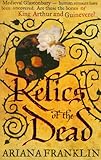
As soon as I’d finished reading The Death Maze I began Ariana Franklin’s third book in her Mistress of the Art of Death series, Relics of the Dead. Now this one was more to my liking and I enjoyed it very much.

The date is 1176, the setting is Glastonbury where the monks, after a fire had destroyed their monastery, discovered two skeletons buried in their graveyard. The question is  – are these the remains of King Arthur and Queen Guinevere? The problem is that Henry II needs evidence that they are not – that the legendary Arthur is indeed dead and not the ‘Once and Future King’, sleeping but waiting for the right time to lead the belligerent Welsh against him. Henry’s solution is to send Adelia Aguilar, the anatomist, to examine the bones for evidence, preferably to establish that no one can say that the bones are not that of Arthur and his queen. Given that this is the 12th century and the technology wasn’t there to prove the age and identity of the bones, Adelia assisted by Mansur, does a pretty good job in her investigation, despite attempts on her life.

Where Relics of the Dead stands out is in the depiction of Glastonbury, a mysterious, spiritual place, ‘one of the world’s sacred centres, a place where the division between man and God was thinner than anywhere else‘, a place where ‘there was a special magnetism that pulled people to worship a presence her long before Christ had set foot on his native heath.’ But Adelia, that down-to-earth, practical woman couldn’t feel it – for her all mysteries had to have an explanation. And she was determined to find it.

I’ve always liked the stories about King Arthur and the beliefs about his life and death, about Excalibur (which does feature in this book), about Guinevere’s affair with Lancelot,  and the Holy Grail (which do not). As well as a strong sense of place and atmosphere the characters are well-drawn and believable, even if some aspects of the plot required quite a hefty suspension of disbelief (which I managed easily enough).

Similarly I wasn’t bothered by Franklin’s use of modern language – in her Author’s Note, she had noted that she was sometimes criticised for making her characters use modern language and explained that ‘in 12th century England the common people spoke a form of English even less comprehensible than Chaucer’s in the 14th, the nobility spoke Norman French and the clergy Latin. Since people then sounded contemporary to each other, and since I hate the use of what I call ‘Gadzooks’ in historical novels to denote a past age, I insist on making them sound contemporary to us.’ If she had used such ‘gadzooks’ language I don’t think I’d have got very far into the book. And, it didn’t occur to me that her dialogue was anachronistic.

Franklin also used a lot of terms common to the age, such as ‘Mort d’Ancestor’, which she did explain within the text, so that that too did not bother me. In fact I liked it, I think it added to the atmosphere and I did enjoy looking up such terms for more information in a book I used to use a lot when I worked in a local archive repository – The Local Historian’s Encyclopedia by John Richardson, a fascinating book.

Ariana Franklin was the pseudonym of Diana Norman. She died in 2011. The last book in the series is The Assassin’s Prayer (published as Murderous Procession in the US), continuing Adelia’s story.

The Death Maze by Ariana Franklin

Normal service has been resumed – thankfully!! – I’m back to writing on this blog thanks to my son.

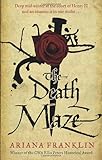
It seems quite a while since I finished reading Ariana Franklin’s The Death Maze (published as The Serpent’s Tale in the US), so these are just a few thoughts about the book.

Back in 2007 I’d really enjoyed her first book, Mistress of the Art of Death (which I wrote about here) and I was eager to read the next book about Adelia Aguilar, the 12th century anatomist employed by Henry II. But I was a bit put off by reports that The Death Maze was not as good, and other books grabbed my attention. Time passed, the third book came out – Relics of the Dead – and curiosity got the better of me so I bought both books, and eventually I got round to reading them – one after the other.

Yes, The Death Maze does not live up to the first book for me, but it’s still enjoyable. Rosamund Clifford, Henry II’s mistress has been poisoned, allegedly by Eleanor of Aquitane, Henry’s wife. Adelia is summoned to investigate her death. So, she sets off to Oxford, accompanied by her baby daughter, Allie, her servant Gyltha and the Saracen, Mansur, who has to pose as the doctor whilst Adelia pretends to be his assistant. Adelia was a graduate of the School of Medicine in Salerno, which, unlike England, allowed women to train as physicians; in England her forensic skills would have been considered witchcraft.

Rosamund had lived in a strange and sinister tower surrounded by a maze, constructed of walls of granite with blackthorn planted against them. So, the first problem Adelia had to solve was to find the way through the maze. She was then faced with the gruesome discovery of Rosamund’s dead body. The main thrust of the book centres on Eleanor’s moves to overthrow Henry II, and after Eleanor and her supporters capture Adelia, they take her to the nunnery at Godstow, where they wait snowbound for the right moment to launch their rebellion.

I think the book works well as historical fiction, even though as Ariana Franklin wrote in her Author’s Notes that there is only a brief reference to Rosamund Clifford in the historical records and so this is a fictional portrayal based on legend. And she inserted a fictional rebellion in England in a gap in the medieval records. It has whetted my appetite to know more about the period. But as crime fiction, I was rather disappointed because although I found the details of Rosamund’s death interesting, there was actually very little about Adelia’s investigation, very little for her to exercise her forsenic skills, which was one of the elements I’d enjoyed in Mistress of the Art of Death. 

This is my second book for Carl’s  R.I.P.VII challenge and it also slots into the Historical Fiction Challenge and the Mount TBR Challenge 2013.

New-To-Me Books

I went to Barter Books in Alnwick last week and was really delighted to find these books:

Heatwave etcFrom the bottom up they are:

  • Instructions For A Heatwave by Maggie O’Farrell – this was right at the top of a bookcase, far too high up for me to reach, but a helpful member of staff got it down for me. It’s one I’ve had on my wishlist since I read The Hand that First Held Mine, which I thought was excellent. This is her sixth book and is a portrait of a family in crisis during the heatwave in 1976.
  • The Shooting Party by Isabel Colegate – this is the book to read in October for Cornflower’s Reading Group. I read about on the morning I was going to Barter Books  was amazed to find a good hardback copy just as though I’d reserved it. The shooting party takes place in autumn 1913 – ‘Here is a whole society under the microscope, a society soon to be destroyed.’ I began reading it in the shop whilst having a cup of coffee and it promises to be really good.
  • Ordeal by Innocence by Agatha Christie – I always check which Agatha Christie books are in at Barter Books. Sometimes there aren’t any I haven’t read, but this time there were two. This one does not feature Poirot or Miss Marple, not like the TV adaptation that had Miss Marple (in the form of Geraldine McEwan), solving the mystery. In her Autobiography Agatha Christie wrote that ‘of her detective books the two that satisfy me best are Crooked House and Ordeal by Innocence.’ (An Autobiography page 538)
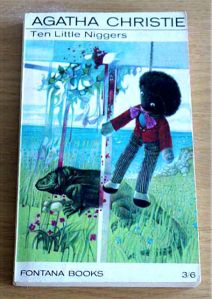
  • Ten Little Niggers by Agatha Christie – I was so pleased to find this book as it’s one of the best-selling books of all time and one I’ve never read, although I remember the basics of the plot from TV/film versions. I’ve beenlooking out for it for ages. The book was originally published in 1939, when the title would have given little offence in the UK, but it was different in the USA and it was first published there in 1940, a few months later, as And Then There Were None. This copy was published in 1968 in the UK and still has its original title, as the book continued to be published under this title until 1985 . I was quite startled, though, to see the cover picture showing a golliwog:

Ten Little Niggers

I’m looking forward to reading all of them – and the pleasurable problem now is deciding which one to read first – it maybe Ten Little Niggers! Again quoting from her Autobiography, Agatha Christie wrote that:

It was well received and reviewed, but the person who was really pleased with it was myself, for I knew better than any critic how difficult it had been. (page 488)

Third Girl by Agatha Christie

Third Girl was first published in 1966. In it Poirot is probably meant to be approaching eighty, although if he had aged with the books he would have been well over a hundred! Anyway, the young lady who comes to see him about ‘a murder she might have committed‘ runs out of his room after blurting out:

You’re too old. Nobody told me you were so old. I really don’t want to be rude but – there it is. You’re too old. I’m really very sorry.’ (page 13)

Poirot is bored. He had finished his Magnum Opus, an analysis of detective fiction writers, in which he had spoken scathingly of Edgar Allen Poe, and had complained of the lack of method or order in the romantic outpourings of Wilkie Collins. He had no idea what to do next, so, his interest is aroused by the young lady’s announcement and he sets out to discover what murder she ‘might have committed.’ It turns out that Mrs Ariadne Oliver had told the girl about him when talking with friends about detectives and together they discover that she is Norma Restarick, the ‘third girl’, sharing a flat with two other girls.

Norma thinks she might be crazy, but won’t see a doctor. She doesn’t always remember what she has done. She hates her stepmother and thinks she might have poisoned her. Poirot is intrigued but when a suspicion of espionage surfaces it is all too much for him:

Poirot gave an exasperated sigh.

‘Enfin,’ he said, ‘it is too much! There is far too much. Now we have espionage and counter espionage. All I am seeking is one perfectly simple murder. I begin to suspect that that murder only occurred in a drug addict’s brain! (page 211)

But as Poirot reminds himself it is his ‘metier’ to deal with murder, to clear up murder, to prevent murder and eventually with a casual phrase spoken by Mrs Oliver it all becomes clear to him.

The plot is complex, which is rather puzzling,  but for me Third Girl is also interesting because of its commentary on the 1960s culture seen through the eyes of the older characters – the disparaging remarks about the youth of the day – beatniks, long hair, clothes that were of doubtful cleanliness, and skimpy skirts, and the Van Dyke type clothes some of the young men wore, the drink and drugs and wild parties. Mrs Oliver has her usual gripe about people saying things to her about her books and how they longed to meet her, making her feel ‘hot, bothered and rather silly‘ and how much they love the ‘awful detective Sven Hjerson‘ she had created and now hates.

Maybe it’s not one of Agatha Christie’s best books but I think it’s very entertaining.

The Saint Zita Society by Ruth Rendell

When I began to read The Saint Zita Society I could not remember all the characters, so many were introduced one after the other. So, I wrote them all down together with where they lived. In the first 30 pages I counted 28 characters. It helped to write their names down, and eventually their relationships and characteristics became familiar to me. There were just a few of the initial characters who did not play a large part later in the book.

I’d borrowed the book from the library and had totally missed the fact that the book’s endpapers contain a plan of Hexham Place with the names of the people who live at each house! It was partly my own fault that I missed this, not looking properly and skipping over straight away to the first chapter, but it was also because the library had covered up the front endpaper with labels and had sealed the book jacket to both the front and back endpapers! It would really have helped if I’d seen this when I started to read the book!

This is not a who-done-it, nor a why-done-it, but is really a character study of the people who live and work at Hexham Place in Pimlico and a ‘will-they get away with it’ mystery. To that extent I found it entertaining, if predictable. As usual with Ruth Rendell’s books the characters are a mix of odd personalities, with even the most ‘normal’ ones, revealing their idiosyncrasies – a reflection of real society, I suppose!

The Saint Zita Society is the brainchild of June (78 years old and the paid companion of the wealthy Princess Susan Hapsburg, 82 years old) who lives at No. 6 Hexham Place, along with Gussie the dog). As June explains Saint Zita is the patron saint of domestic servants, who gave food and clothes to the poor. The Society doesn’t function well, mainly because the members (cleaners, drivers, gardeners, and home helps – a nanny and an au pair) use it to air their grievances with little hope of resolving them. On the fringes of the Society is Dex, a strange man who keeps to himself, sees evil spirits and talks to Peach, his ‘god’, on his mobile. The others are uneasy around Dex, especially when they’re told that he had  tried to kill his mother and had spent time in a place for the criminally insane, but he is now cured and working as a gardener for Dr Jefferson at No.3 Hexham Place

After about a third of the book there is a death and an attempt to cover it up. And from that point on the action spirals to its predictable conclusion and even what I think was meant as an unexpected twist near the end was also rather obvious.

Overall, not a taxing mystery, but a look at the interaction between a group of disparate characters. I enjoyed it even though it lacked suspense and it ends rather abruptly (a bit like this post!). Just be careful next time you’re out shopping in a crowd or are out jogging on your own!