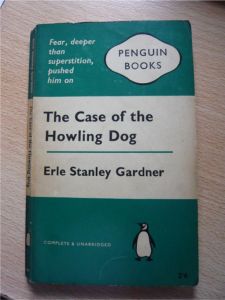
The Case of the Howling Dog by Erle Stanley Gardner

In January I read The Case of the Curious Bride also by Gardner and was rather disappointed because I found it far-fetched and at times was at a complete loss to understand what  Perry Mason was doing and why. I wondered whether to bother reading any more of the Perry Mason books. But I had enjoyed the TV series very much years ago and I still had one more of the books to read. So, the other day I began reading The Case of the Howling Dog and was relieved when I realised that it is much better than the Curious Bride case!

Synopsis from the back cover:

A dog howled by night in the quiet of Milpas Drive, and drove Arthur Cartright crazy with terror. He begged lawyer Perry Mason to bring a warrant against its owner, who, he said, had taught the dog to howl in order to drive him mad. According to superstition the howling meant a death in the neighbourhood, and Cartright appeared to believe it.

But Mason believed that a deeper fear than superstition was impelling his client and when both the dog and its owner were killed he took up the challenge and set himself to find the murderer.

My view:

The Case of the Howling Dog was first published in 1934, the fourth Perry Mason book and inevitably it is dated, but interesting because of that. I couldn’t really see my way through all the intricacies of this case but I thought it was very entertaining and well done, and I hadn’t foreseen the twist at the end. It’s fast-paced, with just the right balance of description and dialogue.

Mason is quickly established as a lawyer who doesn’t like routine:

I want excitement. I wan to work on matters of life and death, where minutes count. I want the bizarre and the unusual. (page 21)

So at first he’s not really interested in Cartright’s problem and thinks the man is crazy. But it soon becomes obvious that there is more to the case than making a will and taking out a warrant against the dog’s owner. In fact it becomes a complicated and complex murder mystery, and involves Mason getting dangerously close to breaking the law himself; as Paul Drake, the tall detective with drooping shoulders, warns him more than once he’s skating on thin ice. Mason insists that everything he does is within his rights and he is representing a client who is entitled to a fair trial. The Deputy Attorney, Claude Drumm thought the prosecution was certain of a verdict, but he hadn’t reckoned with Mason’s tactics.

Della Street was also doubtful that Perry was doing the right thing

‘Perry Mason,’ she said. ‘I worship you. You’ve got more brains and more ability than any other man I know. You’ve done things that have been simply marvellous, and now you’re doing something that is just plain, downright injustice. (pages 114-5)

But he insists what he is doing is his duty:

It’s the function of the lawyer for the defence to see the facts in favour of the defendant are presented to the jury in the strongest possible light. …

That’s my sworn duty. That’s all I’m supposed to do. (page 115)

And at the end that is just what he does do and after the trial Della views him through starry eyes!

The Bookman's Tale by Charlie Lovett

When Alma Books contacted me to ask if I would like a review copy of The Bookman’s Tale: a novel of love and obsession by Charlie Lovett I was delighted. How could I resist a book about books, involving a search to discover the truth behind what could be a priceless Shakespearean manuscript? The book arrived the next day and I made the ‘mistake’ of looking at it whilst I drank a cup of coffee. I couldn’t put it down and by the end of the day I had read half the book.

The Bookman’s Tale

Synopsis from the back cover:

 A mysterious portrait ignites an antiquarian bookseller’s search – through time and the works of Shakespeare – for his lost love.

After the death of his wife, Peter Byerly, a young antiquarian bookseller, relocates from the States to the English countryside, where he hopes to rediscover the joys of life through his passion for collecting and restoring rare books. But when he opens an eighteenth-century study on Shakespeare forgeries, he is shocked to find a Victorian portrait strikingly similar to his wife tumble out of its pages, and becomes obsessed with tracking down its origins. As he follows the trail back to the nineteenth century and then to Shakespeare’s time, Peter learns the truth about his own past and unearths a book that might prove that Shakespeare was indeed the author of all his plays.

My view:

There are three different strands to this book, which interconnect and are interwoven throughout the book: the present day ie 1995 with Peter in England, the 1980s in America when Peter met and fell in love with Amanda, and the story of the Pandosto manuscript, a romance by Elizabethan poet Robert Greene, on which Shakespeare based The Winter’s Tale, from 1592 to 1879.

It began really well and Peter is not the only bookseller involved in the story – there is Bartholomew Harbottle in the Elizabethan/Stuart period and the Victorian Benjamin Mayhew both of whom play important roles. I really liked the historical sections and the details about the book trade and forgery is fascinating. I found the love story between Peter and his beloved Amanda rather cloying. Peter himself, suffers from an anxiety disorder and it is only his love for books and Amanda that seemed to make it possible for him to function at all – a good portrayal of an obsessive neurotic character.

By the second half of the book however, my enthusiasm for it began to droop a little as the chase around England became more frantic and a bit improbable. The many story lines as the book progressed became a series of cliff hangers, culminating in what seemed to me like something out of a cross between a Dan Brown novel, an Enid Blyton Famous Five book and a murder mystery. But, although there are just too many coincidence, twists and turns, and at times it is a bit melodramatic I still enjoyed it, swept along by the plot, an absorbing mix of historical fact and fiction, mystery and romance set in a book lovers’ world.

Charlie Lovett is a writer, teacher and playwright of plays for children. He is also a former antiquarian bookseller and an avid book collector. All this is evident in The Bookman’s Tale! He has a website with more information about the book and the sources he used.

Tamburlaine Must Die by Louise Welsh

It was a treat to read Tamburlaine Must Die, a short book that I read in a day. I can’t remember when I last read a book in a day!

Sometimes novellas, such as this is with just 140 pages, can seem lacking, needing more depth of character or plot, leaving me feeling that it should really have been a full length novel, or an even shorter story. But Tamburlaine Must Die has an immediacy, that drew me in to the late Elizabethan world.

I wrote about the opening paragraph and synopsis on Tuesday and almost immediately after I began to read the book. Written in the first person and set in May 1593, it’s a tense, dramatic story of the last days of Christopher Marlowe, playwright, poet and spy. Accused of heresy and atheism, his death is a mystery, although conjecture and rumours abound. Louise Welsh has used several sources in writing this novella, but as she writes in the Author’s Note:

History has bequeathed us a tantalising framework of facts – the Elizabethans were as prolific as the Stasi when it came to official documents. Yet the facts can’t tell us the full tale and historian’s theories on Marlowe’s death are ultimately well informed, meticulously researched speculation.

We know that Marlowe dies in a house in Deptford. We know the date of his death and the three men present. We know the nature of the wound that killed him. Everything else is educated guesswork, or in this author’s case, a fiction.

Tamburlaine Must Die conveys the claustrophobic atmosphere of danger surrounding Marlowe; who can he trust, and who is behind the pseudonym of ‘Tamburlaine’, who posted a libellous handbill referencing Marlowe’s plays? He is very aware that death is just around the corner:

A dagger can find its way into a belly or a back before the victim spies it. I thought I felt the prickle of surveillance on my shoulders. And though I knew it was most likely the effect of my own blood running faster in my veins, I made my way from the crush of people, trying to keep note of who was around me, checking  if any faces lingered in the thinning crowd. (page 31)

As well as Marlowe, Louise Welsh throws in Dr Dee and Thomas Walsingham, Marlowe’s patron and refers to Walter Raleigh too. In such a brief book she has managed to convey the political and the seedy underworld of the Elizabethan period, the dishonesty and love of intrigue, the dangers of the plague and the threat of war. Has much changed since then, I wonder.

The Drowning by Camilla Lackberg: Book Notes

You can’t like every book you read and if I find I’m not enjoying a book I stop reading it. But it’s not always so straight forward because a book can begin well and hook you into the story, get your attention then begin to irritate because it takes so long to get there, and you read on. Then when you get to the end you heave a sigh of relief that you have finished it. It was just about OK.

The Drowning by Camilla Lackberg is such a book. It began well – I wrote about the opening paragraphs in this post. They made me want to read on but I had some reservations because of the blurb on the back cover €“ €˜Expert at mixing scenes of domestic cosiness with blood-curdling horror’. Well, there is a lot of domestic cosiness and not really any blood-curdling horror. There are a few nasty scenes, but nothing that made me want to skim read, nothing in fact that I couldn’t read.

Synopsis from the back cover:

Christian Thydell’s dream has come true: his debut novel, The Mermaid, is published to rave reviews. So why is he as distant and unhappy as ever? When crime writer Erica Falck, who discovered Christian’s talents, learns he has been receiving anonymous threats, she investigates not just the messages but also the author’s mysterious past€¦

Meanwhile, one of Christian’s closest friends is missing. Erica’s husband, Detective Patrik Hedström, has his worst suspicions confirmed as the mind-games aimed at Christian and those around him become a disturbing reality.

But, with the victims themselves concealing evidence, the investigation is going nowhere. Is their silence driven by fear or guilt? And what is the secret they would rather die to protect than live to see revealed?

My view:

  • This is the sixth book in Camilla Lackberg’s  Fjällbacka series, so maybe I should have begun with the first book. However, I didn’t feel that I’d jumped into a series without understanding how the characters interacted, or that there were back stories that I should know, so I think it does work as a stand-alone book.
  • It’s written from several perspectives and has a second narrative interspersed with the main one. It’s not clear at first how these are related but it soon becomes apparent.
  • None of the characters came alive for me, apart from Erica  and Patrik and there was little I could visualise from the description of the location – it’s in Sweden, it’s cold and there is snow on the ground.
  • It’s unevenly paced, disjointed with snippets of information being passed between the characters and not shared with the reader, presumably to increase the suspense and tension, which it didn’t achieve for me. As a page-turner it just didn’t work, and I sighed mentally each time it came up.
  • The  description in places reminded me of an exercise I did on a training course in which you had to describe in detail how to make a cup of tea – decide to make a cup, pick up the kettle, take it to the tap etc. I am exaggerating, but you get the picture.
  • It’s predictable – I knew quite early on who the culprit was. That doesn’t necessarily mean it spoils a book, but in this instance it did because I kept on thinking, it’s … I couldn’t see why Erica and the police couldn’t see it either.
  • The ending was so irritating – a cliff hanger, aimed at getting you to read the next book??

I doubt I’ll read any of the other books in the series.

First Chapter First Paragraph Tuesday Intros

Every Tuesday Diane at  Bibliophile by the Sea hosts First Chapter First Paragraph Tuesday Intros, sharing the first paragraph or (a few) of a book she’s reading or thinking about reading soon.

Today I’m in the mood for reading short fiction and picked this book off my to-be-read shelves. It’s Tamburlaine Must Die by Louise Welsh, set in 1593 it tells the story of playwright, Christopher Marlowe’s last days, weaving together fact and fiction. It’s only 140 pages.

It begins:

I have four candles and one evening in which to write this account. Tomorrow I will lodge these papers with my last true friend. If I survive the day, they will light our pipes. But should I not return, he has instructions to secrete this chronicle where it will lie undiscovered for a long span, in the hope that when these pages are found, the age will be different and my words may be judged by honest eyes.

When I read the first four words I immediately thought of the Ronnie Barker and Ronnie Corbett sketch from years ago in the Two RonniesThe Four Candles. I don’t suppose that is the response Louise Welsh would have expected, but there it is, that’s what came to my mind. But this is not a comedy as this summary from Amazon reveals:

London, 1593. A city on edge. Under threat from plague and war, strangers are unwelcome, suspicion is wholesale, severed heads grin from the spikes on Tower Bridge. Playwright, poet and spy, Christopher Marlowe walks the city’s mean streets with just three days to find the murderous Tamburlaine, a killer escaped from the pages of his most violent play. Tamburlaine Must Die is the searing adventure of a man who dares to defy both God and the state and whose murder remains a taunting mystery to the present day.

What do you think? Would you keep reading?

June's Books & Crime Fiction Pick of the Month

I read six books in June, a bit less than usual as one of the books, Barnaby Rudge by Charles Dickens is a long book. Three are books from my backlog of to-be-read books, two are historical fiction and one was a re-read. All but one are crime fiction!

June 2013

  • A Fearful Madness by Julius Falconer – after the violent death of a part-time cathedral verger the dead man’s sister, anxious to see justice done, and two of the police suspects, both released without charge carry out their own investigations into his death. A complex mystery that kept me guessing right to the end.
  • The Third Pig Detective Agency by Bob Burke – a fairytale detective story in which Harry, the third little pig is employed by Aladdin to find his stolen lamp, aided or hindered by numerous characters, and finding himself in all sorts of tricky and dangerous situations.
  • The Owl Killers by Karen Maitland – a tale of witchcraft and pagan superstition set in 1321, mystical and mysterious and tragic as it explores the struggle to survive and the battleground between the old pagan beliefs and Christianity.
  • Kissing the Gunner’s Daughter by Ruth Rendell – this begins with the shooting of Sergeant Martin of Kingsmarkham CID whilst he was standing in a queue at the local bank. Then DCI Wexford is faced with more murders a few months later, when author Davina Flory, her husband and daughter, are shot dead at Tancred House.
  • Raven Black by Ann Cleeves – a re-read. This is the first of the Inspector Perez books set on Shetland, in which Perez investigates the death of a schoolgirl. I had forgotten who the culprit was and as on my first reading I failed to identify the murderer.
  • Barnaby Rudge by Charles Dickens – historical murder mystery set in England in the 1770s and the Gordon Riots of 1780. This  is now one of my favourite of Dickens’s books.

My Crime Fiction Pick of the Month is: Kissing the Gunner’s Daughter by Ruth Rendell, a book I just did not want to put down.

Kissing the Gunner's DaughterFor more Crime Fiction Picks of the Month see Kerrie’s blog, Mysteries in Paradise.