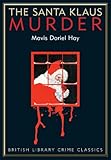
The Santa Klaus Murder by Mavis Doriel Hay

When I saw that The Santa Klaus Murder was available for loan from the Kindle Lending Library I wondered if it was worth looking at. I’d never heard of Mavis Doriel Hay before, but I thoroughly enjoyed reading this book, one of the British Library Crime Classics.

Mavis Doriel Hay (1894-1979) was a novelist of the golden age of British crime fiction. Her three detective novels were published in the 1930s and are now rare and highly collectable books. She was an expert on rural handicraft and wrote several books on the subject.

Summary from the British Library:

A classic country-house murder mystery, The Santa Klaus Murder begins with Aunt Mildred declaring that no good could come of the Melbury family Christmas gathering at their country residence Flaxmere. So when Sir Osmond Melbury, the family patriarch, is discovered€”by a guest dressed as Santa Klaus€”with a bullet in his head on Christmas Day, the festivities are plunged into chaos.

Nearly every member of the party stands to reap some sort of benefit from Sir Osmond’s death, but Santa Klaus, the one person who seems to have every opportunity to fire the shot, has no apparent motive. Various members of the family have their private suspicions about the identity of the murderer, but in the midst of mistrust, suspicion, and hatred, it emerges that there was not one Santa Klaus but two.

My view:

This was first published in 1936 and it is a classic locked room murder mystery. There are lots of suspects, especially as there were rumours that Sir Osmond was about to re-write his will. The story has several narrators, including – Sir Osmond’s daughter, Jennifer and her fiancé, Philip (Sir Osmond has withheld his blessing to their engagement), his daughter Hilda, a widow, Mildred, his sister, Grace, his young and vivacious secretary, and Colonel Halstock, the Chief Constable, investigating the crime. The suspects all seem to have alibis, but are they all telling the truth?

In short, it seems impossible to be sure of anyone’s exact movements during that half-hour.

No one admits seeing anyone enter the study after Oliver Witcombe left Sir Osmond there, until Witcombe returned and found him dead. (page 81)

It is a complicated plot and I enjoyed all the twists and turns. The opening chapters are rather detailed setting out the family background, but the characters all came to life as they arrived at Flaxmere.

There is a map showing the layout of the ground floor of Flaxmere, to help the reader and I kept referring to it as I read, together with the list of characters and their relationships.

To help you even more, if you haven’t worked out who did it there is a Postscript by Colonel Haverstock listing the questions and clues to identify the murderer. So don’t look at the end if you don’t want to know how and why Sir Osmond was murdered.

Hay’s other two murder mysteries Murder Underground and Death on the Cherwell are due to be published in June 2014 – I’ll be looking out for them.
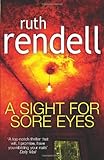
Book Beginning: A Sight for Sore Eyes by Ruth Rendell

The library van came round this week and I borrowed another Ruth Rendell book: A Sight for Sore Eyes, first published in 1998. I don’t really check what the book is about when it’s one by Ruth Rendell, as I usually enjoy her books. This one begins:

They were to hold hands and look at one another. Deeply, into each other’s eyes.

‘It’s not a sitting,’ she said, ‘it’s a standing. Why can’t I sit on his knee?’

He laughed. Everything she said amused him or delighted him, everything about her captivated him from her dark-red curly hair to her small white feet. The painter’s instructions were that he should look at her as if in love and she at him as if enthralled. This was easy, this was to act naturally.

This could be the opening to a love story, but this is a Ruth Rendell book and I’m expecting it to be something darker and more mysterious. Indeed, the information on the back cover warns that this is ‘Masterfully spooky. Don’t read this alone.’

For more Book Beginnings see Gilion’s blog Rose City Reader.

My Kind of Mystery Challenge

Here is yet another reading challenge for 2014 – the My Kind of Mysery challenge which is being hosted by Riedel Fascination, who explains her idea:

Mystery needs no murder! Hidden passageways, ancient places, eerie phenomenon€¦ ‘Dan Brown’ meets Nancy Atherton! Gothic greats of the 1960s-1980s, modern releases. I am launching a reading challenge that welcomes the lot: tutorials, mystery author biographies, fiction€¦ Any form of mystery and its authors fit my all-encompassing theme.

Keep an eye out for fun riddles to solve throughout the year!

The categories are:

Any format.
Any demographic

Non-adult must be published by 1990 or earlier.
Limitless length.
A short story, compilations; bring them to the table!
Reviews wanted.
A link to Goodreads, Book Depository€¦ just to show you finished. One line is fine.

Catch your breath: we launch February 1st, 2014 €“ February 28th, 2015!

I’ve gone through my list of unread crime fiction/mystery books and found I have over 40! So, I’ve decided to go for the category ‘Lost Artifacts’.

A Year of Reading Agatha Christie: 2013

Agatha ChristieThe Agatha Christie Reading Challenge is run by Kerrie at Mysteries in Paradise. I don’t think of it as a Challenge €“ it’s really a reading project, as it is quite simply to read Agatha Christie’s books. I’m not reading them in order of publication but as I come across them.

As I wrote in a guest post on Alyce’s blog for her series of Best and Worst earlier this year, Agatha Christie has long been one of my favourite writers. I first read some of her books as a teenager, but over the last four years or so I’ve been reading as many of her books that I can find.

She wrote over 100 novels, short story collections and plays and she is one of the best-selling (if not the best-selling) novelists of all time, well known for her crime fiction featuring Hercule Poirot and Miss Marple and other detectives, both amateur and police.

I like many things about her writing. Her style is light, humorous at times, but her writing can be dark creating a tense and menacing atmosphere. Her plots are often ingenious, intricate, complicated puzzles, with the clues scattered throughout the texts. Some of her characters are clearly defined and fully rounded, some are lightly sketched, and others are comic characters, caricatures presented satirically or even farcically. Her settings are often country houses in idyllic English villages, but also in exotic locations in the Middle East as in her archaeological mysteries.

The full list of the 55 novels and short stories that I’ve read is on my Agatha Christie Reading Challenge page. This year I’ve read 9 of her books:

My favourite this year is Cards on the Table, but they all make fascinating reading.

Cards on the Table

  1. Cat Among the Pigeons  (Poirot)
  2. Mrs McGinty’s Dead (Poirot and Ariadne Oliver)
  3. Murder in the Mews (Poirot 4 short stories)
  4. Cards on the Table (Poirot)
  5. Third Girl (Poirot)
  6. Ten Little Niggers aka And Then There Were None
  7. A Murder is Announced (Miss Marple)
  8. N or M? (Tommy and Tuppence)
  9. Ordeal by Innocence

I’ve also read two biographies:

  1. Agatha Christie: an English Mystery by Laura Thompson
  2. Agatha Christie at Home by Hilary Macaskill

There are still plenty of Agatha Christie’s books for me to read. The following books are the ones I own and will be reading next year (not necessarily in this order):

  • They Do It With Mirrors (Miss Marple)
  • The Moving Finger (Miss Marple)
  • Miss Marple and Mystery: Complete Short Stories
  • Poirot Investigates (short stories)
  • The Golden Ball (short stories)
  • Complete Parker Pyne (short stories)
  • The Adventure of the Christmas Pudding (short stories)

Ordeal by Innocence by Agatha Christie

Agatha Christie wrote in An Autobiography that Ordeal by Innocence and Crooked House were the two books she’d written that satisfied her the best. Neither book features Poirot or Miss Marple, so maybe she had become rather tired of them and had enjoyed introducing completely new characters.

Ordeal by Innocence (The Christie€¦Summary from the back cover of my copy:

According to the courts, Jacko Argyle bludgeoned his mother to death with a poker. Sentenced to life imprisonment, he died behind bars following a bout of pneumonia. Tragically, it was not until two years later that Dr Arthur Calgary came forward with the testimony that could have acquitted Jacko. Worse the doctor’s revelations were about to re-open old wounds in the family, increasing the likelihood that the real murderer would strike again.

My view:

Ordeal by Innocence is thus a stand-alone novel, first published in 1958, unlike the TV adaptation that had Miss Marple (in the form of Geraldine McEwan), solving the mystery.

Dr Calgary was surprised by the reception he received from the family when he visited them to tell them that Jacko was innocent and why he hadn’t come forward at the time to confirm his alibi. Instead of relief he was met with wariness and suspicion as the family members realised that one of them could be the murderer. This is a cold case that they wish had never been re-opened; they had been happy to accept that Jacko, a thoroughly nasty character, was guilty. Only Philip the eldest daughter’s wheelchair-bound husband is keen to discover the murderer’s identity. So, it is up to him, Doctor Calgary, helped by the family solicitor and Superintendent Huish to carry out fresh investigations.

What I liked about Ordeal by Innocence was the way Agatha Christie delved into the family relationships and their characters. Mrs Argyle was one of those mothers who was always right and thought she knew best and at times all her children had rebelled or wanted to rebel against her authority, so all were suspects, along with her long-suffering husband, who since her death was planning to marry his secretary.

The novel is as much about protecting the innocent as punishing the guilty, and the fact that stating your innocence is not proof of it. Calgary has to find the murderer so that the innocent will not suffer from the taint of guilt. Without knowing who was guilty they would have all come under suspicion, destroying their love and trust.

I swung from believing first one, then another character, was the guilty person and was quite taken in by all the red herrings Agatha Christie threw into the book. All is made clear in the last chapter when Dr Calgary presents his findings and reveals the killer. Although I don’t think it is one of Agatha Christie’s best books, I still enjoyed its complexity and admired her skill in plotting this novel.

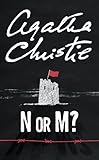
N or M? by Agatha Christie

N or M? is the third of the Tommy and Tuppence stories, set in 1940 and first published in 1941.  Agatha Christie wrote this at the same time as writing The Body in the Library. She explained the reason in her Autobiography:

I had decided to write two books at once, since one of the difficulties of writing a book is that it suddenly goes stale on you. Then you have to put it by, and do other things – but I believed that if  I wrote two books, and alternated the writing of them, it would keep me fresh at the task. One was The Body in the Library, which I had been thinking of writing for some time, and the other one was N or M?, a spy story, which was in a way a continuation of the second book of mine, The Secret Adversary, featuring Tommy and Tuppence. Now with a grown-up son and daughter, Tommy and Tuppence were bored by finding that nobody wanted them in wartime. However, they made a splendid come-back as a middle-aged pair, and tracked down spies with all their old enthusiasm. (An Autobiography by Agatha Christie page 506)

Tommy is asked to go under cover to track down members of the Fifth Column, two of the most important and trusted German agents, whose mission is to infiltrate British society, like the Trojan wooden horse. All that is known is that N is a man and M a woman and they are thought to be at Leahampton on the south coast. He tells Tuppence that he is being sent to Scotland and that she can’t go with him, but she surprises him by being at Sans Souci, a seaside guesthouse in Leahampton, when he arrives. So there they are, both under cover, Tommy as Mr Meadowes and Tuppence as Mrs Blenkensop.

There is definitely something not right about the guesthouse, it has the feel of something sinister, something evil. And it’s not long before Tommy and Tuppence are embroiled in a series of dangerous near-disasters, involving German spies, and Smuggler’s Rest, a cottage with a secret room, set on a cliff overlooking a little cove and ideal for enemy action.

N or M? is an easy book to read and not too demanding. Agatha Christie makes use, as in some of her other books, of nursery rhymes, in this one it’s ‘Goosey goosey gander’, which comes from a Mother Goose picture book Tuppence reads to little Betty Sprot. Of all the characters in the book (apart from Tommy and Tuppence) Betty, a toddler, who speaks her own baby language, is the most well-drawn, so much so that at one point I even found myself wondering if she could be M!!!

One of its attractions for me is its historical setting, although when Agatha Christie wrote this book it was very current, she did not know how the war would end. It is interesting to see how she portrays the general public’s attitude towards the war, about patriotism, and the fear of Fifth Columnists, of spies, and Fascists and Communists. Also of note is that whilst most of the characters thought the war would be over very quickly, which is what I thought was the general consensus at the time, one of them thought it would last at least six years.

Following the publication of N or M? Agatha Christie was investigated by MI5 because she had named one of the characters ‘Major Bletchley’ and MI5 suspected she had a spy in Britain’s undercover code breaking centre, Bletchley Park.