A Year of Reading Agatha Christie: 2013

Agatha ChristieThe Agatha Christie Reading Challenge is run by Kerrie at Mysteries in Paradise. I don’t think of it as a Challenge €“ it’s really a reading project, as it is quite simply to read Agatha Christie’s books. I’m not reading them in order of publication but as I come across them.

As I wrote in a guest post on Alyce’s blog for her series of Best and Worst earlier this year, Agatha Christie has long been one of my favourite writers. I first read some of her books as a teenager, but over the last four years or so I’ve been reading as many of her books that I can find.

She wrote over 100 novels, short story collections and plays and she is one of the best-selling (if not the best-selling) novelists of all time, well known for her crime fiction featuring Hercule Poirot and Miss Marple and other detectives, both amateur and police.

I like many things about her writing. Her style is light, humorous at times, but her writing can be dark creating a tense and menacing atmosphere. Her plots are often ingenious, intricate, complicated puzzles, with the clues scattered throughout the texts. Some of her characters are clearly defined and fully rounded, some are lightly sketched, and others are comic characters, caricatures presented satirically or even farcically. Her settings are often country houses in idyllic English villages, but also in exotic locations in the Middle East as in her archaeological mysteries.

The full list of the 55 novels and short stories that I’ve read is on my Agatha Christie Reading Challenge page. This year I’ve read 9 of her books:

My favourite this year is Cards on the Table, but they all make fascinating reading.

Cards on the Table

  1. Cat Among the Pigeons  (Poirot)
  2. Mrs McGinty’s Dead (Poirot and Ariadne Oliver)
  3. Murder in the Mews (Poirot 4 short stories)
  4. Cards on the Table (Poirot)
  5. Third Girl (Poirot)
  6. Ten Little Niggers aka And Then There Were None
  7. A Murder is Announced (Miss Marple)
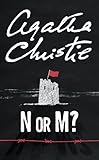
  8. N or M? (Tommy and Tuppence)
  9. Ordeal by Innocence

I’ve also read two biographies:

  1. Agatha Christie: an English Mystery by Laura Thompson
  2. Agatha Christie at Home by Hilary Macaskill

There are still plenty of Agatha Christie’s books for me to read. The following books are the ones I own and will be reading next year (not necessarily in this order):

  • They Do It With Mirrors (Miss Marple)
  • The Moving Finger (Miss Marple)
  • Miss Marple and Mystery: Complete Short Stories
  • Poirot Investigates (short stories)
  • The Golden Ball (short stories)
  • Complete Parker Pyne (short stories)
  • The Adventure of the Christmas Pudding (short stories)

Ordeal by Innocence by Agatha Christie

Agatha Christie wrote in An Autobiography that Ordeal by Innocence and Crooked House were the two books she’d written that satisfied her the best. Neither book features Poirot or Miss Marple, so maybe she had become rather tired of them and had enjoyed introducing completely new characters.

Ordeal by Innocence (The Christie€¦Summary from the back cover of my copy:

According to the courts, Jacko Argyle bludgeoned his mother to death with a poker. Sentenced to life imprisonment, he died behind bars following a bout of pneumonia. Tragically, it was not until two years later that Dr Arthur Calgary came forward with the testimony that could have acquitted Jacko. Worse the doctor’s revelations were about to re-open old wounds in the family, increasing the likelihood that the real murderer would strike again.

My view:

Ordeal by Innocence is thus a stand-alone novel, first published in 1958, unlike the TV adaptation that had Miss Marple (in the form of Geraldine McEwan), solving the mystery.

Dr Calgary was surprised by the reception he received from the family when he visited them to tell them that Jacko was innocent and why he hadn’t come forward at the time to confirm his alibi. Instead of relief he was met with wariness and suspicion as the family members realised that one of them could be the murderer. This is a cold case that they wish had never been re-opened; they had been happy to accept that Jacko, a thoroughly nasty character, was guilty. Only Philip the eldest daughter’s wheelchair-bound husband is keen to discover the murderer’s identity. So, it is up to him, Doctor Calgary, helped by the family solicitor and Superintendent Huish to carry out fresh investigations.

What I liked about Ordeal by Innocence was the way Agatha Christie delved into the family relationships and their characters. Mrs Argyle was one of those mothers who was always right and thought she knew best and at times all her children had rebelled or wanted to rebel against her authority, so all were suspects, along with her long-suffering husband, who since her death was planning to marry his secretary.

The novel is as much about protecting the innocent as punishing the guilty, and the fact that stating your innocence is not proof of it. Calgary has to find the murderer so that the innocent will not suffer from the taint of guilt. Without knowing who was guilty they would have all come under suspicion, destroying their love and trust.

I swung from believing first one, then another character, was the guilty person and was quite taken in by all the red herrings Agatha Christie threw into the book. All is made clear in the last chapter when Dr Calgary presents his findings and reveals the killer. Although I don’t think it is one of Agatha Christie’s best books, I still enjoyed its complexity and admired her skill in plotting this novel.

N or M? by Agatha Christie

N or M? is the third of the Tommy and Tuppence stories, set in 1940 and first published in 1941.  Agatha Christie wrote this at the same time as writing The Body in the Library. She explained the reason in her Autobiography:

I had decided to write two books at once, since one of the difficulties of writing a book is that it suddenly goes stale on you. Then you have to put it by, and do other things – but I believed that if  I wrote two books, and alternated the writing of them, it would keep me fresh at the task. One was The Body in the Library, which I had been thinking of writing for some time, and the other one was N or M?, a spy story, which was in a way a continuation of the second book of mine, The Secret Adversary, featuring Tommy and Tuppence. Now with a grown-up son and daughter, Tommy and Tuppence were bored by finding that nobody wanted them in wartime. However, they made a splendid come-back as a middle-aged pair, and tracked down spies with all their old enthusiasm. (An Autobiography by Agatha Christie page 506)

Tommy is asked to go under cover to track down members of the Fifth Column, two of the most important and trusted German agents, whose mission is to infiltrate British society, like the Trojan wooden horse. All that is known is that N is a man and M a woman and they are thought to be at Leahampton on the south coast. He tells Tuppence that he is being sent to Scotland and that she can’t go with him, but she surprises him by being at Sans Souci, a seaside guesthouse in Leahampton, when he arrives. So there they are, both under cover, Tommy as Mr Meadowes and Tuppence as Mrs Blenkensop.

There is definitely something not right about the guesthouse, it has the feel of something sinister, something evil. And it’s not long before Tommy and Tuppence are embroiled in a series of dangerous near-disasters, involving German spies, and Smuggler’s Rest, a cottage with a secret room, set on a cliff overlooking a little cove and ideal for enemy action.

N or M? is an easy book to read and not too demanding. Agatha Christie makes use, as in some of her other books, of nursery rhymes, in this one it’s ‘Goosey goosey gander’, which comes from a Mother Goose picture book Tuppence reads to little Betty Sprot. Of all the characters in the book (apart from Tommy and Tuppence) Betty, a toddler, who speaks her own baby language, is the most well-drawn, so much so that at one point I even found myself wondering if she could be M!!!

One of its attractions for me is its historical setting, although when Agatha Christie wrote this book it was very current, she did not know how the war would end. It is interesting to see how she portrays the general public’s attitude towards the war, about patriotism, and the fear of Fifth Columnists, of spies, and Fascists and Communists. Also of note is that whilst most of the characters thought the war would be over very quickly, which is what I thought was the general consensus at the time, one of them thought it would last at least six years.

Following the publication of N or M? Agatha Christie was investigated by MI5 because she had named one of the characters ‘Major Bletchley’ and MI5 suspected she had a spy in Britain’s undercover code breaking centre, Bletchley Park.
November's Books & Crime Fiction Pick of the Month

These are the books I finished reading in November (linked to my posts on the books):

  1. Saints of the Shadow Bible by Ian Rankin
  2. Gone with the Wind by Margaret Mitchell and also this post
  3. Instructions for a Heatwave by Maggie O’Farrell
  4. Julius by Daphne Du Maurier (from my To-Be-Read books)
  5. The Midwich Cuckoos by John Wyndham (Kindle)
  6. N or M? by Agatha Christie (from my To-Be-Read books)
  7. St Mawr by D H Lawrence (from my To-Be-Read books)

The books without posts are:

Instructions for a Heatwave is a book I bought this year; it’s shortlisted for the 2013 Costa Novel Award.  The Midwich Cuckoos is an e-book I borrowed from the Kindle Users Lending Library. Three of the books are books I’ve owned for several years (the To-Be-Read books).

It was a good month for reading. Just two of the books are crime fiction – Saints of the Shadow Bible and N or M?  Both books are by writers at the top of their form, but Ian Rankin’s Saints of the Shadow Bible is my Crime Fiction Pick of the Month.

See Kerrie’s blog for more Crime Fiction Picks of the Month.


Sunday Selection: Choosing the next book to read

Yesterday I finished reading both Instructions for a Heatwave by Maggie O’Farrell and Julius by Daphne Du Maurier, leaving me with no books on the go. This morning I started to read The Midwich Cuckoos by John Wyndham, but I like to read more than one book at a time of different genres so that I don’t get them mixed up in my mind, preferably with one non-fiction book.

I think I’ll read a biography or an autobiography.

There was a programme on TV last night about D H Lawrence, a Culture Show Special, which reminded me that I haven’t read his biography yet which I bought a few years ago when we visited the house in Eastwood where he was born. It’s D H Lawrence: the Life of an Outsider by John Worthen who was one of the contributors to the programme. I got the book off the shelf and immediately saw why I haven’t read it yet – it’s in such a small font, with quotations in an even smaller font – not good for my eyes. It’s a pity I don’t have it on Kindle but maybe I’ll give it a go, definitely a book to read in daylight. And as I have just one of D H Lawrence’s books that I haven’t read yet – St Mawr – I may read that. It’s a novella, so it won’t take me long.

Anther book I’ve been meaning to read before now is Peter Ackroyd’s Shakespeare:the Biography. The Classics Club is running a new project next year Twelve Months of Classic Literature with different topics for each month and January’s topic is William Shakespeare.  I think Ackroyd’s book would be a good choice for this project. It’s described on the book jacket as

 … neither an academic description, nor a didactic analysis. Written with intuition and imagination unique to Peter Ackroyd, a book by a writer about a writer, brilliant and straightforward, it vividly presents the reader with the circumstances of Shakespeare’s life and art.

It sounds just right. I think I’ll begin with this book.

That leaves me with choosing a crime fiction book and I have quite a lot of those to choose from. I haven’t read an Agatha Christie this month so I’m going to choose one of hers or some of her short stories (I have several collections still unread). I think I’ll read the oldest I have, which is N or M? a Tommy and Tuppence war time mystery, first published in 1941. I have a feeling this will be better than the last Tommy and Tuppence book I read, Postern of Fate, which was Agatha Christie’s last novel and not one of her best.

Saints of the Shadow Bible by Ian Rankin

I finished reading the latest Rebus book, Saints of the Shadow Bible a few days ago and have been wondering what to write about it that would do it justice. Ian Rankin is one of my favourite authors and his Rebus books never fail to impress me both with their ingenuity and the quality of their plots and characterisations – Saints of the Shadow Bible is no exception. In fact, I think it’s one of the best – a realistic and completely baffling mystery.

Rebus is now back on the force, the rules on retirement age having changed, but as a Detective Sergeant, not a DI and Siobhan Clarke is his boss. It begins with the discovery of a crashed car, on the face of it just a straight forward road traffic accident but it soon develops into a complex, multi-layered case, linking back to one of Rebus’s early cases on the force as a young Detective Constable. A case that with the changes in the double jeopardy law in Scotland can be reopened.

Rebus has always been an outsider, not one to play completely by the rules but his past gets put under scrutiny when Inspector Malcolm Fox investigates that case from the 1980s. There are suspicions that Rebus and his colleagues, who called themselves ‘The Saints of the Shadow Bible’ were involved in covering up a crime, allowing a murderer to go free.

The ‘Shadow Bible’ was a copy of Scots Criminal Law, a big black book

‘with a leather cover and brass screws. And we all spat on it and rubbed it in until it was dry. I thought it was a kind of oath, but it wasn’t – we were saying the rules could go to hell, because we knew we were better. We were the ones in the field …

The evidence was tainted, interviews hadn’t been conducted properly. How was Rebus involved, was he a Saint, and just how much did he know as a very junior member of the team?

The interaction between Rebus and Fox is one of the joys of this book as unlike Rebus, Fox does play by the rules. Ah, but does he? Beneath his controlled exterior Fox is just as much a loose cannon as Rebus, he’s not a team player either and it is fascinating to see how Rebus gets under his skin and reveals Fox’s true nature. For Rebus and Fox it’s the job that matters, but can they trust each other?

I wonder, though, just how much I would have enjoyed it if this was the first Rebus book I’d read. I have a feeling that I wouldn’t. There are characters who were in earlier books and references to previous cases which would have been lost on me otherwise. The first Rebus book I read was Set in Darkness (the 11th book) and whilst I had no difficulty in following who was who and their relationships I realised then that I had to read the books in order to fully understand the background and how the characters had evolved. I felt they were real people and I wanted to know more about them. I then went back to the beginning (Knots and Crosses) and read them in sequence, right up to the present day.

It’s all been an exhilarating and most enjoyable journey and I have a sneaking suspicion that this may indeed be the end – who knows? Only Ian Rankin and he isn’t telling, but he’s off on a year’s sabbatical in February and by then Rebus will almost be due a second retirement.