Crime Fiction Pick of the Month: April

I read three crime fiction books in April: 

  • The Nine Tailors by Dorothy L Sayers
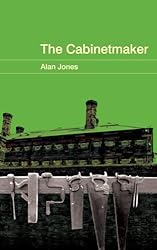
  • The Cabinetmaker by Alan Jones
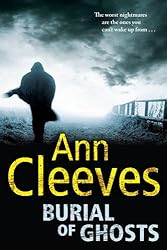
  • Burial of Ghosts by Ann Cleeves

I’ve already reviewed The Cabinetmaker -based in Glasgow telling the story of a local cabinetmaker, Francis Hare, father of a murdered son, and John McDaid, a young detective on the investigation. It is an intricately plotted book which had me totally gripped.
Burial of Ghosts by Ann Cleeves is a standalone book, not part of either her Vera or Shetland series. Lizzie Bartholomew, a social worker is on leave after a particular nasty episode which has left her traumatised. After a brief holiday affair with Philip Sansom in Morocco, she is surprised when he left her £15,000 in his will. But there are certain conditions she is required to fulfil, which plunges her into a terrifying situation. This is largely a psychological study, focussing on Lizzie, as she relives her past in flashbacks.

All three books are good reads, but my Crime Fiction Pick of the Month for April is The Nine Tailors by Dorothy L Sayers, one of the Golden Age crime fiction writers. It’s a Lord Peter Wimsey Mystery, first published in 1934, by far the most complicated book of the three crime fiction books I read in April and the most fascinating for a number of reasons. It had me completely baffled, first the bell-ringing, and then the twists and turns and all the red herrings.
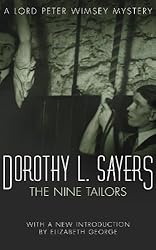
Wimsey driving through a snow storm ends up in a ditch near the village of Fenchurch St Paul in the Fens and is taken in for the night by the vicar. It’s New Year’s Eve (at some period in the early 1930s) and the vicar has arranged that the bell-ringers will ring in the New Year, involving 9 hours of bell-ringing. As one of the ringers is ill with influenza, Wimsey steps in at the last minute to take his place. I had never realised just how complicated bell-ringing is:

The art of ringing is peculiar to the English, and, like most English peculiarities, unintelligible to the rest of the world. To the musical Belgian, for example, it appears the proper thing to do with a carefully tuned ring of bells is to play a tune upon it. By the English campanologist, the playing of tunes is considered to be a childish game, only fit for foreigners; the proper use of bells is to work out mathematical permutations and combinations. (page 21)

A few weeks later Wimsey is asked back to Fenchurch St Paul to help solve the mystery of the dead man found by the sexton whilst he was opening up Lady Thorpe’s grave to bury her husband. The identity of the dead man is unknown, his face was mutilated and his hands had been cut off  – who was he, who killed him and why? And what is the significance of the enigmatic note found in the bell-tower? It’s not an easy crime to solve and involves Wimsey in a trip to France as he tries to identify the victim. An added complication is the mystery of the missing necklace, stolen from the Thorpe family but never recovered.

I think one of the things that makes this such a good read is that it’s not just crime fiction, not just solving a puzzle, but it is also a fascinating portrait of the Fens, of their bleakness and isolation; of society in the 1930s with its rigid class divisions into gentry, clergy and villagers. The last part of the book is dominated by the floods as the sluice gates failed to keep back the water flooding all the low-lying ground, despite the new drainage works. It reminded me of the floods in the Somerset Levels this last winter, with various water authorities disputing responsibility for the disaster.

Above all, it is novel in which everything works well together, the characters are individuals, their behaviour is true to their beliefs and passions, and their conversations are realistic. It begins with a leisurely pace, with lots of detail about bell-ringing, which sometimes seemed a bit unnecessary to me, but as the plot unfolded I realised that I was wrong and I needed to pay more attention to the detail. It is essential to the plot. After this leisurely start the pace picks up as Wimsey and the police try to untangle the mystery.

It’s a book that you have to read with care, paying close attention as it is easy to get swept along with Dorothy Sayers’ beautifully descriptive prose and skilful story-telling. This is the sight that greets Wimsey from the top of the bell-tower:

An enormous stillness surrounded him. The moon had risen, and between the battlements the sullen face of the drowned fen showed like a picture in a shifting frame, like the sea seen through the porthole of a rolling ship, so widely did the tower swing to the relentless battery of the bells.

The whole world was now lost in one vast sheet of water. He hauled himself to his feet and gazed out from horizon to horizon. To the south-west St Stephen’s tower still brooded over a dark platform of land, like a broken mast upon a sinking ship.  Every house in the village was lit up:  St Stephen was riding out the storm.  Westward, the thin line of the railway embankment stretched away to Little Dykesey, unvanquished as yet, but perilously besieged. Due south, Fenchurch St Peter, roofs and spire etched black against the silver, was the centre of a great mere. Close beneath the tower, the village of St Paul lay abandoned, waiting for its fate.  Away to the east, a faint pencilling marked the course of the Potters Lode Bank, and while he watched it, it seemed to waver and vanish beneath the marching tide. (page 294)

The Nine Tailors is the first detective book by Dorothy L Sayers that I have read (previously I’d read The Descent into Hell, extracts from her translation of Dante’s Inferno). It’s her ninth Wimsey novel and I intend to read more.
Books read in April

April was a good reading month – I finished reading 9 books, bringing my total for the year so far to 35:

  1. The Last Enchantment (Arthurian Saga 3) by Mary Stewart
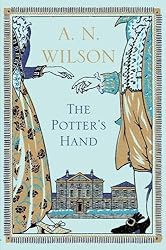
  2. The Potter’s Hand by A N Wilson
  3. The Bell Jar by Sylvia Plath (a re-read for book group)
  4. St Bartholomew’s Man by Mary Delorme
  5. The Nine Tailors by Dorothy L Sayers (to be reviewed)
  6. The Cabinetmaker by Alan Jones
  7. Black Dogs by Ian McEwan
  8. Tantalus by Jane Jazz
  9. Burial of Ghosts by Ann Cleeves (to be reviewed)

They were all good reads, although I wouldn’t have re-read The Bell Jar if it hadn’t been my book group’s choice. I can’t say that I enjoyed that one, it is so depressing, but it is well written. All bar the first one are either library books or books I’ve acquired this year – a reaction, I suppose to finishing three months of reading only books I’ve owned before 1 January 2014!

It’s been difficult this month deciding which book to choose as my Best Book of the Month as they’ve all been enjoyable in different ways.

With so many good books by both established and new authors to choose from, after much thought, my all-round Best Book of the Month for April is The Potter’s Hand by A N Wilson, a remarkable novel about the Wedgwood family, their lives, loves, work, illnesses, depressions, addictions and deaths. I found it fascinating throughout, whether it was set in America during the fight for independence, or in England in Wedgwood’s factories, or his grand new house Etruria Hall, or travelling through England on the new canals.
And I should also flag up Tantalus by Jane Jazz, a love story with a difference, set in the Yorkshire moors and Tuscany. There is so much in this book that I loved €“ the characters, the story, the charged emotions and longing, the setting and the art.

Reading Challenges progress up to 30 April (for details of these challenges see my Challenges page):

  • Mount TBR Reading Challenge €“ 24 of my own unread books. My target is 48.
  • Read Scotland Challenge €“ 6 books. My target 13+.
  • What’s in a Name 7 €“ I’ve completed 5 of the 6 sections – just  a ‘book with a school subject in the title’ to read.
  • Historical Fiction Challenge €“ 6 books. My target is 25 books.
  • Colour Coded Challenge €“ 3 books. The target is to read 9 books in the different colour categories.
  • The Agatha Christie Reading Challenge €“ 2 books. This is an open-ended challenge to read all her books. So far I have read 57.
  • My Kind of Mystery Challenge €“ 10 books. My target is 31+.
  • Once Upon a Time VIII challenge – 2 books, both read this month – The Last Enchantment and Tantalus, both excellent fantasy novels.

Book Beginnings: The Chosen Dead

What to read next is nearly always a difficult question, the problem being that I have so many books I’ve bought/borrowed that I really want to read right now and much as I would like to I can’t read them all at once.

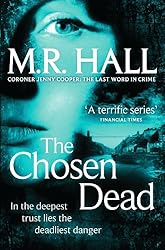
So, this morning here I am nearly ready to start a new book and wondering which one to go for. It could be The Chosen Dead by M R Hall, his fifth novel in the Coroner Jenny Cooper series.

It begins:

Scottsdale Arizona, 12 March 1982

The last thing Roy Emmett Hudson was expecting on the eve of his forty-first birthday was a bullet in the head, but life and death are only a single breath apart, and as a biologist, he appreciated that more than most. Even as he strolled across the company lot to the Mercedes Coupé he had driven all winter without once raising the roof, his killers’ thoughts were already moving on to where they might dump his body so that it might never be found.

I’ve read three of the earlier books in the series, and liked them, so I’m hoping this one will be good. It’s an intriguing beginning because it doesn’t seem likely that Coroner Jenny Cooper could be involved in investigating this death as she is a Bristol coroner …

Synopsis from the back cover:

When Bristol Coroner Jenny Cooper investigates the fatal plunge of a man from a motorway bridge, she little suspects that it has any connection with the sudden death of a friend’s thirteen year old daughter from a deadly strain of meningitis. But as Jenny pieces together the dead man’s last days, she’s drawn into a mystery whose dark ripples stretch across continents and back through decades. In an investigation which will take her into the sinister realms of unbridled human ambition and corrupt scientific endeavour, Jenny is soon forced to risk the love and lives of those closest to her, as a deadly race to uncover the truth begins . . .

Every Friday Book Beginnings on Friday is hosted by Gillion at Rose City Reader where you can share the first sentence (or so) of the book you are reading, along with your initial thoughts about the sentence, impressions of the book, or anything else the opener inspires.

The Cabinetmaker by Alan Jones

When Alan Jones emailed me about reading his book The Cabinetmaker he described it as a gritty crime novel based in Glasgow that tells the story of a local cabinetmaker, Francis Hare, father of a murdered son, and John McDaid, a young detective on the investigation.

He went on to say that it contained some strong language, some sleazy police and a smattering of Glasgow slang, which did make me unsure I wanted to read it. But he also said that it combined Glasgow gang culture, sloppy policing and amateur football with fine furniture making and taking that into account I thought that it probably wouldn’t be your normal run-of-the mill crime fiction.

And I was right – it is different and I did like it, despite some of the language (which actually is no worse than in some other books) and there are no truly gruesome descriptions to put me off. In parts I thought it lost focus somewhat, the crime and justice aspects becoming a bit lost in a wealth of detail about football and furniture making, but apart from that it is a intricately plotted book which had me totally gripped. By the end of the book I realised that there is a purpose to those chapters beyond Alan Jones’s obvious love of football and furniture making. Within them lie the clues to what was really going on in Francis and John’s lives.

The Cabinetmaker follows John McDaid’s life from his first day as a detective up to his retirement in 2008, focussing on one crime – the killing of Patrick Hare, a student by a gang of thugs in Glasglow’s west end. The killers were tried but walked free.  From that point onward the story is of John and Francis and their search for justice.  Patrick’s death was a turning point in their lives and although they become friends through a shared interest in football and cabinet making, under pinning everything is their desire for justice.

There are many characters, including police and villains and at times some of them did begin to blur in my mind, with the exception of Francis, John and Sarah, Patrick’s girl friend, who all stand out as vivid and believable people. There are many twists and turns in the story, before the full truth is revealed. It’s a novel of loss and retribution.

Alan Jones (his pen name) is Scottish, living on the Clyde coast. I see from this interview on Omnimystery News that he is writing another book – I’ll be looking out for it.

First Chapter, First Paragraph: Burial of Ghosts

First chapterEvery Tuesday Diane at Bibliophile by the Sea hosts First Chapter First Paragraph Tuesday Intros, where you can share the first paragraph, or a few, of a book you are reading or thinking about reading soon.

Today’s pick is a book that I mentioned in my post the other day on New Additions at BooksPlease. It’s Burial of Ghosts by Ann Cleeves.

It begins:

My nightmares feature knives and blades and blood. I don’t do falling down holes or being chased through deserted streets. And though I usually dream in black and white, the blood is very red, glossy, and it slides out from the rest of the scene, which is flat and dull. The worst thing is that when I wake, I realise it wasn’t a dream at all.

I’m in Blyth. It’s market day and I’m there to shop for Jess. There’s a stall where she buys all her fruit and veg – she knows the bloke who runs it and he always gives her a good deal. It’s mid-morning , with lots of people about. It’s not long before Christmas and everyone’s in the mood when they have to buy, even if the stuff’s crap, otherwise they feel they’re not prepared. A foggy, drizzly day, and cold with it. There’s a raw east wind which cuts into the skin. But it doesn’t draw blood. Not like the scissors I buy in Woolworths. I ask the assistant to take them out of the plastic packet to check they’re sharp. I run my thumb across the blade and there’s a small read line and then tiny, perfectly round red drops like jewels. I fumble with the money when I pay, not because of the cut, which is already healing, but because my hands are freezing.

What do you think? Would you keep reading?

Burial of Ghosts is a standalone book. It’s not a new book as it was first published in 2003 It’s now available in a new Pan paperback edition, which was published in September 2013.

Note: I see ITV are trailing series four of Vera when the first episode will be an adaptation of Harbour Street, the sixth and latest Vera Stanhope book. I really must read that one soon.

New-To-Me Books

Just eleven days left to go before the end of March and the end of the TBR Triple Dog DareThe basic idea of the Triple Dog Dare is to spend the first three months of the year cleaning house by reading only books in your TBR stack as of midnight, Dec. 31 and with a few allowed exceptions I’m still on track. But I’ve downloaded books onto Kindle and got some books from Barter Books over these last three months and I’m really looking forward to reading them from April onwards. I wrote about some of them in an earlier post.

Here are some more of the ‘physical’ books I have waiting not-so-patiently to be read:

Sweet Thursday P1090384

  •  Sweet Thursday by John Steinbeck – because I loved Cannery Row and this is the follow-up story. ‘Set in Monterey, on the California Coast, Sweet Thursday is what they call the day after Lousy Wednesday, which is one of those days that’s just naturally bad.’ I was really pleased to find this on the shelves at Barter Books – it just jumped out at me.
  • The Last Girl by Jane Casey – because I’ve read good things about her books, crime fiction of the thrilling kind. It’ll probably be a while before I read this book as I haven’t read the first in the Maeve Kerrigan series and this one is the third.
  • A Medal for a Murderer by Frances Brody – because I enjoyed the first Kate Shackleton mystery, Dying in the Wool. This is the second in the series, set in the 1920s in Harrogate where the leading lady in a play at the theatre is found dead in a doorway.
  • The Day of the Lie by William Brodrick – because I’ve read two of the earlier Father Anselm books and enjoyed them. In this one Anselm investigates events in Eastern Europe in the grip of the Cold War.

The books on Kindle include these:

Books on Kindle P1090385The one I’m most interested in is The King in the North: the Life and Times of Oswald of Northumbria by Max Adams – because it’s history of the area where I live, set in the 7th century about Oswald, a prince of the Northumbrian royal house. He reigned briefly, from 634 – 642, but during that time he re-united and re-Christianized the North-East; forged a hybrid culture of Briton, Irish, Scot and Anglo-Saxon; and founded a monastery on Lindisfarne. He was the first British king to die a Christian martyr. Max Adams is a biographer, archaeologist,  traveller and writing coach who lives in North-east England.

I think I’ll be reading this book very soon!