R.eaders I.mbibing P.eril XI

It’s time for the annual R. (eaders) I. (mbibing) P. (eril) event, hosted by Carl  at Stainless Steel Droppings, taking place between September 1st and October 31st.
(Much thanks to Hugo Award winning artist Abigail Larson for the use of her art)

This event involves reading books from these categories: Mystery, Suspense, Thriller, Dark Fantasy, Gothic, Horror, Supernatural or other closely-related fields. Reviews, while not required, may be posted on Carl’s blog.

I shall be attempting:


Peril the First: Read at least four books, any length, that you feel fit (the very broad definitions) of R.I.P. literature. I have plenty of Mystery, Suspense, Thriller and Gothic books on my shelves and Kindle to choose from, including these four:

The Girl in a Swing by Richard Adams

The Taxidermist’s Daughter by Kate Mosse

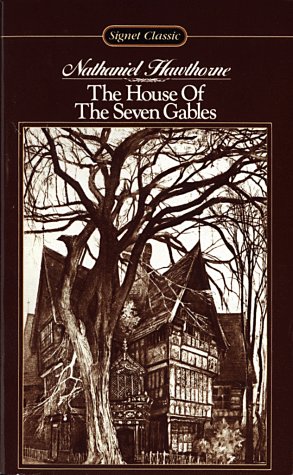
The House of the Seven Gables by Nathaniel Hawthorne

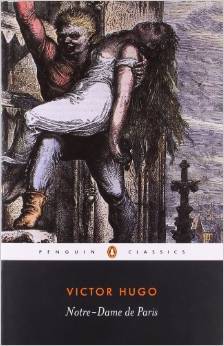
The Hunchback of Notre Dame by Victor Hugo

30600

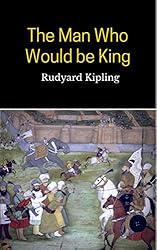
The Man Who Would Be King by Rudyard Kipling

For me the book chosen for the current Classics Club Spin is The Man Who Would Be King by Rudyard Kipling. It’s a novella, just 60 pages, which first appeared in The Phantom Rickshaw and other Eerie Tales, published in 1888.

Set in India and narrated by a journalist this is a story of two ruffianly-looking adventurers, wanderers and vagabonds, Daniel Dravot and Peachey Carnehan, who announce that they are off to Kafiristan in the mountains of Afghanistan to make themselves Kings. They tell the journalist that when they have got their kingdom ‘in going order’ they will let him know and that he can then come and help them govern it.

But some two years later, on a hot summer’s night, what was left of Carnehan crept into the journalist’s office,

He was bent into a circle, his head was sunk between his shoulders, and he moved his feet one over the other like a bear. I could hardly see whether he walked or crawled- this rag-wrapped, whining cripple who addressed me by name, crying that he was come back. (page 24)

And he had a sorry tale to tell.

I was a bit disappointed with it, mainly because for a novella it took such a long time to set the scene and the opening section was confusing, with references I didn’t understand. After the slow beginning the story picks up when it gets to relating what happened to Dravot and Carnehan. The Kipling Society website (where you can read the story, which is also free on Amazon) has some notes that helped me understand more – Masonic, Biblical and other references and details about the places and people mentioned.

The Kipling Society also gives details of the background to the story and some critical responses to it. Overall the responses are good – that it is a memorable, fantastic tale, some believing it to be a masterpiece, but Kingley Amis stated it was a ‘grossly overrated long tale‘. I was also interested that Edmund Wilson is quoted as stating that the story is “…surely a parable of what might happen to the English if they should forfeit their moral authority.”[Edmund Wilson ‘The Kipling that Nobody Read’, in Kipling’s Mind and Art ed. Andrew Rutherford, Oliver & Boyd, 1964.]

There was a film adaptation in 1975, starring Sean Connery as Dravot and Michael Caine as Carnehan with Christopher Plummer as Kipling, which according to some is much better than the story itself.

Rudyard Kipling was born in Bombay in 1865 and lived there until he was five when he was taken to live in England, returning to India in 1882, where he worked as a journalist. As well as short stories he also wrote poems, including If, and novels, and was awarded the Nobel Prize in Literature in 1907.

My copy is an e-book, which I’ve had for several years, so it counts towards my Mount TBR Reading Challenge.

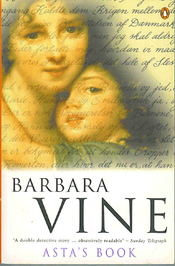
Asta’s Book by Barbara Vine

What an amazing book is Asta’s Book by Barbara Vine*. It was published as Anna’s Book in the USA. I loved A Dark Adapted Eye, A Fatal Inversion and The House of Stairs, but Asta’s Book tops all those.  I think it’s brilliant!

It’s a book that demanded all my attention and I just didn’t want to put it down. There’s a murder, a missing child, a question of identity and overarching it all are the stories of two families – the Westerbys and the Ropers and all the people connected to them. So many characters, so many red herrings, so many incidents that at first did not appear to be of any or of much importance that turned out to have great relevance.

It had me going backwards and forward and placing so many markers in the book to try and keep track of it all. How did Barbara Vine handle so much material in such a clever way? It is so intricately plotted and the portrayal of so many characters is so skilfully handled.

It begins in 1905 when Asta Westerby and her husband Rasmus have come to East London from Denmark with their two little boys and their servant Hansine. With Rasmus constantly away on business, Asta keeps loneliness and isolation at bay by writing a diary in her native tongue of Danish. The story is not told chronologically, but switches backwards and forwards between Asta’s diaries, beginning in 1905 when she was pregnant and hoping the new baby would be a daughter, and the present day after Asta’s death. The diaries had been translated and published by her daughter Swanny (Swanhilde), and along with details of the family’s life reveal clues to an unsolved murder and to the mystery of a missing child. After Swanny died Asta’s granddaughter Ann became involved in searching for the truth about these facts. Additional material is also related through a trial transcript and various accounts of events by different people.

The book kept me guessing all the way throughout the various mysteries it threw up. I was very tempted to peek at the end of the book for the answers, but managed not to and I’m glad I didn’t as it would have ruined the suspense. I was so impressed at how it all hung together, with no extraneous material – all those minor incidents and characters are completely necessary.

As in other books by Barbara Vine it is not only the characters and the mystery that are enthralling, it is also the atmosphere and the settings. Houses in her books take on characters of their own and in this one there are several, maybe the most dominant is Devon Villa where Lizzie Roper was murdered, her mother also died of a heart attack and Lizzie’s daughter, Edith was last seen as she climbed the stairs up to her mother’s bedroom. And then there is the doll’s house that Rasmus made for his daughter, Marie, replicating Padanaram, the Westerbys’ second house in Shepherd’s Hill, Highgate.

*Barbara Vine is the pseudonym of Ruth Rendell, who was a Fellow of the Royal Society of Literature and the author of many thrillers and psychological murder mysteries . She died in 2015 at the age of 85. Her mother was born in Sweden and brought up in Denmark; her father, Arthur Grasemann, was English. As a result of spending Christmas and other holidays in Scandinavia, Rendell learned Swedish and Danish.

Asta’s Book is my third book for the 20 books of Summer Challenge and the 25th for the Mount TBR Reading Challenge. Definitely a book I’d love to re-read.

Short Story Sunday: The Shepherdess and the Sweep

Short story questI’m taking part in Carl’s Once Upon a Time event, specifically in the Short Story Quest, which involves the reading of one or more short stories that fit within at least one of the four genres of Fairy Tale, Folklore, Fantasy and Mythology, during the course of any weekend, or weekends, during the challenge. Ideally, posting about your short story readings on Sundays or Mondays, but this is not strictly necessary.

This will be a weekly event for me, until the end of the event on 21 June. I’m reading some of Hans Christian Andersen’s Fairy Tales ‘“ I first read a lot of the tales as a child. Andersen was a Danish author, born in 1805 in Odense. He was a prolific writer of plays, travelogues, novels, and poems, as well as fairy tales. Some of his most famous fairy tales include The Emperor’s New Clothes, The Little Mermaid, The Nightingale, The Snow Queen, The Ugly Duckling, Thumbelina, and many more. He died in 1875.

I’m reading from my mother’s book: P1010936This week it’s another fairy tale that I don’t remember reading before – The Shepherdess and the Sweep.

Unlike The Rose Elf, the story I read last week, The Shepherdess and the Sweep is not a gruesome story, but a story of love, romance, and bravery.

The Shepherdess and the Sweep are two china figures who fall in love but their love is threatened by a strange looking carved satyr the children called the Goatsleg-Highadjutant-general-militarycommandant, as he had goat’s legs, short horns and a long beard and was constantly grinning. He stood on top of a very old wooden cabinet, looking down on the beautiful Shepherdess on the table opposite and wanted her for his wife. There is also a bigger china figure than the little couple – a big old Chinese, who could nod his head. He claims authority over the Shepherdess and says she will marry the satyr that night.

So the two little china figures decide to leave the table and venture out into the wide world. In their desperation to escape they decide to climb the chimney, but when they get to the top the Shepherdess is overcome with fear and cries “This is too much” she sobbed, “That I can never bear. The world is too large; oh, were I but back again on the table under the looking glass!”

Illustration from “Fairy Tales, 1850” by Vilhelm Pedersen, Andersen’s first illustrator (from Wikipedia)

Spoiler follows – don’t read the next paragraph if you don’t want to know how this story ends.

The sweep can’t console her and so they climb back down even though he thought it was foolish. But they find that the Chinese figure in his attempt to follow them had fallen and broken into three pieces. The family mended him but his head, which had rolled far off into a corner of the room had to be riveted onto his neck, so that he could no longer nod. He was too proud to tell the Satyr and so when he asked if he were to have the Shepherdess or not, the Chinese figure was silent. And the little couple remained together. So, a happy ending for this tale.

The Voyage Out by Virginia Woolf

The idea for March and April in HeavenAli’s Virginia Woolf Read-a-long was to read one or more of: The Voyage Out, Night and Day (Virginia Woolf’s first and second novels) or Between the Acts which was her final novel. This was just the reminder I needed to get The Voyage Out down from my bookshelves where it’s been sitting unread for years.

This post is far too long, but one reason for writing this blog is to record what I think of a book and what I want to remember about it – this post only touches on that even at this length! There is so much more to be said about it.

I’ve not written much about the plot. This is the Synopsis from the back cover of my copy (published by Penguin in 1992):

The Voyage Out opens with a party of English people aboard the Euphrosyne, bound for South America. Among them is Rachel Vinrace, a young girl, innocent and wholly ignorant of the world of politics and society, books, sex, love and marriage. She is a free spirit half-caught, momentarily and passionately, by Terence Hewet, an aspiring writer met in Santa Marina. But their engagement is to end abruptly, and tragically.

Background to the novel:

In 1913 Virginia Woolf (1882 – 1941) had been suffering ill health for some time – depression,  nervous breakdowns and anorexia – when her half-brother George Duckworth published The Voyage Out in 1915. She had started writing it years earlier and had revised it several times before finalising it in 1912 and 1913.

I don’t like to read the introduction of a book first as often it gives away elements of the plot that I’d rather not know in advance, but I think that this paragraph does help to explain much that I wondered about as I read the book. But if you don’t want to know just skip this next paragraph.

In the introduction to the book, Jane Wheare wrote:

A knowledge of Woolf’s life will certainly deepen our response to all her work. Amongst many other details from the young Virginia Woolf’s experience that appear in fictional form in The Voyage Out one can single out her bouts of mental illness, on which she drew for the description of Rachel’s  fever; the voyage which she made to Spain and Portugal with her brother Adrian in the spring of 1905, her sister Vanessa’s illness and her brother Thoby’s death from typhoid in 1906; and her interest on feminism. (page xiii)

My thoughts:

I finished reading it a short time ago, but have found it difficult to write about it. It is an intriguing book, beginning in a leisurely fashion as Mr and Mrs Ambrose (Rachel’s aunt and uncle) stroll down the Strand to the Embankment on their way to board the ship, Euphrosyne  and yet there is tension in the air and Mrs Ambrose has tears rolling down her face. This tension and sense of underlying trouble and anxiety continues throughout the book.

It begins mid-stream, as it were, with little background at first about the characters or about why the people are on board the Euphrosyne. It is only when the ship arrives at Santa Marina (a fictional place) that Woolf explains why they are going there; and their relationships are slowly revealed through their conversations and actions. The Dalloways make a brief appearance in the book when they spend a short time aboard the ship, leaving before the ship reaches Santa Marina.

I was surprised at just how naive Rachel is for a young woman of 24, even though she had been brought up by her two aunts. Helen Ambrose is shocked, writing about her niece in a letter to a friend, criticising the current methods of education:

This girl, though twenty-four, had never heard that men desired women, and until I explained it did not know how children were born. (page 59)

In some ways this is a coming-of -age novel and Rachel’s actions and reactions are the focus of the book. In it Woolf explores the nature of Rachel’s mind, her obsessions and beliefs and through it her own thoughts about depression, suicide, death and the meaning of life. It’s a huge subject, at times celebrating the wonder and beauty of life and at other times plunging down into the hopelessness and despair that some of the characters experience.

I knew from the book’s description that it ends in tragedy and I wondered as I read what form it would take. But even so, I was taken aback at the desperate sadness of it – it was draining!

Some quotations:

On religion: Mrs Dalloway is talking to Helen Ambrose – “I always think religion’s like collecting beetles,” she said, summing up the discussion as she went up the stairs with Helen. “One person has a passion for black beetles; another hasn’t; it’s no good arguing about it.” (Page 33)

On politics: Mr Dalloway (a politician) talking about a suffragette sitting outside the house (House of Commons): “My good creature, you’re only in the way where you are. You’re hindering me, and you’re doing no good to yourself.” And later in the conversation he says: “Nobody can condemn the utter folly and futility of such behaviour more than I do: and as for the whole agitation, well! may I be in my grave before a woman has a right to vote in England! That’s all I say.” (page 24)

Mr Ambrose replies: “I don’t care a fig one way or t’other. If any creature is so deluded as to think that a vote does him or her any good, let him have it. He’ll soon learn better.”

On women:  St. John Hirst speaking, “Just consider: it’s the beginning of the twentieth century, and until a few years ago no woman had ever come out by herself and said things at all.” …

It’s the man’s view that’s represented, you see. Think of a railway train: fifteen carriages for men who want to smoke. Doesn’t it make your blood boil? If I were a woman I’d blow someone’s brains out. Don’t you laugh at us a great deal? Don’t you think it’s all humbug? (page 139)

There is much more I could quote on women’s suffrage in this book.

On England in June – an example of Woolf’s descriptive writing: The thought of England was delightful, for they would see the old things freshly; it would be England in June, and there would be June nights in the country; and the nightingales singing in the lanes, into which they would steal when the room grew hot; and there would be English meadows gleaming with water and set with stolid cows, and clouds dipping low and trailing across the green hills.

and comparing it with South America:

… “Lord, how good it is to think of lanes, muddy lanes, with brambles and nettle, you know, and real grass fields, and farmyards with pigs and cows, and men walking beside carts with pitchforks – there’s nothing to compare with that here – look at the stony red earth, and the bright blue sea, and the glaring white houses – how tired one gets of it! And the air without a stain or a wrinkle. I’d give anything for a sea mist.” (pages 138-9)

A note about the cover

I think the cover is striking. It’s from a painting by Roger Fry – Roquebrune and Monte Carlo from Palm Beach, in the City of Glasgow Art Gallery.

Roger Eliot Fry (14 December 1866 ‘“ 9 September 1934) was an English painter and critic, and a member of the Bloomsbury Group. Establishing his reputation as a scholar of the Old Masters, he became an advocate of more recent developments in French painting, to which he gave the name Post-Impressionism. He was the first figure to raise public awareness of modern art in Britain, and emphasised the formal properties of paintings over the “associated ideas” conjured in the viewer by their representational content. He was described by the art historian Kenneth Clark as “incomparably the greatest influence on taste since Ruskin … In so far as taste can be changed by one man, it was changed by Roger Fry”.[1] The taste Fry influenced was primarily that of theAnglophone world, and his success lay largely in alerting an educated public to a compelling version of recent artistic developments of the Parisian avant-garde. (from wikipedia)
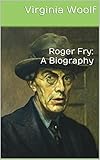
Fry, who for a while had an affair with Vanessa Bell, Virginia’s sister, was a friend of Virginia’s. She wrote three books subtitled ‘A Biography‘ – her biography of Roger Fry is one of them, first published in 1940.

For more information on Roger Fry see Art UK.

Needless to say – I enjoyed this book and it has encouraged me to read more of Virginia Woolf’s books (I’ve already read Mrs Dalloway, To the Lighthouse and Flush, all before I began my blog, and Death of a Moth and Other Essays – see also this post.)

Adding to the TBRs

As usual I am behind with writing about the books I’ve read, with four to do. I’m in the middle of writing about The Voyage Out by Virginia Woolf, but it is taking me longer than I’d hoped and I haven’t finished my post yet.

So, here’s a post about the four books I’ve added to my TBRs this week:

STSmall

Stacking The Shelves is all about sharing the books you are adding to your shelves. This means you can include ‘˜real’ and ‘˜virtual’ books (ie physical and ebooks) you’ve bought, books you’ve borrowed from friends or the library, review books, and gifts.

I’ve added one paperback and three e-books:

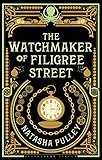
  • The Watchmaker of Filigree Street by Natasha Pulley. A friend recommended this book to me and I was delighted to see that it is one of the Kindle Daily Deals this morning. It’s steam-punk, a genre completely new to me! It is described as:

Utterly beguiling, The Watchmaker of Filigree Street blends historical events with dazzling flights of fancy to plunge readers into a strange and magical past, where time, destiny, genius ? and a clockwork octopus ? collide.

I hope I’ll like it as much as my friend did!

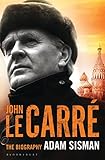
  • John Le Carré: the Biography by Adam Sisman, because I want to know more about the author of Tinker, Tailor, Soldier, Spy; The Night Manager and his other espionage books. During the 1950s and the 1960s, he worked for the Security Service and the Secret Intelligence Service, and began writing novels under a pen name. This is the definitive biography of a major writer, described by Ian McEwan as ‘perhaps the most significant novelist of the second half of the twentieth century in Britain’.
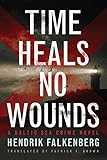
  • Time Heals No Wounds: a Baltic Sea crime novel by Hendrick Falkenberg. This is one of the free books for Amazon Prime members in May. German author Hendrik Falkenberg studied sports management and works in sports broadcasting. The magical allure that the sea holds for him comes alive in his stories, which are set on the north German coast. His first book, Die Zeit heilt keine Wunden (Time Heals No Wounds), was a #1 Kindle bestseller in Germany and has been translated for the first time into English.
  • And lastly, HeavenAli held a draw to give away some of Virginia Woolf’s books and I’m delighted that I won Orlando in the giveaway.

Orlando tells the tale of an extraordinary individual who lives through centuries of English history, first as a man, then as a woman; of his/her encounters with queens, kings, novelists, playwrights, and poets, and of his/her struggle to find fame and immortality not through actions, but through the written word. At its heart are the life and works of Woolf’s friend and lover, Vita Sackville-West, and Knole, the historic home of the Sackvilles. But as well as being a love letter to Vita, Orlando mocks the conventions of biography and history, teases the pretensions of contemporary men of letters, and wryly examines sexual double standards.

I’m looking forward to reading these books in the coming months!