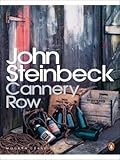
Cannery Row by John Steinbeck

As soon as I began reading Cannery Row I thought I could be in for a treat – this is the opening sentence:

Cannery Row in Monterey in California is a poem, a stink, a grating noise, a quality of light, a tone, a habit, a nostalgia, a dream.

There are some books that begin well and then tail off so I was hoping this wouldn’t be one of those. There are some books, just a few, that have everything, rich descriptions of locations, wonderful characters and a storyline, even though in this book it’s really a series of stories with a thread running through to connect them to the whole, that grabs my attention and makes me want to know more. Cannery Row is just such a book.

I knew nothing about the book before I began reading (it’s my book group choice) and that made it even more enjoyable. Steinbeck’s style is perfect for me, I could see Cannery Row itself, a strip of Monterey’s Ocean View Avenue, where the Monterey sardines were caught and canned or reduced to oil or fishmeal, along with all the characters – no, it was more than that -I was there in the thick of it, transported in my mind, whilst I was reading and even afterwards as I thought about the novel.

The characters include a group of down and outs, lead by Mack, whose well intentioned actions usually end in disaster for himself and others. Then there is the shop keeper, Lee Chong, who also owns the Palace Flophouse where he lets Mack and the boys live, Dora, a woman with flaming red hair, the madam who runs the Bear Flag Restaurant, Doc who lives and works at the Western Biological Laboratory and Henri the painter who is building and never finishing a boat. There is humour and tragedy, meanness and generosity, life and death all within Cannery Row‘s 148 pages.

I loved this description of Cannery Row:

Early morning is a time of magic in Cannery Row. In the gray time after the light has come and before the sun has risen, the Row seems to hang suspended out of time in a silvery light. The street lights go out and the weeds are a brilliant green. The corrugated iron of the canneries glows with the pearly lucence of platinum or old pewter. No automobiles are running then. The street is silent of progress and business. And the rush and drag of the waves can be heard as they splash in among the piles of the canneries. It is a time of peace, a deserted time, a little era of rest. Cats drip over the fences and slither like syrup over the ground looking for fish heads. (page 64)

This paragraph continues in the same vein for almost a whole page. For me it conjures up such a vivid picture of the place, its light and sound and the sentence comparing the movement of cats dripping and slithering like syrup is just perfect.

It’s not just a visual delight, the book contains many gems, the frog collecting expedition and the party scene that end in chaos and wreckage, and the words of wisdom from Doc. Here is just one example:

‘It has always seemed strange to me,’ said Doc. ‘The things we admire in men, kindness and generosity, openness and honesty, understanding and feeling are the concomitants  of failure in our system. And those traits we detest, sharpness, greed, acquisitiveness, meanness, egotism and self-interest are the traits of success. And while men admire, the quality of the first, they love the produce of the second.’ (page 107)

This is the best book I’ve read so far this year and one I shall read again. I loved it and I definitely want to read more of Steinbeck’s books (I may have read, or at least started to read The Grapes of Wrath when I was at school and didn’t appreciate it at the time – the opening seems so familiar!).
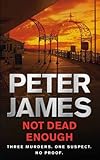
Not Dead Enough by Peter James

I read the first Detective Superintendent Roy Grace book, Dead Simple nearly two years ago now and have been meaning to read more of the books, so because I’m now concentrating on reading books I’ve owned before 1 January 2014 I thought it was time to read Not Dead Enough by Peter James. It’s the third Roy Grace book and whilst I don’t think it’s as good as Dead Simple I still enjoyed it – mainly because of the characterisation and the detail James goes into. It’s a long book and I see on Amazon that it’s been criticised for being too long and too detailed, but I liked that. For me it gave added interest and verisimilitude. Some people also criticised it because it has short chapters – to my mind that’s much better than having long chapters!

It’s set in Brighton and begins with the murder of Katie Bishop. The immediate suspect is her husband Brian Bishop, but it appears that he couldn’t be the murderer unless he could have been in two places at once. Then Sophie Harrington is killed. She had been having an affair with Brian thus intensifying the police investigation into his movements and background.

James takes his time setting out the details and the characters, so it’s quite slow to start off, but then the pace picks up, which makes this a quick read as I really wanted to know what happens next. It isn’t difficult to work out who the murderer is, but this didn’t lessen my enjoyment  – and there is just a little twist at the end that I hadn’t foreseen earlier on.

Roy Grace comes across as a real character, concerned about his work and his colleagues, even if he doesn’t get on too well with his boss, ACC Alison Vosper. Grace’s wife, Sandy, had disappeared nine years earlier and he is still wondering what happened to her even though he is now involved with Cleo Morey, the Chief Mortician and he takes a quick trip over to Munich when his friends tell him they had seen her there. This takes his attention away from the murders and he has to defend his visit to Vosper.

This is very much a police procedural, detailing how the detectives go about their work, including Grace’s ideas about whether eye movements indicate whether a person is telling the truth, which I’ve read about before, and what happens when a person is charged and arrested, which I know very little about (only from books and TV – and want to keep it that way)!

Cloud Atlas: The Book and The Movie

Cloud Atlas by David Mitchell:

A reluctant voyager crossing the Pacific in 1850; a disinherited composer blagging a precarious livelihood in between-the-wars Belgium; a high-minded journalist in Governor Reagan’s California; a vanity publisher fleeing his gangland creditors; a genetically modified ‘dinery server’ on death-row; and Zachry, a young Pacific Islander witnessing the nightfall of science and civilisation €” the narrators of Cloud Atlas hear each other’s echoes down the corridor of history, and their destinies are changed in ways great and small. (Copied from David Mitchell’s website.)

Over the Christmas period we watched the movie, Cloud Atlas and I was surprised at how good I thought it was. In the past I have not appreciated movies based on books, but as I hadn’t read the book (despite beginning it several times) I wasn’t influenced by it and could watch the movie with a completely open mind. It is fantastic – a kaleidoscope of visual delights, the scenery, the settings and the costumes are blazes of colour and drama. It made me want to read the book because some of the dialogue was difficult to follow – words spoken quickly and not clearly and in a sort of abbreviated English (we put the subtitles on!) and there are many changes of scene and storylines as the movie switches backwards and forwards between the six stories, sometimes only showing short scenes.

So after watching the movie I read the book.  Cloud Atlas covers a time period from the 19th century to a post apocalyptic future. It is an amazing creation (‘amazing‘ is a very overused word, but in this instance very apt), at times confusing and at times brilliant. I think seeing the movie first was for me the best way to enjoy it. Where the dialogue and plot were confusing in the movie they were clearer in the book – where each separate story is dealt with in much more detail and I could read the dialogue in the post-apocalyptic episodes slowly and take it in more easily.

But the movie really brought the whole thing alive for me and captured my imagination. I think the book is over-long, at times I began to count the pages of each section wanting it to finish – it’s not a book to read quickly; it requires patience, but on the whole I enjoyed it. I liked the change in style, suited to each time period, moving between straight narrative and letters and journal entries, encompassing historical fiction, thriller and sci-fi.

The main difference between the book and the movie is the structure – the book sets out each story in some detail, whereas the movie streamlines each one and moves quickly between them at times overlapping the dialogue. The beginning and the ending are different, with scenes in the movie that are not in the book. The actors play several roles, which actually helps identify their characters and some of the characters in the book don’t appear in the movie. So, really the book and the movie are two different creations – that complement each other.

Cloud Atlas is about good and evil, about truth and greed – for power and money – and love; it’s about freedom and slavery, about the value of the individual; and about morality and evolution, civilisation and savagery. It’s a powerful book and if it wasn’t so long I’d read it again!

Read Scotland 2014

This year I’m taking part in Peggy Ann’s Read Scotland 2014 challenge. She has compiled this helpful list of writers:

As I’m trying to read mainly from my own books this year I’ve searched my shelves and found I already have books by these authors to fit the bill of books written by a Scottish author (by birth or immigration) or about or set in Scotland. These are a mix of fiction and non-fiction writers. I have a feeling this is not an exhaustive list. I may have more, as I hadn’t realised the Scottish connections until I started looking – I don’t usually take any notice of an author’s nationality etc when deciding what to read!

  1. John Allen
  2. Kate Atkinson
  3. R M Ballantyne
  4. Iain Banks
  5. William Barclay
  6. Chris Brookmyre
  7. John Buchan
  8. Sir Arthur Conan Doyle
  9. A J Cronin
  10. Barbara Erskine
  11. Neil M Gunn
  12. Jane Harris
  13. James Hogg
  14. Michael Innes
  15. Ed James
  16. Philip Kerr
  17. Leanda de Lisle
  18. Alexander McCall Smith
  19. Neil MacGregor
  20. S G MacLean
  21. Sinclair Macleod
  22. Mark MacNicol
  23. Iain Macwhirter
  24. Allan Massie
  25. Neil Oliver
  26. James Oswald
  27. Stef Penney
  28. John Prebble
  29. Ian Rankin
  30. Sir Walter Scott
  31. Tobias Smollett
  32. R L Stevenson
  33. Iain Stewart
  34. Mary Stewart
  35. Dorothy Wordsworth

On the Black Hill by Bruce Chatwin

On The Black Hill (Vintage classics) by€¦

Synopsis (from the Vintage Books website):

On the Black Hill is an elegantly written tale of identical twin brothers who grow up on a farm in rural Wales and never leave home. They till the rough soil and sleep in the same bed, touched only occasionally by the advances of the 20th century. In depicting the lives of Benjamin and Lewis and their interactions with their small local community Chatwin comments movingly on the larger questions of human experience. 

The book was awarded the 1982 James Tait Black Memorial Prize and Whitbread First Novel of the Year Award.

I quoted the opening paragraphs in a Book Beginnings post back in 2011, when I first bought this book, but I think it’s worth repeating them here as they are typical of the style of the book:

For forty-two years, Lewis and Benjamin Jones slept side by side, in their parents’ bed, at their farm which was known as -˜The Vision’.

The bedstead, an oak four-poster, came from their mother’s home at Bryn-Draenog when she married in 1899. Its faded cretonne hangings, printed with a design of larkspur and roses shut out the mosquitoes of summer, and the draughts in winter. Calloused heels had worn holes in the linen sheets, and parts of the patchwork quilt had frayed. Under the goose-feather mattress, there was a second mattress, of horsehair, and this had sunk into two troughs, leaving a ridge between the sleepers. (page (9)

I love this book with its rich descriptions of both the landscape and the characters on the border between England and Wales. It follows the lives of identical twins, Lewis and Benjamin Jones on a farm, barely touched by the 20th century, a period of over 80 years. They are inseparable, Benjamin in particular suffering whenever they are apart. Their lives are hard, lonely, brutal at times, but full of love for their mother and the land they farm.

Most of all I love they way Chatwin brings the characters to life, not just Lewis and Benjamin, but all the other personalities, some eccentric, some comic and some tragic. His attention to detail is remarkable – at no time does it seem excessive, or intrusive but all the little minutiae of daily life are essential to the book. At the same time Chatwin highlights questions of love, religion, death and above all relationships. It is most definitely not a book to race through to find out what happens, although I did want to know, but one to savour – and one to re-read.

My Kind of Mystery Challenge

Here is yet another reading challenge for 2014 – the My Kind of Mysery challenge which is being hosted by Riedel Fascination, who explains her idea:

Mystery needs no murder! Hidden passageways, ancient places, eerie phenomenon€¦ ‘Dan Brown’ meets Nancy Atherton! Gothic greats of the 1960s-1980s, modern releases. I am launching a reading challenge that welcomes the lot: tutorials, mystery author biographies, fiction€¦ Any form of mystery and its authors fit my all-encompassing theme.

Keep an eye out for fun riddles to solve throughout the year!

The categories are:

Any format.
Any demographic

Non-adult must be published by 1990 or earlier.
Limitless length.
A short story, compilations; bring them to the table!
Reviews wanted.
A link to Goodreads, Book Depository€¦ just to show you finished. One line is fine.

Catch your breath: we launch February 1st, 2014 €“ February 28th, 2015!

I’ve gone through my list of unread crime fiction/mystery books and found I have over 40! So, I’ve decided to go for the category ‘Lost Artifacts’.