Seven White Gates by Malcolm Saville

Once more I’m behind with writing reviews – I blame it on the season! So to catch up I’m going to write some shortish posts with just a few thoughts on the books I’ve been reading.
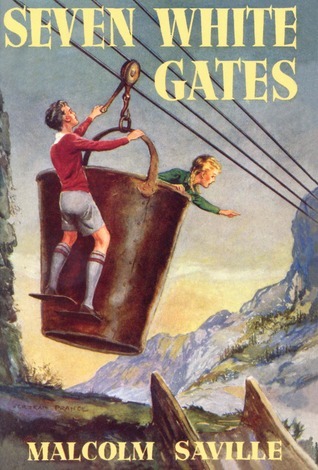
Seven White Gates by Malcolm Saville is the second in his Lone Pine series. I first read some of his books when I was a child, but none of this series. But even so this was a nostalgic read for me and I would have really loved it if I’d read it years ago. It was first published in 1944. The Lone Pine books are about a group of children who formed a secret society in wartime Shropshire.

I particularly like the setting of Seven White Gates, in Shropshire not far from the border with Wales, an area rich in folklore and legend. It begins at the beginning of the Easter holidays, when Peter (Petronella) Stirling, who is fifteen, discovers that she cannot spend them at home with her father at Hatchholt, as he has to go away. Instead she is to stay with her unknown aunt and uncle, near Barton Beach, whose farm is under the Stiperstones mountain crested by the Devil’s Chair. The Stiperstones range lies within the Shropshire Hills Area of Outstanding Natural Beauty and is now on my wishlist of places to visit and the Devil’s Chair is really there:

The Devil’s Chair – Photo from Wikimedia Commons

She invites the other members of the Lone Pine club, David Morton, aged sixteen and his younger brother and sister, the annoying twins, Dickie and Mary, who are nine to stay at the farm with her. She meets a family of gypsies and makes a new friend, Jenny at Barton Beach, who all tell her the terrifying legends about the Stiperstones and the Devil’s Chair. Reuben warns her:

Remember, Petronella, our friend, never to be seen near the Stiperstones on the longest night of the year, for then all the ghosts in Shropshire and all the counties beyond meet on the summit – right on and around the Chair they meet – to choose their king … And any who venture out on that night and see the ghosts of all the years dead from hereabouts are stricken with fear and often do not live the year … (page 31)

What follows is an exciting adventure story. Peter’s Uncle Micah is a strange character, a forbidding. gloomy, unhappy man missing his son Charles who had left home some years earlier. It’s fast paced and full of danger for Peter and her friends as they explore the Stiperstones and its secrets.

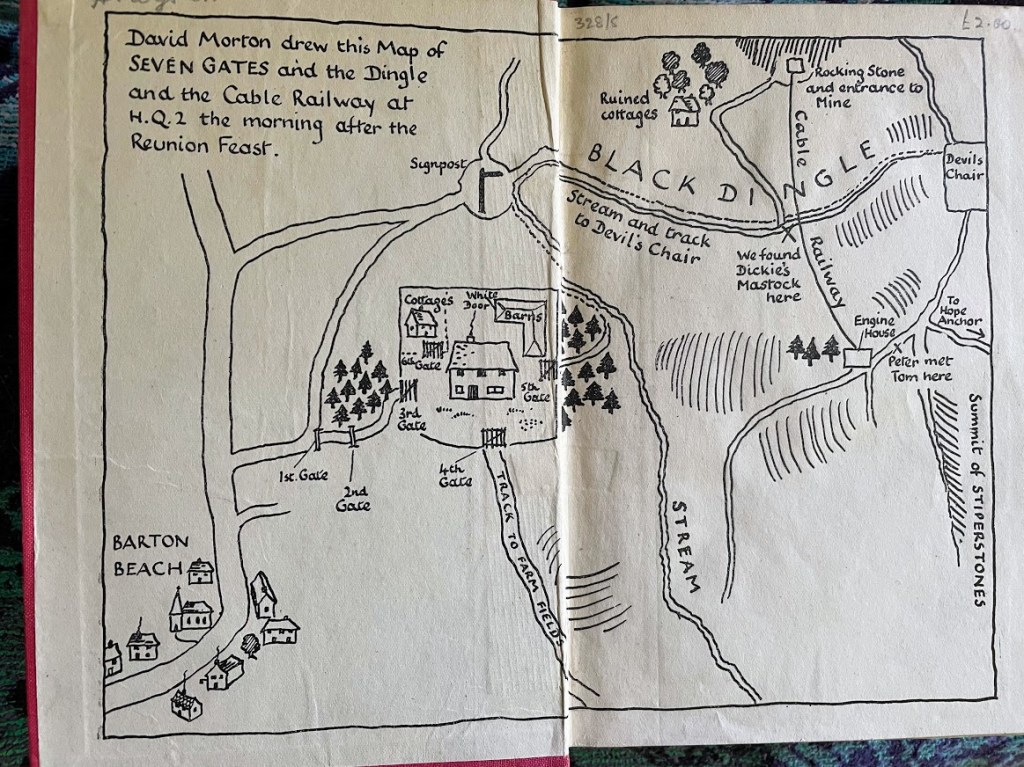
The book is illustrated with full page black and white drawings and a plan of Seven Gates, which I found very useful in following the action!
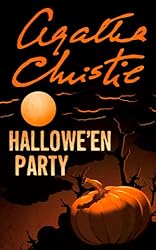
Hallowe'en Party by Agatha Christie

Hallowe’en Party begins with the party given by Mrs Drake for teenagers. One of the guests, Joyce Reynolds, a boastful thirteen-year old, who likes to draw attention to herself, announces that once she’d witnessed a murder. It seems nobody believed her and yet later on she is found dead, drowned in the tub used for the bobbing for apples game – someone had believed her and had killed her. Mrs Ariadne Oliver was at the party and she asks Poirot to help in finding the murderer.

This is one of Agatha Christie’s later books, first published in 1969, when she was approaching 80, and although I did like it for the most part, it is certainly not one of her best. It’s not terribly coherent and it lacks focus in parts as several characters, not sharply defined, are introduced along with a lot of detail and repetition. The plot, as usual in Agatha Christie’s murder mysteries is convoluted with lots of red herrings and loose ends. I thought the revelation of one of the character’s parenthood at the end was just too contrived to be believable. There are meandering and critical conversations about the ‘young people today’ and the state of the mental health service, with overcrowded mental homes, which so many of the characters thought must be the cause of the murder.

… so doctors say “Let him of her lead a normal life. Go back and live with his relatives, etc. And then the nasty bit of goods, or the poor afflicted fellow, whichever way you like to look at it, gets the urge again and another young woman goes out walking and is found in a gravel pit, or is silly enough to take lifts in a car. (page 37)

So it is down to Poirot to discover the real motive, but not before there is another murder. He investigates the possibility that Joyce was telling the truth and asks retired Superintendent Spence, living in the area with his sister, for details of any local deaths and disappearances over the past few years.

Even though I found this book less satisfying than many of Christie’s other books there are things in it that I liked. The relationship between Ariadne Oliver and Poirot for one – Poirot has to have a sip of brandy to fortify himself for the ‘ordeal’ of talking to her:

‘It’s a pity,’ he murmured to himself, ‘that she is so scatty. And yet she has originality of mind. It could be that I am going to enjoy what she is coming to tell me. It could be -‘ he reflected a minute ‘- that it may take a great deal of the evening and that it will all be excessively foolish. Eh bien, one must take one’s risks in life.’ (page 20)

And for another there is the description of a beautiful garden in a sunken quarry,  a well designed garden with the appearance of being perfectly natural. There are several pages lyrically describing this garden, which seemed to me to reflect Agatha Christie’s own interest in gardens, particularly the gardens at her house in Devon, Greenway. Seeing this garden sends Poirot into an almost mystical state of mind as he absorbed the atmosphere:

It had qualities  of magic, of enchantment, certainly of beauty, bashful beauty, yet wild. Here, if you were staging a scene in the theatre, you would have your nymphs, your fauns, you would have Greek beauty, you would have fear too. Yes, he thought, in this sunk garden there is fear. (page 93)

Overall, there are some vivid descriptions in this book – the Hallowe’en party and some of the descriptions of the teenagers ’60s style clothing for example as well as the beauty of the sunken garden, which for me compensated for its flaws. But if you haven’t read any of Agatha Christie’s books I wouldn’t recommend that you start with this one.

Portrait in Sepia by Isabel Allende

I picked up Portrait in Sepia up in a bookshop four years ago. As I knew nothing about it or the author it joined the other to-be-read books until just recently.

The opening pages of this historical novel grabbed my attention, about Aurora del Valle’s birth in 1880 in San Francisco in the Chinese quarter and referring to family secrets:

I have come to know the details of my birth rather late in life, but it would have been worse not to discover them at all, they could have been lost forever in the cracks and crannies of oblivion. There are so many secrets in my family that I may never have time to unveil them all: truth is short-lived, watered down by torrents of rain. (page 3)

Portrait in Sepia is part of a trilogy, with The House of the Spirits and Daughter of Fortune, and maybe it would have helped if I’d read the other two books, but I thought there was plenty of background history to the characters and I had no problem in following the story and distinguishing the characters.

Summary from the back cover:

After her mother dies in childbirth, Aurora del Valle is raised by her grandmother in San Francisco, but despite growing up in this rich and privileged environment, Aurora is unhappy. Haunted by terrible nightmares and the inexplicable absence of many of her childhood memories, and finding herself alone at the end of a love affair, she decides to travel to Chile to discover what it was, exactly, all those years ago, that had such a devastating effect on her young life. 

Aurora is the narrator and this the story of her family and after giving details of her birth, Aurora goes back to 1862 beginning her story with details about her grandparents. This is not a book you read quickly as there is a lot of detail, a lot of 19th century history of Chile, its mix of nationalities, politics and wars – at first I felt I was drowning in detail, but once I settled into the rhythm of the writing I began to appreciate Allende’s style. It takes you right into the characters, seeing them through Aurora’s eyes – her Chinese grandfather, Tao Chi’en, her uncle Severo and her two grandmothers, Paulina and Eliza, who both play a large role in her life. And there are many other colourful characters and momentous events in this book.

It’s a book about love, loss, identity, betrayal and about family relationships. It’s a portrayal of the strengths and weaknesses of the characters and their struggle to survive. Aurora tells her family’s story through looking at photographs, snapshots in time, through her own disjointed, incomplete and vague memories of her childhood and through conversations with her family members. Whilst she was still very young her two grandmothers decided her future, thinking that time would erase the memory of the traumatic events she had seen, never realising that the scenes would live forever in her nightmares.

Portrait in Sepia explores the nature of memory, how each moment of our lives is so transitory and how the past becomes confused as we try to recapture the moments we’ve lived through. Through photographs we can keep memories alive. As Aurora discovered:

Every instant disappears in a breath and immediately becomes the past; reality is ephemeral and changing, pure longing. With these photographs and pages I keep memories alive; they are my grasp on a truth that is fleeting , but truth none the less; they prove that these events happened and that these people passed through my destiny. Thanks to them I can revive my mother who died at my birth, my stalwart grandmothers, and my wise Chinese grandfather, my poor father, and other links in the long chain of my family, all of mixed and ardent blood. (pages 303-4)

Reading a book like this inevitably leads me on to yet more books, because now I want to read the other two books in the trilogy.

Service of All the Dead by Colin Dexter

Colin Dexter 001

A question on the TV show Pointless about the novels of Colin Dexter reminded me I have a few of his books to read, Service of All the Dead being one of them – and it was one of the pointless answers too! So that gave me the push to read it.  My copy is a secondhand book – an Omnibus containing  The Silent World of Nicholas Quinn as well as Service of All the Dead.

It really is one of the most puzzling crime fiction books I’ve read – if not the most puzzling! CI Morse sums it up himself:

There are some extremely odd points in this case, Lewis – or rather there were – each of them in itself suggestive but also puzzling. They puzzled all of us, and perhaps still do to some extent, because by the time we’d finished we’d got no less than five bodies on our hands and we were never in a position to learn what any of the five could have told us. (page 295)

Morse was on holiday, bored and at a loose end, when, stepping off a bus near St Frideswide’s Church in Oxford, he saw a notice advertising a jumble sale at the church – it seemed to him pre-ordained that he should enter the church. This set in motion his fascination with the death of the churchwarden, killed in the church the previous year and his subsequent discovery of the deaths of four more people. His interest is enhanced by the attraction he feels for Ruth Rawlinson, who cleans the church.

Aided by Sergeant Lewis, he digs into the history of the churchwarden, the vicar and members of the church and uncovers an intricate web of lies and deceit. Morse acts on instinct and consequently both Lewis and myself were in the dark for a great part of this book. He proposes several motives for the murders and alternate scenarios of what had happened before untangling the complex mess. There are plenty of red herrings and twists and turns.

Even though I was lost in the plot I found the book compelling reading – it’s a superbly constructed puzzle. This is certainly not a police procedural in the normal sense – there is little account of forensic evidence for example. It is strong on character and on place. The scene of the murders is St Frideswide’s, a fictional church, possibly based a couple of Oxford churches, St Michael-by-the-North-Gate with a Saxon tower and St Mary Magdalen and it is there in the tower that Morse suffers from his great fear of heights.

Service of All the Dead was first published in 1979. I suppose I must have seen the TV version of this book, as I watched all the episodes and this one was shown in 1987 – I don’t remember it! Inevitably as I read it I could see John Thaw as Morse and Kevin Whately as Lewis.

What's In A Name 2015

The eighth annual What’s In A Name Challenge is being hosted again next year by Charlie at The Worm HoleWhat's in a name 2015

The challenge runs from January to December. During this time you choose a book to read from each of the following categories (Charlie has included examples of books you could choose in brackets):

  • A word including €˜ing’ in it (The Time Of Singing, Dancing To The Flute, Lex Trent Fighting With Fire) These examples are verbs but you can of course use other words.
  • A colour (The Red Queen, White Truffles In Winter, On Gold Mountain)
  • A familial relation (Daughter Of Smoke And Bone, Dombey And Son, My Cousin Rachel) By all means include in-laws, step, and halves.
  • A body of water (The River Of No Return, Black Lake, Beside The Sea)
  • A city (Barcelona Shadows, Shanghai Girls, Under The Tripoli Sky)
  • An animal (Black Swan Rising, The Leopard Unleashed, The Horse And His Boy)

The books may be in any form (audio, print, e-book). It is preferred that the books don’t overlap other challenges, but it’s not against the rules. Books cannot, however, overlap categories and it’s not necessary to make a list of books before hand.

I’ve checked my books and found plenty of choice for the category of books with the word ‘ing‘ in the title and a some for the other categories, but I’m not listing them here (too many) and will wait and see what I do eventually read.

For full details and the sign up post go to The Worm Hole.

Victorian Bingo Challenge 2015

Victorian Bingo

I read about The Victorian Bingo Challenge hosted by Becky at Becky’s Book Reviews on Cath’s blog, Read Warbler and thought it looked interesting.

The goal is to get a Bingo (horizontal, vertical, diagonal, four corners and centre square). This will require a minimum of five books.

One book per square. For example: Oliver Twist can count for “Book with a name as the title” or “Charles Dickens” or “Book published 1837-1940” or “Book published in serial format” or “Book over 400 pages” or “Book that has been adapted into a movie” or “Book set in England.” But obviously, it can only count once.

This is the bingo card:

Bingo cardMore details:

1. Fiction or nonfiction.

2. Books, e-books, audio books all are fine.

3. Books and movies can be reviewed together or separately.

4. You can create a reading list if you want, but it’s not a requirement. 

5. If you do make a list, consider adding a list of five books you’d recommend to others

6. If possible try to try a new-to-you author! I know it can be really tempting to stick with familiar favorites.

7. Children’s books published during these years should not be forgotten!

8. Rereads are definitely allowed if you have favourites!

I’ve not done a bingo style challenge before – selecting books to fit into the categories looks a bit daunting, but I’m going to have a go. I’m not sure I’ll complete this challenge but the only way for me I think is to read what I want to read and see if the books qualify for any of the squares. I’ll be choosing books by Charles Dickens, Elizabeth Gaskell, Anthony Trollope, George Eliot, Thomas Hardy, R L Stevenson and Wilkie Collins – books on my Kindle and on my shelves.

These are a few of my paper copies:

Victorian bksI’ll see where I can fit them into the bingo card!