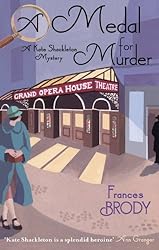
A Medal for Murder by Frances Brody

Last year I read and enjoyed Dying in the Wool, the first of Frances Brody’s series of historical crime fiction books set in 1920s Yorkshire and featuring Kate Shackleton. The second book, A Medal for Murder is even better and I was thoroughly immersed in the mystery.

A pawn shop robbery brings Kate and her assistant Jim Sykes, an ex-policeman,  their second case. It leads on to her discovery of a dead body, that of Lawrence Milner, outside a Harrogate theatre where Kate had been watching a production of a dramatisation of Arnold Bennett’s novel, Anna of the Five Towns. Then Captain Wolfendale, a Boer War veteran asks Kate to find his granddaughter, Lucy, who had starred in the play, as she has disappeared and he had received a ransom note. The murder  brings Kate into contact again with Inspector Marcus Charles of Scotland Yard (she had first met him in Dying in the Wool).

The book is told from the different characters’ perspective, but mainly from Kate’s, with flashbacks to the Boer War at the turn of the century. This is a detailed, complex plot which kept me guessing almost to the end about the identity of the murderer.  What is Captain Wolfendale hiding in his attic that he doesn’t want Kate to see? Just what is his relationship with Lawrence Milner who had also fought in the Boer War? How/is the pawn shop robbery connected to the murder? Will Lucy be rescued? And why doesn’t Dan Root, a watch maker, who also rents a room in the Captain’s house want to Kate to see inside his workroom?

There is so much going on in this book, and yet it was easy to read and each sub-plot fitted in so well with the main mystery that I didn’t get confused – I just couldn’t see who could have killed Milner. I had several suspects, all of whom turned out to be innocent of the crime. I liked the historical setting and the characters rang true. I’m left wondering whether Kate’s relationship with Inspector Charles will develop further, and whether she will ever hear what happened to her husband, reported missing in the 1914-18 War.

These are the books in the Kate Shackleton Mystery series:

1. Dying in the Wool (2009)
2. A Medal For Murder (2010)
3. Murder in the Afternoon (2011)
4. A Woman Unknown (2012)
5. Murder on a Summer’s Day (2013)
6. Death of an Avid Reader (2014)
7. A Death in the Dales (2015) to be published 1 October 2015

For more information about the author and her books see Frances Brody’s blog and website.

Reading Challenges: Mount TBR Reading Challenge, 10 Books of Summer, Historical Fiction Reading Challenge.
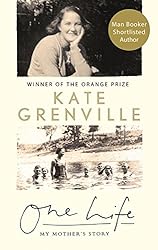
One Life: My Mother’s Story by Kate Grenville

One Life: My Mother’s Story

Australian author, Kate Grenville has written a beautiful biography of her mother Nance Russell. A book that casts light not only on Nance’s life but also on life in Australia for most of the 20th century. Nance was born in 1912 and died in 2002, so she lived through two World Wars, an economic depression and a period of great social change. Nance wasn’t famous, the daughter of a rural working-class couple who became pub-keepers, but she was a remarkable woman.

Kate’s mother had wanted to write her own story and had left fragments of stories about her ancestors, stories her mother had told her, about her childhood, but most about her adult life up to her mid-forties. (Kate Grenville has used some of the stories of her ancestors in her own novels – such as The Secret River, a wonderful historical novel).

So this biography reads like a novel, but is based on Nance Russell’s memories, making it much more than a factual account of a person’s life. It’s is a vivid portrait of a real woman, a woman of great strength and determination, who had had a difficult childhood, who persevered, went to University, became a pharmacist, opened her own pharmacy, brought up her children, and helped build the family home. She faced sex discrimination and had to sell her pharmacy in order to look after her children at home.

Nance had wanted to be a teacher, but when she said this to her mother she ‘exploded. Over her dead body Nance was going to be a teacher!‘  But her parents thought that pharmacy was ‘good for a girl‘. It was 40  years later, after her own children were grown up, that Nance took an arts degree, then a teaching diploma and a diploma in teaching English as a foreign language. ‘She taught French in schools, taught English to newly arrived migrant children, and ran her own business teaching English to the wives of Japanese business men.

My bare account of Nance’s life doesn’t do justice to this book, in which Kate Grenville brings to life both the good times and the bad times, writing about her mother’s heartache, worries, joys and sorrows, of the hard times during the economic depression, all of it as a whole making a rich and fulfilled life. Very near to the end of the book Kate Grenville writes:

One of her last trips [to Europe] was to Florence, where she stood in front of the frescoes that Dante had seen. A line came into her mind from somewhere in all her reading: Suffering pierces the shield of habit. It was a thought that made sense of the unhappiness she’d known, and also the happiness. She knew that ultimately it didn’t matter what happened to you. In the light of eternity, in the light of all those dead writers in whose work she’d recognised the great truths, only one thing mattered. What other people did was up to them. Your job was to live – as richly and honestly as you could – your one life. (page 246)

Reading Challenges: Non Fiction Reading Challenge 2015 and What’s in a Name? 2015 in the category of a book with a familial relation in the title.

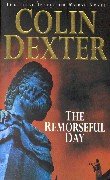
The Remorseful Day by Colin Dexter

Chief Inspector Morse is one of my favourite fictional detectives (maybe even the favourite). I first ‘met’ him years ago in the ITV series Inspector Morse and so, just as Joan Hickson is forever in my mind as Miss Marple and David Suchet is Poirot, John Thaw is Morse. The series was first broadcast in 1987, but I don’t intend to write about the books versus the TV adaptations – I’ve enjoyed both. This post is just about the last book in the series – The Remorseful Day.

I’ve delayed reading this for so long (I watched the TV version when it was first broadcast, which was 15 years ago!) because it’s the last of the Morse books and sadly the end of Morse too. So if you’ve not read any of the Morse books I suggest that you don’t start with this one.

Needless to say that I loved it. The plot is detailed, complex and as usual with Morse a puzzle type murder mystery with plenty of challenging clues. Sergeant Lewis is left to investigate the murder of nurse Yvonne Harrison that had remained unsolved for a year – Morse initially refused to work on the case, despite Chief Superintendent Strange’s wishes. Sergeant Lewis is concerned as this looks just the sort of puzzle Morse excels in solving … and Morse’s behaviour has been worrying Lewis recently.  Lewis can’t believe that Morse could have a personal reason to keep out of the investigation. And when Morse phones to say he is feeling unwell Lewis is most concerned – Morse seldom mentioned his health, what is wrong with him?

The plot is complex, but the real focus of the book is on Morse and how he copes with his illness and his drinking habits and it becomes obvious just how alone he is in the world and how devastating his situation is to Lewis. The novel also reveals more about Strange’s character and also about his understanding of Morse. I found it both a most satisfying book and a very sad one.

There are only 13 Morse books. The links are to my posts on the books – I read some before I began to write this blog and I’m hoping to re-read those in due course.

  1. Last Bus to Woodstock (1975)
  2. Last Seen Wearing (1976)
  3. The Silent World of Nicholas Quinn (1977)
  4. Service of All the Dead (1979)
  5. The Dead of Jericho (1981)
  6. The Riddle of the Third Mile (1983)
  7. The Secret of Annexe 3 (1986)
  8. The Wench is Dead (1989)
  9. The Jewel That Was Ours (1991)
  10. The Way Through the Woods (1992)
  11. The Daughters of Cain (1994)
  12. Death is Now My Neighbour (1996)
  13. The Remorseful Day (1999)

As The Remorseful Day has sat unread on my shelves for so long it obviously qualifies for the Mount TBR Challenge 2015. I also included it as one of My 10 Books of Summer, which brings my total to 5.

Austen in August

Roof Beam Reader is hosting, for the 4th year, the annual Austen in August event. This is a one-month event focused on all things Jane Austen, including her primary texts, any re-imaginings of her works, biographies, critical texts, etc.

The Goal: To read as many of Jane Austen’s works (finished or unfinished) as you want or are able to, during the month of August.  Biographies, audiobooks, spin-offs, and re-reads also count.

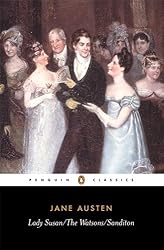
I haven’t taken part before but as I have just one book by Jane Austen left to read I thought it would give me a gentle push in the direction of Lady Susan, The Watsons and Sanditon.
These are three short works in one volume – Lady Susan is a finished novel and the other two are unfinished fragments.

I may also make a start on reading Jane Austen’s Letters, edited by Deidre Le Faye, but I don’t think I’ll finish the book in August!

Zen There Was Murder by H. R. F. Keating

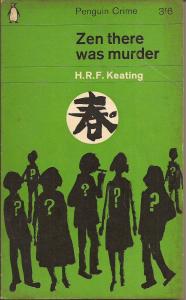
I don’t think I’ve read anything like Zen There Was Murder, a mixture of Zen Buddhism and murder. It was the second book H R F Keating wrote, first published in 1960 and then published in 1963 by Penguin Books in their green Penguin Crime series. (This cover is much more appropriate than the Bloomsbury Reader e-book cover showing guns)

It was the Zen Buddhist setting that made it difficult for me to get to grips with the murder. In fact it is practically halfway into the book before the murder actually takes place. The first half is taken up with introducing the characters, gathered together for a course on Zen Buddhism.  There is a schoolteacher, Alasdair Stuart, a clergyman, the Rev. Cyprian Applecheek, Miss Olive Rohan, Miss Flaveen Mills, Honor Brentt, a jounalist and her husband, Gerry Manvers, and Jim Henderson, an Irishman from Ulster.

None of them know anything about Zen and much time is spent with them trying to understand what it is. Mr Utamaro, the lecturer comes out with various sentences, such as ‘Books about Zen are legs on a snake‘, saying you cannot understand Zen by reading a book about it and applying the principles of logic to what you read, and tweaking Alasdair’s nose saying, ‘this is Zen‘, as well as using koans, such as ‘what is the sound of one hand clapping?‘ But they fail to understand, saying it is nonsense. Mr Utamaro agrees.

Mr Utamaro shows them a sword, locked in a glass showcase. The sword, a wakizashi, is one of pair used by samurai for hari-kiri, and on the evening of the first day Mr Utamaro discovers that the sword has been taken from the case, leaving it intact and without setting off the alarm. And then Flaveen is found dead, the sword driven into her body up to the hilt.

The clue to discovering the identity of the murderer is in solving who is telling lies  and why.  For most of the time I was completely bamboozled and kept wondering just how the two German girls employed to make the beds and do the cooking fitted into the mystery. Their conversations regularly interrupt the narrative as they comment on the characters and the events taking place.

All in all this book has a surreal feel about it. It’s not just a puzzle type of murder mystery but as Keating explained in an interview with Dale Salwek in Mystery Voices: Interviews with British Crime Writers it is also making a point about something you believed:

And the thing I believed in, one of the things that bugged me most, was the subject of telling lies, which is fine for a detective story. And that was how I came to write my second, Zen There Was Murder, which is really more about telling lies than about Zen.

When writing the second book, I thought I could say something about telling lies. At that time, too, Zen Buddhism was a fad over here, and so for the background of the book, I took Zen, which does reflect very much on lies. I found I could say things about lies by giving each of the characters a different viewpoint on telling lies – ranging from one of those people who absolutely objects to lying in any way to the sort of pathological liar. And I made the whole book turn on that. (pages 64-65)

H R F Keating (1926 – 2011) was chairman of the Crime Writers’ Association (CWA) (1970’“71), chairman of the Society of Authors (1983’“84) and president of the Detection Club (1985’“2000). He was a fellow of the Royal Society of Literature.  His most famous novels are the Inspector Ghote books (I have just one on my TBR shelves – Inspector Ghote’s Good Crusade, the second in the series).  For more information about Keating see this article by Martin Edwards.

I’ve had this book for about three years, so it qualifies for the Mount TBR Reading Challenge 2015 and it is also one of the books I listed for the 10 Books of Summer Challenge, and the TBR Pile Challenge.

The Secret Keeper by Kate Morton

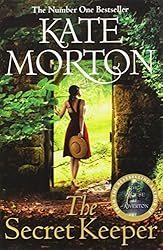
This is a book that really captured my imagination. I loved everything about it – the descriptive passages, the mystery, the secrets and the people involved. It was all real to me. It’s one of the best books, if not the best book, I’ve read this year.

The Secret Keeper by Kate Morton has been sitting unread for two years on my bookshelves, but if I’d read it earlier I wouldn’t have had the pleasure of reading it now – it was well worth the wait!

It begins on a summer’s day in 1961 in Suffolk when sixteen-year old Laurel is shocked when she sees her mother stabbing a stranger who had come to their farm. Fast forward 50 years Laurel and her three sisters and brother are coming to terms with the fact that their mother, Dorothy is moving closer to the end of her life. Laurel realises that there is so much she doesn’t know about Dorothy’s life and when they find a photograph of Dorothy and a friend, Vivien, in a book of the play Peter Pan, it arouses old and ugly memories for Laurel – images of her mother’s frightened face as she confronted the stranger. Who was Vivien and who was the stranger? Why was Dorothy so scared? Laurel is determined to find out.

It’s a story moving between time periods from 2011, back to the 1960s and also to the 1940s when Dorothy first met and fell in love with Jimmy, a war photographer, and also became friends with the wealthy and beautiful Vivien, married to a successful novelist.  Laurel, with the help of her brother, Gerry, tracks down records throwing light on Dorothy’s and Vivian’s past, back to war-time England and pre-war Australia.

It’s not a straight forward story. By that I don’t mean it’s difficult to read, because each time period is clearly headed and the characters are clearly defined. But there are so many twists and turns – I thought several times I’d got things clear and knew where the story was heading only a bit later on to realise that not all the clues had been revealed and I had to revise my thoughts. It’s so cleverly written and so well plotted that it was only near the end that I had an inkling of Dorothy’s relationship with Vivien and what had really happened to them all. It really is a book I didn’t want to put down and also a book I wanted to enjoy as long as possible. By the end, though, I couldn’t turn the pages fast enough!

Kate Morton’s next book, The Lake House is due to be published in October 2015. I’m looking forward to reading it.

Note: as well as being my 17th book for the Mount TBR Challenge 2015 this is my 3rd book for the TBR Pile Challenge 2015. And the 9th book for the Historical Fiction Reading Challenge 2015.