A Walk in the Woods by Bill Bryson

I thoroughly enjoyed Bill Bryson’s A Walk in the Woods, but with
Christmas and New Year just a few days away this is just a brief post to record a few of my thoughts before they fade from my mind.

This is the Blurb:

In the company of his friend Stephen Katz (last seen in the bestselling Neither Here nor There), Bill Bryson set off to hike the Appalachian Trail, the longest continuous footpath in the world. Ahead lay almost 2,200 miles of remote mountain wilderness filled with bears, moose, bobcats, rattlesnakes, poisonous plants, disease-bearing tics, the occasional chuckling murderer and – perhaps most alarming of all – people whose favourite pastime is discussing the relative merits of the external-frame backpack.

Facing savage weather, merciless insects, unreliable maps and a fickle companion whose profoundest wish was to go to a motel and watch The X-Files, Bryson gamely struggled through the wilderness to achieve a lifetime’s ambition – not to die outdoors.

And here’s what I thought:

I was fascinated by it all from the details of the Appalachian Trail itself stretching from Georgia to Maine, to Bryson’s observations about the people he met, the difficulties of walking with a huge backpack, and his relationship with Katz, who struggled to keep up with him. I know what that feels like, hiking with people fitter than you and seeing them march off in front of you, waiting for you to catch up and then setting off again – I felt sorry for Katz.

I can’t say that it made me want to go out and walk for days along a long distance trail, but I did enjoy reading about his experiences and his descriptions of the trail and of the places he visited off the trail. Some of the route sounds very dangerous, such as this for example as Bryson and Katz walked through a snow storm:

… we came to a narrow ledge of path along a wall of rock called Big Butt Mountain.

Even in ideal circumstances the path around Big Butt would have required delicacy and care. It was like a window ledge of path on a skyscraper, no more than fourteen or sixteen inches wide, and crumbling in places, a sharp drop on one side of perhaps 80 feet and long, looming stretches of vertical granite on the other. Once or twice I nudged foot-sized rocks over the side and watched with faint horror as they crashed and tumbled to improbably remote resting places. (pages 100-101)

What? He watched with ‘faint horror’? It terrifies me just to think of being on a path like that! He goes on to say that all the way along this ledge they were half blinded by snow and jostled with wind. It wasn’t a blizzard, it was a tempest and at one point Katz lost his footing and ended up hugging a tree, his ‘feet skating, his expression bug-eyed and fearful’. Oh, no that is definitely not for me.

I liked all the facts about the flora and fauna, and the history of the Trail and indeed about the history connected to the landscape.  Bryson’s descriptions set the scene so vividly I could easily imagine myself there – too easily in the hard places, but also in the beautiful locations, such as this in the Shenandoah Valley:

… a spacious, sun-dappled dell, tucked into a bowl of small hills, which gave it an enchanted secretive feel. Everything you might ask of a woodland scene was there – musical brook, carpet of lush ferns, elegant well-spaced trees … (page 204)

I wished it had an index and that the map of the Trail was more detailed, oh and some photos would have been good. I shall have to wait until I see the film to really see what the Trail is like.

I set out to write just a brief post! But there is so much more that I could have written that really it is just a brief post.
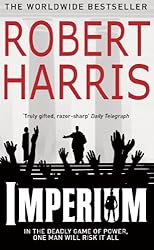
Imperium by Robert Harris

With not many days left until Christmas and the New Year I’ve just about got time to write a bit about two books I’ve read this month from my to-be-read books. I’ll be writing about the second book in a later post.

The first one is Imperium by Robert Harris, the first in his Cicero Trilogy.

I love historical fiction and over the years I’ve read quite a lot of it, including novels set in Ancient Rome, so I’m familiar with the characters in this book, but not about all the details that Robert Harris has packed into Imperium.

Beginning in 79 BC, this book set in the Republican era is a fictional biography of Marcus Tullius Cicero by Tiro, his slave secretary. Tiro was a real person who did write a biography of Cicero, which has since been lost in the collapse of the Roman Empire. Tiro is credited with the invention of shorthand. Harris has based Imperium on, among other sources, Cicero’s letters, which Tiro had recorded, successfully interweaving Cicero’s own words with his own imagination.  It is basically a political history, a story filled with intrigue, scheming and treachery in the search for political power as Cicero, a senator, works his way to power as one of Rome’s two consuls.

The first part of the book (and I think the best part) covers the trial of Verres, a corrupt governor of Sicily. I found this gripping as it was by no means obvious that Verres would be found guilty. Cicero builds the case against him and the resulting trial is a dramatic showdown.

After that the book dragged just a little bit for me as it moved on to describing a complicated struggle to change Rome’s government from a Republic to having an Emperor as absolute ruler. But it picked up again towards the end and overall I thought this was a very good book and I’m keen to read the second in the trilogy, Lustrum.

In such a short post as this is I cannot go into much detail – and the novel is very detailed. I marked many passages that struck me as interesting and felt much of the struggle for power applies as much today as it did in Ancient Rome. I’ll finish this post with one quotation (there are plenty of others I could have chosen):

You can always spot a fool, for he is the man who will tell you he knows who is going to win an election. But an election is a living thing – you might almost say, the most vigorously alive thing there is – with thousands upon thousands of brains and limbs and eyes and thoughts and desires, and it will wriggle and turn and run off in directions no one ever predicted, sometimes just for the joy of proving the wiseacres wrong. (page 471)

Mount TBR Reading Challenge 2016

It’s that time of year when people are thinking about next year’s reading challenges. I’m aiming to cut back on challenges, so I’ll not be taking part in many. But I’ll definitely be doing this one.

Mount TBR 2016

It’s the Mount TBR Challenge 2016 hosted by Bev at My Reader’s Block. It’s the most simple challenge ‘“ read your own books ‘“ that is, books you’ve owned prior to January 1, 2016. No library books. (See this post for more information.)  I don’t know exactly how many TBRs (under this definition) that I have – it’s a lot. And actually I wouldn’t want to have it any other way. It means I’ve always got a choice of books to read and I enjoy browsing my own shelves.

My target for 2016 is to read as many of my own books as I can, which realistically could be 36 books as I like to read library books and newly acquired books (new or used) as well.

These are the challenge levels:

Pike’s Peak: Read 12 books from your TBR pile/s
Mount Blanc: Read 24 books from your TBR pile/s
Mt. Vancouver: Read 36 books from your TBR pile/s
Mt. Ararat: Read 48 books from your TBR piles/s
Mt. Kilimanjaro: Read 60 books from your TBR pile/s
El Toro: Read 75 books from your TBR pile/s
Mt. Everest: Read 100 books from your TBR pile/s
Mount Olympus (Mars): Read 150+ books from your TBR pile/s

What’s In A Name? – 2016

Whats in a name16

I’ve decided that in 2016 I’m not going to take part in many reading challenges. But I’ve been doing the What’s In A Name? challenge for so many years that it’s become a given for me – and the challenge is just to read 6 books over the year!

It’s hosted again in 2016 by Charlie at The Worm Hole and runs from January to December. During this time you choose a book to read from each of the following categories. The titles in brackets are the books I’ve initially chosen, but this could change over the year as I have more than one for each category:

  • A country (Stephen Fry in America)
  • An item of clothing (The Black Robe by Wilkie Collins)
  • An item of furniture (The Woman Who Went to Bed for a Year by Sue Townsend)
  • A profession (The Chimney Sweeper’s Boy by Barbara Vine )
  • A month of the year (The Enchanted April by Elizabeth Von Arnim)
  • A title with the word ‘˜tree’ in it (The Tree of Hands by Ruth Rendell)

See The Worm Hole for more information and the sign-up post.

Mrs Jordan’s Profession by Claire Tomalin

Mrs. Jordan's Profession: The Actress and the Prince

I loved Mrs Jordan’s Profession: The Story of a Great Actress and a King, Claire Tomalin’s biography of Dora Jordan. It is both well researched and well written making it easy to read despite being packed with information, brilliantly bringing the late 18th and early 19th centuries to life as she tells the story of Dora and her relationship with the Duke of Clarence, later King William IV .  It’s based on material in the Royal Archives at Windsor; letters from Dora held at the Huntingdon Library, San Merino, California; various private family papers, letters and memorabilia, as well as numerous secondary sources from national and local libraries.  The resulting biography took her several years to complete.

Much of the information about Dora is taken from her own letters, written over 25 years, to her children and friends and many hundreds of those to the Duke of Clarence, the father of ten of her children (the FitzClarences) have survived. She was a remarkably strong character and an incomparable actress.

William, the Duke of Clarence and Dora Jordan were born into very different families – born in 1765 he was the third son of George III and Queen Charlotte,  and she was born in 1761, the daughter of Francis and Grace who although not legally married lived together as Mr and Mrs Bland.  He was not expected to succeed to the throne and as a boy served in the navy, later he was given a dukedom, an income and an estate. She became an actress, known as ‘Mrs Jordan’, although there was never a Mr Jordan. She made her stage debut in 1777 at the age of 15 and her first Drury Lane appearance in 1785. The two met and she became his mistress in 1790, eventually living together at Bushy House in Middlesex. Their relationship was a happy one until, as the years went by, William was put under pressure to find a suitable wife and, of course, marriage to Dora was out of the question. They separated in 1811 and she was heart broken.

There is so much in this book that fascinated me. The attacks in the press on their relationship were vicious and there were storms of abuse – as an actress and a prince they could not have private lives and the journalists and cartoonists were savage in their portrayal of the couple. The cartoons in particular amazed me. ‘Jordan’ was a common term for a chamber-pot, so her name came in very handily, and became an instantly recognisable visual symbol:

Sometimes it was put over the Duke’s head; sometimes he was shown standing in it, with her prettily draped round the edge, naked and mermaid-like. In other drawings the pot reverted to its domestic function under the bed; the words ‘Public jordan open to all parties’ were written round one of these. The most effective and cruellest was Gillray’s simple picture showing Dora as a giant chamber-pot, cracked and with a vagina-shaped hole into which the figure of William is disappearing, giving a nautical shout of pleasure as he does so. His braided coat is hanging on a peg to one side and her ankles and feet in dainty slippers appear below the pot. The caption reads ‘The Lubber’s Hole, alias the Cracked Jordan’, (page 123)

Dora comes across as a very likeable person, hard working, and devoted to her family. She was a talented and probably  the most popular actress of the time in Britain, based at the Theatre Royal, Drury Lane and also appearing in theatres throughout the country, acting throughout her pregnancies and often taking a baby with her on tour. Claire Tomalin writes

She was the best-loved and most admired comic actress of her time, hailed by fellow actors, critics and public alike as a uniquely gifted performer, fully the equal in comedy to Mrs Siddons in tragedy: for several decades they were generally referred to as the Muses of Comedy and tragedy. (page 3)

After she and the Duke separated the debts incurred by a son-in-law drawn on her account forced her to live abroad until they could be cleared, but she sank into illness and despair and died near Paris in 1816.

William succeeded to the throne in 1830, after the death of his older brother, George IV. One of the first acts of his reign was to commission a sculpture – he wanted a life-size representation of Dora, She had been dead for  fifteen years, so Francis Chantrey, the sculptor worked from portraits, finishing it in 1834. William’s intention was to place the statue in Westminster Abbey, but the Dean of Westminster refused to allow it and it remained in Chantrey’s studio. Eventually, after passing through several hands, the fifth Earl of Munster bequeathed it to the Queen and it is now in Buckingham Palace among the portraits of kings and queens in the Picture Gallery.

Like all good biographies Mrs Jordan’s Profession has an extensive bibliography, additional notes and an index. There are several photographs, family trees of and an appendix of Mrs Jordan’s Roles.

  • Paperback: 422 pages
  • Publisher: Penguin 1995
  • Language: English
  • ISBN-13: 978-0140159233
  • Source: I bought the book

Reading Challenges: Mount TBR Reading Challenge 2015, Non Fiction Reading Challenge 2015, TBR Pile Challenge 2015.

Color Coded Challenge 2015 – Completed

Colour coded

I’ve completed the Color Coded Challenge hosted by Bev at My Readers Block by reading nine books in different colour categories. The colour may either be named in the title or it may appear as the dominant colour for the cover of the book.

Here is what I read with links are to my posts on the books:

1. A book with ‘Blue‘ or any shade of Blue (Turquoise, Aquamarine, Navy, etc) in the title/on the cover. Blue Mercy by Orna Ross (Kindle)

2. A book with ‘Red‘or any shade of Red (Scarlet, Crimson, Burgundy etc) in the title/on the cover. Five Red Herrings by Dorothy L Sayers

3. A book with ‘Yellow‘or any shade of Yellow (Gold, Lemon, Maize, etc.)in the title/on the cover. The Golden Age of Murder by Martin Edwards

4. A book with ‘Green‘or any shade of Green (Emerald, Lime, Jade, etc) in the title/on the cover. Green Darkness by Anya Seton

5. A book with ‘Brown‘or any shade of Brown (Tan, Chocolate, Beige, etc) in the title/on the cover. Appointment with Death by Agatha Christie ‘“ brown cover

6. A book with ‘Black‘or any shade of Black (Jet, Ebony, Charcoal, etc) in the title/on the cover. Gray Mountain by John Grisham

7. A book with ‘White‘or any shade of White (Ivory, Eggshell, Cream, etc) in the title/on the cover. The Man in the Wooden Hat by Jane Gardam ‘“ white cover

8. A book with any other colour in the title/on the cover (Purple, Orange, Silver, Pink, Magneta, etc.). Silver Lies by Ann Parker (Kindle)

9. A book with a word that implies colour (Rainbow, Polka-dot, Plaid, Paisley, Stripe, etc.). House of Shadows by Nicola Cornick