Calendar of Crime Challenge 2020

One of the reading challenges I’ve loved doing this year is Bev’s Calendar of Crime, so I am delighted to see that she is hosting it again in 2020. This may be the only challenge I take part in next year!

This is a reading challenge that allows mystery readers to include any mystery regardless of publication date. If it falls in a mystery category (crime fiction/detective novel/police procedural/suspense/thriller/spy & espionage/hard-boiled/cozy etc.), then it counts and it does not matter if it was published in 1892 or 2019.

The Challenge runs from January 1, 2020 to December 31, 2020. All books should be read during this time period and you can sign up on Bev’s blog at any time.

I have summarised the rules below – for all the details see Bev’s sign up post.

  • All books must be mysteries.
  • Twelve books, one representing each month, are required for a completed challenge. Each month comes with several categories (see chart above) that may be selected to fulfil the month’s reading.
  • The “wild card” book is exactly that.
  • For the category that says “Book title contains a word that starts with the letter A,” the following do not count: “A” and “An.”
  • Books may only count for one month and one category, but they may count for other challenges.
  • Books do not have to be read during the month for which they qualify. So–if you’re feeling like a little “Christmas in July” (or May or…), then feel free to read your book for December whenever the mood strikes.
  • A wrap-up post/comment/email will be requested that should include a list of books read and what category they fulfilled. [Example: January: The House of Sudden Sleep by John Hawk (original pub date January 1930)]

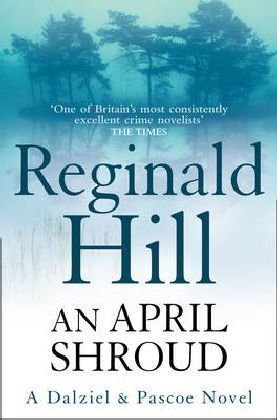
An April Shroud by Reginald Hill

April Shroud

HarperCollins|2011|326 pages|Paperback|my own copy| 3* 

An April Shroud is Reginald Hill’s fourth Dalziel and Pascoe novel, first published in 1975, in which Dalziel is on holiday and Pascoe is on his honeymoon.

From the back cover:

Inspector Pascoe may take holidays but Death never does – and neither, it seems, does Superintendent Dalziel. A watery accident on a solitary country holiday leads to the Fat Man drying off in Lake House, a nearby mansion well past its prime.

The same cannot be said for its owner, the fulsome Mrs Fielding. She has only recently buried her husband, but seems more concerned with her future. Dalziel’s curiosity is aroused – purely professionally of course – and by the time Pascoe’s honeymoon is over, there have been several more deaths and Dalziel might have compromised himself beyond redemption …

Whereas in the previous book, Ruling Passion Dalziel’s character was more of a caricature, on An April Shroud Hill develops his character more fully, in fact I think the book is primarily a superb character study of Dalziel.  He is rude, coarse and insensitive, but his capacity for getting to the bottom of a mystery is shown to be immense.

Although on holiday he cannot help but ferret out what really happened to Conrad Fielding, when he meets the Fielding family on their way back home after Conrad’s funeral. He was rescued by them when his journey south was brought to an abrupt end by floods. The police had decided that Conrad’s death had been an accident – he had fallen off a ladder onto the drill he had been using and it had pierced his heart. Mrs Fielding invites Dalziel to stay at their home, Lake House, where it soon becomes apparent to him that the family have plenty of secrets they would rather he didn’t discover.

I couldn’t easily distinguish who was who in the family, except to realise that they were all rather odd. The plot seemed over complicated and in parts I thought I was reading a farce as more bodies turned up dead. I had little idea who was guilty and the identity of the culprits took me by surprise. Dalziel’s ‘interlude’ with the widow, Bonny Fielding, was entertaining as well as revealing about Dalziel’s personal life – he is sensitive and vulnerable beneath his boorish exterior. 

Overall, I enjoyed the book, although for me it was far from Hill’s best Dalziel and Pascoe book and I’m looking forward to reading book 5, A Pinch of Snuff, as I know that the later books are much better. Reginald Hill wrote 24 Dalziel and Pascoe novels. I’ve read some of them and currently I’m reading my way through the rest.

These are the Dalziel and Pascoe books I’ve read so far:

1. A Clubbable Woman (1970) 
2. An Advancement of Learning (1971)
3. Ruling Passion (1973)
4. An April Shroud (1975) 
8. Exit Lines (1984)
11. Bones and Silence (1990) 
14. Pictures of Perfection (1993) – read, no post
17.On Beulah Height (1998) 
20. Death’s Jest Book (2002) 
21. The Death of Dalziel (2007)

Reading Challenges: Mount TBR 2019 (a book I’ve owned for four years) and the Calendar of Crime 2019 challenge (for the month of April – a book with the month in the title).

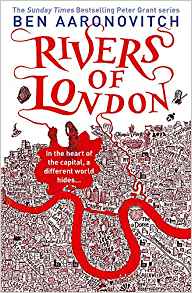
Rivers of London by Ben Aaronovitch

Rivers of London

Gollanz|January 2011|396 pages|e-book |5*

Blurb:

My name is Peter Grant and until January I was just probationary constable in that mighty army for justice known to all right-thinking people as the Metropolitan Police Service (and as the Filth to everybody else). My only concerns in life were how to avoid a transfer to the Case Progression Unit – we do paperwork so real coppers don’t have to – and finding a way to climb into the panties of the outrageously perky WPC Leslie May. Then one night, in pursuance of a murder inquiry, I tried to take a witness statement from someone who was dead but disturbingly voluble, and that brought me to the attention of Inspector Nightingale, the last wizard in England.

Now I’m a Detective Constable and a trainee wizard, the first apprentice in fifty years, and my world has become somewhat more complicated: nests of vampires in Purley, negotiating a truce between the warring god and goddess of the Thames, and digging up graves in Covent Garden … and there’s something festering at the heart of the city I love, a malicious vengeful spirit that takes ordinary Londoners and twists them into grotesque mannequins to act out its drama of violence and despair.

The spirit of riot and rebellion has awakened in the city, and it’s falling to me to bring order out of chaos – or die trying.

My thoughts:

I wish I had read Rivers of London when was first published in 2011, or in 2016 when I bought it because, when I finally began reading it I found I just didn’t want to put it down. 

I really didn’t expect to enjoy it so much, but I was completely engrossed in this book right from the beginning. It is a magical reading experience, and a fast-paced police procedural of a very different kind. It’s fantastical in the literal meaning of the word; an urban fantasy set in the real world of London. It’s a mix of reality and the supernatural, as Peter explains ‘Police work is all about systems and procedures and planning – even when you’re hunting a supernatural entity.

When a headless corpse is found in front of the West Portico of St Paul’s at Convent Garden, Peter interviews a witness, Nicholas Wallpenny, who tells him he has been dead for at least a hundred and twenty years – he is a ghost. From that point on nothing is straight forward as Peter is assigned to work with Detective Chief Inspector Thomas Nightingale (who is the last wizard in England) as part of a special and secret branch of the Met, dealing with all things magical and supernatural. And there are more murders

But interwoven with the murders is the feud between the Rivers of London, or rather between Mother Thames, whose territory is downstream and Father Thames who owns upstream. They both believe they rule the Thames and its tributaries. The dividing line is at Teddington Lock, two miles downstream from Eel Pie Island. Nicholas wants Peter to speak to Mother Thames to find out what the problem is and to find an amicable solution. And so he meets Beverley Brook and the other river goddesses.

Ben Aaronovitch knows London like he back of his hand and it shows in this book. It’s complex, the characters are great, the London setting is wonderfully detailed, and the writing is humorous and very entertaining. I loved it! It’s the first book in the Rivers of London series. The 8th book, False Value, will be published next year. So I have lots more Peter Grant novels to read, beginning with the next one, Moon Over Soho.

About the author:

Born and raised in London, Ben worked as a scriptwriter for Doctor Who and Casualty before the inspiration for his own series of books struck him whilst working as a bookseller in Waterstones Covent Garden. His unique novels are the culmination of his experience of writing about the emergency services and the supernatural.

See more about him and his work on his website.

The Vanished Bride by Bella Ellis

Vanished Bride

Hodder & Stoughton|12 September 2019|352 pages|e-book|Review copy|5*

From the Sunday Times-bestselling author of The Memory Book, Rowan Coleman, comes a special new series featuring the Brontë sisters, written under the name Bella Ellis

Yorkshire, 1845

A young woman has gone missing from her home, Chester Grange, leaving no trace, save a large pool of blood in her bedroom and a slew of dark rumours about her marriage. A few miles away across the moors, the daughters of a humble parson, Charlotte, Emily, and Anne Brontë are horrified, yet intrigued.

Desperate to find out more, the sisters visit Chester Grange, where they notice several unsettling details about the crime scene: not least the absence of an investigation. Together, the young women realise that their resourcefulness, energy and boundless imaginations could help solve the mystery – and that if they don’t attempt to find out what happened to Elizabeth Chester, no one else will.

The path to the truth is not an easy one, especially in a society which believes a woman’s place to be in the home, not wandering the countryside looking for clues. But nothing will stop the sisters from discovering what happened to the vanished bride, even as they find their own lives are in great peril…

My thoughts:

When I first came across this book I wasn’t at all sure I wanted to read it, as I’m never very keen on books about famous authors solving crimes. However, the Brontë sisters books have been amongst my favourites for years and I was curious find out what this book was all about. So, I was delighted to find that I thoroughly enjoyed The Vanished Brideand that it is not all a flight of fancy, although of course the story of how they became ‘detectors’, or amateur sleuths, is pure imagination.

‘Bella Ellis’ is the Brontë inspired pen name for the author Rowan Coleman, who has been a Brontë devotee for most of her life. I haven’t read any of her other books but I’ll be looking out for them now. The Vanished Bride is historical fiction that brings the period (1845) and the setting vividly to life, Charlotte, Emily and Anne and their brother, Branwell becoming real people before my eyes in their home in the Parsonage at Howarth.

I think it helps that is not all pure fiction – in the Author’s Note she explains that it is based on biological facts or inspired by them. The book begins with a short passage in 1851 when Charlotte is alone in the Parsonage her sisters, brother and father had all died and she looks back to the year 1845 when they were all together. That is fact – and in the following September they began to consider writing for their living.

The mystery whilst it is well plotted is not to difficult to solve and I had predicted the basics of it quite early on in the book, although  I didn’t guess the full detail until much later on. But the real joy of the book is in the historical detail and the depiction of the characters and the insights given to their personalities through their conversation. The story is told through each of the sisters eyes, each one clearly distinctive, whilst Emily is the standout character. All three are clearly individuals, women caught in a society dominated by men and each wanting to lead independent lives. 

The book ends as a letter arrives for the sisters presenting a new case for them to investigate. Their curiosity is immediately ‘taking flight’ – and so is mine!

My thanks to Hodder & Stoughton for an e-book review copy via NetGalley

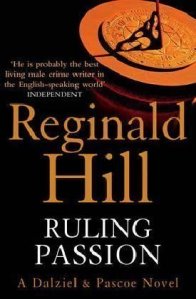
Ruling Passion by Reginald Hill

Ruling passion

HarperCollins|1993|388 pages|Paperback\ my own copy| 3.5* (rounded up to 4*)

Ruling Passion is Reginald Hill’s third Dalziel and Pascoe novel, first published in 1973, in which Pascoe finds his social life and work uncomfortably brought together by a terrible triple murder. Meanwhile, Dalziel is pressuring him about a string of unsolved burglaries, and as events unfold the two cases keep getting jumbled in his mind.

Peter Pascoe is the main character with Dalziel, his boss playing a minor role. Moving on from the second book where Pascoe had renewed his relationship with Ellie Soper, they are now a couple and friends from their university days, Colin and Rose Hopkins have invited them to stay for a weekend in the country at their cottage in the village of Thornton Lacey. They hadn’t seen them for more than five years and the other guests were also old friends, Timothy Mansfield and Charles Rushworth. (References here to Jane Austen’s Mansfield Park)

However, Peter and Ellie didn’t arrive until the Saturday morning when they found a terrible scene – Timothy and Charles lying on the dining room floor in a pool of blood, dead from wounds caused by a shotgun fired at close range, and Rose was in the back garden lying dead at the base of a sundial in the centre of the lawn, her face pressed into the grass. Colin was nowhere to be seen – and the police, headed by Superintendent Backhouse, immediately assume he is the murderer. Peter for once is faced with being a witness rather than a detective and he doesn’t find it easy. He and Ellie are both convinced that Colin didn’t commit the murders – it’s a matter of finding him and proving Backhouse wrong.

As in the previous book, An Advancement of Learning, the plot is by no means straight forward and I found it rather confusing for a while, trying to remember who was who and where they fitted into the mystery. It’s not helped by the fact that the action moves between Thornton Lacey, Yorkshire and Scotland. It wasn’t only Peter who muddled the murder mystery with his unsolved burglaries – I did too. But it all became much clearer towards the end of the book as the connections between the storylines were made.

It’s the main characters though that interested me most and the development of their characters – Peter and Ellie in particular. Their relationship has moved on and during the course of the book they realise how deep their feelings for each other are – leading them into considering getting married. Peter recognises that he can be a very solitary man:

Solitariness was not far from loneliness and this he feared. He believed he could recognize similar characteristics in Ellie, but how good a basis for marriage this common area would be he could not speculate. Equally far from contemplation, however, was a life without Ellie. Which is as good a definition of love as I’m likely to get in a police station, he told himself. Motives for marriage are at least as varied and unexpected as motives for murder. That sounded like the kind of cold comfort Dalziel would doubtless offer! (page 325)

Whereas Peter and Ellie have now become more developed characters Dalziel still remains more of a caricature, rude, coarse and insensitive. But as Ellie gets to know him more so he becomes more human – and more likeable, with more understanding than she had previously thought. By the end of the book Peter, having passed his exams, is promoted to Inspector.

Reginald Hill wrote 24 Dalziel and Pascoe novels. I’ve now read the first and the last and some in between. Currently I’m reading my way through the rest of them – so book 4 is next on my list – An April Shroud.

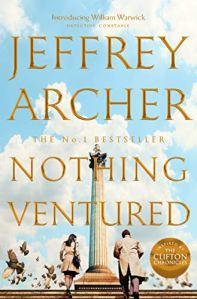
Nothing Ventured by Jeffrey Archer

‘This is not a detective story, this is a story about a detective’

Nothing ventured

Macmillan|5 September 2019|337 pages|e-book|Review copy|3*

Years ago I enjoyed reading a few of Jeffrey Archer’s books, including Not a Penny More, Not a Penny Less and Kane and Able. Archer is a prolific author, but I haven’t read any of his later books or his diaries about his time in prison. But I was interested when I saw that he had started a new series about William Warwick – Nothing Ventured. It is the first in the series of books following William’s progress from detective constable to the commissioner of the Metropolitan Police.

It is indeed, a story about a detective, rather than a detective story and as such it is rather episodic, following William Warwick’s career.

William joins the Metropolitan Police force, against his father’s wishes. Sir Julian Warwick QC, had hoped his son would join him in chambers and train to be a barrister, like his sister Grace. He works on the beat in Lambeth before transferring to the Art and Antiques Squad at Scotland Yard, where he becomes involved in a number of cases of fraud and theft, including tracing the whereabouts of a phial of the moon dust brought back from the Apollo 11 mission by Neil Armstrong, and arresting an old man who had forges the signatures of famous authors in first editions. Whilst investigating the theft of a Rembrandt painting, the Syndics of the Cloth Makers Guild, from the Fitzmolean Museum in Kensington, he meets Beth Rainsford, a research assistant at the gallery and they fall in love almost at first sight – but Beth has a secret that she keeps from him. 

The premise is promising, but it’s written in a very straight-forward and factual style and my overall impression, despite the crime elements, is that this is a rather mundane and bland novel. William does this, does that, goes here, goes there, often at a break-neck pace that gives impetus. But the characters are drawn very sketchily with little depth – William is an intelligent young man, precocious and naive, eager to please and to learn, his father, Sir Julian, a suave, elegant and successful QC and Grace, his sister, an up and coming young barrister, and so on.

I suppose it is the base for the rest of the series but I found it too predictable. However, I thought the court scenes and the final little twist at the end enjoyable and I’m wondering if I want to go one to read the next book in the series which focuses on William’s time as a young detective sergeant in the elite drugs unit. I’m not sure that I do want to – there are so many more enticing books to read.

My thanks to Macmillan for an e-book review copy via NetGalley