The Lost Letter from Morocco by Adrienne Chinn

The Lost Letter From Morocco

Avon Books UK|7 March 2019|Print length 416 pages|e-book Review copy|2*

Blurb:

Morocco, 1984. High in the Atlas Mountains, Hanane’s love for Irishman Gus is forbidden. Forced to flee her home with the man she loves, Hanane is certain she’s running towards her destiny. But she has made a decision that will haunt her family for years to come.

London, 2009. When Addy discovers a mysterious letter in her late father’s belongings, she journeys to Morocco in search of answers. But instead, she finds secrets – and is quickly pulled into a world that she doesn’t understand.

And when history starts to repeat itself, it seems her journey might just change the person she is forever…

My thoughts:

Reading the blurb I thought The Lost Letter from Morocco by Adrienne Chinn sounded an interesting book set in a country I know very little about. The setting in Morocco is well described, although in places it comes across as more of a travel and cultural guide than a novel and I liked that much more than the rest of the book. So, I’m sad to say that this book did not live up to my expectations and it was a disappointment.

Set in two time frames the narrative moves between Addy’s and Haldane’s stories. In 2009 Addy is recovering from cancer and conscious of how short life can be she has decided to sell her flat, leave Nigel, her cheating boyfriend, and her job in a photography shop to work on a travel book. Her father had recently died and in his belongings she finds an unfinished letter addressed to her from him, together with several photos of Morocco, including a photo of him with an arm around a young woman. On the back of the photo her father had written ‘Zitoune waterfalls, Morocco, August 1984 – with Hanane.‘ Haldane is clearly pregnant. Seeing her father’s photos of Morocco she decides that is the place to go to try to find out what had happened to Haldane and at the same time to work on her travel book.

I was keen to find out what Addy would discover. However, what followed is a rambling and repetitive story about Addy and Omar, a tour guide, and their relationship. It was slowed down with too much detail and I began to lose interest and at several points I almost abandoned the book. Omar is a an annoying character, bossy and possessive with Addy, who for a 40 year old woman is incredibly naive, even given that she is recovering from cancer and from her broken relationship with Nigel. I was much more interested in Gus and Haldane’s story and was frustrated by having to wade through the details of Addy’s and Omar’s relationship as she discovered what had happened in 1984. The twist at the end made me even more disappointed that the story had not focused on Haldane’s story.

My thanks to the publishers, Avon Books UK for my review copy via NetGalley.
First Chapter First Paragraph: The Immortal Life of Henrietta Lacks by Rebecca Skloot

Every Tuesday First Chapter, First Paragraph/Intros is hosted by Vicky of I’d Rather Be at the Beach sharing the first paragraph or two of a book she’s reading or plans to read soon.

This week I’m featuring The Immortal Life of Henrietta Lacks by Rebecca Skloot. This is one of the books that I’m currently reading.

The Immortal Life of Henrietta Lacks


Prologue

The Woman in the Photograph

There’s a photo on my wall of a woman I’ve never met, its left corner torn and patched together with tape. She looks straight into the camera and smiles, hands on hips, dress suit neatly pressed, lips painted deep read. It’s the late 1940s and she hasn’t yet reached the age of thirty. Her light brown skin is smooth, her eyes still young and playful, oblivious to the tumor that would leave her five children motherless and change the future of medicine. Beneath the photo, a caption says her name is “Henrietta Lacks, Helen Lane or Helen Larson.”

Blurb (Amazon)

Her name was Henrietta Lacks, but scientists know her as HeLa. Born a poor black tobacco farmer, her cancer cells – taken without her knowledge – became a multimillion-dollar industry and one of the most important tools in medicine. Yet Henrietta’s family did not learn of her ‘immortality’ until more than twenty years after her death, with devastating consequences . . .

Rebecca Skloot’s fascinating account is the story of the life, and afterlife, of one woman who changed the medical world forever. Balancing the beauty and drama of scientific discovery with dark questions about who owns the stuff our bodies are made of, The Immortal Life of Henrietta Lacks is an extraordinary journey in search of the soul and story of a real woman, whose cells live on today in all four corners of the world.

~~~

So far, I’ve read 34% and I am thoroughly enjoying this book. It tells Henrietta’s life story, explains the details of her cancer, and the medical details of how her cells were grown, how they have stayed alive and multiplied. It also considers the ethical issues around ownership of her cells, racism and the distress, anger and confusion this caused her family.

I know ‘amazing’ is such an over used word – but this book really is amazing!

If you’ve read it I’d love to know what you thought of it. If you haven’t, does it tempt you too?

The Family Secret by Tracy Buchanan

The Family Secret

Avon Books UK|10 January 2019|Print length 400 pages|e-book Review copy|3*

The Family Secret by Tracy Buchanan is the first of her books that I’ve read. Although I liked it, I didn’t love it, but maybe that’s because it is romantic fiction, a genre that I don’t read very often.

It’s an emotional family drama set in two timelines. The narrative switches between the two periods – one in 2009 written in the third person present tense and the other in 1989 – 1996 in the first person past tense, so the timelines are easily distinguishable. The two storylines eventually merge. However, it begins with a prologue in which an unnamed woman drowns in a frozen lake, watched by an unnamed man. As I read on I was wondering who they were and what had led up to that scene and how it fitted into the main part of the book.

There are plenty of secrets and several twists in the story. In 2009, Amber Caulfield comes across a young girl, stumbling along the beach at Winterton Chine on the south coast of England, not wearing a coat or shoes and unable to remember who she is, or how she got there. Amber who has her own problems decides to help her remember who she is and to reunite her with her family.

The second storyline, beginning in 1989 is full of secrets too. Gwyneth is a wildlife documentary filmmaker who gets lost as she’s driving in the Scottish Highlands. She comes across a lodge overlooking a loch. It’s Christmas Eve, freezing cold and snowing, so she decides to ask for help, but seeing a ptarmigan gets out her camera to film the bird and steps onto the frozen loch, the ice cracks and she falls into the water. Fortunately she is rescued by Dylan McClusky and taken in by his family. She is made welcome but it soon becomes apparent that this is a dysfunctional family with a number of problems and secrets. Gwyneth too has a troubled background and a big secret that she keeps well hidden.

 It’s a novel about love, loss and guilt, but it’s a bit too predictable for my liking, with rather too many coincidences that weren’t very convincing. But it’s an easy and enjoyable book to read and it kept my interest to the endI liked the vivid descriptions of the landscape and wildlife both in the Scottish Highlands and in Iceland in the depths of winter, bringing the settings to life.

My thanks to the publishers, Avon Books UK for my review copy via NetGalley.

Six Degrees of Separation: from How To Be Both to The Prime of Miss Jean Brodie

I love doing Six Degrees of Separation, a monthly link-up hosted by Kate at Books Are My Favourite and Best. Each month a book is chosen as a starting point and linked to six other books to form a chain. A book doesn’t need to be connected to all the other books on the list, only to the one next to it in the chain.

This month (April 6, 2019), the chain begins with Ali Smith’s award-winning novel, How to be Both.

How to be both

How to be Both is a novel all about art’s versatility. Borrowing from painting’s fresco technique to make an original literary double-take, it’s a fast-moving genre-bending conversation between forms, times, truths and fictions. There’s a Renaissance artist of the 1460s. There’s the child of a child of the 1960s. Two tales of love and injustice twist into a singular yarn where time gets timeless, structural gets playful, knowing gets mysterious, fictional gets real—and all life’s givens get given a second chance.’ (Goodreads)

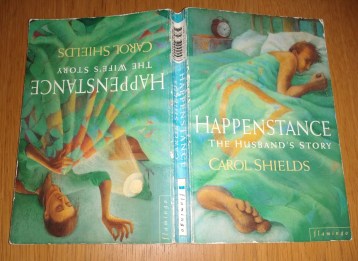
I haven’t read this book but I’d like to sometime. I see that there are two versions: one begins with the contemporary story, the other with the 15th-century story. This reminded me of Carol Shields’ book Happenstance, two stories about the same five-day period – one from Jack Bowman’s point of view, and the other from his wife, Brenda’s. They’re printed in the same book in an unusual format of containing two books in one, either can be read first – then turn the book upside down and read the other story.

Happenstance

My next link is a bit of a jump – from the character Brenda in Happenstance I immediately thought of Brenda Blethyn, who plays Vera in Ann Cleeves’s books. One of these books is Silent Voices in which D I Vera Stanhope finds a dead body in the sauna room of her local gym. The victim, a woman had worked in social services – and was involved in a shocking case involving a young child.

Social Services also feature in Fair of Face by Christina James. Ten year old Grace is being fostered when her foster mother and her baby are found dead in their beds. Social Services are asked to work with the police, in order to question Grace and her friend Chloe, a child from a troubled family.

Another author with the name James, is P D James, also a crime writer. An Unsuitable Job for a Woman is a Cordelia Gray detective story in which she takes on an assignment from Sir Ronald Callander, a famous scientist, to investigate the death of his son, Mark who had been found hanged in suspicious circumstances. Mark had left Cambridge University without completing his degree and had taken a job as a gardener.

My next link is to Agatha Christie’s Cat Among the Pigeons, set mainly in an exclusive and expensive girls’ school, Meadowbank, in England. Some new staff members have been appointed, including Adam Goodman, a handsome young gardener.

My final link is to another school, the Marcia Blaine School for Girls in Muriel Spark’s novel, The Prime of Miss Jean Brodie. Marcia Blaine is a traditional school where Miss Brodie’s ideas and methods of teaching are viewed with dislike and distrust. The Head Teacher is looking for ways to discredit and get rid of her. The girls in her ‘set’ fall under her spell, but one of them betrays her, ruining her teaching career.

Different formats, the name ‘Brenda’, Social Services, authors’ surname ‘James’, gardeners,  and girls’ schools all link How To Be Both to The Prime of Miss Jean Brodie.

Except for The Prime of Miss Jean Brodie the books in my chain are all crime fiction and apart from How To Be Both I’ve read all the books in the chain – clicking on the titles takes you to my posts, where they exist.

Next month (May 4, 2019), the chain will begin with Jane Harper’s debut best-seller, The Dry.

My Friday Post: A Foreign Field by Ben Macintyre

Book Beginnings Button

Every Friday Book Beginnings on Friday is hosted by Gillion at Rose City Reader where you can share the first sentence (or so) of the book you are reading, along with your initial thoughts about the sentence, impressions of the book, or anything else the opener inspires.

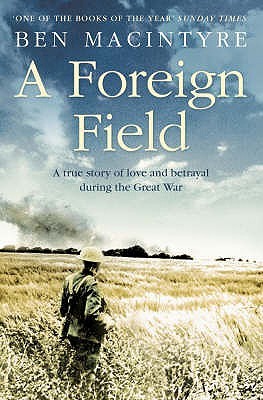
This week I’m featuring one of my TBRs, A Foreign Field by Ben Macintyre. It’s non-fiction about four young British soldiers who were trapped behind enemy lines at the height of the fighting on the Western Front in August 1914. 

A Foreign Field

It begins with a Prologue:

Prologue

The glutinous mud of Picardy caked at my shoe-soles like mortar, and damp seeped into my socks as the rain spilled from an ashen sky. Ina patch of cow-trodden pasture beside the little town of Le Catelet we stared out from beneath a canopy of umbrellas at a pitted chalk rampart, the ivy-strangled remnant of a vast medieval castle, to which a small plaque had been nailed: ‘Ici ont été fusillés quatre soldats Britannique.’ Four British soldiers were executed by firing squad on this spot.

Followed by Chapter One – The Angels of Mons:

On a balmy evening at the end of August in the year 1914, four young soldiers of the British army – two English and two Irish  – crouched in terror under a hedgerow near the Somme river in northern France, painfully adjusting to the realisation that they were profoundly lost, adrift in a briefly tranquil no-man’s land somewhere between their retreating comrades and the rapidly advancing German army, the largest concentration of armed men the world had ever seen.

Also every Friday there is The Friday 56, hosted by Freda at Freda’s Voice.

30879-friday2b56These are the rules:

  1. Grab a book, any book.
  2. Turn to page 56, or 56% on your eReader. If you have to improvise, that is okay.
  3. Find any sentence (or a few, just don’t spoil it) that grabs you.
  4. Post it.
  5. Add the URL to your post in the link on Freda’s most recent Friday 56 post.

Page 56:

Local gossips thought that Jeanne was a’racy’ type; she smoked cigarettes, drove an automobile without gloves on, and treated everybody with exactly the same direct, penetrating and faintly lofty manner, usually from the saddle.

~~~

I enjoyed reading Ben Macintyre’s Operation Mincemeat about the Allies’ deception plan code-named Operation Mincemeat in 1943, which underpinned the invasion of Sicily, so I’m hoping I’ll like this one too.

What do you think? Would you keep reading?

Wakenhyrst by Michelle Paver

A tale of mystery and imagination laced with terror. 

Wakenhyrst

Head of Zeus|4 April 2019|e-book 5683 KB|Review copy|4*

Wakenhyrst by Michelle Paver is a dark and sinister tale, full of menace and suspense. It’s a slow-burner, told through different points of view, that builds to a climax with a sad twist in the story right at the end – one I hadn’t seen coming. It’s set in a remote hamlet in the Suffolk Fens, an eerie waterlogged landscape where Edmund Stearn, a historian, and his family live in a large manor house, Wake’s End, on the edge of the Fens, said to be the oldest and most rotten of fens. It was a place of dread, haunted by spirits and the home of eels and other foul creatures.

The novel begins with a magazine report in 1966 on the events that took place at Wake’s End in 1913 when sixteen-year old Maud Stearne watched her father, Edmund, leave the house, armed with an ice-pick and a geological hammer and murder the first person he came across in the orchard. Maud was the only witness. She is now a recluse and in 1913 she had only spoken briefly at his trial. But now she needs money to repair the ancient manor house that is her home and has invited the journalist to Wake’s End. He believes Edmund was innocent and hopes to discover the truth – was Edmund mad and what did he write in his notebook that Maud has never confirmed even existed? Maud’s evidence was full of holes – did she commit the murder and frame her father, who took the blame?

 Edmund never explained why he did it, or how he ended up in the well, screaming with terror as he fought off a mass of eels. He spent the rest of his life in an asylum, where he created three paintings that astonished the world – grotesque paintings full of colour and tiny malevolent faces leering out of the canvas, the stuff of nightmares. 

What follows is a story of disintegrating madness, revealed in Edmund Stearne’s notebook as the reporter persuades Maud to tell her story, going back to her childhood, when her mother was still alive. Her mother got the same illness every year, or so Maud believed – an illness where her middle swelled, resulting in a period of ‘groaning’, as her middle would burst and ending with either ‘a bloody chamberpot’, or a dead baby. When she died Maud blamed her father and believed he was insane when he became obsessed with the medieval painting  of the Last Judgement, known as the Doom, that he found in the churchyard. He connects the Doom with the writings of Alice Pyett, a medieval mystic whose book he was transcribing.

There is a sense of impending disaster as the tale unfolds. Whilst the fens are a source of dread and fear for Edmund, they are a place of solace and beauty for Maud. The book is full of the folklore and customs of the local people and their belief in the spirits that haunt the fen – ferishes, Jack-o’-Lanterns and Black Shuck – Michelle Paver notes in her Author’s Note that she has not invented these. Maud’s childhood, her fear of her father and his violence towards her and her mother, are scenes that are based on the misogynist attitudes of the period.

Maud’s life was run by her father’s rules. She had no friends or companions apart from the servants, whose lives were ruled by superstitions, until she met Jubal Rede, the wild man who lived in the fen. He was kind to her and taught her the ways of the fen. But there is also Chatterpie, the magpie she rescued from the well and grew to love, and then Clem, the young under-gardener who she also grew to love.

It’s a compelling story, steeped in atmosphere, with characters typical of an earlier age whose lives were oppressed and isolated from the wider world. I loved the setting, the mysterious fenland, the horrific gothic and dark nature of the story, the mystery of the murder and most of all I loved Maud and her independent spirit that brought her through the nightmare.

My thanks to the publishers, Head of Zeus for my review copy via NetGalley.