Art Books

I was looking for a book on drawing trees this morning. I knew I had one, but wasn’t sure where it was and had to spend some time searching for it. I should be more organised, but my problem is that each time I look at an art book I never put it back in the same place. So I got them all out (and found the book I wanted today). I hadn’t realised we’d got so many!

These are the ‘How to draw’ books:

and books on watercolour painting:

and just three specifically on pastel:

It’s the art group this afternoon, so I will actually be drawing/painting this afternoon and not, as D said, just reading about it!

First Chapter First Paragraph Tuesday Intros

Diane at Bibliophile By the Sea hosts this weekly meme. The idea is that you post the opening paragraph (sometimes maybe a few ) of a book you decided to read based on the opening paragraph (s).

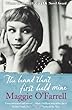
A friend lent me this book, saying she’d really enjoyed it. It’s The Hand That First Held Mine by Maggie O’Farrell and it begins:

Listen. The trees in this story are stirring, trembling, readjusting themselves. A breeze is coming in gusts off the sea, and it is almost as if the trees know, in their restlessness, in their head-tossing impatience, that something is about to happen.

The garden is empty, the patio deserted, save for some pots with geraniums and delphiniums shuddering in the wind. A bench stands on the lawn, two chairs facing politely away from it.  A bicycle is propped against the house but its pedals are stationary, the oiled chain motionless. A baby has been put out to sleep in a pram and it lies inside its stiff cocoon of blankets, eyes obligingly shut tight.  A seagull hangs suspended in the sky above and even that is silent, beak closed, wings outstretched to catch the high thermal draughts.

I can visualise the scene, feel the breeze and find myself holding my breath copying out these paragraphs from the book, waiting with bated breath to find out what is going to happen.

Crime Fiction Alphabet: J is for …

ithe letter Js for … Peter James

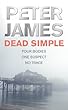
Peter James is an author I’ve been aware of for a while and although I’ve owned a couple of his books until recently I hadn’t read them. Now I’ve read Dead Simple I realise I should have read it years ago – I didn’t know what I was missing. It’s really good.

Peter James is currently the Chair of the Crime Writers’ Association. As well as being a crime fiction writer he is also a film producer and script writer. He has sold more than a million books internationally and has been translated into 35 languages. His most recent books, set in Brighton, feature Detective Superintendent Roy Grace – there are 8 in the series, the first being Dead Simple.There is full list of all his books with summaries on his website.

Dead Simple is anything but simple. There are plenty of twists and turns in this story of a race against time to find Michael Harrison who disappeared after what was supposed to be a harmless stag night prank three days before his wedding. Michael’s fiancée, Ashley and his mother are frantic with worry, but surely Mark, his best man and business partner must have some idea where he is, even though he missed the stag night himself.

Detective Superintendent Roy Grace is in charge of the investigation, which has added impetus for him as his wife disappeared eight years earlier and has never been found. When all the usual sources had failed to find her he had turned to psychics and mediums for help and he eventually resorts to consulting them again in this case.

It’s told from a number of viewpoints which gives a rounded view of the events and yet the full picture is never quite in view. There are hints that led me to suspect the outcome, but not completely. Some of it does seem rather far-fetched but it’s totally gripping, building to a tremendous climax.

I shall certainly be seeking out the other 7 books in his Grace series, and his earlier books too, which according to the author information in Dead Simple, all reflect his ‘deep interest in medicine, science and the paranormal.’

For more blog posts featuring the letter J in The Crime Fiction Alphabet go to Mysteries in Paradise.

Reading on Kindle

There are many advantages to reading on a Kindle – mainly because it’s easy to use:

  • because of instant purchase. I can see a book I’d like to read and have it within seconds. That can also be a disadvantage because it’s so easy to get yet more books, without considering whether I do really want them.
  • because of ease of handling and enlarging the the font size. This is a big plus!
  • because I can pop it in to a bag to take with me anywhere and have a book on hand ready to read. It was perfect for taking to the hospital and reading whilst waiting for radiography, etc.
  • because I can highlight text without spoiling the book and make notes without using a separate notebook. Another great feature.
  • because I can organise the books into different collections, or in any other order – A-Z, recent additions and so on.
No doubt there are other advantages too that haven’t come to my mind right now, because there is one major disadvantage and that is that
  • I can’t see the books in front of me as I can with physical books on actual bookshelves.This means that it’s so easy to forget what I’ve downloaded.
  • It doesn’t help me that I am disorganised. I’ve said that it’s an advantage to be able to categorise the books and put them into collections- but it would help if I actually did that on a consistent basis. I don’t!
  • And I’ve downloaded over 100 samples – I don’t know how many because after I reached 104 samples I stopped recording them. It’s the ease of adding samples that messes it all up – once I’ve downloaded them, I forget all about them!! I might as well not bother.
  • I was reading on it this morning and it kept freezing. That’s another downside –
  • that and having to stop reading to recharge the battery when you’re in an exciting part of a book and just want to know what happens next.
Still, I wouldn’t want to be without it.

Library Loot

It’s been ages since I did a Library Loot post. These reflect the variety of books that I enjoy. For more details about the books click on the links which take you to Amazon UK:

  • D H Lawrence – Daughters of the Vicar. This is a novella written in 1911. I’d never come across this before and thought it looked interesting. It has a foreword by Anita Desai – she writes that ‘here in the little story, Daughters of the Vicar (could any title be more redolent of the England of its time?) we have the essential D H Lawrence – the little contained world in a mossy valley of coal-veined hills from which that D H Lawrence grew’.
  • Kate Atkinson – Started Early, Took My Dog. This is the fourth Jackson Brodie book, described by The Times as ‘A comic novel of great wit and virtuosity.’ I’ve been meaning to get this since it came out a couple of years ago.
  • Edna O’Brien – The Country Girls. This was first published in 1960 and it’s set in a country village in Ireland in the early 1960s – a period piece now. Her books then were both successful and scandalous. In her native Ireland she was considered irreligious.
  • Guilty Consciences: a Crime Writers’ Association Anthology, edited by Martin Edwards (himself a successful crime fiction writer and blogger). I had to borrow this collection of short stories from some of my favourite crime fiction authors.
  • Peter James – Looking Good Dead. Even though I’ve had a couple of Peter James’s books for a few years I’d never read them, until I started Dead Simple (the first Detective Superintendent Grace book) this week. I’m hooked – it’s really good. So when I saw this in the library today I was delighted – it’s the second of his Roy Grace books!
  • M R Hall – The Flight. Another series of crime fiction that I like – this is the fourth in Hall’s Coroner Jenny Cooper series. I’ve read the first and the third – Jenny Cooper is a coroner who acts as a detective. Again, another series that has me captivated.

And finally, two books on a subject that is equally as absorbing as reading and blogging – painting:

Both books include demonstrations and advice on techniques, types of paint and pastels, and composition. I just need to get painting – and reading!

Death at the President’s Lodging by Michael Innes: a Book Review

A Golden Age Mystery
Death at the President's Lodging 001

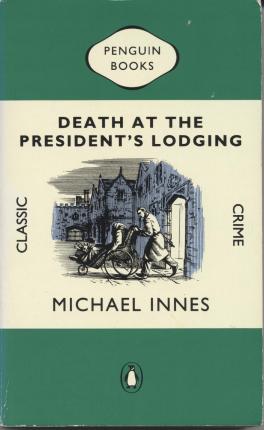
This is the first Inspector Appleby mystery by Michael Innes. What struck me most about Death at the President’s Lodging is that it is essentially a ‘locked room’ mystery. Dr Umpleby, the unpopular president of St Anthony’s College (a fictional college similar to an Oxford college)  is found in his study, shot through the head.


The crime was at once intriguing and bizarre, efficient and theatrical. It was efficient because nobody knew who had committed it. And it was theatrical because of a macabre and necessary act of fantasy with which the criminal, it was quickly rumoured, had accompanied his deed. (page 1)

Inspector Appleby from Scotland Yard is in charge of the investigation, helped by Inspector Dodd from the local police force. They provide an interesting contrast, both in appearance, age and methods. Appleby is an intellectual, contemplative, preferring to study human nature rather than rely on the use of finger prints and material evidence. Dodd is reliant on routine and although untrained and unspecialised is shrewd and thorough. They know each other and make a good pair. This passage sums up their working relationship:

And now Dodd for all his fifteen stone and an uncommon tiredness (he had been working on the case since early morning), sprang up with decent cordiality to welcome his colleague. ‘The detective arrives,’ he said with a deep chuckle when greetings had been exchanged, ‘and the village policeman hands over the body with all the misunderstood clues to date.’ (page 5)

What follows is an extremely convoluted and complex investigation of the strange crime. Without the plan at the beginning of the book I would have been lost. The college is divided into different areas and each area is locked each evening, shutting it off from the outside world and shutting one part of the college off from the rest. Dodd describes it as a ‘submarine within a submarine’. The questions are how did the murderer get in and out, who had keys, and why was Umpleby murdered?

Appleby and Dodd interview the Fellows of the College, each of whom it seems at first could have had reason to murder Umpleby. Who is telling the truth? I couldn’t tell and there are innumerable clues to mystify both the police and the reader. Appleby watches and listens, recognising that he is not going to get a quick result in such a complicated case. Of course, in the end he works it all out. He gathers together the Fellows and calls on a number of them to give their statements of the facts as they know them. They each suspect a different person as the culprit, but Appleby gradually eliminates the suspects to reveal the murderer.

It was masterly. It’s also a book that you can’t read quickly. It requires concentration. There is little action, much description and a lot of analysis. I enjoyed it very much, but after reading it I felt my brain needed a little rest.

I also wrote about Michael Innes in my Crime Fiction Alphabet series of posts – I is for Innes.