Our Mutual Friend by Charles Dickens

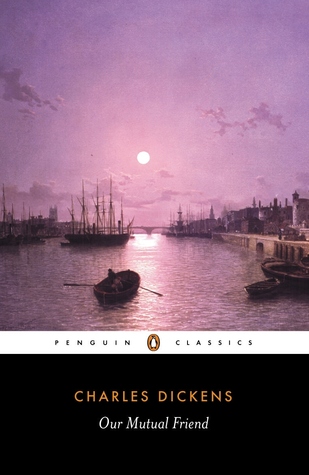
It’s hard to know just what to write about Our Mutual Friend by Charles Dickens. The General Introduction to the book advises that you enjoy the book before reading the Introduction (which I did), so I have tried not to reveal any spoilers in this post.

  • It’s Dickens’s last complete book, first published in 19 monthly instalments from May 1864 to November 1865. It’s meant to be read at a leisurely pace.
  • It’s a long multiplot novel, with a multitude of characters.
  • In it Dickens comments on the ills of contemporary society.
  • It concerns mysteries, lost identities, hidden wills, corruption and violence.
  • It’s varied in style, sometimes comic, other times serious, sometimes sombre and dark and at others ironic and flippant.
  • It’s written in both the past and present tense and from the characters’ differing perspectives.

Brief synopsis (from the back cover of the Wordsworth Classic edition)

The chief of its several plots centres on John Harmon who returns to England as his father’s heir. He is believed drowned under suspicious circumstances – a situation convenient to his wish for anonymity until he can evaluate Bella Wilfer whom he must marry to secure his inheritance. The story is filled with colourful characters and incidents – the faded aristocrats and parvenus gathered at the Veneering’s dinner table, Betty Higden and her terror of the workhouse and the greedy plottings of Silas Wegg.

My view

Although it nows reads like historical fiction, in the mid 1860s Our Mutual Friend was modern up-to-date fiction, beginning with the words:  ‘In these times of ours’, in case there was any doubt in the readers’ minds.

The opening chapter reveals a darkly atmospheric scene on the River Thames, a modern scene for its first readers,with a macabre story of a boatman, Gaffer Hexham and his daughter, Lizzie, searching the Thames for human corpses:

Allied to the bottom of the river rather than the surface, by reason of the slime and ooze with which it was covered, and its sodden state, this boat and the two figures in it obviously were doing something that they often did, and were seeking what they often sought. (pages 3-4)

In direct contrast in the next chapter Dickens moves to the nouveau-riche setting of the Veneerings house:

Mr and Mrs Veneering were bran-new people in a bran-new house in a bran-new quarter of London. Everything about the Veneerings was spick-and-span new. (page 7)

Just like their name the Veneerings are all show, all surface, without any depth. They collect people as well as objects. Their standing in society is dependent on their wealth – just as Gaffer Hexham’s is at the other end of the financial strata. And there is a great emphasis on money, wealth and poverty in Our Mutual Friend.

There are some wonderful characters, such as the Boffins, Silas Wegg and Jenny Wren to name but a few. As John Harmon is presumed to have been drowned in  the Thames (the body found by Gaffer Hexham), it is his father’s faithful servants, Mr and Mrs Boffin who inherit the miserly and incredibly wealthy ‘dust’ contractor’s fortune. This pair are at first unchanged by their good fortune and take in Bella Wilfer, the socially ambitious young woman who would have married Harmon, had he lived. Through these characters Dickens shows the effect that greed in all its forms can have.

I particularly like Dickens’s depiction of Wegg, who is employed by Mr Boffin to read to him what he calls the ‘Decline-And-Fall-Off-The-Rooshan-Empire.’ Wegg is a hard, rascally character, out for anything he can get. His wooden leg reflects his nature:

Wegg was a knotty man, and a close-grained, with a face carved out of very hard material, that had just as much play of expression as a watchman’s rattle. … Sooth to say, he was so wooden a man that he seemed to have taken his wooden leg naturally, and rather suggested to the fanciful observer, that he might be expected — if his development received no untimely check — to be completely set up with a pair of wooden legs in about six months. (page 43)

Wegg is one of the characters that Dickens also uses to inject some humour. He is obsessed with his lost leg and goes to Mr Venus’s shop to see if he can find it for him – Venus is an articulator of skeletons and a taxidermist, who has great skill in piecing things together. He boasts:

Mr Wegg, if you was brought here loose in a bag to be articulated, I’d name your smallest bones blindfold equally with your largest, as fast as I could pick ’em out, and I’d sort them all, and sort your wertebrae, in a manner that would equally surprise and charm you. (page 77)

Wegg is positive that he doesn’t want anyone’s bones:

… I tell you openly I should not like – under such circumstances, to be what I call dispersed, a part of me here, and a part of me there, but should wish to collect myself like a genteel person. (page 77)

It’s not just social injustices, the class system, the importance of money, property, greed and materialism that Dickens highlights, but also family relationships – in particular that of fathers and daughters and the position of women. He also concentrates on instances of violence, through drownings and physical assaults.

There is so much in this novel, more that I can explore in this (long) post. I haven’t even touched on the majority of the major characters.

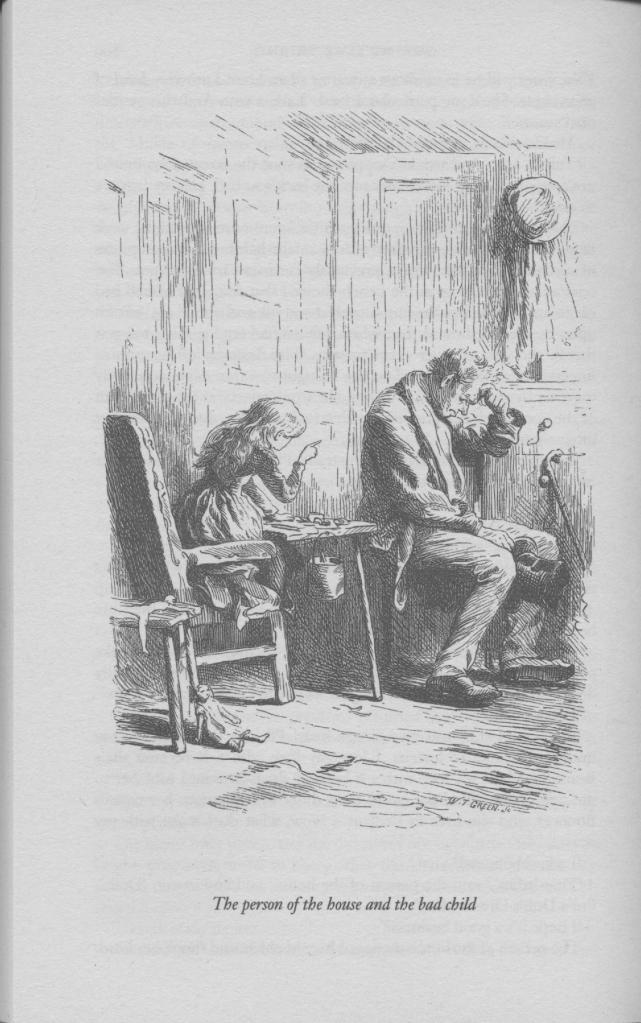
This Wentworth Classics edition includes the original illustrations by Marcus Stone. The one shown below is ‘The person of the house and the bad child‘ – this shows ‘Jenny Wren’, the dolls’ dressmaker, whose back is ‘so bad‘ and whose legs are ‘so queer‘, and her drunken father, who she calls her ‘bad child‘ and treats him as such.
  • Paperback: 832 pages
  • Publisher: Wordsworth Editions Ltd; New Ed edition (1 Jan 1998)
  • Language: English
  • ISBN-10: 1853261947
  • ISBN-13: 978-1853261947
  • Source: my own copy
  • My Rating 3.5/5

The Girl on the Stairs by Louise Welsh: a Book Review

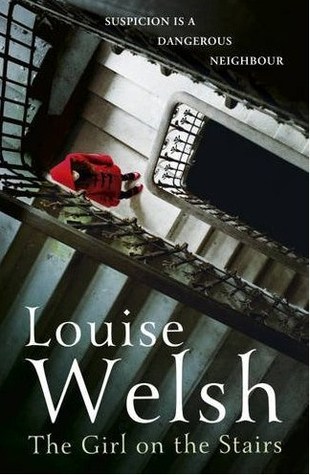
The Girl on the Stairs

The Girl on the Stairs is Louise Welsh’s latest book. It’s a book that once I started reading it I just had to finish it. It’s full of suspense and increasing tension as Jane moves to an apartment in Berlin to join her partner, Petra. Everything is new to her, she only speaks a little German, she doesn’t know the area and has no friends there. And she’s pregnant.

It begins slowly and calmly, with Jane alone in the flat. Whilst Petra is out at work, she explores the neighbourhood, the streets, the church and the forbidding, derelict building (the backhouse) that overlooks their apartment building at the back.

She meets some of the other residents of the apartment building, their neighbour Dr Mann and his daughter Anna – the girl on the stairs. She hears them arguing and fears Dr Mann is abusing Anna. She ventures out at 3.00am one dark morning drawn by a flickering light in the backhouse, worried that Anna was hiding in there:

Jane looked up towards the looming bulk of the backhouse, hearing the sound of her own breath, shallow and uneven. the light was gone from the window. This was her cue to turn back, but she stepped on, into the dimness of the courtyard, tensing against the cold and the sensation of unseen eyes. The backhouse door gaped; beyond it, nothing but blackness. (page 55)

Then there are the Beckers, who live in the ground-floor flat. Heike Becker is suffering from dementia and insists that Dr Mann had killed his wife and buried her beneath the floorboards in the backhouse.

Jane’s suspicions about her neighbours grow, and her sense of isolation mounts when Petra has to go to Vienna for a week for her work. The book is narrated by Jane, which means that there is only Jane’s perspective on events and as more secrets are revealed I began to wonder just how paranoid Jane was and how much was down to her imagination. Jane tries to befriend Anna, who regards her with suspicion and contempt – are Jane’s fears justified or is she delusional? The uncertainties and ambiguities kept me guessing to the end.

The Girl on the Stairs is a dark, psychological thriller, full of atmosphere and claustrophobic tension. I really enjoyed it.

  • Hardcover: 288 pages
  • Publisher: John Murray (2 Aug 2012)
  • Language: English
  • ISBN-10: 1848546483
  • ISBN-13: 978-1848546486
  • Source: Review copy from the publishers
  • My rating: 4.5/5

Started Early, Took My Dog by Kate Atkinson: Book Notes

Started Early, Took My Dog by Kate Atkinson is the fourth book featuring Jackson Brodie and one in which he doesn’t have a major role. It’s a complex book with several plots and sub-plots. The narrative moves between the past and the present day – sometimes not too clearly and is told from various characters’ perspective.

Jackson Brodie is working for Hope McMaster, who was adopted as a very young child in the 1970s and wants to find out about her birth family. Tracy Waterhouse, an ex-police officer is working as a security post in a shopping centre and can’t forget about a particular murder that had happened when she was a young detective. Detective Superintendent Barry Crawford,Tracy’s ex-colleague, with now just two weeks to go before retirement is also haunted by past events. Tilly is an elderly actress, suffering from the early stages of dementia. Add in to this mix a small child, Courtney and a little dog, called The Ambassador.

The book begins slowly and gradually builds to a tremendous pace. Brodie’s past keeps surfacing as he travels around in his search for Hope’s family roots, staying at Travel Lodges at Premier Inns, and in Bed and Breakfasts. He’s tired:

And truth be told he was tired of his vagrant life. He wanted a home. He would like a woman in that home. Not all the time, he had grown too used to his own company. (page 103)

There’s a lot in this novel about grief and loss, parenthood and responsibility and it paints a grim picture. The characters are well-drawn – the ex-copTracy, the child Courtney and the actress Tilly stand out in my mind as memorable characters, not forgetting The Ambassador, a small scruffy dog, who is ‘big inside‘.

It’s very much a book about consequences, full of regrets and lost opportunities as it moves, seemingly without reason from one character to another and from the past to the present. It’s a book you have to read with thought and concentration. I think It would benefit from re-reading, but my copy is a library book, due back today. Maybe I’ll re-read it one day.

  • Paperback: 496 pages
  • Publisher: Black Swan (17 Feb 2011)
  • Language: English
  • ISBN-10: 0552772461
  • ISBN-13: 978-0552772464
  • Source:  library book
  • My Rating: 4/5

Crime Fiction Alphabet: Letter O

Kerrie’s Crime Fiction Alphabet has reached the letter O.

I was surprised quite recently to discover that Baroness Orczy had not only written books about the Scarlet Pimpernel, but had also written crime fiction.

Emmuska Orczy (1865 – 1947) was born in Hungary and she and her family moved to London in 1880, where she went to the West London School of Art and then Heatherley’s School of Fine Art.  Several of her paintings were exhibited at the Royal Academy. She married Montague MacLean Barstow in 1894 and encouraged by him, she began writing in 1900. As well as the Scarlet Pimpernel stories she wrote mysteries for the Royal Magazine and Cassell’s Magazine. She created one of the earliest female detectives in a collection of short stories about Molly Robertson-Kirk – Lady Molly of Scotland Yard in 1910.

The Old Man in the Corner
The Old Man in the Corner, Greening & Co. 1910, Design by H. M. Brock. From Flickr

Her book of short stories, The Old Man in the Corner features one of the earliest armchair detectives. It was first published in 1909, although she had written the stories before that and published them in magazines. The ‘Old Man’ sits in the corner of an A. B. C. (Aerated Bread Company) tearoom and relates the mysteries to Polly Burton of the Evening Observer. She was amused by his appearance:

Polly thought to herself that she had never seen anyone so pale  so thin, with such funny light-coloured hair, brushed very smoothly across the top of a very obviously bald crown. He looked so timid and nervous as he fidgeted incessantly with a piece of string; his long, lean and trembling fingers tying and untying it into knots of wonderful and complicated proportions. (Location 47 of 2760)

Tying knots in a piece of string seems to be essential to his deductive powers, for as he unravels the knots so he solves the mysteries. His philosophy is:

There is no such thing as a mystery in connection with any crime, provided intelligence is brought to bear upon its investigation.  (Location 29)

Very like Hercule Poirot, I thought, but the resemblance ends there. The Old Man’s sympathies are with the criminal rather than the police; he solves the mysteries just for the love of doing it, to discover the motive and method. He doesn’t pass his information onto the police and in most of the cases there is still an element of doubt.

The mysteries included in The Old Man in the Corner are:

The Fenchurch Street Mystery
The Robbery in Phillimore Terrace
The York Mystery
The Mysterious Death on the Underground Railway
The Liverpool Mystery
The Edinburgh Mystery
The Theft at the English Provident Bank
The Dublin Mystery
An Unparalleled Outrage (The Brighton Mystery)
The Regent’s Park Murder
The De Genneville Peerage (The Birmingham Mystery)
The Mysterious Death in Percy Street

They seem to be the most baffling cases that the police had been unable to solve, involving murder, blackmail, forgeries and puzzling crimes. I enjoyed reading them, although they don’t overtax the brain.

  • Format: Kindle Edition
  • File Size: 302 KB
  • Print Length: 186 pages
  • Sold by: Amazon Media EU S.à r.l.
  • Language: English
  • ASIN: B0084BMM6W
  • Source: my own copy
  • My Rating 3/5


August Prompt – A Classics Challenge

This year I am taking part in a Classics Challenge hosted by Katherine of November’s Autumn. The goal is to read at least seven classics in 2012 and every month Katherine is posting a prompt to help us discuss the books we are reading. This month we are asked to share some quotes from our current read.
Rather than a questions August’s prompt is to share a memorable
Quote… or a few of them from what you’re currently reading. Try to select ones that are not so well-known but, of course, if you can’t help yourself share it too!

This month I’ve been reading Our Mutual Friend by Charles Dickens. There are many passages I could quote. Here are just a few:

“Has a dead man any use for money? Is it possible for a dead man to have money? What world does a dead man belong to? ‘Tother world. What world does money belong to? This world. Can a corpse own it, want it, spend it, claim it, miss it,? Don’t try to go confounding the rights and wrong of things in that way. But it’s worthy of the sneaking spirit that robs a live man.” (page 6)

“No one who can read, ever looks at a book, even unopened on a shelf, like one who cannot.” (page 18)

“And this is the eternal law. For, Evil often stops short at itself and dies with the doer of it! but Good, never. (page 95)

“I have made up my mind that I must have money, Pa. I feel that I can’t beg it, borrow it, or steal it; and so I have resolved that I must marry it.” (page 302)

“This reminds me, godmother, to ask you a serious question. You are as wise as wise can be (having been brought up by the fairies), and you can tell me this: Is it better to have had a good thing and lost it, or never to have had it?” (page 410)

“And Oh! there are days in this life, worth life and worth death. And Oh, what a bright old song it is, that Oh, ’tis love, ’tis love, ’tis love, that makes the world go round!” (page 636) (From a popular song usually sung to the French tune ‘C’est l’amour’.)

Book Beginnings: Before the Fact

I went to Barter Books yesterday and came home with several crime fiction books, plus a book on painting with pastels and a book on Northumberland’s coastal castles.

The book I’m writing about today is one of the crime fiction books, that I was quite excited to find, because I’ve never read anything by Francis Iles, the pseudonym of Anthony Berkeley Cox (1893-1970), a journalist and mystery writer from the Golden Age of crime fiction.

The book is his second novel written as Francis Iles, Before the Fact and it is a psychological study of a potential murderer as seen through the eyes of his intended victim. It begins:

Some women give birth to murderers, some go to bed with them, and some marry them. Lina Aygarth had lived with her husband for nearly eight years before she realized that she was married to a murderer.

I’m eager to read on …

For more Book Beginnings on Friday see Gilion’s blog Rose City Reader.