Crime Fiction Alphabet: Q

For the letter Q in Kerrie’s Crime Fiction Alphabet I’ve chosen Death of a Red Heroine by Qiu Xiaolong.
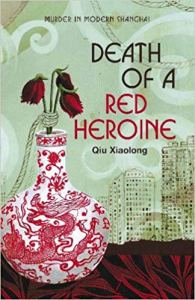
Death of a red heroineQX

I  ‘discovered’ Qiu Xiaolong in 2010 during a previous series of the Crime Fiction Alphabet when I wrote about his second book, A Loyal Character Dancer. Death of Red Heroine is his first book featuring Chief Inspector Chen. It won the Anthony Award for Best First Crime Novel in 2001.

Synopsis from the back cover

Shanghai in 1990. An ancient city in a Communist country: looking to the future for its survival. Chief Inspector Chen, a poet with a sound instinct for self-preservation, knows the city like few others. 

When the body of a prominent Communist Party member is found, Chen is told to keep the party authorities informed about every lead. And he must keep the young woman’s murder out of the papers at all costs. When his investigation leads him to the decadent offspring of high-ranking officials, he finds himself instantly removed from the case and reassigned to another area.

Chen has a choice: bend to the party’s wishes and sacrifice his morals, or continue his investigation and risk dismissal from his job and from the party. Or worse . . .

My thoughts:

I think this is as much historical fiction as it is crime fiction. There is so much in it about China, its culture and its history before 1990 – the Communist regime and then the Cultural Revolution in the 1960s – as well as the changes brought about in the 1990s after the massacre of Tiananmen Square. This does interfere with the progress of the murder investigation as Chen has to cope with the political ramifications and consequently there are several digressions and the pace is slow and lacking tension. As Chen is a poet as well as a policeman there are also references to Chinese literature which although interesting, don’t move the murder mystery forward. A fair amount of concentration is needed both to understand the background and work out the plot.

Chen is a reluctant policeman, he has a degree in  English literature and is a published poet and translator. However, he is a good detective and helped by Detective Yu begins to unravel the mystery. Having found a suspect it is really the motive that provides a stumbling block, that and the constant need to keep in mind the ‘interests of the Party’ that prevents a quick resolution.

I like the characterisation, Chen and Yu in particular are clearly drawn, distinctive characters, and the setting is superb. I also like the many descriptions of food (as there are in A Loyal Character Dancer), such as this dinner menu Chen lays on for a party in his new apartment:

For the main dishes, there were chunks of pork stomach on a bed of green napa, thin slices of smoked carp spread on fragile leaves of jicai, and steamed peeled shrimp with tomato sauce. There was also a plate of eels with scallions and ginger, which he had ordered from a restaurant. He had opened a can of Meiling steamed pork and added some green vegetables to make it another dish. On the side, he placed a small dish of sliced tomatoes, and another of cucumbers. When the guests arrived, a soup would be made from the juice of the canned pork and canned pickle. (page 12)

It’s a fascinating book on several levels and one I enjoyed reading. I’m a bit late catching up with reading Qiu Xiaolong’s books as there are now seven Inspector Chen books:

1. Death of a Red Heroine (2000)
2. A Loyal Character Dancer (2002)
3. When Red Is Black (2004)
4. A Case of Two Cities (2006)
5. Red Mandarin Dress (2007)
6. The Mao Case (2009)
7. Don’t Cry, Tai Lake (2012)
A Card From Angela Carter by Susannah Clapp: Book Notes

I liked the look of A Card from Angela Carter when I saw it in the library. It’s a small book that slots easily into a pocket or handbag and is very short – just 103 pages. I thought it would be a nice change after some of the very long books I’ve been reading recently.

I also liked the concept – a study of Angela Carter using the postcards she had sent to Susannah Clapp, who is the literary executor of Angela Carter as well as being a publisher’s reader, editor and critic. She and Angela had been friends for a number of years.

Now, Angela Carter is one of those writers whose books I’ve been meaning to read and have never got round to them, so I thought this book, which forms a sort of biography would give me at least an elementary picture  of her life and work. And that’s just what it did. Now I really do want to read some of her books – Angela Carter’s Book of Fairy Tales and Nights at the Circus, for example. I really find it hard to realise that it is twenty years ago now since she died at the age of 51 from lung cancer.  The fact that she had never made the shortlists of the Booker Prize led to the foundation of the Orange Prize, but this book, slight as it is, is the only biographical work to have been published.

Susannah Clapp uses the postcards Angela had sent to her ‘form a paper trail through her life.’ Sent from various places around the world some have a full message, some only a few words, which Susannah uses to paint a picture of what Angela was like, a ‘great curser’, capable of the sharpest of remarks, clever, unpredictable, quirky, and funny. She laughed and talked a lot. Using the postcards as a trigger, the book is mainly Susannah’s recollections of Angela, full of stories of her family life, her political views and what the critics made of her work. There’s also a considerable amount, considering the length of the book, about her physical appearance.

As for the postcards, I was disappointed at the black and white reproductions. I was also disappointed that as she was a cat lover, Angela had not sent her any cards featuring felines, although she did send them to her friend and publisher Carmen Callil. Angela herself loved cats and her first book written at the age of six was called ‘Tom Cat Goes to Market’, which her mother eventually threw away!

Susannah Clapp, whilst allowing that Angela’s fiction and prose did not go unacknowledged while she was alive, considers that her work did not receive the acclamation it deserved because:

She was ten years too old and entirely too female to be mentioned routinely alongside Martin Amis,  Julian Barnes and Ian McEwan as being a young pillar of British fiction. She was twenty years too young to belong to what she considered the ‘alternate pantheon’ of Iris Murdoch, Doris Lessing and Muriel Spark in the forties, when ‘in a curious way, women formed the ascendancy.’ (page 3)

This is an entertaining and vivid account in miniature which left me wanting to know more and to read Angela Carter’s books for myself.

Opening Lines: The Distant Hours

I  thought I’d read – The Distant Hours by Kate Morton, at least I thought from the title that I had read it. But when I read some reviews of it on LibraryThing  it didn’t sound at all familiar.  Then I couldn’t find the book on my fiction bookshelves and I thought maybe I’d given it away, thinking I’d read it, when I haven’t – panic! Eventually, I found it in a bookcase full of non-fiction – apart from this and a few other novels that I’d put there whilst tidying up one day.

Looking at it it seems ideal for R.I.P.VII – ‘A dilapidated castle, aristocratic twins, a troubled sister and a series of dark secrets cast a whispery spell in Morton’s third book.’ (Quoted on the back cover from Marie Claire)

It begins:

Hush … Can you hear him?

The trees can. They are the first to know that he is coming.

Listen! The trees of the deep, dark wood, shivering and jittering their leaves like papery hulls of beaten silver; the sly wind, snaking through their tops, whispering that it will soon begin.

The trees know, for they are old and have seen it all before.

I can hardly wait to read it, but I have to because I’m only halfway into Death of a Red Heroine by Qiu Xiaolong and that is really good – I have to finish that first!

Diane at Bibliophile By the Sea hosts this weekly meme. The idea is that you post the opening paragraph (sometimes maybe a few ) of a book you decided to read based on the opening paragraph (s).

August’s Books and Crime Fiction Pick of the Month

Most of my reading time in August was taken with reading Charles Dickens’s Our Mutual Friend, but I did read 7 other books too, all 7 of them crime fiction, although you could consider Our Mutual Friend as a type of crime fiction too. They are (in the order I finished reading them):

  1.  Lord Edgware Dies by Agatha Christie
  2. Started Early, Took my Dog by Kate Atkinson
  3. Postern of Fate by Agatha Christie
  4. Guilty Consciences a collection of short stories edited by Martin Edwards
  5. A Room Full of Bones by Elly Griffiths – post to follow
  6. The Girl on the Stairs by Louise Welsh
  7. Our Mutual Friend by Charles Dickens
  8. The Old Man in the Corner by Baroness Orczy

The links are to my posts on the books.

My Crime Fiction Pick of the Month is The Girl on the Stairs by Louise Welsh. Actually with the exception of Postern of Fate and The Old Man in the Corner it’s a close call between the other books.

The Girl on the Stairs is Louise Welsh’s latest book. It’s a tense psychological thriller about Jane, who is pregnant and living in Berlin, suspicious about her neighbours, as she hears screams from the next apartment, sees shadows on the stairs and feels she is being watched. Are her suspicions justified or is she paranoid? Read more …

Kerrie has a round-up post of bloggers’ book choices for the month, so for more recommendations, go to Mysteries in Paradise.

Crime Fiction Alphabet: Letter P

It’s the letter P this week in Kerrie’s Crime Fiction Alphabet and I have another of Agatha Christie’s books to illustrate the letter.

If you haven’t read any of Agatha Christie’s books don’t begin with Postern of Fate. It’s the last novel she wrote, published in 1973, and it’s rambling and repetitive, with very little in the way of mystery. It’s the fourth of the Tommy and Tuppence Beresford mysteries and it begins with the ageing couple, now retired and living in a new home. I read it because I like Tommy and Tuppence and wanted to know what they were doing in this final book.

I liked the opening pages in which Tuppence is bemoaning the fact that they have so many books and there isn’t enough room to shelve them. They’d sorted out their books before they moved house, only bringing with them the ones they couldn’t bear to part with, but they had bought books from the previous owners of the house. Tuppence is sorting through them and in Robert Louis Stevenson’s The Black Arrow she sees that some of the letters are underlined in red ink, spelling out an intriguing message: ‘Mary Jordan did not die naturally. It was one of us. I think I know which one.’

Naturally the Beresfords have to find out more and after talking to some of the local people Tuppence discovers that Mary Jordan had lived in the house during the First World War and there are rumours that she was a German secret agent. It appeared she had died from accidental poisoning. But they aren’t satisfied and want to know more. Whilst Tuppence continues talking to the locals, Tommy goes to London and talks to Captain Pikeaway, ex-head of Special Branch and the enigmatic Mr Robinson (who appeared in Agatha Christie’s thriller Passenger to Frankfurt). They discover some facts, and have lots of meandering discussions, but the denouement is very vague (at least I found it so).

Its interest for me lies in what the book reveals about Agatha Christie. Clearly she is remembering her own childhood when Tuppence is reminiscing about the books she had read as a child, listing them and exclaiming how much she liked them – books such as The New Treasure Seekers, lots of Stanley Weyman books (he wrote historical romances), The Prisoner of Zenda, Treasure Island and Kidnapped.

Throughout her life she was an avid reader and her books include many references to a variety of sources from Shakespeare to T S Eliot. The title of this book derives from a poem Gates of Damascus by John Elroy Flecker, quoted as an epigraph and by Tommy as he worries about keeping Tuppence out of danger:

Four great gates has the city of Damascus …

Postern of Fate, the Desert Gate, Disaster’s Cavern, Fort of Fear …

Pass not beneath, O Caravan, or pass not singing.

Have you heard

That silence where the birds are dead, yet something pipeth like a bird?

I think when Tommy and Tuppence are complaining about the difficulties of getting tradesmen to complete work on their new house Agatha Christie was writing from experience:

Electricians arriving in a kindly tangle of optimism and efficiency had stated work. “Coming along fine now, not much more to do,” they said. “We’ll be back this afternoon.” But they hadn’t been back that afternoon. Tommy was not precisely surprised. He was used, now, to that general pattern of labour in the building trade, electrical trade, gas employees and others. They came, they showed efficiency, they made optimistic remarks, they went away to fetch something. They didn’t come back. One rang up numbers on the telephone but they always seemed to be the wrong numbers. If they were the right numbers, the right man was not working at this particular branch of the trade, whatever it was. (pages 35-36)

Then there are her misgivings about the state of the country:

England was in a funny state, a different state from what it had been. Or was it really always in the same state? Always underneath the smooth surface there was some black mud. There wasn’t clear water down to the pebbles, down to the shells, lying on the bottom of the sea. There was something moving, something sluggish somewhere, something that had to be found, suppressed. (page 138)

But there is rather too much of this sort of digression in Postern of Fate and Agatha Christie comes across as disillusioned with modern life. Here, for example, she has Colonel Pikeaway complaining about the worship of money:

…big fortunes made out of drugs, drug pushers, drugs being sent all over the world, being marketed, a worship of money. Money not just for buying yourself a big house and two Rolls Royces, but money for making more money and doing down, doing away with the old beliefs. Beliefs in honesty, in fair trading. (page 249)

Although there are things I like in this book and I am glad I’ve read it, I think it must be my least favourite of Agatha Christie’s books that I’ve read.

R.I.P. VII

Each autumn Carl runs an event called ‘R.eaders I.mbibing P.eril, or R.I.P. for short, a participatory event wherein we the people spend however little, or much, time we want over the months of September and October imbibing all things ghastly and ghostly.’

This year Carl has removed the word challenge from the title of this event because, as he says, it ‘is primarily about the great pleasure that can be found in embracing this type of fiction/non-fiction during this season of the year.’ I was unsure whether to join in this year as my enthusiasm for challenges has dropped, but I do enjoy reading the type of books he lists:

Mystery.
Suspense.
Thriller.
Dark Fantasy.
Gothic.
Horror.
Supernatural.
Or anything sufficiently moody that shares a kinship with the above.

So, I’ve decided to to take part. Of the various levels of participation I’m aiming to do Peril the First.

Which is to… ‘Read four books, any length, that you feel fit (the very broad definitions) of R.I.P. literature. It could be King or Conan Doyle, Penny or Poe, Chandler or Collins, Lovecraft or Leroux’¦or anyone in between.’

And my choice of books includes:

  • Dark Matter: a Ghost Story by Michelle Paver
  • Dark Matter: the Private Life of Sir Isaac Newton: a Novel by Philip Kerr
  • The Castle of Otranto by Horace Walpole
  • The Legend of Sleepy Hollow by Washington Irving
  • The Mysterious Island by Jules Verne
  • The Four Last Things by Andrew Taylor
  • The Judgement of Strangers by Andrew Taylor
  • The Death Instinct by Jed Rubenfeld
  • Great Ghost Stories (I’ve read a few of these in an earlier R.I.P. event)
  • City of the Beasts by Isabel Allende
  • The Sixth Lamentation by William Brodrick
  • The Brief History of the Dead by Kevin Brockmeier

They’re all books I own (some on Kindle). But I shan’t restrict myself to these books and I may not read any of them, because I like to read as my fancy takes me. I certainly shan’t read all of them and it could be that I read any other books that come my way in the next two months.