This was originally Cleo’s idea (Cleopatra Loves Books). It’s to look back over your reviews of the past five years and pick out your favourite books for each month from 2011 ‘“ 2015. I like it so much it inspired me to do the same.
I really enjoy looking back over the books I’ve loved reading. These are some of my favourite books for each November from 2011 to 2015 (click on the titles/covers to see my original reviews). November is apparently the month where the crime fiction books I’ve read have been my favourite reads.
Three of the five books are Ian Rankin’s Rebus books – November is the month he’s published his latest books and November is the month I read them. Ian Rankin is one of my favourite authors and his Rebus books never fail to impress me both with their ingenuity and the quality of their plots and characterisations.
2011
White Nights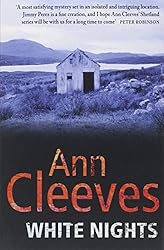 by Ann Cleeves – the second in her Shetland Quartet, featuring Detective Jimmy Perez, set mainly in Biddista, a fictional village of a few houses, a shop, an art gallery and restaurant called the Herring House, and an old Manse. A man’s body is found, hanging in the hut where the boat owners of the village of Biddista keep their lines and pots. Perez recognises the dead man ‘“ he’s the mystery man who had caused a scene the previous evening at the opening of Bella Sinclair’s and Fran Hunter’s art exhibition.
This book is not only full of believable characters, each one an individual in their own right, it also has a nicely complicated plot and a great sense of location. It’s the place, itself, that for me conveyed the most powerful aspects of the book. The ‘˜white nights’ are the summer nights when the sun never really goes down. They call it the ‘˜summer dim’, the dusk lasts all night, and in contrast to the bleak, black winters, fills people with ‘˜a kind of frenzy‘˜.
2012
Standing in Another Man’s Grave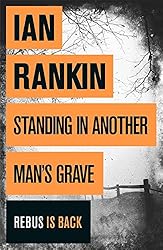 by Ian Rankin. This is the first book after Rebus’s retirement in which he is working for SCRU ‘“ the Serious Crime Review Unit, a Cold Case unit of retired police officers, investigating the disappearance of a young woman missing since 1999, and linking it with later cases of missing women all in the vicinity of the A9. He also clashes with Malcolm Fox of Edinburgh’s internal affairs unit – their dislike is mutual.
I was gripped by this book and liked the way Rankin included characters from earlier books, such as Big Ger Caffety, Siobhan Clarke, now a DI, and in particular Malcolm Fox.
2013
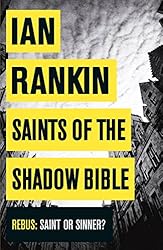 Saints of the Shadow Bible by Ian Rankin. I think this is one of his best ‘“ a realistic and completely baffling mystery. a complex, multi-layered case, linking back to one of Rebus’s early cases on the force as a young Detective Constable. Rebus is now back on the force, the rules on retirement age having changed, but as a Detective Sergeant. Once more he is under scrutiny by Malcolm Fox. There are suspicions that Rebus and his colleagues, who called themselves ‘˜The Saints of the Shadow Bible’ were involved in covering up a crime, allowing a murderer to go free.
The interaction between Rebus and Fox is one of the joys of this book. Beneath his controlled exterior Fox is just as much a loose cannon as Rebus, he’s not a team player either and it is fascinating to see how Rebus gets under his skin and reveals Fox’s true nature.
2014
And now for a different author, but still crime fiction:
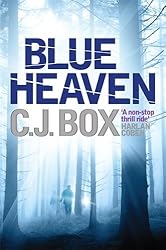 Blue Heaven by C J Box. I loved this book, the first one of C J Box’s books that I’ve read. The action takes place over four days in North Idaho one spring. It’s a story about two children, Annie and William who decide to go fishing without telling their mother, Monica, and witness a murder in the woods. One of the killers sees them and they run for their lives.
I loved the writing style – straightforward storytelling, with good descriptions of locality and characters; characters that are both likeable and downright nasty, but not caricatures. It’s a book that got right inside my mind so that I found myself thinking about when I wasn’t reading it and keen to get back to it. And the ending was what I hoped, and also dreaded it would be.
2015
Back to Rebus – although I also loved Claire Tomalin’s Mrs Jordan’s Profession.
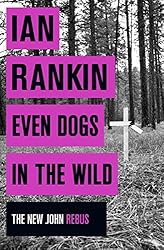 Even Dogs in the Wild – Now, two years later on from The Saints of the Shadow Bible Rebus is on his second retirement, working in a ‘˜consultative capacity’, albeit not as a cop and with no warrant card or real powers and with no pay. Once more this is a complicated plot, involving Malcolm Fox now seconded to the team of undercover cops from Glasgow, gang warfare, and Big Ger Cafferty. There are so many deaths and twists and turns that my mind was in a whirl as I tried to sort out all the characters.
Rankin, as usual, successfully combined all the elements of the crime mystery with the personal lives of the main characters and at the same time highlighting various current political and social issues.
Is this the last we’ll see of Rebus? Only time and Ian Rankin will tell.
 Ingenious! That’s what I thought when I’d finished reading The Murder at the Vicarage. Although Agatha Christie had written short stories featuring Miss Marple this is the first full length Miss Marple story, published in 1930.
 ‘One of the most haunting books you could ever wish to read … it is stunning – moving, exciting, and wonderful’, Lenny Henry.


