The Last Protector by Andrew Taylor

London, 1668 – A dangerous secret lies beneath Whitehall Palace…
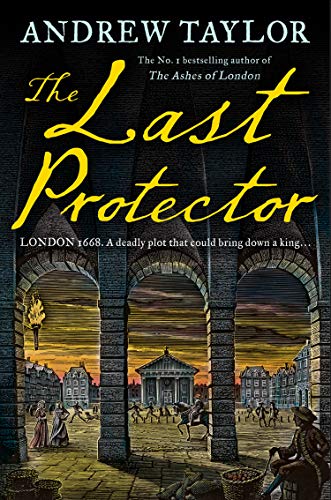
The Last Protector HarperCollins|2 April 2020|419 pages|ebook |Review copy via NetGalley|4* The Last Protector is the fourth book in Andrew Taylor’s series featuring James Marwood, a government agent and Cat (Catherine) Lovett, set in Restoration England. The year is 1668 and the exiled Richard Cromwell, son of Oliver, heavily in debt, has returned in disguise to England. Charles’ extravagant life style and licentious behaviour has now lost him the support of the people and many are hankering after the old days under Oliver Cromwell and then his son, Richard as Lord Protectors. He needs Parliament to vote him the funds to pay off his debts, maintain his court and fund the expansion of the navy and is relying on the Duke of Buckingham for support. However Marwood’s masters suspect that Buckingham is secretly conspiring against the King and assign him to spy on him.  Cat, a regicide’s daughter, is married to Simon Hakesby, an elderly and ailing surveyor and architect. She knew Richard’s daughter Elizabeth as a child and finds herself drawn into the Cromwells’ plan to recover a package Richard’s mother had hidden in the Cockpit in the gardens of the Palace of Whitehall just before her death; a package Richard hopes would be sufficient to clear his debts. He turns to the Duke of Buckingham for support in gaining access to the Cockpit. Buckingham is keen to use Richard in his plans to gain power. Cat, who now is unhappy in her marriage, resentful of Simon’s demands on her, is reluctant to get involved but unfortunately for her Simon is eager to help, and they soon find themselves in great danger. She is reluctant to ask for Marwood’s help fearing they could be charged with treason. Like the earlier books in the series this is a gripping story, full of historical detail, complications, intrigue and danger. The characterisation is brilliant with memorable characters such as Ferrus, a mazer-scourer’s labourer, who lives a terrible life, forced to sleep in a kennel with Windy, a vicious dog that guards the kitchen yard at the Cockpit. Treated brutally by his master, Ezra Reeves, his job is to clean the sewers. He is starved so he can squeeze himself down unto the foul stinking mess of the sewers, bending his long thin arms and legs. The stench of London comes across very vividly in this novel. Then there is Chloris, the kind-hearted prostitute, who helps Marwood.  This is a book full of action too, with a swiftly moving plot and a climatic ending. It is full of suspense and surprises. Andrew Taylor is a supreme storyteller, combining fact and fiction – his novels are full of historical details that slot seamlessly into his stories. I’ve read all  the earlier books and loved them too – The Ashes of London (set in 1666, six years after Charles II was reinstated as King) and The Fire Court (set in 1667, eight months after the Great Fire of London), and The King’s Evil (set seven months later). It is not necessary to read the earlier books as I think they all work well as standalones, but I think it really helps if you do. Many thanks to the publishers, HarperCollins for my review copy.
Bookshelf Travelling for Insane Times

Judith at Reader in the Wilderness hosts this meme – Bookshelf Travelling for Insane Times.  I am enjoying this meme, looking round my actual bookshelves and re-discovering books I’ve read or am looking forward to reading. The idea is to share your bookshelves with other bloggers.

This is really a Friday meme, but once more I’m late writing my post!

For this week’s post I’ve been looking through some of my oldest books.

The Secret Garden

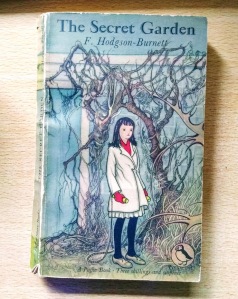
First is a book from my childhood, The Secret Garden by Frances  Hodgson-Burnett. It is now yellowing and a bit battered, but still in one piece. In the description at the front of the book the editor writes: Girls like it most, and between the ages of nine and fourteen – and, be warned, keep your copy carefully. You will want to go back and read it over and over again. I can’t remember how old I was, but the editor was right – I did read it over and over again.  I’ve wanted a walled garden ever since I read about the secret garden that Mary found at her Uncle’s house, Misselthwaite Manor in Yorkshire. It’s about the magic of nature, that makes plants and people grow and develop, the magic of the power of positive thinking and prayer, of the healing power of the mind, and of laughter and love.

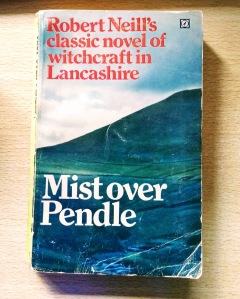
Mist over PendleNext a book I read as a teenager – Mist Over Pendle by Robert Neill. Set in rural Lancashire in the early 17th century it tells the story of Margery Whitaker, an orphan who went to live with her relatives on the Lancashire and Yorkshire border. People have died, apparently from belladonna poisoning and two old crones are suspected of witchcraft. Margery and her cousin Roger investigate whether they really were witches. I found it fascinating and it was probably the book that started me off reading historical fiction.
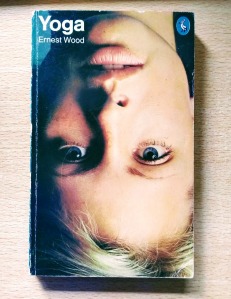
YogaI began doing yoga when I was in my thirties and Yoga by Ernest Wood is one of several books I bought at the time. It’s not just a book about the yoga breathing practices or the yoga postures – and there are no photos demonstrating them – it’s more about the classical background of yoga and its goals – the awakening of the higher spirit, bodily and mental health and the benefits of yoga in daily life. So, there are chapters on the ethics and morality of yoga, yoga and the intellect, yoga and vitality and the basic philosophy of yoga.
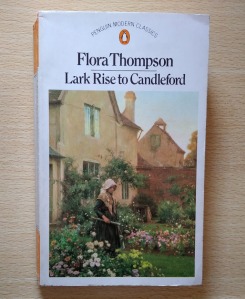
Lark Rise mineAnd finally a book I read in my forties. I’d had a really bad case of flu which meant that I couldn’t even lift my head off the pillow, never mind pick up a book! But when  I was recovering I read and loved Flora Thompson’s book Lark Rise to Candleford. It’s a trilogy including in addition to Lark Rise, Over to Candleford and Candleford Green. It’s a record of country life at the end of the 19th century, based on the author’s experiences during childhood and youth. It chronicles May Day celebrations and forgotten children’s games as well as the daily lives of farmworkers and craftsmen, and her friends and relations.

The Classics Club Spin Result

Classics Club
The spin number in The Classics Club Spin was announced yesterday. It’s number … 6

which for me is The Return of the Native by Thomas Hardy. The rules of the Spin are that this is the book for me to read by 1 June, 2020.

The Return of the Native

I’m delighted with this as I’ve been meaning to read it for years and never got round to it.

‘To be loved to madness – such was her great desire’

Eustacia Vye criss-crosses the wild Egdon Heath, eager to experience life to the full in her quest for ‘music, poetry, passion, war’. She marries Clym Yeobright, native of the heath, but his idealism frustrates her romantic ambitions and her discontent draws others into a tangled web of deceit and unhappiness.

Early readers responded to Hardy’s ‘insatiably observant’ descriptions of the heath, a setting that for D. H. Lawrence provided the ‘real stuff of tragedy’. For modern readers, the tension between the mythic setting of the heath and the modernity of the characters challenges our freedom to shape the world as we wish; like Eustacia, we may not always be able to live our dreams. (Amazon)

Did you take part in the Classics Spin? What will you be reading?

Bookshelf Travelling for Insane Times

Judith at Reader in the Wilderness hosts this meme – Bookshelf Travelling for Insane Times.  I am enjoying this meme, looking round my actual bookshelves and re-discovering books I’ve read or am looking forward to reading. The idea is to share your bookshelves with other bloggers. Any aspect you like:

1. Home.
2. Books in the home.
3. Touring books in the home.
4. Books organized or not organized on shelves, in bookcases, in stacks, or heaped in a helter-skelter fashion on any surface, including the floor, the top of the piano, etc.
5. Talking about books and reading experiences from the past, present, or future.

Whatever you fancy as long as you have fun basically.

This is really a Friday meme, but what with one thing and another, it is now Sunday and I have only just finished writing this post! I am so behind with everything these days.

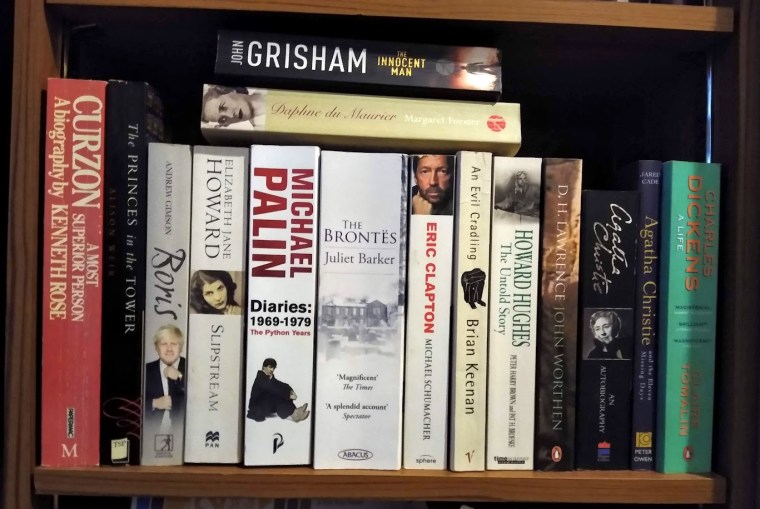
If you were to visit our house as soon as you came in you would see a wall lined with bookshelves. The first bookcase has six shelves – the top two are filled with OS maps, then there are three shelves of biographies and autobiographies, with the bottom shelf containing random books. The photo below shows one of the shelves of autobiographies/biographies.

Biographies

I have read some of these books – those marked with an *. From the left (as you look at the screen) they are:

*Curzon: A Most Superior Person, a biography by Kenneth Rose. George Nathaniel Curzon was the first and last Marquess of Kedleston, who in 1898 became the Viceroy of India. I bought this book after we visited Kedleston Hall in Derbyshire, several years ago. It’s been the home of the Curzon family since the 12th century.

Next to that is *The Princes in the Tower by Alison Weir. I first read this book many years ago. In it she examined the available evidence of the disappearance of the princes in 1483 at the time her book was first published in 1992.

Then comes Boris: the Rise of Boris Johnson by Andrew Gimson, published in 2012. I bought this book secondhand several years ago after Boris had been elected as Mayor of London and it is an updated version of his earlier biography to include his time as the Mayor of London.

After that are two autobiographies that I have started reading, but haven’t finished yet. They are Elizabeth Jane Howard’s Slipstream, and Michael Palin’s Diaries 1969 – 1979: the Python YearsNext The Brontes by Juliet Barker, inspired by my visit to their family home in Howarth.

The biography of Eric Clapton by Michael Schumacher is my husband’s book. I’d probably enjoy it though as I like his music too.

I was stunned when I read *An Evil Cradling by Brian Keenan, about the time he was kidnapped by fundamentalist Shi’ite militiamen and held in the suburbs of Beirut for four and a half years between 1986 and 1990.

I haven’t read the next book, Howard Hughes: the Untold Story by Peter Brown and Pat H. Broeske, although my husband has – he thought it was excellent. It’s the book that inspired Martin Scorses’s film, The Aviator.

I’ve read the next four books, John Worthen’s *D H Lawrence: the Life of an Outsider, Agatha Christie’s *An Autobiography, * Agatha Christie and the Eleven Missing Days by Jared Cade and *Charles Dickens: A Life by Claire Tomalin.

On top of the rest, because I couldn’t fit them in anywhere else, are two more books – one I have read, a biography of *Daphne du Maurier by Margaret Forster and John Grisham’s The Innocent Man, another book my husband has read but I haven’t yet. It tells the true story of Ron Williamson, who was arrested, tried, found guilty of the rape and murder of a cocktail waitress. He was sent to Death Row.

My Friday Post: Caught Out in Cornwall by Janie Bolitho

Book Beginnings Button

Every Friday Book Beginnings on Friday is hosted by Gillion at Rose City Reader where you can share the first sentence (or so) of the book you are reading, along with your initial thoughts about the sentence, impressions of the book, or anything else the opener inspires.

Caught Out in Cornwall


Caught Out in Cornwall by Janie Bolitho is one of the books I borrowed from the library before it closed because of COVID-19. So now I have plenty of time to finish reading it!

A small crowd began to gather. One minute, apart from a few distant dog walkers, Rose Trevelyan was alone on the beach; the next a dozen people had arrived to witness the ensuing drama.

A yacht is drifting dangerously, its mast snapped as a lifeboat goes to its rescue.

Also every Friday there is The Friday 56, hosted by Freda at Freda’s Voice.

30879-friday2b56These are the rules:

  1. Grab a book, any book.
  2. Turn to page 56, or 56% on your eReader. If you have to improvise, that is okay.
  3. Find any sentence (or a few, just don’t spoil it) that grabs you.
  4. Post it.
  5. Add the URL to your post in the link on Freda’s most recent Friday 56 post.

Page 56:

‘So, tell me about your interesting day.’

‘Did you hear about that little girl that’s gone missing?’

‘Yes. Have they found her yet?’

Rose shook her head sadly before describing her part in it.

Blurb

When Rose Trevelyan sees a young girl being carried away by someone who appears to be her father, she thinks nothing of it. Until, that is, the appearance of a frantic mother who cannot find her child. Beth Jones is only four years old, and her mother is adamant that the man Rose saw taking her away must be a stranger.

Wracked with guilt for not intervening, Rose once again finds herself entangled in a criminal investigation. As time passes, it becomes clear that the chances of getting Beth back unharmed are very bleak indeed . . .

~~~

This is the seventh and last book in the Rose Trevelyan series featuring Rose, an artist and photographer. I’ve read and enjoyed two of the earlier books.

Books I Enjoyed But Rarely Talk About

top-ten-tuesday-new

Top Ten Tuesday is a weekly meme created by The Broke and the Bookish and now hosted by Jana at That Artsy Reader Girl. For the rules see her blog.

This week’s topic is Books I Enjoyed but Rarely Talk About (This is for the books you liked, but rarely come up in conversation or rarely fit a TTT topic, etc.)

These are books I read before I began blogging. First is book I bought in an airport bookshop waiting to board a plane:

It’s Fortune’s Rocks by Anita Shreve. I had never heard of Anita Shreve, but I liked the look of this book – and the fact that it’s a chunky book of nearly 600 pages, so, good to read on holiday. It’s set in the summer of 1899 when Olympia Biddeford and her parents are on holiday at the family’s vacation home in Fortune’s Rocks, a coastal resort in New Hampshire. She is fifteen years old and this is the story of her love affair with an older man. I read more by her later and whilst I enjoyed her early books, I wasn’t so taken with her later ones.

Carol Shields is another author I’d never heard of until picked up Happenstance whilst at Gatwick Airport, waiting for another plane to go on holiday. I began reading it in the departure lounge, then on the plane and round the hotel pool, then passed it on to my husband. It’s written in two halves – one telling the wife’s story, then you turn the book round and upside down and there is the second half  telling the husband’s. Both tell their stories of a certain period in their lives from their own point of view. I read the wife’s side first. I didn’t talk about it to my husband just gave him the book and he read the husband’s side first. Then we discussed it and of course we both had different views on it. I’ve since read and enjoyed several more of her books

The Memory Box – Margaret Forster – A young woman leaves a sealed memory box for her baby daughter before she dies. Years later, as a young woman herself, Catherine finds her mother’s box full of unexplained, even bizarre objects. Finding out what the objects represent is her only chance to find out about the mother she never knew. A lovely book.

The Thornbirds – Colleen McCullough. I read this many years ago and have never forgotten it. In the rugged Australian Outback, three extraordinary generations of Cleary’s live through joy and sadness, bitter defeat and magnificent triumph – driven by their dreams, sustained by remarkable strength of character…and torn by dark passions, violence and a scandalous family legacy of forbidden love.

The Falls – Joyce Carol Oates. this was the first of Oates’ books I read and I loved it. A man climbs over the railings and plunges into Niagara Falls. He’s a newly-wed, and his bride has been left behind in the honeymoon suite the morning after their wedding. For two weeks, Ariah, the deserted bride, waits by the side of the roaring waterfall for news of her husband’s recovered body.

Possession – A S Byatt is an exhilarating novel of wit and romance, at once a literary detective novel and a triumphant love story. It is the tale of a pair of young scholars investigating the lives of two Victorian poets. Following a trail of letters, journals and poems they uncover a web of passion, deceit and tragedy, and their quest becomes a battle against time.

Miss Garnet’s Angel by Salley Vickers combines two stories, that of Julia Garnet, a retired school teacher, who goes to Venice prompted by the death of a friend, and that of  Tobias and the Angel, which she sees in the Guardi panels in the Chiesa dell’ Angelo Raffaele. This is a beautiful book.

The Soldier’s Return – Melvyn Bragg, a novel about the aftermath of the Second World War. Sam Richardson returns home to Wigton in Cumbria where he finds the town little changed. But the war has changed him. His six year old son barely remembers him and his wife has gained a sense of independence from her wartime jobs. There are two further books to complete the story – A Son of War and Crossing the Lines. All three books are outstandingly good.

Glittering Images – Susan Howatch. The first in her Church of England series. I loved the whole series when I read them years ago. This book is set in 1937 and beneath the smooth surface of an episcopal palace lurks the sordid breath of scandal. Charles Ashworth, a Canon to the Archbishop of Canterbury is sent to untangle the web of corruption, only to become involved himself. I’m not an Anglican so I was fascinated by the description of the hierarchy within the church as well as all the scandals.

An Alien at St Wilfred’s by Adrian Plass is another book about an Anglican church, but this is very different from Susan Howatch’s series. It’s very funny, about a small alien, calling himself Nunc who comes to live in a parish church and learns to speak Prayer Book English. His effect on the vicar and the congregation is hilarious.