R.eaders I.mbibing P.eril XI

It’s time for the annual R. (eaders) I. (mbibing) P. (eril) event, hosted by Carl  at Stainless Steel Droppings, taking place between September 1st and October 31st.
(Much thanks to Hugo Award winning artist Abigail Larson for the use of her art)

This event involves reading books from these categories: Mystery, Suspense, Thriller, Dark Fantasy, Gothic, Horror, Supernatural or other closely-related fields. Reviews, while not required, may be posted on Carl’s blog.

I shall be attempting:


Peril the First: Read at least four books, any length, that you feel fit (the very broad definitions) of R.I.P. literature. I have plenty of Mystery, Suspense, Thriller and Gothic books on my shelves and Kindle to choose from, including these four:

The Girl in a Swing by Richard Adams

The Taxidermist’s Daughter by Kate Mosse

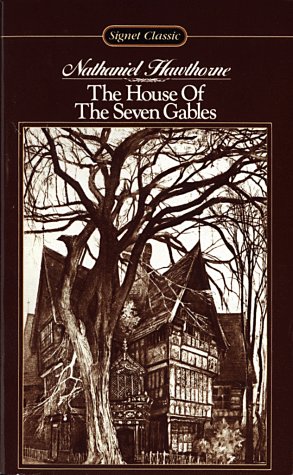
The House of the Seven Gables by Nathaniel Hawthorne

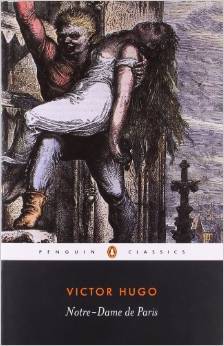
The Hunchback of Notre Dame by Victor Hugo

30600

Six Degrees of Separation: From Flowers in the Attic to We Have Always Lived in the Castle

Six Degrees of Separation is a monthly link-up hosted by Books Are My Favourite and Best. On the first Saturday of every month, a book is chosen as a starting point and linked to six other books to form a chain. A book doesn’t need to be connected to all the other books on the list, only to the ones next to them in the chain.

Flowers in the Attic chain

This month’s chain begins with:

Flowers in the Attic by V C Andrews, a book I haven’t read. From the synopsis I see that it’s about Chris, Cathy, and the twins, Cory and Carrie who are kept hidden until their grandfather dies so that their mother will receive a sizeable inheritance.

It continues with:

  • Her Fearful Symmetry by Audrey Niffeneger, also about twins, a ghost story about love, loss and identity. When Elspeth Noblin dies, she leaves her beautiful flat overlooking Highgate Cemetery to her twin nieces, Julia and Valentina Poole. I liked all the information about Highgate Cemetery, but overall this book was disappointing.
  • I much preferred Falling Angels by Tracy Chevalier, also set in part in Highgate Cemetery in 1901-1908, the early years of the suffragette movement. Two families visit neighbouring graves in Highgate Cemetery. One is decorated with a sentimental angel, the other with an elaborate urn.
  • Another book I loved, also about an angel, but a very different one, is Miss Garnet’s Angel by Salley Vickers – this combines two stories, that of Julia Garnet, a retired school teacher, who goes to Venice prompted by the death of a friend, and that of  Tobias and the Angel, which she sees in the Guardi panels in the Chiesa dell’ Angelo Raffaele.
  • The next link in the chain is also set in Venice: Wilful Behaviour by Donna Leon – crime fiction, in which Commissario Brunetti looks into the possibility of a pardon for a crime committed by a student’s grandfather during World War 2 and then investigates that student’s murder.
  • Also set in part during World War 2 is Atonement by Ian McEwan, a complex story, split into four parts and told from several points of view. This is a love story and also a mystery. It provides the link to the next book in my chain as revolves around the lives of  two sisters, Briony and her older sister, Cecelia. A book that I loved.
  • We Have Always Lived in the Castle by Shirley Jackson is also a fantastic book – a weirdly wonderful book about sisters, Merricat and her sister Constance. They live in a grand house, away from the village, behind locked gates, feared and hated by the villagers. Merricat is an obsessive-compulsive, both she and Constance have rituals that they have to perform in an attempt to control their fears.

This chain has taken me from siblings in New York to twin sisters in London, via Highgate Cemetery, angels, Venice, World War 2, back to sisters in America.

My Friday Post: The Scent of Death

Book Beginnings ButtonEvery Friday Book Beginnings on Friday is hosted by Gillion at Rose City
Reader
 where you can share the first sentence (or so) of the book you are reading, along with your initial thoughts about the sentence, impressions of the book, or anything else the opener inspires.

This week’s book is a library book I’m thinking of reading. It’s The Scent of Death by Andrew Taylor. I borrowed it because I’ve enjoyed some of his other books. It begins:

This is the story of a woman and a city. I saw the city first, glimpsing it from afar as it shimmered like the new Jerusalem in the light of the setting sun.

Synopsis:

August, 1778. British-controlled Manhattan is a melting pot of soldiers, traitors and refugees, surrounded by rebel forces as the American War of Independence rages on. Into this simmering tension sails Edward Savill, a London clerk tasked with assessing the claims of loyalists who have lost out during the war.

Savill lodges with the ageing Judge Wintour, his ailing wife, and their enigmatic daughter-in-law Arabella. However, as Savill soon learns, what the Wintours have lost in wealth, they have gained in secrets.

The murder of a gentleman in the slums pulls Savill into the city’s underbelly. But when life is so cheap, why does one death matter? Because making a nation is a lucrative business, and some people cannot afford to miss out, whatever the price’¦

Also every Friday there is The Friday 56, hosted by Freda at Freda’s Voice.Friday 56

These are the rules:

  1. Grab a book, any book.
  2. Turn to page 56, or 56% on your eReader.
  3. Find any sentence (or a few, just don’t spoil it) that grabs you.
  4. Post it.
  5. Add the URL to your post in the link on Freda’s most recent Friday 56 post.

Page 56:

You’re a thief, a damned pickpocket. There were two empty purses in your bundle. And those shoes you had on your feet – well they tell their own story don’t they?

I like the promise of this book – historical crime fiction set during the American War of Independence, a war about which I know only the briefest of details.

Books Read in August 2016

I read 6 books this August, three of them TBR books, and all are fiction, a mix of crime fiction, historical fiction and epic fantasy novels. One book is a library book and one a review copy. (The links are to my  posts on the books.)

  • The Sunne in Splendour by Sharon Penman (TBR), a fascinating novel about the Wars of the Roses and Richard III from his childhood to his death at Bosworth Field in 1485 and one of the best historical novels that I’ve read.
  • The Woman Who Walked into the Sea by Mark Douglas Hume (LB), the second The Sea Detective novel, set in an imaginary coastal village of Poltown in the north of Scotland, the story revolves around the main character,Violet who had been abandoned as a new-born baby.  It had been assumed that her mother, Megan had committed suicide, although her body had never been found.  Cal McGill helps Violet find out what really happened.
  • The Girl in the Cellar by Patricia Wentworth, a Miss Silver Mystery first published in 1961. It begins well as the main character finds herself in the dark in a cellar, not knowing who she is or how she got there. Overall, I thought the book was odd and not very convincing. There are too many coincidences, improbabilities, and loose ends.
  • The Plague Charmer by Karen Maitland, a review copy from Lovereading due to  be published in October. This is another unputdownable book by Karen Maitland, set in Porlock Weir in 1361, bringing the medieval world to life in all its brutality and hardship. I thoroughly enjoyed it. My full review will follow later this month.
  • A Game of Thrones (A Song of Ice and Fire,1) by George R R Martin (TBR), an epic fantasy novel  set in a grim and violent world full of tragedy, betrayals and battles; a tale of good versus evil in which family, duty, and honour are in conflict. It’s complex and multifaceted, and full of stories and legends and wonderful characters. I loved it.
  • The Mysterious Mr Quin (Agatha Christie'¦The Mysterious Mr Quin by Agatha Christie (TBR) – I finished this collection of short stories yesterday. It’s one of her earliest books, first published in 1930, not at all like her Poirot or Miss Marple books, and I enjoyed it very much. It’s beautifully written. I’ll write about it in more detail soon.

It’s impossible to decide which is my favourite this month between books in different genres. I loved The Sunne in Splendour, The Game of Thrones and The Mysterious Mr Quin in almost equal measure, each book taking me to completely different worlds and times.

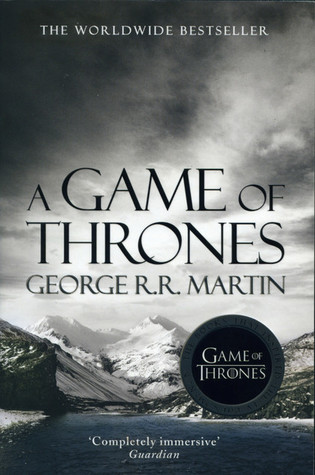
A Game of Thrones by George R R Martin

‘When you play the game of thrones, you win or you die. There is no middle ground.’
22740513

When we began watching the HBO TV series, A Game of Thrones, I was hooked and once we finished watching I immediately wanted to read the series, A Song of Fire and Ice. I’d just read The Sunne in Splendour by Sharon Penman, about the Wars of the Roses and had noticed the similarities between that and A Game of Thrones, the battles between the Houses of York and Lancaster paralleled by those between the Houses of Stark and Lancaster for example.

I don’t often read a book after seeing an adaptation, but in this case it proved ideal – the actors and scenery were perfect for my reading of the book, although there are some differences (the ages of the Stark children for example). I loved both the book and the TV series.

Blurb:

Summers span decades. Winter can last a lifetime. And the struggle for the Iron Throne has begun.

As Warden of the north, Lord Eddard Stark counts it a curse when King Robert bestows on him the office of the Hand. His honour weighs him down at court where a true man does what he will, not what he must ‘¦ and a dead enemy is a thing of beauty.

The old gods have no power in the south, Stark’s family is split and there is treachery at court. Worse, the vengeance-mad heir of the deposed Dragon King has grown to maturity in exile in the Free Cities. He claims the Iron Throne.

I was completely immersed in this world inhabited by numerous characters and set in different locations (Seven Kingdoms), all portrayed in meticulous detail and expertly constructed so that all the fantastic creations are credible, and complete with back stories and histories. Beginning with a Prologue the book is then narrated through different characters’ points of view – each chapter is headed by that character’s name making the plotlines easy to follow:

  • Lord Eddard “Ned” Stark, Warden of the North and Lord of Winterfell, Hand of the King.
  • Lady Catelyn Stark, of House Tully, wife of Eddard Stark.
  • Sansa Stark, elder daughter of Eddard and Catelyn Stark.
  • Arya Stark, younger daughter of Eddard and Catelyn Stark.
  • Bran Stark, second-youngest son of Eddard and Catelyn Stark.
  • Jon Snow, illegitimate son of Eddard Stark, mother unknown.
  • Tyrion Lannister, son of Lord Tywin Lannister, called the Imp, a dwarf, brother of the twins, the beautiful and ruthless Queen Cersei and Ser Jaime, called the Kingslayer,
  • Daenerys Targaryen, Stormborn, the Princess of Dragonstone, sister of Prince Viserys, the last of the Targaryens.

Other characters include:

  • King Robert of the House Baratheon, Lord of the Seven Kingdoms, Eddard Stark’s oldest friend, married to Queen Cersei, his son Joffrey, spoiled and wilful with an unchecked temper, heir to the Iron Throne.
  • Robb Stark, oldest true born son of Eddard Stark. He remained at Winterfell when Eddard became the Hand of the King.
  • Tywin Lannister, Lord of Casterly Rock, Warden of the West, Shield of Lannisport.
  • Khal Drogo – a powerful warlord of the Dothraki people on the continent of Essos, a very tall man with hair black as midnight braided and hung with bells.

Locations:
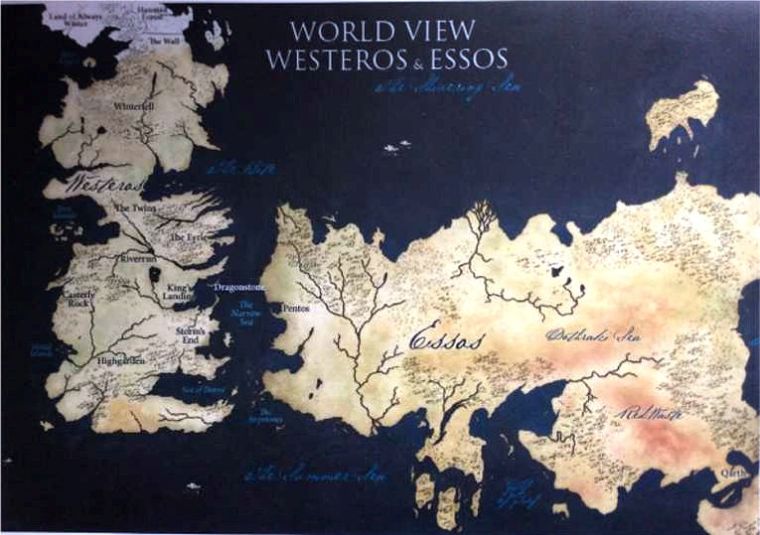
GOT Map1

  • Winterfell: the ancestral castle of House Stark.
  • The Wall: built of stone, ice and magic, on the northern border of the Seven Kingdoms, guarded by the Night’s Watch to protect the Kingdoms from the dangers behind the huge wall from ‘the Others’ and the Wildings.
  • Beyond the Wall: the first book begins Beyond the Wall with members of the Night’s Watch on the track of a band of Wildling raiders.
  • King’s Landing: a walled city, the capital of the continent of Westeros and of the Seven Kingdoms.
  • Essos: across the Narrow Sea from Westeros, includes the grassland known as the Dothraki Sea.

This article in The Telegraph lists the locations used in the TV series.

This is no fairy tale – it’s set in a grim and violent world full of tragedy, betrayals and battles; a tale of good versus evil in which family, duty, and honour are in conflict, the multiple viewpoints giving a rounded view of the conflicts the characters face. It’s a love story too. There are knights, soldiers and sorcerers, priests, direwolves, giants, assassins and bastards.  It’s complex and multifaceted, and it’s full of stories and legends – here for example Maester Luwin tells young Bran Stark about the children of the forest:

“They were people of the Dawn Age, the very first before kings and kingdoms,” he said. “In those days there were no castles or holdfasts, no cities, not so much as a market town to be found between here and the sea of Dorne. There were no men at all. Only the children of the forest dwelt in the lands we now call the Seven Kingdoms.

‘They were a people dark and beautiful, small of stature, no taller than children even when grown to manhood. They lived in the depths of the wood, in caves and crannogs and secret tree towns. Slight as they were, the children were quick and graceful. Male and female hunted together, with weirwood bows and flying snares. Their gods were the gods of the forest, stream and stone, the old gods whose names are secret. Their wisemen were called greenseers and carved strange faces in the weirwoods to keep watch on the woods. (page 713)

I shall be reading the next book in the series soon, A Clash of Kings. The other books are A Storm of SwordsA Feast for Crows, and A Dance with Dragons.

I read the Kindle Edition:

  • File Size: 8515 KB
  • Print Length: 819 pages
  • Page Numbers Source ISBN: 0007448031
  • Publisher: Harper Voyager (23 Dec. 2010)

Reading Challenges: Mount TBR Reading Challenge  – a book I’ve had since October 2015, and the What’s In a Name Challenge – in the category of a book with a piece of furniture in the title.

First Chapter, First Paragraph:

First chapterEvery Tuesday Diane at Bibliophile by the Sea hosts First Chapter First Paragraph Tuesday Intros to share the first paragraph sometimes two, of a book that she’s reading or planning to read soon.

The Wench is Dead by Colin Dexter is one of those books I’ve been meaning to read for some time and it’s one of my 20 Books of Summer. It’s an Inspector Morse book.

It begins:

Intermittently, on the Tuesday, he felt sick. Frequently, on the Wednesday, he was sick. In the Thursday, he felt sick frequently, but was actually sick only intermittently. With difficulty, early on the Friday morning – drained, listless, and infinitely weary – he found the energy to drag himself from his bed to the telephone, and seek to apologise to his superiors at Kidlington Police HQ for what was going to be an odds-on non-appearance at the office that late November day.

Blurb:

That night he dreamed in Technicolor. He saw the ochre-skinned, scantily clad siren in her black, arrowed stockings. And in Morse’s muddled computer of a mind, that siren took the name of one Joanna Franks . . .

The body of Joanna Franks was found at Duke’s Cut on the Oxford Canal at about 5.30 a.m. on Wednesday, 22nd June 1859.

At around 10.15 a.m. on a Saturday morning in 1989 the body of Chief Inspector Morse – though very much alive – was removed to Oxford’s John Radcliffe Hospital. Treatment for a perforated ulcer was later pronounced successful.

As Morse begins his recovery he comes across an account of the investigation and the trial that followed Joanna Franks’ death . . . and becomes convinced that the two men hanged for her murder were innocent . . .

What do you think? Would you keep reading? I’m predisposed to like this book, because I loved the Morse TV series and also because I’m a fan of cold case investigations – especially one this old.