Autumn by Ali Smith

Autumn

Autumn is the first of Ali Smith’s books I’ve read and at first I wasn’t sure what to make of it. The blurb attracted me – it describes it as ‘a breathtakingly inventive new novel, a meditation on a world growing ever more bordered and exclusive, on what richness and worth are, on what harvest means.‘ I didn’t find it ‘breathtaking’ but I did enjoy it.

I liked the beginning which begins with a stream of consciousness as Daniel Gluck, a very old man, ponders his life and his approaching death. The main focus of Autumn is the relationship between Daniel and Elisabeth Demand who first met when Elisabeth was a child and moved into the house next door to Daniel’s. We see their friendship at various stages in their lives throughout the book.

As I expected from the blurb Autumn is not a straightforward story, so whilst I wanted to know more about the Daniel and Elisabeth story I was quite happy to diverge from their story through the different sections about a variety of different themes from death, aging, love and of course autumn.

I liked the wordplay and references to many other books from Dickens to Shakespeare, the details about Christine Keeler and the Profumo Affair, the life, work and death of the pop artist Pauline Boty, and the accurate and amusing accounts of the frustrations of everyday life such as those describing Elisabeth’s attempts to renew her passport.

It’s both poignant and cutting in its look at modern life, how we got to where we are, and the mood of the country post-Brexit (that word is never mentioned) – the confusion and the misery and rejoicing, the insanity, and the division. It’s a remarkable book.

Autumn is the first installment in Ali Smith’s novel quartet Seasonal: four standalone books, separate yet interconnected and cyclical (as the seasons are), exploring what time is, how we experience it, and the recurring markers in the shapes our lives take and in our ways with narrative.

Ali Smith was born in Inverness in 1962. She is the author of Free Love and Other Stories, Like, Other Stories and Other Stories, Hotel World, The Whole Story and Other Stories, The Accidental, Girl Meets Boy, The First Person and Other Stories, There but for the, Artful, How to be both, and Public library and other stories. Hotel World was shortlisted for the Booker Prize and the Orange Prize and The Accidental was shortlisted for the Man Booker and the Orange Prize. How to be both won the Baileys Women’s Prize for Fiction, the Goldsmiths Prize and the Costa Novel Award and was shortlisted for the Man Booker and the Folio Prize. Ali Smith lives in Cambridge.

  • Format: Kindle Edition
  • File Size: 5464 KB
  • Print Length: 243 pages
  • Page Numbers Source ISBN: 0241207010
  • Publisher: Penguin (20 Oct. 2016)

I received a copy of this book from the publisher, via NetGalley, for review.

On the Black Hill by Bruce Chatwin

One of my favourite books – On the Black Hill by Bruce Chatwin was first published in 1982 when it won the James Tait Black Memorial Prize and the Whitbread First Novel of the Year Award. The Black Hill is one of the Black Mountains on the border of England and Wales, although fictionalised in this book. It was made into a film in 1988. And today it is released in an e-book edition by Open Road Integrated Media.

It’s a gentle, richly descriptive book of both the landscape and the characters, about lonely lives on a farm, largely untouched by the 20th century. It follows the lives of identical twins, Lewis and Benjamin Jones, a period of over 80 years. They are inseparable, Benjamin in particular suffering whenever they are apart. Their lives are hard, lonely, brutal at times, but full of love for their mother and the land they farm.

I love this book and most of all I love they way Chatwin brought the characters to life, not just Lewis and Benjamin, but all the other personalities, some eccentric, some comic and some tragic. His attention to detail is remarkable ‘“ at no time does it seem excessive, or intrusive but all the little minutiae of daily life are essential to the book. It highlights questions of love, religion, death and above all relationships. It is most definitely not a book to race through to find out what happens, although I did want to know, but one to savour ‘“ and one to re-read.

  • File Size: 6409 KB
  • Print Length: 236 pages
  • Publisher: Open Road Media (October 18, 2016)
  • Publication Date: October 18, 2016
  • Language: English
  • ASIN: B01K6GBLWI
  • Source: review copy from the publisher via NetGalley

Amazon US link


The Songlines by Bruce Chatwin

The Songlines by [Chatwin, Bruce]

As I loved On the Black Hill by Bruce Chatwin I was keen to read The Songlines when the publishers, Open Road Integrated Media, asked if I’d like to read and review this e-book edition. It includes an illustrated biography of Bruce Chatwin including rare images and never-before-seen documents from the author’s estate. The Songlines was originally published in 1987.

It’s set in Australia exploring the ‘Songlines’, the labyrinth of invisible pathways which cross and re-cross Australia, ‘known to Europeans as ‘Dreaming-tracks’ or ‘Songlines’; to the Aboriginals as the Footprints of the Ancestors’ or the ‘Way of the Law’.

On the one hand this is a fascinating account of Chatwin’s visit to Australia to find out about the Songlines and the myths of the legendary totemic beings who sang the world into existence as they wandered over the continent in the Dreamtime. It’s an account of Chatwin’s exploration of the Songlines, in the company of a Russian, Arkady Volchek who was mapping these sacred sites for a railway company so that they could work round the Songlines rather than obliterating them with the railroad.

On the other hand it is much more than that – and this is where I found the book a bit difficult – in the middle of his account of his travels Chatwin throws in a whole hodge-podge of ideas, quotations from numerous writers and philosophers, travel notes, speculations on the origins of life and anecdotes all thrown into the mix before he gets back to writing about his travels and the people he met. I marked lots of passages in the section ‘From the Notebooks‘, particularly on the subject of walking – for example:

Above all, do not lose your desire to walk: every day I walk myself into a state of well-being and walk away from every illness; I have walked myself into my best thoughts, and I know of no thought so burdensome that one cannot walk away from it … but by sitting still, and the more one sits still, the closer one comes to feeling ill … Thus if one just keeps on walking, everything will be all right.

Søren Kierkegaarde, letter to Jette (1847)

and on nomads and the nomadic life:

Psychiatrists, politicians, tyrants are forever assuring us that the wandering life is an aberrant form of behaviour; a neurosis; a form of unfulfilled sexual longing; a sickness which, in the interests of civilisation must be suppressed. …

Yet in the East, they still preserve the once universal concept: that wandering re-establishes the original harmony which once existed between man and the universe.

The Songlines contains beautiful descriptions of the Australian landscape such as this:

A pair of rainbows hung across the valley between the two mountains. The cliffs of the escarpment, which had been a dry red were now a purplish-black and striped like a zebra, with vertical chutes of white water. The cloud seemed even denser than the earth, and beneath its lower rim, the last of the sun broke through, flooding the spinifex with shafts of pale light.

I really don’t know whether this book fits into any particular genre. Chatwin was an author, a novelist and a travel writer – a skilled storyteller. It seems to me that this book combines all these forms of writing. I enjoyed both the account of Chatwin’s experiences in Australia and the long and loosely connected middle section of the book, but would have preferred these to stand on their own rather than be combined in one book.

My thanks to Open Road Integrated Media for a review copy via NetGalley.

  • File Size: 6061 KB
  • Print Length: 281 pages
  • Publisher: Open Road Media (October 18, 2016)
  • Publication Date: October 18, 2016
  • Language: English
  • ASIN: B01K6GBLVY

Amazon US link

Accidents Happen by Louise Millar

Accidents Happen is one of my TBR e-books that I’ve had for a couple of years. It’s described as a ‘gripping psychological thriller where one woman’s streak of bad luck may be something far more sinister’, so I thought it would be just the right sort of book to read for this year’s R.eaders I.mbibing P.eril XI.

It begins well with a strange, scary episode about a child waking up to the sight of something slithering, full of threat, not sure what it was but terrified as it was angry with a gaping mouth revealing a tiny white spot, where the poison came from.

Episodes like this are interspersed between the chapters of the story, each one more terrifying than the rest. These are actually much more scary than the main story, which is about Kate, a widow and her young son Jack.

Blurb:

Kate Parker has had so much bad luck in her life, she’s convinced she’s cursed. But when she tries to do her best to keep herself and her son safe, people tell her she’s being anxious and obsessive.

Just when her life starts to spin completely out of control, an Oxford professor she meets offers to help. But his methods are not conventional. If she wants to live her life again, he will expect her to take risks.

When a mysterious neighbour starts to take more than a passing interest in her, Kate tries to stay rational and ignore it.

Maybe this, however, is the one time Kate should be worried.

My thoughts:

Kate’s husband had died 5 years before the book starts and Kate is obsessed with statistics, so much so that they are now ruling her life – statistics about all the things that go wrong, or could go wrong. And this is preventing her from living a normal life – the lengths she goes to are extreme and they are affecting her Jack, her son. As readers we know that some of Kate’s fears are real, but she doesn’t focus on those, although they do bother her. I began to feel something was wrong. And when she met Jago, an Oxford professor my feelings intensified – there was definitely something suspicious going on. Why was he getting her to take such risks and putting herself into such strange situations?

At first I was enjoying this book – it’s very readable, although the concentration on Kate’s fears got a bit repetitive – but increasingly as I read on I just couldn’t believe what was happening. For me the tension that had been building up just disappeared. I didn’t think it was plausible and I couldn’t suspend my disbelief.

I think I’m in the minority about this book as it has more favourable reviews on both Amazon and Goodreads.

Reading Challenges: Mount TBR Reading Challenge and R.eaders I.mbibing P.eril XI.

Joyland by Stephen King

I’m so glad I read Joyland by Stephen King – it’s so good.

13596166

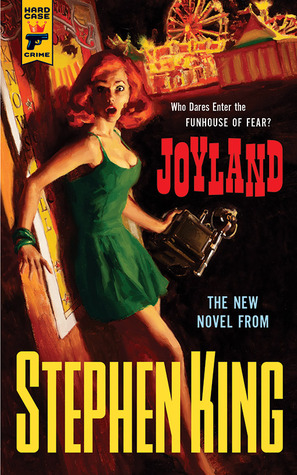
I nearly didn’t buy it, put off by the cover (you should never judge a book by its cover!) and by the publishers, Hard Case Crime – it was the word ‘hard‘ that really made me pause, especially when I looked at their site and saw they publish ‘the best in hardboiled crime fiction‘. Not being quite sure just what ‘hard boiled crime fiction‘ is, I looked it up. This is Encyclopedia Britannica’s definition:

Hard-boiled fiction, a tough, unsentimental style of American crime writing that brought a new tone of earthy realism or naturalism to the field of detective fiction. Hard-boiled fiction used graphic sex and violence, vivid but often sordid urban backgrounds, and fast-paced, slangy dialogue.

Not my sort of book, at all! But it’s by Stephen King and I like his books, so I did buy it. It’s not ‘hard boiled fiction‘ as defined above. The only way it fits that definition is that there is a lot of slang in it – ‘carny’ slang, which King explains in his Author’s Note is what he calls in this book ‘the Talk‘. It is ‘carnival lingo, an argot both rich and humorous’. So not ‘hard boiled’ at all!

Joyland is a ghost story, a love story, a story of loss and heartbreak. It’s also a murder mystery and utterly compelling to read.

It’s narrated by Devin Jones, looking back forty years at the time he was a student, suffering from a broken heart, as his girlfriend had just rejected him and he spent a summer working at Joyland, in North Carolina, an amusement park with ‘a little of the old-time carny flavor‘.

Along with various rides, ‘Happy Hounds’, and a palm-reader, there is the Horror House, a ‘spook’ house which is said to be haunted by the ghost of Linda Gray, whose boyfriend cut her throat in the Horror House. The boyfriend had not been found and it appears he may be a serial killer as there had been four other similar murders in Georgia and the Carolinas.

It’s also a story of friendship, of Tom and Erin, of children with the ‘sight’, a young boy in a wheelchair and his mother, and Dev’s search for the killer.

I loved the setting of the funfair, Dev’s nostalgia for his youth, his sensitivity, and the images the story evokes – it’s not just the story but the way King tells his tale, with just a touch of horror and the supernatural.

Who knows – maybe I should read some more of Hard Case Crime’s publications!

Reading ChallengesReaders.Imbibing.Peril XI.

Magpie Murders by Anthony Horowitz

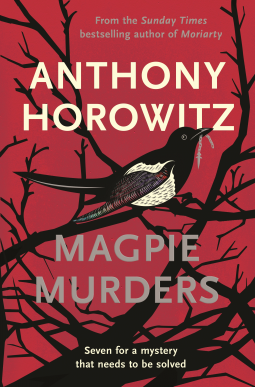
I previously enjoyed The House of Silk by Anthony Horowitz, so when I saw Magpie Murders  on NetGalley I was keen to read it and delighted when I received an uncorrected proof. I think it is an outstanding book by a master story-teller, with a wonderfully intricate plot. It’s a prime example of a puzzle-type of crime fiction combining elements of the vintage-style golden age crime novel with word-play and cryptic clues and allusions to Agatha Christie and Arthur Conan Doyle. It’s also a novel within a novel, with mystery piled upon mystery. I loved it.

The outer story and the contemporary mystery is that of Alan Conway, the author of the Atticus Pund Mysteries. His editor, Susan Ryeland is reading a manuscript of his latest novel Magpie Murders, expecting to enjoy it as much as his earlier books, even though she really couldn’t stand Conway himself. What she wasn’t prepared for is that this book would change her life.

The inner story, that told in Conway’s novel is a whodunnit, a murder mystery full of twists and turns with plenty of red herrings. I was enjoying it as much as Susan as she read of the death of Mary Blakiston in the little village of Saxby-on-Avon in 1955. Mary was an unpleasant character. She had been found dead at the bottom of the stairs at Pye Hall where she was the cleaner for the owner, Sir Magnus Pye. It appeared that she had tripped and fallen down the stairs.Then Magnus is also found dead, but this was obviously murder as he had been beheaded.

So back to the outer story. When Susan came to the end of the manuscript she found it wasn’t finished – there was no denouement. And she couldn’t contact Conway to get the final chapters of the book and then she discovered that he was dead. So, she sets out to find the missing chapters and in so doing discovers even more mysteries – was Conway’s death an accident, suicide or murder? Like Mary Blakiston in his novel, he was not a popular man, and there are a number of other parallels between his novel and his real life.

Magpie Murders is a really satisfying read, with believable characters, set in beautifully described locations, tantalisingly mysterious and so, so readable. I also particularly liked the use of the rhyme of ‘One for Sorrow’ in the chapter headings of Conway’s novel in the same way that Agatha Christie used ryhmes in some of her books. It’s quite long, but the pages sped by as I was drawn into both stories and keen to find the answers to all the questions all the mysteries it had posed.

Many thanks to NetGalley and the publishers Orion Books for an ARC.