Ten Little Niggers by Agatha Christie

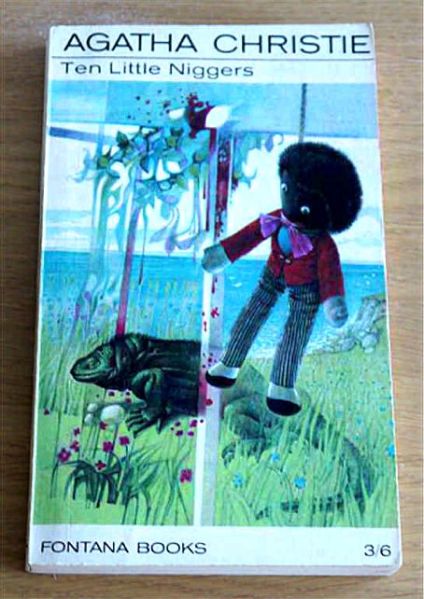
I wondered when I began to write this post whether to use the current title, And Then There Were None, for this book, but chose to use its original title, Ten Little Niggers as that is the title of my copy, a 1968 reprint of its first publication in the UK in 1939. Because of its offensive title it was first published in the US a few months later in 1940 as And Then There Were None.

Ten Little Niggers

Description from the back cover:

10 people are invited to a fabulous mansion on Nigger Island off the coast of Devon. Though they all have something to hide, they arrive hopefully on a glorious summer evening… But soon a series of extraordinary events take place: the island is suddenly bathed in a most sinister light .. panic grips the visitors one, by one … by one… by one…

Eight people are invited to the island (based on a real island – Burgh Island off the south west coast of Devon). They are met by the butler and housekeeper/cook who explain that the owner, Mr Owen (U.N.Owen) has been delayed but has left instructions for their reception. In each of their rooms is a framed copy of the rhyme about the ten little nigger boys who all met their death. On their first evening they sit down to dinner in good spirits until, without any warning they hear a Voice accusing each of them (including the butler and housekeeper) of having caused the deaths or murdered a number of people. From that point onwards, one by one they are found dead, corresponding to the deaths in the rhyme and one by one a china figurine on the dining room table mysteriously disappears.

As the weather worsens they are stranded on the island and unable to leave or to get help from the mainland. Agatha Christie has created not only a ‘locked room’ type of mystery but also a mystery full of suspense, as the guests try to identify Mr U N Owen and become increasingly suspicious of each other. Their fear is further amplified by the house itself, which surprisingly is not an old Gothic house full of creaking wood and dark shadows –

But this house was the essence of modernity. There were no dark corners – no possible sliding panels – it was flooded with electric light – everything was new and bright and shining. There was nothing hidden in this house, nothing concealed. It had no atmosphere about it.

Somehow, that was the most frightening thing of all …

They exchanged good-nights on the upper landing. Each of them went into his or her own room, and each of them automatically, almost without conscious thought, locked the door … (page 52)

Despite their precautions the deaths continue, and each time no one sees or hears anything. I’d marked the page with the rhyme and kept flipping back to it to check how the next victim was going to meet with death, as I tried to work out who the murderer was and how he/she was able to carry out the murders unobserved. What makes it more tense for the reader (or at least for me) is the technique Agatha Christie makes of revealing the thoughts of the remaining characters, but without letting on who the thinker is.

In 1943 Agatha Christie adapted the book into a play, changing the ending, and there have been several film versions, none of which I’ve seen, so I didn’t know who the murderer was, although I knew the outline of the plot. Part way through the book I thought – ah, there is only one person who could be the murderer and I was right. I must re-read the book sometime to see if there were any clues, because if there were I missed them. My idea was based on the probability of that character being the murderer rather than any specific clues.

It is an ingenious mystery, revolving around the concepts of guilt and justice. There was no doubt that each of the victims had committed murder or caused/influenced the death of another person. But did the punishment fit the crime and could it ever be justified? As the murderer explains in an epilogue there were varying degrees of guilt among the victims and those whose guilt was lightest were killed off first!

This is possibly the most famous of Agatha Christie’s books. In her Autobiography Agatha Christie wrote that she had written the book because it was so difficult to do and the idea fascinated her. I found it fascinating too, but as an exercise and a puzzle rather than as a novel. Writing about the play and the book she stated:

I don’t say it is the play or the book of mine I like best, or even that I think it is my best, but I do think in some ways that it is a better piece of craftsmanship than anything else I have written. (page 489 of An Autobiography)

I agree.

Over My Dead Body by Hazel McHaffie

Over My Dead Body by Hazel McHaffie is a novel that raises questions such as would you be an organ donor, or agree to donating your child’s heart, or eyes. I’ve never read a novel that considered these issues, so when Hazel McHaffie contacted me and asked if I would read and review her book it didn’t take me long to write back, ‘yes please’. She is very well qualified to write such a book – a nurse and midwife, with a PhD in Social Sciences, and a Research Fellow in Medical Ethics.

Synopsis (from Hazel McHaffie’s website):

Carole Beacham is in her mid-sixties and planning to leave her husband. Before she can do so her daughter, Elvira, and two little granddaughters are involved in a fatal road traffic accident. Then a stranger appears in the Intensive Care Unit claiming to be Elvira’s boyfriend, insisting Elvira wanted to donate her organs. But Carole has her own reasons for rejecting such a possibility: a dark family secret which has been hidden for thirty years.

She’s torn in two, but gradually her need to respect Elvira’s wishes overcomes her fear, and the transplants go ahead. Letters from grateful recipients bring comfort and Carole’s dread recedes. Then the barriers created to safeguard anonymity start to slip. A troubling communication from a publishing firm €¦ a moving poem from a teenager €¦ an ambitious would-be journalist €¦ and the family’s peace is in grave danger.

My view:

This is a fascinating, compassionate and informative book, the factual information fitting seamlessly into the narrative. The characters are realistic, so much so that at times I had to stop reading because their predicaments and situations were so poignant and difficult.

I’m familiar with some of the issues surrounding transplants, having watched Casualty and Holby City for years. But there is nothing to beat reading a book written by someone who knows the issues, writes with sensitivity and can go into much more depth than an isolated incident in a TV drama series can. The story is told through a number of the characters’ eyes and poses the questions, thoughts and fears they each have about organ transplants – from both the recipients’ and the donor families’ points of view. Carole fears that her daughter could recover or they could find a miracle cure and it would be too late to bring her back. Some people are worried about the personalities of the recipients – do they deserve the transplant, is their lifestyle healthy enough and so on.

Above all it is a moving story, well-told and with an element of mystery – just what is it in Elvira’s background that causes her family concern? From little hints that were dropped I guessed what it was, but that didn’t detract from my enjoyment of the book. Over My Dead Body certainly gave me much to think about.

Hazel McHaffie’s other novels cover medical ethic issues such as Alzheimer’s and the right to die. Her non-fiction books are about life and death decisions.

My Antonia by Willa Cather

I’d included My Antonia on my Classics Club list of books to read because I’d enjoyed reading A Lost Lady a few years ago (my post on that book is here). So when it popped up in the Classics Club Spin as the book to read in August/September I was pleased.

I liked it, but not as much as A Lost Lady. I think it’s because it’s a bit fragmented, made up of  a series of short stories. But it’s beautifully written with vivid descriptions of people and places. Published in 1918 it’s set in America at the beginning of the 20th century – the story of immigrant settlers and in particular that of Antonia Shimerda and her family as told by Jim Burden. Jim and Antonia meet as children, when he had come to live with his grandparents on their farm in Nebraska. Antonia’s family is from Bohemia, speaking very little English and living in a sort of shed, little more than a cave. They spend a lot of time together as Jim teaches Antonia to speak English.

Jim recounts various episodes as they grow up together. Gradually they drift apart and lose contact, as Jim left for college eventually becoming a lawyer, whilst Antonia stayed in Nebraska. They meet again years later. It’s a story of hardship and suffering, of poverty, people struggling to make a living from the land, and of the attitudes towards immigrants, women and children. It’s also about being an outsider and the importance of belonging, which makes it most poignant that to her father Antonia is ‘My Antonia’.

But the thing that stands out for me is the beauty of Cather’s descriptions of the countryside and as I read I highlighted many passages – this for example:

Presently we saw a curious thing: there were no clouds, the sun was going down in a limpid gold-washed sky. Just as the lower edge of the red disk rested on the high fields against the horizon, a great black figure suddenly appeared on the face of the sun. We sprang to our feet, straining our eyes toward it. In a moment we realized what it was. On some upland farm, a plough had been left standing in the field. The sun was sinking just behind it. Magnified across the distance by the horizontal light, it stood out against the sun, was exactly contained within the circle of the disk; the handles the tongue, the share black against the molten red. There it was, heroic in size, a picture writing on the sun.

Even while we whispered about it, our vision disappeared; the ball dropped and dropped until the red tip went beneath the earth. The fields below us were dark, the sky was growing pale, and that forgotten plough had sunk back to its own littleness somewhere on the prairie. (page 186)

But it’s not just descriptive, it conveys the timelessness of human nature, of how people interact and think, their prejudices, unreliability and of their love for each other. I was struck by this definition of happiness:

I was entirely happy. Perhaps we feel like that when we die and become part of something entire, whether it is sun and air, or goodness and knowledge. At any rate, that is happiness: to be dissolved into something complete and great. When it comes to one, it comes as naturally as sleep. (page 11)

Yet this is a sad book, full of nostalgia and poignancy. There’s such a contrast between the hardness of the life of the settlers and the loving gentle family life that Jim’s grandparents provide for him and their generosity towards their neighbours. Overall, though it is the character of Antonia that caught my attention and in the episodes that weren’t about her I lost interest somewhat. So, a mixed reaction – there are parts that I thought were outstanding and parts that left me rather unsatisfied.

Not the End of the World by Christopher Brookmyre

Not the End of the World

Not the End of the World by Christopher Brookmyre is a crime thriller set in Los Angeles at the end of the last century when people were in the grip of ‘1999 Syndrome’:

1999 Syndrome took plain old Things Are Getting Worse and changed it into Things Are Getting Worse Because The End Is Nigh. Crime used to be seen as instances of anti-social behaviour, sins against society. But now there was this resigned attitude at large that it was indicative of a greater, inexorable process of decay. Each crime now had to Mean Something, each new atrocity held up as the next marker on our descent into uncharted depths of stygia. (page 37)

Synopsis (from Christopher Brookmyre’s website):

The crew of an oceanic research vessel goes missing in the Pacific along with their mini-submarine.

An evangelical media star holds a rally next door to a convention in LA devoted to ‘nubile’ cinematic entertainment.

The cops know there’s going to be trouble and they are not disappointed. What they didn’t foresee was the presence in their state of a Glaswegian photographer with an indecipherable accent and a strong dislike of hypocrisy or of a terrorist who seems to have access to plutonium as well as Semtex.

My View

I became absorbed in this book as I read it. The plot is tightly constructed but the novel is interspersed with details of the main characters’ backgrounds and how they came to have their beliefs and personality traits, which slows down the action somewhat. However, this does flesh out the characters – the tension and drama slowly comes up to boiling point.

Larry Freeman of the LAPD is overseeing security at the Pacific Vista Hotel where the American Feature Film Market is being held. Just over the road the Evangelical Festival of Light is being held, including the Mission of Purity and the American Legion of Decency, led by the TV evangelist and ex-Presidential candidate Luther St John. St John has predicted that time is running out, the countdown has begun and a tidal wave is going to hit LA as God’s punishment for all the evil man has committed. St John’s wrath is also aimed at the ‘Whore of Babylon’, the porn actress Madeleine Witherson, whose father is a Republican Senator. Steff Kennedy is a Scottish photographer who falls in love with Maddy and gets mixed up in the whole scene and the result is chaos. Add into this mix diatribes against fundamental religion and this is the book in a nutshell.

I enjoyed it, but could have done with less detail about the characters’ backgrounds. Brookmyre’s style is snappy, cynical and wise-cracking, although in places I thought it was too wordy. I really liked the ancient history references to the Minoan eruption of Thera (Santorini), one of the largest volcanic eruptions of all time, a ‘devastating caldera eruption’, resulting in one of the largest seismic waves in history. I’d like to find out more about that!

Not the End of the World is Christopher Brookmyre’s third book. He is a Scottish novelist whose novels mix politics, social comment and action with a strong narrative. He has been referred to as a Tartan Noir author.

The Pillars of the Earth by Ken Follett

I’ve been working my way through some of the books I’ve owned for ages – books I really wanted to read when I bought them, but have since just sat on the bookshelves unread for a variety of reasons. I’ve had The Pillars of the Earth by Ken Follett for five years! The main reason I haven’t read it before now is its length – it has 1,076 pages!

I can’t remember now why I bought this book, possibly it was because I like historical novels and I like historic buildings and The Pillars of the Earth is set in 12th century England during the time of the civil war between Stephen and Matilda/Maud (she’s known by both names – in this book she’s called Maud, but at school we were taught her name was Matilda). It’s also the story of the building of a cathedral.

I was interested in the details of building a cathedral, the architecture and building techniques, but it is in essence a family saga. However it is so long-winded and repetitive that I began to think Follett must have written it as maybe three books and then joined them together without editing them, or maybe he was reminding himself of what he’d written earlier – it took him years to complete the book.

It’s a bit like a soap opera – terrible things happen, the characters overcome them and recover only to be knocked down again by more terrible events –  violence, power struggles and rape and pillage abound. It’s a bit simplistic with a really bad, evil character and a saintly one, a beautiful woman and a witch-type and so on. But it kept me entertained without having to think too hard and I even found myself thinking about it when I wasn’t reading, wondering what could possibly happen next. Parts of the novel came to life more than others – one being near the end of the book with the story of Thomas à Becket’s murder in Canterbury Cathedral.

There is a sequel, World Without End, set in the same place and featuring descendants of the original characters nearly 200 years after the events in The Pillars of the Earth. I’m not rushing to read it!

There was a TV version – I didn’t see it!

The Birthday Boys by Beryl Bainbridge

 I was absolutely fascinated by The Birthday Boys by Beryl Bainbridge, a novel about Captain Scott’s last Antarctic Expedition. It’s narrated by Captain Robert Falcon Scott and the other four men who died in the Antarctic having reached the South Pole – Petty Officer Edgar (Taff) Evans in June 1910; Dr Edward (Uncle Bill) Wilson, July 1910; Captain Scott: The Owner (Con), March 1911; Lt Henry Robertson (Birdie) Bowers, July 1911; and Capt Lawrence Edward (Titus) Oates, March 1912.

It’s fascinating not just as an account of the expedition, but also because it gets inside each man’s mind, it seemed to me, vividly describing the events as they progressed to the South Pole and the terrible conditions they had to endure. Beryl Bainbridge’s imagination and research combined make this a dramatic heroic story and an emotional roller-coaster set in the beautiful but deadly dangerous frozen landscape of the Antarctic.

Each character is distinctly drawn, each one revealing his thoughts, fears and hopes and the interaction between them reveals their personality clashes and friendships. The prejudices and class distinctions of the period come through strongly. The setting is superb – I could see the landscape and feel the dangers.

I finished reading this book nearly two weeks ago and apart from their final days one other episode stands out in my mind and that is the journey to the Emperor Penguin rookery at Cape Crozier undertaken by Wilson, zoologist Cherry-Garrard (Cherry) and Bowers. This section is narrated by Bowers. The journey was nearly seventy miles – Bowers described it:

I never thought the Owner would let us go, not with the Polar trek only three months off, but somehow Bill managed to talk him round. To reach the rookery where temperatures often register 100 degrees of frost, it’s necessary to scramble down cliffs exposed to blizzards sweeping ferociously across hundreds of miles of open snow plain. And all this in the dark! Exciting stuff, what? (page 133)

It took them far longer than they had anticipated and they endured dreadful conditions; at times they were ‘half delirious with exhaustion‘ and had ‘frost-bitten fingers bulging like plums.’ But Bowers thought:

It may be that the purpose of the worst journey in the world had been to collect eggs which might prove a scientific theory, but we’d unravelled a far greater mystery on the way – the missing link between God and man is brotherly love. (page 158)

Scott comes over as a sympathetic character, complicated, introspective and at times indecisive, and impatient at others. He is concerned that Amundsen will beat them to the Pole and is able to talk over his feelings with Wilson:

He understands me well enough to know that my continual harping on Amundsen’s  chances of beating us to the Pole isn’t down to self-interest, or a longing for glory, simply a desire to reach, in an endless process of addition and subtraction, a kind of mathematical peace. One hundred dogs, none of them presumably having fallen down a crevasse, must surely equal formidable odds.

It’s ironic that the same situation should be happening to me all over again. It’s barely three years since Shackleton sneaked off and nearly pipped me to the post. There again, I’d made no secret of my intentions. I’m not stupid enough to think of the Pole as mine, but I do detest underhandedness. (pages 116 – 117)

At times I had to remind myself that I was reading a novel, but then again there were passages where I had to remind myself that these events really did take place as they seemed so fantastical. Beryl Bainbridge has written a most remarkable book, full of facts seamlessly woven into the narrative, and full of emotion and feeling. It is one of the best books I’ve read this year.

Reading The Birthday Boys has made me keen to read other books about the Polar expeditions and as I wrote in this post I have South with Scott and Race to The End to look forward to reading.

Note: The Birthday Boys fits into these Reading Challenges: Historical Fiction Reading Challenge, Mount TBR Challenge and What’s In a Name Challenge (book with a celebration in the title).