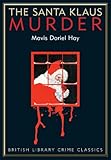
The Santa Klaus Murder by Mavis Doriel Hay

When I saw that The Santa Klaus Murder was available for loan from the Kindle Lending Library I wondered if it was worth looking at. I’d never heard of Mavis Doriel Hay before, but I thoroughly enjoyed reading this book, one of the British Library Crime Classics.

Mavis Doriel Hay (1894-1979) was a novelist of the golden age of British crime fiction. Her three detective novels were published in the 1930s and are now rare and highly collectable books. She was an expert on rural handicraft and wrote several books on the subject.

Summary from the British Library:

A classic country-house murder mystery, The Santa Klaus Murder begins with Aunt Mildred declaring that no good could come of the Melbury family Christmas gathering at their country residence Flaxmere. So when Sir Osmond Melbury, the family patriarch, is discovered€”by a guest dressed as Santa Klaus€”with a bullet in his head on Christmas Day, the festivities are plunged into chaos.

Nearly every member of the party stands to reap some sort of benefit from Sir Osmond’s death, but Santa Klaus, the one person who seems to have every opportunity to fire the shot, has no apparent motive. Various members of the family have their private suspicions about the identity of the murderer, but in the midst of mistrust, suspicion, and hatred, it emerges that there was not one Santa Klaus but two.

My view:

This was first published in 1936 and it is a classic locked room murder mystery. There are lots of suspects, especially as there were rumours that Sir Osmond was about to re-write his will. The story has several narrators, including – Sir Osmond’s daughter, Jennifer and her fiancé, Philip (Sir Osmond has withheld his blessing to their engagement), his daughter Hilda, a widow, Mildred, his sister, Grace, his young and vivacious secretary, and Colonel Halstock, the Chief Constable, investigating the crime. The suspects all seem to have alibis, but are they all telling the truth?

In short, it seems impossible to be sure of anyone’s exact movements during that half-hour.

No one admits seeing anyone enter the study after Oliver Witcombe left Sir Osmond there, until Witcombe returned and found him dead. (page 81)

It is a complicated plot and I enjoyed all the twists and turns. The opening chapters are rather detailed setting out the family background, but the characters all came to life as they arrived at Flaxmere.

There is a map showing the layout of the ground floor of Flaxmere, to help the reader and I kept referring to it as I read, together with the list of characters and their relationships.

To help you even more, if you haven’t worked out who did it there is a Postscript by Colonel Haverstock listing the questions and clues to identify the murderer. So don’t look at the end if you don’t want to know how and why Sir Osmond was murdered.

Hay’s other two murder mysteries Murder Underground and Death on the Cherwell are due to be published in June 2014 – I’ll be looking out for them.
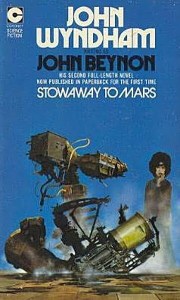
Stowaway to Mars by John Wyndham

Stowaway to Mars by John Wyndham writing as John Beynon, was first published in 1936 as Planet Plane (Newnes Limited, London), then serialised in the periodical The Passing Show as Stowaway to Mars, where it was described as:

an epic serial of the greatest exploration of all … by the man who writes half a century ahead of all the others.

It is set in 1981 when an international prize of £1,000,000 was being offered to the first man to complete an interplanetary journey. Dale Curtance, a British millionaire adventurer takes up the challenge and builds a rocket, the Gloria Mundi. With his crew of four men he blasts off from Salisbury Plain, his destination the planet Mars. Once free of the Earth’s atmosphere they discover a stowaway, a woman, Joan Shirning, the daughter of a professor! She has a strange tale to tell of a machine that her father found, which they believe came from Mars. Having landed on Mars they encounter what appears to be a planet occupied by ‘intelligent self-contained machines’. They claim Mars to be part of the British Commonwealth of Nations, a claim later disputed by the Russians when a second rocket lands.

My copy was published in 1972, with a foreword  stating how right John Beynon was in anticipating the international rivalry for the space race.

Stowaway to Mars is a novel of its time, the male crew members discuss what should be done with their stowaway – they can’t just chuck her overboard, as they would a man! They have a condescending attitude to women thinking that her ‘highest duty is motherhood’. She can be creative, concentrate on producing children rather than machines, because women :

simply have not got the imagination to see the machines as we see them, but they have the power to be jealous of them. … There is nothing good they can say for it. It’s noisy, it’s dirty, it’s ugly, it stinks: and anyway it’s only a jumble of metal bits – what can be really interesting in that? (page 98)

There is a lot of discussion about The Machine and its relationship with Humanity, what it means and what use is made of it. Man’s survival depends on his adaptability and must be willing to break with the past. The reason to venture into space is thought to be to make us wiser, to seek knowledge. Wyndham refers to earlier science fiction writers, such as J J Astor’s Journey in Other Worlds, written in 1894 where he states that ‘the future glory of the human race lies in the exploration of at least the Solar System.’ And Dale and his companions speculate about what they will find on Mars:

It’ll be amusing … to see which of the story-tellers was nearest the truth. Wells, with his jelly-like creatures, Weinbaum, with his queer birds, Burroughs, with his menageries of curiosities, or Stapleton, with his intelligent clouds? And of the theorists, too. Lowell, who started the canal irrigation notion, Lutyen, who said that the conditions are just, but only just, sufficient for life to exist at all. (page 67)

Even though this book is so obviously dated and contains quite lengthy sections theorising about machines, and the existence of life on other planets, I did enjoy it immensely. I really liked the descriptions of Mars, including its history and the reason for the construction of the canals, and the interplay between the characters, although some of them are only sketchily drawn and I couldn’t distinguish between them very easily.

The book ends on an intriguing note, referring to a subsequent tale. To say more would spoil the ending, at least it would have done for me. I don’t think Wyndham actually wrote a sequel, although there is a short story, Sleepers of Mars which deals with the Russians left  stranded on Mars.

John Wyndham’s (1903 – 1969) full name was John Wyndham Parkes Lucas Beynon Harris, and he wrote under several different pseudonyms – John Beynon, John Beynon Harris,  Wyndham Parkes, Lucas Parkes and Johnson Harris.

I’ve had this book for a few years, so it qualifies for Bev’s Mount TBR Challenge and it is the second book I’ve read for Carl’s Science Fiction Experience. It was a really good read and it has got me so interested in finding out more about the history of science fiction itself!

Ordeal by Innocence by Agatha Christie

Agatha Christie wrote in An Autobiography that Ordeal by Innocence and Crooked House were the two books she’d written that satisfied her the best. Neither book features Poirot or Miss Marple, so maybe she had become rather tired of them and had enjoyed introducing completely new characters.

Ordeal by Innocence (The Christie€¦Summary from the back cover of my copy:

According to the courts, Jacko Argyle bludgeoned his mother to death with a poker. Sentenced to life imprisonment, he died behind bars following a bout of pneumonia. Tragically, it was not until two years later that Dr Arthur Calgary came forward with the testimony that could have acquitted Jacko. Worse the doctor’s revelations were about to re-open old wounds in the family, increasing the likelihood that the real murderer would strike again.

My view:

Ordeal by Innocence is thus a stand-alone novel, first published in 1958, unlike the TV adaptation that had Miss Marple (in the form of Geraldine McEwan), solving the mystery.

Dr Calgary was surprised by the reception he received from the family when he visited them to tell them that Jacko was innocent and why he hadn’t come forward at the time to confirm his alibi. Instead of relief he was met with wariness and suspicion as the family members realised that one of them could be the murderer. This is a cold case that they wish had never been re-opened; they had been happy to accept that Jacko, a thoroughly nasty character, was guilty. Only Philip the eldest daughter’s wheelchair-bound husband is keen to discover the murderer’s identity. So, it is up to him, Doctor Calgary, helped by the family solicitor and Superintendent Huish to carry out fresh investigations.

What I liked about Ordeal by Innocence was the way Agatha Christie delved into the family relationships and their characters. Mrs Argyle was one of those mothers who was always right and thought she knew best and at times all her children had rebelled or wanted to rebel against her authority, so all were suspects, along with her long-suffering husband, who since her death was planning to marry his secretary.

The novel is as much about protecting the innocent as punishing the guilty, and the fact that stating your innocence is not proof of it. Calgary has to find the murderer so that the innocent will not suffer from the taint of guilt. Without knowing who was guilty they would have all come under suspicion, destroying their love and trust.

I swung from believing first one, then another character, was the guilty person and was quite taken in by all the red herrings Agatha Christie threw into the book. All is made clear in the last chapter when Dr Calgary presents his findings and reveals the killer. Although I don’t think it is one of Agatha Christie’s best books, I still enjoyed its complexity and admired her skill in plotting this novel.

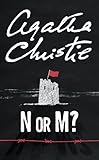
N or M? by Agatha Christie

N or M? is the third of the Tommy and Tuppence stories, set in 1940 and first published in 1941.  Agatha Christie wrote this at the same time as writing The Body in the Library. She explained the reason in her Autobiography:

I had decided to write two books at once, since one of the difficulties of writing a book is that it suddenly goes stale on you. Then you have to put it by, and do other things – but I believed that if  I wrote two books, and alternated the writing of them, it would keep me fresh at the task. One was The Body in the Library, which I had been thinking of writing for some time, and the other one was N or M?, a spy story, which was in a way a continuation of the second book of mine, The Secret Adversary, featuring Tommy and Tuppence. Now with a grown-up son and daughter, Tommy and Tuppence were bored by finding that nobody wanted them in wartime. However, they made a splendid come-back as a middle-aged pair, and tracked down spies with all their old enthusiasm. (An Autobiography by Agatha Christie page 506)

Tommy is asked to go under cover to track down members of the Fifth Column, two of the most important and trusted German agents, whose mission is to infiltrate British society, like the Trojan wooden horse. All that is known is that N is a man and M a woman and they are thought to be at Leahampton on the south coast. He tells Tuppence that he is being sent to Scotland and that she can’t go with him, but she surprises him by being at Sans Souci, a seaside guesthouse in Leahampton, when he arrives. So there they are, both under cover, Tommy as Mr Meadowes and Tuppence as Mrs Blenkensop.

There is definitely something not right about the guesthouse, it has the feel of something sinister, something evil. And it’s not long before Tommy and Tuppence are embroiled in a series of dangerous near-disasters, involving German spies, and Smuggler’s Rest, a cottage with a secret room, set on a cliff overlooking a little cove and ideal for enemy action.

N or M? is an easy book to read and not too demanding. Agatha Christie makes use, as in some of her other books, of nursery rhymes, in this one it’s ‘Goosey goosey gander’, which comes from a Mother Goose picture book Tuppence reads to little Betty Sprot. Of all the characters in the book (apart from Tommy and Tuppence) Betty, a toddler, who speaks her own baby language, is the most well-drawn, so much so that at one point I even found myself wondering if she could be M!!!

One of its attractions for me is its historical setting, although when Agatha Christie wrote this book it was very current, she did not know how the war would end. It is interesting to see how she portrays the general public’s attitude towards the war, about patriotism, and the fear of Fifth Columnists, of spies, and Fascists and Communists. Also of note is that whilst most of the characters thought the war would be over very quickly, which is what I thought was the general consensus at the time, one of them thought it would last at least six years.

Following the publication of N or M? Agatha Christie was investigated by MI5 because she had named one of the characters ‘Major Bletchley’ and MI5 suspected she had a spy in Britain’s undercover code breaking centre, Bletchley Park.

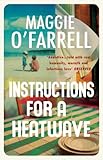
Instructions for a Heatwave by Maggie O'Farrell

I think when I began reading Instructions for a Heatwave that my expectations were too high. I’d anticipated what it would be about, going off the book blurb:

Robert Riordan tells his wife Gretta that he’s going round the corner to buy a newspaper. He doesn’t come back.

The search for Robert brings Gretta’s children – two estranged sisters and a brother on the brink of divorce – back home, each with different ideas as to where their father might have gone. None of them suspects that their mother might have an explanation that even now she cannot share.

I thought the novel would be mainly about Robert’s disappearance and I was wrong, for that isn’t discussed very much until the last quarter of the book. From the opening paragraphs, which I thought were wonderful (see this post) the novel is then concerned with Gretta  and her grown-up children – their childhood years, current situations and their relationships. All of which is fascinating in itself but I wanted to know about Robert. And Robert as a character is only seen through the others’ eyes. I think it was this aspect of the book that bothered me- Robert is not only missing, he is missing from the book itself.

Whilst I was reading this, Ian Rankin’s splendid book, Saints of the Shadow Bible came out and I abandoned Instructions for a Heatwave and lost myself in the Rebus/Fox crime mystery. Coming back to Maggie O’Farrell’s book, I realised that I was approaching it in the wrong way; it’s a character driven book, not plot driven. But, having said that the last quarter of the book, or so, moves much more quickly, things happen and the mystery of Robert’s disappearance is resolved.

The characterisation is very good, I could imagine all the people, and got infuriated at some of their behaviour. They’re not very likeable people but as I read on they did grow on me, especially Aoifa, who has undiagnosed dyslexia! But the heat that was definitely a presence in beginning of the book gets lost as the back story is developed. Whilst I found the mix of present and past tense a bit annoying it certainly clarified what were and what weren’t flashbacks.

I’m still in two minds about the book, for me it was both disappointing and compelling reading.  I would really like to re-read this book some time, now I know what to expect and think maybe I’d appreciate more. It’s shortlisted for the 2013 Costa Novel Award, along with Life After Life by Kate Atkinson (I have an unread copy), Unexpected Lessons in Love by Bernardine Bishop (who died in July), All the Birds, Singing by Evie Wyld. I’d like to read all these! The winner will be announced on 6 January 2014.

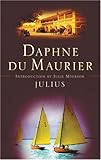
Julius by Daphne du Maurier

Daphne du Maurier’s Rebecca was one of the first adult books that I remember reading and it has remained a favourite ever since I first read it. It led me on to read more of her books and in my teens and twenties I read and re-read Jamaica Inn, Frenchman’s Creek, The Scapegoat, Mary Anne and The King’s General. They were the type of books that I loved.

Later on I discovered that she had written many more books and I’ve gradually been reading them, but, with perhaps the exception of My Cousin Rachel, they have not had the same magic quality that had kept me enthralled in the past. So I wasn’t quite sure what to expect when I began reading Julius, her third book written when she was twenty-six. It may lack that magic quality of her later books, but it is still compelling and disturbing reading, rich in detail and characterisation.

Julius (originally published in 1933 as The Progress of Julius) is the life story of a ruthless man, driven by his lust for power, and his dedication to getting ‘something for nothing’. It’s a chilling tale about a man whose love for his daughter brings about his ruin.

But that is jumping ahead in the story. It begins with his birth in Paris in 1860. Julius Levy grows up in a peasant family in a village on the banks of the Seine and caught up in the Franco-Prussian War, he escapes to Algeria, where he learns to swindle and manipulate. He moves on to London, all the time scheming and making money, getting richer, regardless of who he hurt, or indeed of whose death he caused as he built up his empire of cafés and married Rachel, the daughter of a diamond merchant.

It’s a dramatic story covering the years 1860 -1932, as the old century ended and the new one began:

Now came the close of the century and the death of the Queen followed by peace in South Africa, and these things also served as a milestone in the life of Julius Lévy. They marked the end of an era  showing him the path to greater prosperity than he had as yet achieved. It was the beginning of a new age – the age of progress and speed and efficiency that he had long foreseen and the dawn of mechanism in all things, electricity, motor-cars and soon flying-machines in the air. The spirit abroad was one he understood, the demon of restlessness unsatisfied stretching hungry fingers to the skies in a superhuman effort to conquer insatiable hunger, a spirit of rapacity and greed and excitement burning like a living flame. (page 195)

Julius is half-Jewish and the book veers on anti-Semitism, indeed in later years Daphne du Maurier considered excising those elements from the novel. But that would have meant the novel would have lacked depth as it is his Jewishness that lifts him from being a complete monster. As a mixed-up, lonely child he found in the temple that he was among his own people, and the music took hold of his heart, giving him peace. It is his tragedy that he lost that peace and struggled throughout the rest of his life trying to re-capture it.

His love for his daughter, Gabriel overwhelms him, but it is a possessive, suffocating love that leads him to extremes. His inability to love without the need to possess and control is shown early on in the book when forced to leave home and unable to take his cat he ties a stone around her neck and throws her in the Seine, rather than leave her to fend for herself or for someone else to take care of her. That made me shudder, but it is little compared to how he treated people.

I’ve read that Du Maurier based the character of Julius on that of her father, Gerald, that the possessiveness, the emotional demands and the sentiments Julius expresses were Gerald’s, and the words Gabriel speaks were her own thoughts. (Daphne du Maurier by Margaret Forster page 84)

At times melodramatic, this is a powerful novel, of a deprived, starving child who sold rats on the streets of Paris, and who dragged himself up from poverty and obscurity to become a man of  wealth and status and a cold-blooded sadist and murderer. I wrote about the beginning  of the book in an earlier post, describing how as a baby he was reaching for things beyond his grasp. The book ends as it began with Julius still reaching for the clouds:

He cried to them and they did not come. They passed away from him as though they had never been, indifferent and aloof, like wreaths of smoke they were carried away by the wind, born of nothing, dissolving into nothing, a momentary breath that vanished in the air. (page 308)