Playing With Fire by Peter Robinson

I wrote about the opening of Playing With Fire in my Tuesday post.  I’ve watched the TV version of DCI Banks, (although I don’t remember this seeing this particular one) but there are changes in the televised versions and to my mind the books are better – but then I always think that.

Synopsis (from the back cover)

In the early hours of a cold January morning, two narrow boats catch fire on the dead-end stretch of the Eastvale canal. When signs of accelerant are found at the scene, DCI Banks and DI Annie Cabbot are summoned. But by the time they arrive, only the smouldering wreckage is left, and human remains have been found on both boats.

The evidence points towards a deliberate attack. But who was the intended victim? Was it Tina, the sixteen-year-old who had been living a drug-fuelled existence with her boyfriend? Or was it Tom, the mysterious, lonely artist?

As Banks makes his enquiries, it appears that a number of people are acting suspiciously: the interfering ‘lock-keeper’, Tina’s cold-hearted step-father, the wily local art dealer, even Tina’s boyfriend . . . Then the arsonist strikes again, and Banks’s powers of investigation are tested to the limit . .

My thoughts

I’ve been reading Peter Robinson’s DCI Banks books totally out of order and as I began this one I thought that I’d read the next book in the series a few years ago. One of the benefits of writing a book blog is that I can look back and see what I thought about a book just after I’d read it, instead of having to rack my brain trying to remember. On checking back (nearly five years ago!) I found that I had indeed read the next book – Strange Affair and had thoroughly enjoyed it.

I liked Playing With Fire too, although maybe not quite as much as Strange Affair. It’s a complicated plot and at times I had to remind myself who the various characters were. I did get a bit fed up with reading about what music Banks is playing but I liked the way his relationship with Annie Cabbot is portrayed and the insights into how his mind works.

I thought I’d spotted who the killer was quite early on and was pleased to see at the end that I was right, although I thought Banks should also have spotted it earlier!

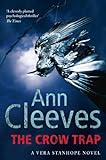
The Crow Trap by Ann Cleeves

The Crow Trap by Ann Cleeves is the first book in her Vera Stanhope series. I’ve been thinking (and writing) about my difficulties in reading books where I think the detail and description swamp the characters and plot, but I had absolutely no problems with that in The Crow Trap – I think Ann Cleeves has got the balance just right.

It begins with chapters about three of the female characters, Rachael, Anne and Grace all staying at Baikie’s an isolated cottage on the North Pennines whilst they carry out an environmental survey. When Rachael arrives at the cottage she is confronted by the body of her friend Bella Furness, who it appears has committed suicide. I was so drawn in by the character portraits and the vivid descriptions of the setting, that I almost forgot that this is a murder mystery. Then Grace is found dead and the mystery really begins.

There is a full cast of characters, all clearly distinct, and a very intricate and clever plot, with plenty of red herrings subtly masking the important clues. Vera is a great character and even though I do like Brenda Blethyn’s portrayal of her in the TV series, I prefer her as she is in the books –  a woman in her fifties, who looks like a bag lady. Here’s a description of her when she first interviews Rachael and Anne:

She was a large woman – big bones, amply covered, a bulbous nose, man-sized feet. Her legs were bare and she wore leather sandals. Her square toes were covered in mud. Her face was blotched and pitted so Rachael thought she must suffer from some skin complaint or allergy. Over her clothes she wore a transparent plastic mac and she stood there, the rain dripping from it onto the floor, grey hair sleeked dark to her forehead, like a middle-aged tripper caught in a sudden storm on Blackpool prom. (page 230)

And this description too:

Vera was wearing a dress of the sort of material turned into stretch settee covers and advertised in the Sunday papers. (page 406)

The identity of the killer foxed me. I kept changing my mind about who I thought it was and when it was revealed I was surprised, because although I’d worked out the motive, I’d got the circumstances completely wrong!

The My Kind of Mystery theme began on 1 February and this book really is ‘my kind of mystery’. A most satisfying book.

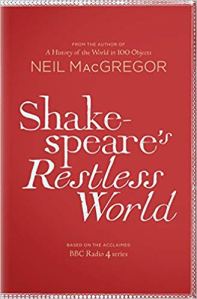
Shakespeare's Restless World by Neil MacGregor

Shakespeare’s Restless World was an impulse buy last year. I saw it on display at Main Street Trading bookshop, took it down off the shelf to look at it whilst having lunch there and then couldn’t resist buying it. It’s such a beautiful book recreating Shakespeare’s world through examining twenty objects. It reveals so much about the people who lived then, who went to see Shakespeare’s plays in the 1590s and 1600s, and about their ideas and living conditions.

The objects include an iron fork  found, when the Rose Theatre on the south bank of the river Thames was excavated, in the remains of the theatre’s inner gallery walls, relics, medals, gold objects, a rapier and a dagger and strange objects such as an eye relic mounted in silver, complete with photos and illustrations. Through looking at each object MacGregor explores a number of themes, not just the theatre, but including what people ate whilst watching plays, religion, medicine, the plague, magic, city life, treason, and the measuring of time amongst other topics. It’s all fascinating and informative, and easy to read. There are plenty of quotations from Shakespeare’s plays and puts both him and his work into context. For me, it was a new way of seeing into the past, which I missed when the series was broadcast on BBC Radio4.

It may seem strange to include this book in the Read Scotland 2014 challenge, but Neil MacGregor, the Director of the British Museum, was born in Glasgow and the challenge is to “read and review Scottish books -any genre, any form- written by a Scottish author (by birth or immigration) or about or set in Scotland.”

I would have read this book in any case, but I was pleased to find that there are sections in it that fit very well into the challenge, including a chapter on Shakespeare’s ‘Scottish Play’ ie Macbeth. Shakespeare lived through a period of great change for Britain, not only the changes to be expected through the passage of time, but also changes nationally and politically with the death of Elizabeth I. The big question of the day in the 1590s was the constitutional question of who would succeed her, but in England the Treasons Act of 1571 forbade any discussion of the succession.  But dramatists addressed this through their plays – such as Shakespeare’s dramatization of the Wars of the Roses.

MacGregor covers James VI of Scotland’s succession to the English crown in 1603, bringing the whole island of Britain under one rule for the first time.  It was not clear then how things would change:

Everybody knew that with James as King of England and King of Scotland a new political world had been born. But it was not at all clear how things were going to change. …

But making a new nation turned out to be very difficult. For much of the previous 300 years England and Scotland had been at war; they had very different political and legal systems, a different established church, different currencies, separate parliaments and a long history of intense dislike and deep suspicion. James’s central ambition was to make two very foreign countries into one new state, with a new name – Great Britain.

The succession of James VI of Scotland to the English throne in 1603 created a dynastic union, and a personal union of political authority, but it did not create a union of the crowns in constitutional, legal, ecclesiastical or economic terms. Forging such a union was James’s paramount aim. (pages 204 – 205)

It was another hundred years before the formal Act of Union united England and Scotland into one state of Great Britain. These days Scotland is currently debating whether to break the union and once again things are very unclear – how will things change if Scotland becomes an independent state?

This post is also my contribution to The Classics Club’s event Shakespeare in January, as well as qualifying for the Mount TBR Challenge 2014.nIt’s also the first non-fiction book I’ve read this year.

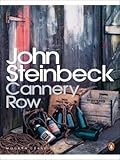
Cannery Row by John Steinbeck

As soon as I began reading Cannery Row I thought I could be in for a treat – this is the opening sentence:

Cannery Row in Monterey in California is a poem, a stink, a grating noise, a quality of light, a tone, a habit, a nostalgia, a dream.

There are some books that begin well and then tail off so I was hoping this wouldn’t be one of those. There are some books, just a few, that have everything, rich descriptions of locations, wonderful characters and a storyline, even though in this book it’s really a series of stories with a thread running through to connect them to the whole, that grabs my attention and makes me want to know more. Cannery Row is just such a book.

I knew nothing about the book before I began reading (it’s my book group choice) and that made it even more enjoyable. Steinbeck’s style is perfect for me, I could see Cannery Row itself, a strip of Monterey’s Ocean View Avenue, where the Monterey sardines were caught and canned or reduced to oil or fishmeal, along with all the characters – no, it was more than that -I was there in the thick of it, transported in my mind, whilst I was reading and even afterwards as I thought about the novel.

The characters include a group of down and outs, lead by Mack, whose well intentioned actions usually end in disaster for himself and others. Then there is the shop keeper, Lee Chong, who also owns the Palace Flophouse where he lets Mack and the boys live, Dora, a woman with flaming red hair, the madam who runs the Bear Flag Restaurant, Doc who lives and works at the Western Biological Laboratory and Henri the painter who is building and never finishing a boat. There is humour and tragedy, meanness and generosity, life and death all within Cannery Row‘s 148 pages.

I loved this description of Cannery Row:

Early morning is a time of magic in Cannery Row. In the gray time after the light has come and before the sun has risen, the Row seems to hang suspended out of time in a silvery light. The street lights go out and the weeds are a brilliant green. The corrugated iron of the canneries glows with the pearly lucence of platinum or old pewter. No automobiles are running then. The street is silent of progress and business. And the rush and drag of the waves can be heard as they splash in among the piles of the canneries. It is a time of peace, a deserted time, a little era of rest. Cats drip over the fences and slither like syrup over the ground looking for fish heads. (page 64)

This paragraph continues in the same vein for almost a whole page. For me it conjures up such a vivid picture of the place, its light and sound and the sentence comparing the movement of cats dripping and slithering like syrup is just perfect.

It’s not just a visual delight, the book contains many gems, the frog collecting expedition and the party scene that end in chaos and wreckage, and the words of wisdom from Doc. Here is just one example:

‘It has always seemed strange to me,’ said Doc. ‘The things we admire in men, kindness and generosity, openness and honesty, understanding and feeling are the concomitants  of failure in our system. And those traits we detest, sharpness, greed, acquisitiveness, meanness, egotism and self-interest are the traits of success. And while men admire, the quality of the first, they love the produce of the second.’ (page 107)

This is the best book I’ve read so far this year and one I shall read again. I loved it and I definitely want to read more of Steinbeck’s books (I may have read, or at least started to read The Grapes of Wrath when I was at school and didn’t appreciate it at the time – the opening seems so familiar!).

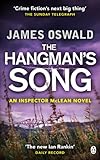
The Hangman's Song by James Oswald

The Hangman’s Song by James Oswald is the third in his Inspector McLean series set in Edinburgh.

DI McLean, seconded to the Sexual Crimes Unit (SCU) by Acting Superintendent Charles Duguid (nicknamed Dagwood) finds himself working on two separate cases – one for the SCU  investigating a group of prostitutes and the subsequent death of their pimp, Malky Jennings, who was beaten to death – and the second, two suicides, which he and his DC, MacBride consider to be suspicious, and continue to investigate against Duguid’s instructions.

I think you need to have read the first two books in the series to fully understand the background or at least have read their synopses, as I found some elements of this book confusing – a small example being the name of the Acting Superintendent and his nickname, as it is not clear that Duguid and Dagwood are one and the same person. At times both names were used within a few paragraphs, making me think they could be two people.

The Hangman’s Song is a dark, tense book; crime fiction with elements of the supernatural  and parapsychology thrown in. The police force is undergoing great change as it prepares for unification as Police Scotland, adding to McLean’s own difficulties with his colleagues, most of whom dislike him, regarding him as a pain in the arse and a troublemaker. He views them as incompetent, lazy and in some cases corrupt. I did get a bit tired of his constant battle with Duguid, which detracted from the story at times. All is not well in McLean’s private life either. His girlfriend Emma (who was nearly killed in the previous book, The Book of Souls) comes out of a coma, but she has lost most of her memory, regressing to an eight-year old. She moves into McLean’s house to help with her recovery.

It is a complicated book with three storylines to keep in mind, and a large cast of characters, not all of them clearly distinguishable. It’s not a book for the faint-hearted or the squeamish as there are details of some gruesome deaths, murders and beatings that the characters go through. At times I had to read with my imagination turned down – a bit like watching something gory on TV from behind my fingers.

Having said that, it was still a compelling, if disturbing, book (particularly the last chapter) that kept me turning the pages to find out what happened next.

James Oswald runs a 350 acre livestock farm in north-east Fife. In addition to his DI McClean books he has also written a fantasy series, The Ballad of Sir Benfro, set in Wales. I have the first book in the series, Dreamwalker, which I have yet to read.

Thanks to www.lovereading.co.uk for the uncorrected advance proof of this book for review. The published book will be available in February 2014.

Not Dead Enough by Peter James

I read the first Detective Superintendent Roy Grace book, Dead Simple nearly two years ago now and have been meaning to read more of the books, so because I’m now concentrating on reading books I’ve owned before 1 January 2014 I thought it was time to read Not Dead Enough by Peter James. It’s the third Roy Grace book and whilst I don’t think it’s as good as Dead Simple I still enjoyed it – mainly because of the characterisation and the detail James goes into. It’s a long book and I see on Amazon that it’s been criticised for being too long and too detailed, but I liked that. For me it gave added interest and verisimilitude. Some people also criticised it because it has short chapters – to my mind that’s much better than having long chapters!

It’s set in Brighton and begins with the murder of Katie Bishop. The immediate suspect is her husband Brian Bishop, but it appears that he couldn’t be the murderer unless he could have been in two places at once. Then Sophie Harrington is killed. She had been having an affair with Brian thus intensifying the police investigation into his movements and background.

James takes his time setting out the details and the characters, so it’s quite slow to start off, but then the pace picks up, which makes this a quick read as I really wanted to know what happens next. It isn’t difficult to work out who the murderer is, but this didn’t lessen my enjoyment  – and there is just a little twist at the end that I hadn’t foreseen earlier on.

Roy Grace comes across as a real character, concerned about his work and his colleagues, even if he doesn’t get on too well with his boss, ACC Alison Vosper. Grace’s wife, Sandy, had disappeared nine years earlier and he is still wondering what happened to her even though he is now involved with Cleo Morey, the Chief Mortician and he takes a quick trip over to Munich when his friends tell him they had seen her there. This takes his attention away from the murders and he has to defend his visit to Vosper.

This is very much a police procedural, detailing how the detectives go about their work, including Grace’s ideas about whether eye movements indicate whether a person is telling the truth, which I’ve read about before, and what happens when a person is charged and arrested, which I know very little about (only from books and TV – and want to keep it that way)!