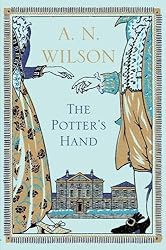
The Potter's Hand by A N Wilson

Now that the TBR Triple Dog Dare has finished I am free to read anything I want. I have bought/borrowed a few books since the beginning of the year and I immediately turned to The Potter’s Hand by A N Wilson, a library book I borrowed in March and fortunately I’ve been able to renew it. I had actually read the first couple of chapters, because I just couldn’t stop myself once I’d glanced at the dramatic opening paragraph, which I wrote about in a Book Beginnings post in March, but I resisted reading any more until April!

The novel begins in 1768 and roughly follows the fortunes of the Wedgwood family until 1805, 10 years after the death of Josiah Wedgwood, an English potter and the founder of the Wedgwood company. I say roughly because the narrative moves back and forth in time and place. It is a most remarkable book, which kept me wanting to read it each time I had to stop reading – it’s a long book which took me several days to read.

As Wilson explains in an Afterword the broad outlines of the story and most of the details are true, but he has altered dates and rearranged historical events and nearly all the letters are invented. It is ‘meant to be read as fiction, even thought it is intended in part, as an act of homage to one of the great men of our history.’

For me it really did convey what it must have been like to live in that period – whilst the the American War of Independence, the French Revolution, were taking place. It was a time of great change (what time isn’t?) both social and political change as the industrial revolution got under way in England. It’s full of ideas about colonialism, the abolition of slavery, working conditions, and women’s rights. It brought about small changes as well as big ones – for example, before Josiah’s time many families ate off pewter plates or wooden platters, but with his production of creamware ‘there was hardly a respectable household in the kingdom which did not eat its dinner off well-glazed delicate plates.’

Wedgwood’s fame was international and resulted in an order to supply Catherine the Great, the Empress of Russia with an enormous dinner service – the Frog Service, decorated with illustrations of grand houses, scenes of country estates, parks and gardens and numerous other British landscapes. And his great creation towards the end of his life was the Portland Vase, a copy of the original cameo glass Roman vase. But Wedgwood was not only a master craftsman, he was also involved with his friends – philosophers, scientist and inventors – in the development of the canals and roads improving transportation as his factory grew and prospered .

It’s big on character (lots of them), the main ones being Josiah Wedgwood himself, ‘Owd Wooden Leg‘, his daughter Sukey, his nephew Tom Byerley, his childhood friend Caleb Bowers and Blue Squirrel, an American Cherokee Tom fell in love with in America. But there are plenty more who come in and out of the narrative along the way, both fictional and historical, including Voltaire, George Stubbs (who painted the Wedgwood family portrait) and Samuel Taylor Coleridge. I was particularly interested in Dr Erasmus Darwin, Charles Darwin’s grandfather, with his stammer and familiar way with his lady patients (if Wilson’s depiction is true to life) and his ideas on creation and evolution.

Overall it is the story of a remarkable family, their lives, loves, work, illnesses, depressions, addictions and deaths. I found it fascinating throughout, whether it was set in America during the fight for independence, or in England in Wedgwood’s factories, or his grand new house Etruria Hall, or travelling through England on the new canals.

The Time Machine by H G Wells

This morning the clocks went forward – does that mean we lost an hour? Quite by coincidence yesterday I read The Time Machine – it seems apt!

The Time Traveller has gathered together a group of his friends, who have names such as the Psychologist, the Editor, the Provincial Mayor and so on. First of all he treats them to an explanation of time – of how it is the fourth dimension, ‘with Time as only a kind of Space.’ He then tells them that he intends to explore time in a machine he has invented that transports him back and forth in time.

And to prove it he travels to the future – specifically to the year 802,701 where humanity has evolved into the Eloi, who are pretty little childlike people, strict vegetarians who live above ground and the Morlocks, bleached, obscene nocturnal beings who live underground. Their society is divided between these two – industry being carried out underground by the Morlocks and the Eloi above pursing pleasure and comfort.

On his return he describes his adventures. He was:

 … in an amazing plight. His coat was dusty and dirty and smeared with green down the sleeves; his hair disordered, and as it seemed to me greyer – either with dust or dirt of because its colour had actually faded. His face was ghastly pale; his chin had a brown cut on it – a cut half-healed; his expression was haggard and drawn, as if by intense suffering. … He walked with just such a limp as I have seen in footsore tramps. (page 15)

Whilst describing what happened to him the Time Traveller comments on the society he encountered. At first he thought it was a social paradise, but soon he realised the truth, that the perfection of comfort and security had actually resulted in the weakening of society with no need to struggle for survival or for work. And the truth about the relationship between the Eloi and Morlocks was devastating!

In addition he had soon realised that he had gone into the future particularly ill-equipped – without anything to protect himself, without medicine and without anything to smoke, or even without enough matches! And no camera:

If only I had thought of a Kodak! I could have flashed that glimpse of the Under-world in a second, and examined it at leisure. But, as it was, I stood there with only the weapons and the powers that Nature had endowed me with – hand, feet, and teeth; these, and the four safety matches that still remained to me. (page 69)

I was struck by Wells’s descriptions of the divisions in society between the Haves and the Have-nots and the conditions of the working class as a result of industrialisation in his own time, citing the new electric railways, the Metropolitan Railway in London, the subways and underground workrooms and restaurants:

Even now, does not an East-end worker live in such artificial conditions as practically to be cut off from the natural surface of the earth?

Again, the exclusive tendency of richer people – due, no doubt, to the increasing refinement of their education, and the widening gulf between them and the rude violence of the poor – is leading to the closing, in their interest, of considerable portions of the surface of the land. About London, for instance, perhaps half of the prettier country is shut in against intrusion. (page 62)

So, The Time Machine, which was first published in 1895, is a work of imagination and an early example of science fiction, but it is also a commentary on late 19th century society and a vehicle for H G Well’s views on socialism and industrialisation.

It’s a book I’ve had for a couple of years and so qualifies for the Mount TBR Reading Challenge and after I finished it I realised that it also fits in the ‘Time’ category for the What’s In a Name? Challenge too.

They Do It With Mirrors by Agatha Christie

I’m slowly reading my way through Agatha Christie’s books, not in chronological order, but just as I come across them and this month I’ve read They Do It With Mirrors which was first published in 1952.

I don’t think it’s one of her best, but I did like it. It begins with Miss Marple reminiscing with an old friend, Mrs Ruth Van Rydock, an American. Miss Marple has known her and her sister, Carrie Louise since they had been together at a pensionnat in Florence. Ruth is worried about Carrie Louise, who is now living in a country house in the south of England with her husband, Lewis Serrocold, which he has turned into a home for delinquent boys. She can’t put her finger on what is wrong, she just felt the atmosphere wasn’t right, whether it was the boys’ home – ‘those dreadful young delinquents‘ or something else and she asks Miss Marple to visit Carrie Louise to see if her fears are justified.
Miss Marple finds an unhappy household, including Mildred, Carrie Louise’s widowed daughter, Stephen and Alex, her stepsons, and Gina, her adopted daughter’s daughter, married to an American, Wally Hudd. Lewis Serrocold is Carrie’s third husband, described by Ruth as a

‘crank’, a ‘man with ideals’, ‘bitten by the bug of wanting to improve everybody’s lives for them. And, really you know, nobody can do that but yourself.’

All is not well with the boys either – one of them, Edgar Lawson is suffering from delusions, saying his father is Churchill and then that he is Montgomery. He loses control and Lewis takes him into his office, but their raised voices are heard by the others, culminating in the sound of gunshots. But it is not Lewis or Edgar who is killed, but one of the trustees of the home, Christian Gulbrandsen, the brother of Carrie Louise’s first husband who was alone in his study. So Ruth’s fears materialise when Christian is found shot dead and it seems that someone is trying to poison Carrie Louise.

As I expected from the title not everything is as it appears.  The layout of the house is of importance and there is a plan showing how the rooms are connected, but even so I was still in the dark. I hadn’t worked out who the murderer is and had even ruled out the person in question quite early on in the book. Miss Marple, however, was not deceived and had sorted out the reality from the illusion and seen through the misdirection.

… all the things that seemed to be true were only illusions. Illusions created for a definite purpose – in the same way that conjurers create illusions to deceive an audience.

There are a number of points that struck me as interesting as I read the book, not essential to the plot, but maybe revealing Agatha Christie’s opinions and her views of post-war society. There is the subject of self-help and the issue of expecting things to be granted as a right, focussing on providing education for the juvenile delinquents by men crazy with enthusiasm like Lewis Serrocold:

One of those men of enormous will power who like living on a banana and a piece of toast and put all their energies into a Cause.


She makes the point that just because a person comes from a deprived background doesn’t mean they’re going to turn into criminals and it is the honest ones who could do with a start in life – ‘But there, honesty has to be its own reward – millionaires don’t leave trust funds to help the worthwhile.’

There are comments on the oddness of the English, being prouder of defeats and retreats than of their victories, using Dunkirk as an example and the Charge of the Light Brigade. At the same time as I was reading this I was also reading Jeremy Paxman’s The English: a Portrait of a People, in which he also comments on this trait – turning the consequence of catastrophe into a ‘victorious retreat’.

On a more personal level there are her views on the vulnerability of women:

Women have a much worse time of it in the world than men do. They’re more vulnerable. They have children and they mind – terribly – about their children. As soon as they lose their looks, the men they love don’t love them any more. They’re betrayed and deserted and pushed aside.


I can’t help thinking that really was Agatha Christie speaking from experience.

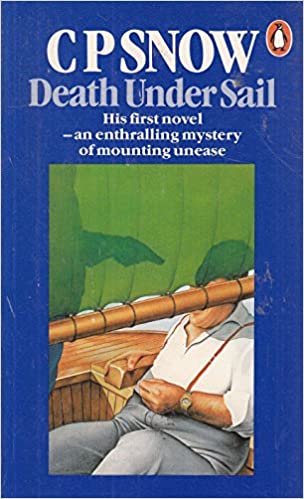
Death Under Sail by C P Snow

I didn’t know that C P Snow had written crime fiction. I’d read some of his books many years ago – the Strangers and Brothers series, in which he had coined the phrase ‘the corridors of power‘. I won Death Under Sail, Snow’s very first novel, in one of Bev’s Mount TBR Checkpoints at My Reader’s Block last year! It was first published in 1932, when Snow was 26 and a research scientist at Cambridge.

This is a classic mystery, a type of ‘country house’ mystery, but set on a wherry (a sailing boat) on the Norfolk Broads, where Roger Mills, a Harley Street specialist, is taking a group of six friends on a sailing holiday. When they find him at the tiller with a smile on his face and a gunshot through his heart, all six fall under suspicion.

The book is narrated by Ian Capel, who is older than the other friends and has joined the party a week later than the others. They are all old friends, with the exception of Tonia, Philip’s new girl friend, who all get on very well together; Avril and Christopher are engaged and William is a young doctor, a colleague of Roger’s. Ian describes them as ‘some of the pleasantest people whom I had ever known‘ – but are they, because one of them must be the murderer?

Ian asks his old friend Finbow, a civil servant home on leave from Hong Kong, to help them discover who did it. Meanwhile the police are also investigating the murder in the form of Detective Sergeant Aloysius Birrell. Finbow and Birrell provide an interesting contrast in the way they work – Finbow looks at the crime from a psychological and philosophical point of view, ruling out suspect after suspect, whereas Birrell looks for facts and evidence – even down to diving into the river himself to look for the missing gun and Roger’s log book. It’s ingenious!

C P Snow (1905 – 1980) was an English novelist and physicist. He was knighted in 1957 and made a life peer in 1964. His last novel, A Coat of Varnish is also crime fiction.

Ethan Frome by Edith Wharton

Ethan FromeWhat a fantastic book. Ethan Frome is a beautifully told tale – a tragedy, signalled right from the beginning of the book, when the unnamed narrator first saw Ethan Frome and was told he had been disfigured and crippled in a ‘smash up’, twenty four years earlier. Life had not been good to him:

Sickness and trouble: that’s what Ethan’s had his plate full up with ever since the very first helping.

I was a bit wary as I began reading Ethan Frome because I’d not long finished reading Doris Lessing’s The Grass is Singing and didn’t want to sink into another bleak and dismal book. I needn’t have worried, even though Ethan Frome is a tragedy there is light to contrast the darkness, and there is love and hope set against repression and misery. It’s another book (like The Grass is Singing) where I hoped the ending would be a happy one, although I knew it couldn’t be. 

It’s a short book (just over 120 pages) and deceptively simple to read, but there is so much packed into it. I enjoyed it very much.  As well as striking and memorable characters the setting is  beautifully described – a ‘mute and melancholy landscape, an incarceration of frozen woe‘, in the isolated village of Starkfield (a fictional New England village). Trapped in an unhappy marriage, Ethan’s life had changed when his father died and he had had to give up his studies to work on the farm. His wife Zeena had always been ill and needing help in the house, which was why her cousin Mattie came to live with them. At first it worked out quite well, but Ethan can’t shrug off a sense of dread, even though he could

… imagine that peace reigned in his house.

There was really even now, no tangible evidence to the contrary; but since the previous night a vague dread had hung on the sky-line. It was formed of Zeena’s obstinate silence, of Mattie’s sudden look of warning, of the memory of just such fleeting imperceptible signs as those which told him, on certain stainless mornings, that before night there would be rain.

His dread was so strong that, man-like, he sought to postpone certainty.

Edith Wharton (1862 – 1937) was an American author. Ethan Frome was first published in 1911 and is in contrast to some of her other books about the New York society of the 1870s to 1920s. It’s a rural tragedy of inevitable suffering and sadness that reminded me of Thomas Hardy’s books.

This book was the Classics Club Spin book for February/March and qualifies in the What’s in a Name 2014 in the Forename/Name category. It’s also a book I’ve owned before 1 January 2014 so is another book for the Mount TBR challenge.

The Thirty-Nine Steps by John Buchan

Way back in 2008 I watched The 39 Steps on TV with Rupert Penry-Jones as Richard Hannay, so inevitably as I read The Thirty-Nine Steps I could see Penry-Jones as Hannay. The dramatisation, however, although there are similarities, is different from John Buchan’s book. There are a number of historical inaccuracies and some artistic licence was used – none of which I was aware of as I watched the film and I thoroughly enjoyed it. It made me want to read the book and it’s taken me until now to get round to it – I’d forgotten most of the details of the film, except for visions of Penry-Jones running away from his pursuers in the Scottish moors, scrambling through the heather.

John Buchan 1936

John Buchan began writing The Thirty-Nine Steps in 1914; it was first published in 1916. He was born in Perth in 1875 and after leaving Oxford University he had a varied career, as well as writing books and articles he was a barrister, a member of Parliament, a soldier and a publisher. He was created Baron Tweedsmuir of Elsefield in 1935 and became the 15th Governor-General of Canada, a position he held until his death in 1940.

Once I began reading The Thirty-Nine Steps I didn’t want to put it down. It’s a fast moving action-story, beginning with an international conspiracy, involving anarchists, financiers and German spies. Richard Hannay, having found Scudder, murdered in his London flat, fears for his life and goes on the run, chased by villains in a series of exciting episodes, culminating in the discovery of the location of the ‘thirty-nine steps’. Hannay is a remarkable character, resourceful, and a master of disguise. As well as fleeing for his life he is searching for Scudder’s notebook, which contains clues to the international conspiracy – Scudder was a spy.

The master villain is also a master of disguise, having the ability to ‘hood his eyes like a hawk‘ :

There was something weird and devilish in those eyes, cold, malignant, unearthly, and most hellishly clever. They fascinated me like the bright eyes of a snake. (page 119)

He can impersonate the British First Sea Lord at a top secret meeting with people who knew the real First Sea Lord very well and is also convincing as the very British gentleman, the plump, bridge-player Percival Appleton.

The Thirty-Nine Steps is to my mind a gem. There are other Hannay books – the Complete series is available on Kindle, The Thirty-Nine Steps, Greenmantle, Mr. Standfast, The Three Hostages, and The Island of Sheep.

And so one book leads on to yet more books!