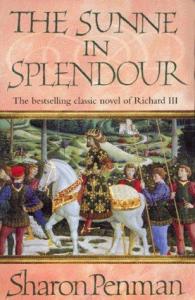
The Sunne in Splendour by Sharon Penman

Richard III (1452 – 1485), that controversial king – what was the truth about him? Did he murder his nephews, the ‘Princes in the Tower’, was he deformed, with a withered arm, a hunch back and a limp as Shakespeare portrayed him, was he a cold-blooded, evil villain? Or has he been maligned and been turned into a  monster who killed his brother’s sons in order to take the Crown?

I remembered merely the brief details about the Wars of the Roses, the conflict between the houses of York and Lancaster for the throne of England,  from my school history lessons and only became interested in Richard III years later when I read Alison Weir’s non-fictional The Princes in the Tower, which examined the available evidence and came to the conclusion that Richard III was responsible for their deaths. Some years later I read Josephine Tey’s novel The Daughter of Time, which also investigates his role in the death of his nephews and his own death at the Battle of Bosworth and concluded that Richard hadn’t murdered his nephews.

The discovery of his skeleton buried beneath a car park in Leicester in 2012 revealed that although ‘the curved spine on the skeleton does show he had Scoliosis, he did not have a withered arm or other details attributed to him in some characterisations’ (see the Incredible Discovery at the King Richard III Visitor Centre ).

But it wasn’t the discovery of his skeleton that nudged me into reading  The Sunne in Splendour, Sharon Penman’s detailed historical novel, first published in 1982. It was watching A Game of Thrones, which is based in part on the Wars of the Roses – Stark and Lannister/York and Lancaster etc.

1192920

The Sunne in Splendour is a fascinating novel about his life from his childhood to his death at Bosworth Field in 1485. Much has been written about Richard, from the time of his death onwards, that Sharon Penman points out has to be considered in the light of the writers’ bias, stating in her Author’s Note at the end of the book:
I once came upon the definition of history as ‘the process by which complex truths are transformed into simplified falsehoods’. That is particularly true in the case of Richard III, where the normal medieval proclivity for moralizing and partisanship was further complicated by deliberate distortion to suit Tudor political needs.’ (page 884)

She states that she had tried to be as accurate as possible, drawing upon facts that are not in dispute, relying on contemporary chroniclers, and when dealing with conflicting accounts ‘to choose the one most in accord with what we know of the people involved.’ 

I think this is one of the best historical novels that I’ve read. It is full of detail, but her research sits very lightly in this book, none of it feels like a history lesson, and it all brings Richard’s world to life. Penman portrays a very likeable Richard, from his childhood onwards he comes across as a kind, generous and brave man, a skilled leader on the battlefield, a loving husband to his wife, Anne, and devoted and loyal to his brother, Edward IV, who was by no means a saint. I particularly liked the way Penman showed his relationship with his family, especially with his brothers Edward and George, the Duke of Clarence.

I could easily visualise the battle scenes, that eventually brought the Wars of the Roses to an end and was fascinated by the view of Henry Tudor (Henry VII) – I’d like to know more about him. It’s his view of Richard that prevailed after his accession to the throne. During his life Richard he had a good reputation and was loved, particularly in the North of England. But he fell victim to treachery and intrigue.

One of the drawbacks of reading historical fiction is that if you have any knowledge of the period you know the eventual outcome. Penman’s skill is such that even though I knew Richard was killed at the battle of Bosworth Field I kept hoping he would survive and defeat Henry Tudor.

As for her solution to who killed the princes, that is one spoiler I’m not going to reveal – I was convinced though by her version of events. I think The Sunne in Splendour is a brilliant book, I was absolutely gripped by it and was sad when I came to the end. It’s a long book, nearly 900 pages and it took me a while to read it, but never once did I think it was too long, or needed editing. I loved it.

Reading Challenges: Mount TBR Reading Challenge – a book I’ve left too long unread as it’s been on my shelves for 5 years!

The Man Who Would Be King by Rudyard Kipling

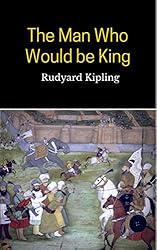
For me the book chosen for the current Classics Club Spin is The Man Who Would Be King by Rudyard Kipling. It’s a novella, just 60 pages, which first appeared in The Phantom Rickshaw and other Eerie Tales, published in 1888.
Set in India and narrated by a journalist this is a story of two ruffianly-looking adventurers, wanderers and vagabonds, Daniel Dravot and Peachey Carnehan, who announce that they are off to Kafiristan in the mountains of Afghanistan to make themselves Kings. They tell the journalist that when they have got their kingdom ‘in going order’ they will let him know and that he can then come and help them govern it.

But some two years later, on a hot summer’s night, what was left of Carnehan crept into the journalist’s office,

He was bent into a circle, his head was sunk between his shoulders, and he moved his feet one over the other like a bear. I could hardly see whether he walked or crawled- this rag-wrapped, whining cripple who addressed me by name, crying that he was come back. (page 24)

And he had a sorry tale to tell.

I was a bit disappointed with it, mainly because for a novella it took such a long time to set the scene and the opening section was confusing, with references I didn’t understand. After the slow beginning the story picks up when it gets to relating what happened to Dravot and Carnehan. The Kipling Society website (where you can read the story, which is also free on Amazon) has some notes that helped me understand more – Masonic, Biblical and other references and details about the places and people mentioned.

The Kipling Society also gives details of the background to the story and some critical responses to it. Overall the responses are good – that it is a memorable, fantastic tale, some believing it to be a masterpiece, but Kingley Amis stated it was a ‘grossly overrated long tale‘. I was also interested that Edmund Wilson is quoted as stating that the story is “…surely a parable of what might happen to the English if they should forfeit their moral authority.”[Edmund Wilson ‘The Kipling that Nobody Read’, in Kipling’s Mind and Art ed. Andrew Rutherford, Oliver & Boyd, 1964.]

There was a film adaptation in 1975, starring Sean Connery as Dravot and Michael Caine as Carnehan with Christopher Plummer as Kipling, which according to some is much better than the story itself.

Rudyard Kipling was born in Bombay in 1865 and lived there until he was five when he was taken to live in England, returning to India in 1882, where he worked as a journalist. As well as short stories he also wrote poems, including If, and novels, and was awarded the Nobel Prize in Literature in 1907.

My copy is an e-book, which I’ve had for several years, so it counts towards my Mount TBR Reading Challenge.

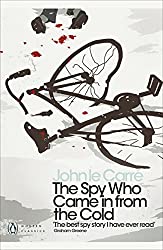
The Spy Who Came in from the Cold by John le Carré

I’ve recently read John le Carré’s biography by Adam Sisman and inevitably it made me want to read le Carré’s books. I decided to start with his third novel, The Spy Who Came in from the Cold, first published in 1963.

Blurb:

a gripping story of love and betrayal at the height of the Cold War. This Penguin Modern Classics edition includes an afterword by the author and an introduction by William Boyd, author of Any Human Heart.

Alex Leamas is tired. It’s the 1960s, he’s been out in the cold for years, spying in the shadow of the Berlin Wall for his British masters. He has seen too many good agents murdered for their troubles. Now Control wants to bring him in at last – but only after one final assignment. He must travel deep into the heart of Communist Germany and betray his country, a job that he will do with his usual cynical professionalism. But when George Smiley tries to help a young woman Leamas has befriended, Leamas’s mission may prove to be the worst thing he could ever have done. In le Carré’s breakthrough work of 1963, the spy story is reborn as a gritty and terrible tale of men who are caught up in politics beyond their imagining.

My view:

This is a dark, tense book and quite short, just 252 pages. It’s complicated and although the language le Carré uses is clear and straight forward at times I wasn’t sure just what was going on, what lay behind the scenes – just what was Leamas up to, amidst the various deceptions and subterfuges? George Smiley does appear briefly in the book, but is there throughout in that he is masterminding Leamas’ mission.

Back from Berlin where he had seen his last agent killed whilst trying to cross the Berlin Wall, Leamas is apparently no longer useful. He goes to seed whilst working out his contact in the Banking Section, transforming into a drunken wreck no longer of use to the Secret Services, left without any money or a job until he finds work as a helper in a library for Psychical Research. Here he meets Liz Gold, who then unwittingly gets drawn into Smiley’s plan.

The atmosphere throughout is of secrecy, manipulation, of human frailty and its duplicitous nature. As the German, Fiedler says for a secret agent:

… deception is first a matter of self-defence. He must protect himself not only from without, but also from within, and against the most natural of impulses; though he earns a fortune, his role may forbid him the use of a razor, though he  be erudite, it can befall him to mumble nothing but banalities; though he be an affectionate husband and father, he must under all circumstances withhold himself from those in whom he should naturally confide. (page 143)

By the end of the book Leamas is in despair as his mission seems to have failed. Liz can’t work out which side he is on and he says:

What do you think spies are: priests, saints, martyrs? They’re a squalid procession of vain fools, traitors too, yes; pansies, sadists and drunkards, people who play cowboys and Indians to brighten their rotten lives. (page 243)

I hate it; I hate it all; I’m tired. But it’s the world, it’s mankind that’s gone mad. We’re a tiny price to pay … but everywhere’s the same, people cheated and misled, whole lives thrown away, people shot and in prison, whole groups and classes of men, written off for nothing. (pages 244-5)

But then again did his mission fail? This is one of those books that I find so hard to write about without giving away too much of the plot – the introduction by William Boyd begins with this statement, ‘New readers are advised that this Introduction makes details of the plot explicit.‘ And indeed it does. I was glad I read it after reading the book, though, as it also gives an interpretation that I found helpful – in particular just what Boyd thought was meant by ‘coming in from the cold‘.

This fulfils the “Broken Object” category on the Silver Vintage Scavenger Hunt card.

Sandlands by Rosy Thornton

SandlandsSandlands is a beautiful collection of short stories that held me spellbound from start to finish. This is all the more extraordinary as I am not a great fan of short story collections. I often find that they leave me feeling that something is missing – either the storyline is not developed enough, or the characters are not convincing, or that they are just too trite or banal. In other words that they are disappointing.

Not so with Sandlands – I think this is a special collection of well written stories set in the Suffolk landscape, describing real people, and containing well- researched detail into myths and folklore, wildlife, and environmental changes that slips seamlessly into the fiction. They are just the right length for me, perfect little cameos each one complete and satisfying – that’s not to say that all the ends are neatly tied up, as some, such as Nightingale’s Return, about an Italian visiting the farm where his father had worked  as a prisoner of war, end leaving me wondering what happened next, or rather just what had happened in the past.

The individual stories are varied, some looking back to the past, some are sad leaving me with tears in my eyes, and some have a supernatural element. I loved all of them, but a few are outstanding, for example, Curlew Call in which a teenager spends time during her gap year living in an old house overlooking the the salt marshes, as a companion to Agnes, an old lady who is wheel-chair bound. She is fascinated by the landscape and the wildlife, in particular the curlews, calling out across the reed beds each evening, before she goes to sleep:

You wonder what they’re doing out there in the dark, sleepless and crying like that. And if you lie still and listen – really  listen – there’s something so pitiful about the sound, it could nearly break your heart. like someone whistling hopelessly over and over for a dog that’s lost. (pages 220 – 221)

Agnes paints, but not the usual East Anglian landscape of sky and clouds with a low horizon. I was really taken with the descriptions of her paintings, nearly all foreground, with reeds at the top and the rest of the painting taken up with the mudflats, showing the swirls and squiggles left by the tide. And the colours she’d used held my attention:

You think that mud is only grey and brown but when you look properly, the way Agnes had, you can see she’s right, and that it’s also the blackest black, and pure white, and it holds glints of red and gold and ochry yellow, and reflected blues and greens, and deep, imperial purple. (page 226)

As the story unfolds, so does the story of Agnes’ life.

And I finished reading the final story, Mackerel, with tears in my eyes when I came to the last paragraph, even though I had begun to realise what was inevitably the outcome. This is the story of a grandmother and her granddaughter, Hattie, set in a fishing village near the Suffolk sea. Ganny, as Hattie calls her has lived all her eighty nine years in the same place and is expert at handling and cooking fish.

Hattie, by way of contrast has an honours degree in marine ecology, has travelled the world, but also loves the Suffolk landscape and the world of her grandparents – the sights, smells and Ganny’s cooking, kippers, fish pie and above all the mackerel. This story is filled with images of Ganny filleting the mackerel, coating them in oatmeal to fry in butter, or to bake in greaseproof sprinkled with lemon or cider in a tight parcel. It made my mouth water reading about it.

As in Curlew Call, Ganny’s life unfolds and this story too is full of colour, this time of the sand instead of the mudflats:

This is a land of sand. The earth hereabouts is nothing but; it’s a wonder anything grows in it at all. On the common it’s a powder grey, soft as ash and lifted by the the slightest breeze, but on the roads it’s as golden yellow as any treasure island beach.

… You could almost fancy it the work of strange secret tides which rise in the night to cover the fields and lanes, then slip away before daylight to leave new spits and spars like a signature on the landscape. A land with the imprint of the sea. (page 256)

It’s impossible for me to do justice to these stories. If you like strong, atmospheric stories, stories that bring to life the world of the past, tying them to the present, stories of family life, of the natural world, of folklore and the mystery and wonder of it all then you’ll love this book as much as I did.

With grateful thanks to Rosy Thornton for sending me this lovely book to review. It’s published tomorrow. And she has also written full length novels that captivated as much as this collection – do read them. For more details see her website.

  • Paperback: 320 pages
  • Publisher: Sandstone Press Ltd (21 July 2016)
  • Language: English
  • ISBN-10: 191098504X
  • ISBN-13: 978-1910985045

No Man’s Nightingale by Ruth Rendell

Last month I read books from my own shelves for the Mount TBR Reading Challenge (books owned before 1 January 2016) and the 20 Books of Summer Challenge, but then the urge to read other books took over, mainly because I’ve been adding books to my shelves. For the time being I won’t be reading for the Mount TBR Challenge as I have several books that I’ve acquired this year that I want to read first.

One of them is Ruth Rendell’s No Man’s Nightingale.

Blurb:

The woman vicar of St Peter’s Church may not be popular among the community of Kingsmarkham. But it still comes as a profound shock when she is found strangled in her vicarage.

Inspector Wexford is retired, but he retains a relish for solving mysteries especially when they are as close to home as this one is. So when he’s asked whether he will assist on the case, he readily agrees.

But why did the vicar die? And is anyone else in Kingsmarkham in danger? What Wexford doesn’t know is that the killer is far closer than he, or anyone else, thinks.

My thoughts:

I like Wexford, so I was predisposed to like this book (who in my mind looks like George Baker in the TV Wexford series) and I did enjoy it, although not as much as some of her other books.

Maxine Sams has several cleaning jobs, including cleaning for Reg and Dora Wexford – she talks all the time and regales Wexford with stories about her family, interrupting his reading of Gibbons’ Decline and Fall of the Roman Empire, which she thinks is a holiday guide to Rome. One of Maxine’s clients is the Reverend Sarah Hussain – and it is Maxine who finds her body, lying on the living room floor. She had been strangled.

Wexford, although enjoying his retirement, is pleased when Detective Superintendent Mike Burden asks if he would like to be involved as a consultant in the investigation into Sarah’s murder. It’s interesting to see how Wexford approaches this as he does not agree with Burden’s methods, thinking he has too many team meetings and ignores things Wexford would have concentrated on, nor can he express his opinions openly. And he isn’t sure just what he should or should not report back to Burden. As most of the book is written from Wexford’s point of view we can see how his mind works and the way he views his former colleagues and society in general and I was glad to see that as a retired person he is portrayed with an agile and observant mind.

There are plenty of red herrings and sub-plots that had me wondering as I read. At times it was rather confusing and I noticed a few continuity problems. Various issues are raised, not just the position of the elderly in society, but also questions of race and gender, religious intolerance, rape, single mothers and family relationships. I liked Wexford’s thoughts on The Decline and Fall of the Roman Empire, his musings on religion – he is a’committed atheist’ ( I don’t remember that from earlier books) and the self-doubt he reveals. I also liked the comic elements as Wexford tries to escape from Maxine’s non-stop chatter.

Overall I enjoyed the book, but think I prefer Ruth Rendell’s standalone books and those she wrote under the name of Barbara Vine.

Wycliffe and the Quiet Virgin by W J Burley

It’s that time of year again when I have less time for blogging – summer when the grass and the weeds grow in abundance. So what with that and a host of other things this post is shorter than I would like it to be.

I like W J Burley’s Wycliffe books. I’ve read several of them up to now and enjoyed each one. Set in Cornwall, they have a strong sense of place, and Wycliffe is a quiet, thoughtful detective.

In Wycliffe and the Quiet Virgin Chief Superintendent Wycliffe is staying with a Penzance lawyer, Ernest Bishop and his family for a few days over Christmas at the Bishops’ hill-top house. With his wife away in Kenya, Wycliffe is not looking forward to Christmas, and the welcome from the family is polite rather than welcoming. The situation only gets worse when a young girl goes missing after playing the part of the Virgin Mary in the local nativity play, and then her father also goes missing and her mother is found dead in their cottage. Wycliffe moves out of the Bishops’ house as it appears they may be suspects.

What follows is Wycliffe’s investigation which goes back to a crime committed five years earlier, involving many twists and turns. It was a quick and entertaining read with a lot of characters, but all are clearly distinguishable. The plot is complex and it was only as I was getting near the end that I began to have an inkling about the identity of the murderer.

W J Burley (1914 – 2002) lived near Newquay in Cornwall and was a teacher until he retired to concentrate on his writing. He wrote 22 Wycliffe novels. Wycliffe and the Quiet Virgin was the 13th, first published in 1986 and as such fits into Bev’s Vintage Mystery Cover Scavenger Hunt in the Silver Age (Vintage Mysteries first published any time from 1960 to 1989) in the category of ‘Spooky/House’ on its cover. It is also one of my 20 Books of Summer 2016.