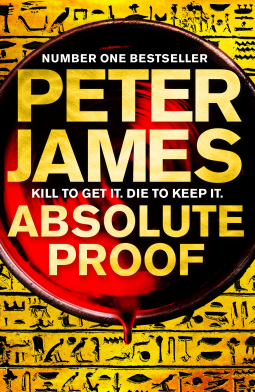
Absolute Proof by Peter James

3.5*

Pan Macmillan|4 October 2018|570 pages|Review copy Investigative reporter Ross Hunter nearly didn’t answer the phone call that would change his life – and possibly the world – for ever. ‘I’d just like to assure you I’m not a nutcase, Mr Hunter. My name is Dr Harry F. Cook. I know this is going to sound strange, but I’ve recently been given absolute proof of God’s existence – and I’ve been advised there is a writer, a respected journalist called Ross Hunter, who could help me to get taken seriously.’ What would it take to prove the existence of God? And what would be the consequences? This question and its answer lie at the heart of Absolute Proof, an international thriller from bestselling author Peter James. The false faith of a billionaire evangelist, the life’s work of a famous atheist, and the credibility of each of the world’s major religions are all under threat. If Ross Hunter can survive long enough to present the evidence . . . Absolute Proof is a long book and at times I struggled to carry on reading as, although for the most part it is fast-paced, it is slow going in parts. And it certainly tested my ability to suspend my disbelief several times. I’ve only read two of Peter James’ books previously, both crime fiction set in Brighton featuring Detective Superintendent Roy Grace. Absolute Proof is a standalone thriller and is very different from the Roy Grace books. It has similarities to Dan Brown’s The Da Vinci Code, as the search is on for proof of  God’s existence. Ross Hunter is married to Imogen and they are expecting their first child – however he has serious doubts about his marriage and suspects Imogen of cheating on him. The story of their marriage unfolds, underlying the main plotline.  Dr Harry  F Cook, a former RAF officer and  retired history of art professor, contacts Ross and drip feeds him information that Cook claims proves that God exists. The grid references Cook gives Hunter takes him to various places including Glastonbury, where he visits the Chalice Well in search of the Holy Grail, and Egypt in search of Queen Hatshepsut’s Temple. All the time he is in danger of death as he is pursued by those who do not want Cook’s claims to be made public. It’s a dramatic and hair-raising story that made me want to know what happened next at the same time as it made me question its credibility. It is certainly thought provoking and entertaining. One of the things that intrigued me was that in his Acknowledgements Peter James explains that the book began with a phone call he received in 1989 from someone who did indeed claim that he had been given absolute proof of God’s existence and that he had been given Peter James’s name as an author who would help him to get taken seriously. This started James’s ‘journey of exploration into what might be considered absolute proof – and just what the consequences might be.’ During the intervening years he has talked to many people from different faiths and had discussions with scientists, academics, theologians and clerics. He has certainly done his research and gives a long list of the people who have helped him, plus a list of his sources of reference, giving me yet more details of books I’d like to read. Thanks to Pan Macmillan and NetGalley for provided a review copy of this book.
The Darkest Place by Jo Spain

The Darkest Place (An Inspector Tom Reynolds Mystery, #4)

4*

Quercus Books|20 September 2018|352 pages|Review copy

The Darkest Place is Jo Spain’s 4th Inspector Tom Reynolds Mystery book and although I haven’t read the first three I was keen to read this book when I saw it offered on NetGalley as I’d enjoyed her standalone book The Confession. As I expected there are references to the cases Tom Reynolds and his team investigated in the earlier books and it’s probably best to read those first, but actually this didn’t affect my enjoyment of this book.

I was soon gripped by the mystery right from the opening lines of the book:

Forty years was too long to wait for somebody to come back from the dead.

But still, she liked to get  everything ready. Just in case.

The ‘somebody’ is Conrad Howe, who was one of the senior doctors at St Christina’s asylum on Oilean na Coillte,  known to locals as the island of lost souls, an island (fictional) off the south-west corner of Ireland. His wife, Miriam had never given up hope that he was alive and would return home.

The psychiatric hospital was closed down years ago, but now there are plans to build a retreat on the island, an exclusive hotel, and during the demolition work a mass grave for the patients had been uncovered. Conrad’s body was found, hidden beneath some of the body bags and it was obvious that he had been murdered.

The narrative alternates between the police investigation and extracts from the diary Miriam had found hidden in the attic, describing what was happening at the hospital and the horrific treatment some of the patients were subjected to by one of the doctors. A few of the hospital staff, including the former head of St Christina’s, Dr Lawrence Boylan and an ex-nurse, Carla Crowley, and it is soon clear that something evil is still going on at the asylum.

This really is a chilling book and in parts I found it disturbing and difficult to read. Jo Spain makes it clear in her Acknowledgements that although this is crime fiction it is based on fact – such terrible things really did happen in mental institutions, housing vulnerable people. They were patients with dementia, deformities, depression, epilepsy and homosexuals – people whose families could not deal with them and they were treated mainly as though they were suffering from a physical illness or disorder, that could be fixed. Those that couldn’t be fixed were kept locked up.

For most of the book I kept wondering what had actually happened to Conrad Howe and suspecting various people of killing him, mainly thinking it was one particular person until halfway into the book, then thinking it couldn’t be that one. I was right about that, but it was only just before the truth was revealed that I had the slightest suspicion of what had really happened, which makes it a very satisfying book indeed. I’m now on the lookout for more books by Jo Spain.

Thanks to Quercus Books and NetGalley for provided a review copy of this book.

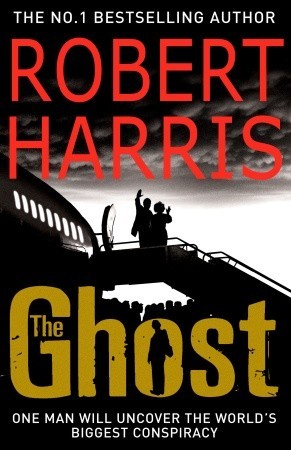
The Ghost by Robert Harris

The Ghost

4*

I have enjoyed all of Robert Harris’s books that I’ve read and The Ghost is no exceptionThe ‘ghost’ in this novel is a professional  ghostwriter employed to finish writing the memoirs of recently retired prime minister of Great Britain, Adam Peter Benet Lang. McAra, Lang’s long-term assistant, had nearly completed Lang’s memoir when he was found dead, drowned. He had gone overboard during the ferry crossing to Martha’s Vineyard, where Lang and his wife, Ruth are staying.

The setting of Martha’s Vineyard in winter reflects Lang’s mood, it is out-of-season, closed down, practically empty – as isolated as Lang himself, disconnected from the world of power he once dominated and stuck on this bleak island with his volatile wife and his aide, the beautiful Amelia Bly, who Ruth suspects is having an affair with Lang. The ghostwriter soon discovers that Lang has secrets in his past that are returning to haunt him – secrets with the power to kill. And he suspects that McAra’s death was neither an accident nor a suicide.

This is fiction, but Adam and Ruth, do have similarities to Tony and Cherie Blair. Lang is charming, personable, full of restless energy, with an engaging smile and thick wavy hair. The narrator, an unnamed writer, who Adam calls ‘man’, is a likeable character more used to ghostwriting the memoirs of footballers than politicians, who has just one month to complete Lang’s memoirs. But soon after he arrives this is reduced to two weeks when news breaks that Lang is accused of war crimes. The International Criminal Court in The Hague are investigating the allegations of Richard Rycart, the former British Foreign Secretary, that Lang had ordered the illegal handover of suspects for torture by the CIA.

I liked the details about ghostwriting from the quotes heading each chapter taken from Andrew Crofts handbook, Ghostwriting. But what I liked most about The Ghost is that it is fast- paced, full of tension and written in a straightforward linear narrative – no flashbacks or fly forwards, or multiple narrators. As in his other books  I’ve read it’s written in such a way that I feel as though I’m there with the characters taking part in the action. And his characters are distinct people, easily distinguishable from each other. In so many books I’ve read recently I’ve come across a character and have been unable to place them and have had to backtrack to find out who they are and how they fit into the plot, or the characters have similar sounding names or all begin with the same letter. Not so with The Ghost the characters have depth, the structure is clear, and there is a twist at the end that revealed the menace implied through the whole novel. Harris is a great storyteller.

My copy:

  • Paperback: 416 pages
  • Publisher: Arrow; Reprint edition (3 July 2008)
  • Language: English
  • ISBN-13: 978-009952749
  • Source: I bought the book
  • My rating: 4*


Timekeepers: How the World Became Obsessed with Time by Simon Garfield

Timekeepers: How the World Became Obsessed With Time

3*

Synopsis:

Time flies like an arrow, but fruit flies like a banana. The Beatles learn to be brilliant in an hour and a half. An Englishman arrives back from Calcutta but refuses to adjust his watch. Beethoven has his symphonic wishes ignored. A US Senator begins a speech that will last for 25 hours. The horrors of war are frozen at the click of a camera. A woman designs a ten-hour clock and reinvents the calendar. Roger Bannister lives out the same four minutes over a lifetime. And a prince attempts to stop time in its tracks.

Timekeepers is a book about our obsession with time and our desire to measure it, control it, sell it, film it, perform it, immortalise it and make it meaningful. It has two simple intentions: to tell some illuminating stories, and to ask whether we have all gone completely nuts.

My thoughts:

Timekeepers fulfils Simon Garfield’s intentions – to tell some illuminating stories, and to ask whether we have all gone completely nuts. It covers a wide variety of topics, all in one way or another about time – how it’s been recorded, the development of the calendar, the standardisation of time to aid with railway timetables, and aspects of time management, for example.

The chapters vary in length and some are more interesting than others. The one that interested me most was Movie Time, with an account of how the silent film, Safety Last! was made in 1923.

File:Safetylast-1.jpg
Harold Lloyd dangling from the clock in Safety Last! (1923)

Harold Lloyd climbs the outside of a department store, obstacles falling on him as he does so, until he reaches the giant clock at the top, grabs hold of it, and dangles above the street below. Garfield recalls that for the first audiences time just froze, some went into hysterics and others fainted. Garfield’s focus is on the concept of time that the movies portrayed and goes on to explain how films were originally produced and shown when the timing depended on the cranking skills of the cameraman during filming and the projectionist during showing.

I was also interested in the chapter on performances of Beethoven’s Ninth Symphony, a long and complex piece of music involving a large orchestra, solo singers and a chorus, where Garfield’s focus is on the tempo of the music and the differences made by different composers’ interpretations; and also in the chapter on Nic Ut’s photograph of children fleeing after a napalm bomb had been dropped on a village in Trảng Bàng, Vietnam. Garfield’s focus here is on the fraction of a second when the photograph was captured that brought the story home to its viewers.

Several other chapters also interested me but I wasn’t taken with those on the technicalities of time measurement, time management,or the production of clocks and watches, that Garfield describes in great detail. The book jumps about from topic to topic with, as far as I can make out, no chronological order. But it is full of facts, and going off the Further Reading and Acknowledgement section it is well researched. A book to dip into rather than read straight through.

  • Format: Kindle Edition
  • File Size: 4503 KB
  • Print Length: 369 pages
  • Publisher: Canongate Books; Main edition (29 Sept. 2016)
  • Source: Canongate Books via NetGalley
  • My Rating: 3 stars

Thanks to Canongate Books and NetGalley for my copy of this book for review.

Now We Shall Be Entirely Free by Andrew Miller

Now We Shall Be Entirely Free

4*

Hodder and Stoughton|23 August 2018|432 pages|Review copy

The opening chapters of Now Well Shall Be Entirely Free drew me in immediately as I read about Captain John Lacroix’s return to England from Spain in 1809, close to death after the battle of Corunna, during the Peninsular War. Miller’s descriptive writing, lyrical and poetic, vividly sets the scene as Lacroix is nursed back to health by Nell, his servant. But it is clear that he is on the edge of a breakdown, mentally and emotionally, saying little about the battle and indeed, unable to face the memories of the horrors he experienced. When another officer arrives ordering him to report back to duty, he decides instead to leave for the Highlands to recuperate.

This is followed by an account of the investigation of the atrocities carried out  in the village of Los Morales during the army’s retreat to Corunna.  The village was burned down, men were lynched and women raped. Two men, a vicious Englishman, Corporal Calley is ordered to track down and kill the officer responsible and a Spaniard, Lieutenant Medina, a liaison officer with the British army, is assigned to accompany him and report back that the execution has been carried out. It is soon obvious that the officer is Captain John Lacroix and so the hunt is on, as Calley and Medina follow his trail from Somerset to Bristol and Glasgow and then on to the Hebrides, leaving a trail of violence and death behind them.

The pace is brisk, until Lacroix reaches the isles, where he meets the Frend family, a brother and sisters, living as part of an isolated community. Jane is pregnant and Emily is slowly losing her sight. At this point in the novel the pace dropped partly because of the vagueness in describing the location of the island (somewhere in the Outer Hebrides beyond Mingulay) and Lacroix’s own mental and physical slowing down on the island – after being attacked and robbed in Glasgow, he began taking opium to relieve his pain. My attention began to wander until he and Emily returned to Glasgow for an operation to improve her eyesight. The pace picked up and I was fascinated by the medical details, with intriguing insights into new discoveries in medical treatment.

But then the ending came all too quickly and left me feeling uncertain about what actually happened – the ambiguity surrounding their ‘freedom’. Freedom is a theme throughout the novel – its definition and how it differs for men and women. The relentless brutality of war, of course is another theme, demonstrated through the inhumanity of Calley’s actions and its effects on Lacroix as he finally reveals what had happened in Spain.

I enjoyed the historical details, the medical techniques as well as the effects of industrialisation, and in particular the conditions in the cotton mills, where Calley laboured as a child. He had worked as a ‘piecer’ mending the cotton threads and cleaning the machines, in danger of losing a limb, deafened by the noise in the hot machine room where the air was thick with little bits of cotton filling up your nose and lungs.

But most of all I enjoyed the writing. Miller’s ability to write in such a lyrical style, to convey emotions and create such complex characters that are so believable that you can empathise, to a limited extent, even with a thug like Calley, make this book remarkable.

Thanks go to Hodder and Stoughton and NetGalley for my copy of this book for review.

A Perfectly Good Man by Patrick Gale

A Perfectly Good Man

5*

Having read Notes from an Exhibition earlier this year I expected to like Patrick Gale’s A Perfectly Good Man, so I’m delighted to say that I loved it.

I have read plenty of books that move backwards and forwards in time and move from one character to another, but not one like A Perfectly Good Man, that does it so successfully that you don’t experience any confusion or struggle to remember who is who – at least that was my experience with this book. It’s set in Cornwall, in particular in Pendeen and Morvah, north-west of Penzance, the setting for Notes from an Exhibition.

The ‘perfectly good man‘ is Barnaby Johnson, a parish priest, a man who always tries to do the right thing; needless to say he doesn’t always manage it. There’s his wife, Dorothy, who becomes known, not appropriately as ‘Dot’, his daughter, Carrie, his adopted Vietnamese son ‘Jim’, who, in the course of the book, reverts to his native name ‘Phuc’, pronounced to rhyme with ‘foot’ and not ‘luck’, and a particularly nasty character who calls himself ‘Modest Carlsson’.

But the novel begins with Lenny, aged 20, who is paralysed after an accident playing rugby and is in a wheelchair. He is unable to cope with the prospect of a life never being able to run or  walk again, a life of people making allowances for him, of charity; he had lived for nights out with his girlfriend,and for rugby. He asks Barnaby to be with him as a witness to his suicide and to pray for him.

I got to know these people very well over the course of the book and eventually understand their individual stories and how their lives interconnect. The significance of their actions not only on themselves but on the others around them became so real as I read on – for example, Dot’s anguish over her miscarriages and the consequences, not just on her and the boy, but on the whole family and community, of adopting a Vietnamese orphan is agonisingly plain. I was pleased to see glimpses of some characters from Notes from an Exhibition as they made fleeting appearances, and a return of Morwenna Middleton to the area, which explained what had happened to her after the events of Notes from an Exhibition. Modest Carlsson is the antithesis of Father Barnaby in his cruel and heartless behaviour in destroying what is a treasured possession and in revealing a devastating secret that he should have kept to himself.

A Perfectly Good Man is a beautifully written book about faith and the loss of faith, about love and cruelty and deception, about ordinary life and about everyday tragedies, and also sublime moments. It’s a quiet novel that left me feeling I must read more of Patrick Gale’s books. Fortunately I already have one more on my shelves, A Place Called Winter historical fiction described as a novel of forbidden love, secrets and escape and in The Times as a novel ‘written with intelligence and warmth’.

My copy:

  • Paperback: 406 pages
  • Publisher: Fourth Estate 2012
  • ISBN-13: 9780007465088
  • Source: Library book
  • My rating: 5*