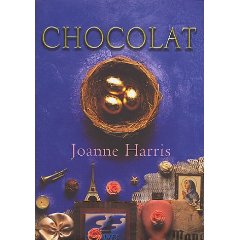
Chocolat by Joanne Harris

CelebrateTheAuthorJuly’s Birthday author is Joanne Harris (3 July), so I read Chocolat. There is so much more to this book than a simple story about a chocolaterie.

chocolat1

This is a fabulous book. I saw the film a few years ago (so I’ve forgotten the details) and loved that and amazingly the book is even better. I think for me that’s the right sequence of events if I’m going to see the film of a book at all – see the film, then read the book.

Simply told it’s a story about Vianne Rocher who arrives in Lansquenet-sous-Tannes, a place that is” no more than a blip on the fast road between Toulouse and Bordeaux” on Shrove Tuesday. She takes over the old bakery and transforms it into La Celeste Praline Chocolaterie Artisanale – in other words the most enticing, the most delicious and sensuous Chocolaterie, selling not only all sorts and types of chocolate treats but delicious chocolate drinks. Together with Anouk her daughter with her imaginary friend Pantoufle the rabbit, she also transforms everyone’s life along the way.

The story is told alternately by Vianne and Francis Renauld, the Cure of the parish. Renauld regards Vianne as the devil opposing everything he believes in and viewing her chocolate as sinful temptations designed to lure people away from the church. This is particularly provoking for him as it is Lent and the church is opposite the shop, open on Sundays and his parishioners are succombing to the temptations of Vianne and her shop.

In the weeks before Easter Vianne plans a grand festival of chocolate to take place on Easter Sunday. This infuriates Renauld:

To rail against a children’s celebration is to court ridicule. Already Narcisse has been heard to refer to my brigade anti-chocolat, amidst disloyal sniggering. But it rankles. That she should use the Church’s celebration to undermine the church – to undermine me. I dare not go further than this. And every day her influence spreads. Part of it is the shop itself. Half-cafe, half confisierie, it projects its air of cosiness, of confidences. Children love the chocolate shapes at pocket-money prices. Adults enjoy the atmosphere of subtle naughtiness, of secrets whispered, grievances aired. Several families have begun to order a chocolate cake for lunch every sunday; I watch them as they collect the beribboned boxes after Mass. The inhabitants of Lansquenet-sous-Tannes have never eaten as much chocolate. Yesterday Denise Arnauld was eating – eating! – in the confessional. I could smell it on her breath, but I had to maintain anonymity.

As the story progresses it becomes clear that Renauld has more than just a problem with Vianne. He is convinced of his own unworthiness and increases his Lenten fast in an attempt to cleanse himself. There is also something in his past which bothers him enormously. And he is not the only person in Lansquenet-sous-Tannes who has problems. Amongst others, there are Josephine, whose husband beats her up, Armande a diabetic in her eighties, whose snobbish daughter Caroline prevents her son from having any contact with her, and Guillaume a lonely old man struggling with the death of his dog, Charly. Vianne herself is fleeing from the ‘Black Man’, just like her mother did before she died. Into this mix of characters come the river gypsies and Roux causing even more angst for Renauld.

So, this book covers an enormous range of topics – fear of the outsider, prejudice against “these people” – immigrants, vagrants, and gypsies; bigotry; fear of death, old age and illness; and fear that the Church will lose its purity and that the community will be corrupted by liberal and heretic beliefs. It’s also about how so many lives intersect and interact and above all about the importance of love and understanding in everyone’s life.

Of course it’s also about food, and not just chocolate, although there are many descriptive passages extolling chocolate. The food at the party to celebrate Armande’s birthday includes:

Soupe de tomates a la gasconne, served with fresh basil and a slice of tartelette meridonle, made on biscuit-thin pate brisee and lush with the flavours of olive oil and anchovy and the rich local tomatoes garnished with olives and roasted slowly to produce a concentration of flavours which seems almost impossible. … vol-au-vents, light as a puff of summer air, then elderflower sorbet followed by plateau de fruits de mer with grilled langoustines, grey shrimps, prawns, oysters, berniques, spider-crabs … and a giant black lobster, regal on its bed of seaweed. … The dessert is a chocolate fondue … and dark-and-white- chocolate roulade bicolore. … We round off the meal with my own chocolate ice-cream, truffles and coffee in tiny demi-tasses, with a calvados chaser, drunk from a hot cup like an explosion of flowers.”

I judge a book by my desire to re-read it and to read more by the same author. This book passes both tests. I will have to re-read it to fully appreciate all its many layers and I already have The Lollipop Shoes waiting for me on my bookshelves. I believe it’s a sequel to Chocolat.

A Splash of Red, Antonia Fraser

Jemima Shore, writer and presenter of the television programme “Jemima Shore Investigates” is flat-sitting for her friend Chloe Fontaine, also a writer. The block of flats is a controversial development in a large Georgian square close to the British Library, which is ideal for Jemima as she plans to spend most of her time there researching for her next novel. 

“The Splash of Red” is the title of an enormous painting of a woman’s figure, slurred with red, a painting by Chloe’s ex-lover Kevin John Athlone. The painting, hanging on the bedroom wall looks as though blood has been splashed on the wall. After Chloe leaves Jemima thinks she’ll take down the painting – she doesn’t need reminders of Kevin John and his violent relationship with Chloe. As Jemima settles down to enjoy her stay, alone in the flat apart from Tiger, Chloe’s long-haired golden cat, her peace is shattered by an anonymous threatening phone call.

From that point on the mystery deepens. Chloe has disappeared. Her parents were expecting to see her, but she didn’t arrive. Chloe had told Jemima she was off to the Camargue, to write an article commissioned by Isabelle Mancini, the editor of the magazine, ‘Taffeta’, but it turns out this was a lie. Jemima bothered by yet another threatening phone call is distracted from her own research and returns to the flat to find Chloe in a real splash of red – lying across the bed with her throat cut. I thought I’d worked out who had killed Chloe from the numerous suspects, but I was completely wrong – which was good as it meant that I read with anticipation and was surprised by the actual culprit.

Who is Chloe’s mystery lover, ‘the most divine angel in heaven’ and who is the ‘new angel’ in her life with whom she had a surprising casual or carnal encounter? Then there are a number of suspects –  Kevin John, her ex-lover; Adam Adamson, a squatter in the building and one of the objectors to Sir Richard Lionnel’s development of the concrete building that had replaced an elegant 18th century house; Sir Richard himself and his wife; Valentine Brightman, Jemima and Chloe’s publisher; and even Isabelle.

Jemima of course solves the mystery. This is the first Jemima Shore mystery I’ve read although I remember the TV series back in the 1980s with Patricia Hodge as Jemima. Now I’m going to have to add the other books to my ‘to be read’ list.

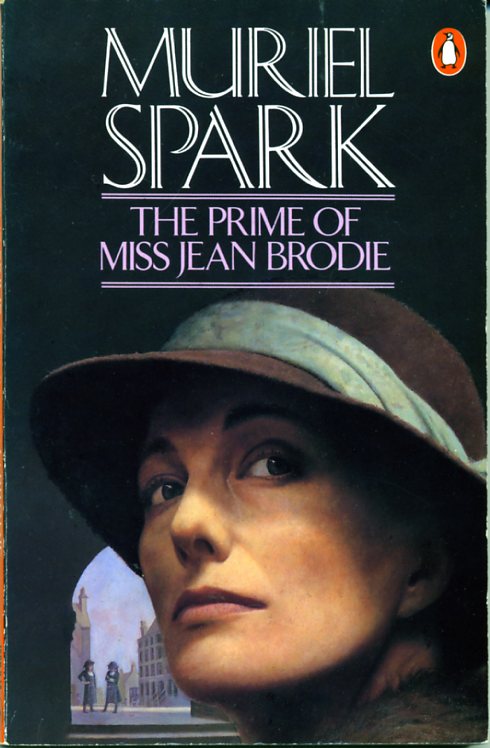
The Prime of Miss Jean Brodie by Muriel Spark


I was pleased this book was chosen for discussion for Cornflower’s Book Group because I thought it was a brilliant  book when I first read it some years ago. I like to re-read books I’ve enjoyed and sometimes I find that my views/mood have changed and I no longer think the book is as good as I first thought. No such problem with The Prime of Miss Jean Brodie! I still think it’s an excellent book.

It’s set in Edinburgh and starts in 1936 with schoolteacher Miss Brodie and the Brodie Set, a group of girls she has groomed to accept her ideas. The school is the Marcia Blaine School for Girls, a traditional school where Miss Brodie’s ideas and methods of teaching are viewed with dislike and distrust. The Head Teacher is looking for ways to discredit and get rid of her. The story is told in flashbacks from 1930 – 1939 and quite early on in the book we are told who ‘betrayed’ Miss Brodie.

Although it’s a short book I immediately was plunged into the school world, reminded so much of my own schooldays when you had to wear the school hat or beret under penalty of detention and it was absolutely forbidden that any girl from my school should be found eating even an ice cream in the street. Like the Brodie Set my friends and I used to meet boys either before or after school, both boys and girls leaning on the handlebars of our bikes as we talked. The likeness to Marcia Blaine ends there though – there were no teachers like Miss Brodie at my school, but I did enjoy that trip down memory lane for a brief time.

Team spirit is encouraged at Marcia Blaine but team spirit is despised by Miss Brodie, who encourages the girls to recognise their ‘prime’ and live it to the full. Instead of lessons she takes them outside and with text books open in case anyone comes she regales them with stories of her life and loves. Miss Brodie’s love affairs intrigue the girls, from her lover who was killed in World War 1 to the love triangle of Miss Brodie, Gordon Lowther the singing teacher and Teddy Lloyd the married art teacher with six children.

Miss Brodie wants to dominate the girls’ lives and the darker side of her character is shown through her admiration of Mussolini and fascism. Despite, or may be because, of her failings the girls are all loyal to her until one of them betrays her and she is left to wonder just which girl it was.

The novel is not so much concerned with plot as with character. The moral aspect of Miss Brodie’s betrayal is not questioned but how people are influenced by others, their vulnerability or indifference to others’ feelings and thoughts, how we appear to others and how we try to impose our beliefs are amongst the issues explored.

Coincidentally, I see that the film, The Prime of Miss Jean Brodie starring Maggie Smith is being shown on ITV1 today at 1.00pm. I saw this after I first read the book and loved it. Maggie Smith was just right as Jean Brodie.

The Scarlet Pimpernel by Baroness Orczy

I’ve had my copy of The Scarlet Pimpernel for a long time. I can’t remember how long and there is no date in the book – all I know is that it cost 3s 6d and I must have been about 11, 12 or 13 when I first read it. Once I started to read it this time I realised that I remembered very little of the plot, apart from the fact that it’s about the French Revolution and a band of Englishmen, led by the mysterious Scarlet Pimpernel,  rescuing French aristos from the guillotine. No-one knows his identity, the French hate him and are desperate to catch him whilst he is the toast of the British aristocracy – the Prince of Wales describes him to Chauvelin, the agent of the French government, as “the bravest gentlemen in all the world, and we all feel a little proud, Monsieur, when we remember he is an Englishman.”

And I hadn’t forgotten this little verse that that “six foot odd of georgousness as represented by Sir Percy Blakeney, Bart” had composed whilst tying his cravat:

We seek him here,
We seek him there,
Those Frenchies seek him everywhere.
Is he in heaven?
Is he in hell?
That demmed elusive Pimpernel.

Everyone knows that Sir Percy is hopelessly stupid, but he is incredibly rich and as a leader of fashion he is the talk of the town and “his inanities were quoted, his foolish laugh copied by the gilded youth at the Almanack’s or the Mall.” His French wife, Marguerite is by contrast, a clever, witty woman, but she is trapped by Chauvelin into betraying the identity of the Pimpernel. Chauvelin had acquired a letter written by her brother revealing that he was working with the Scarlet Pimpernel – either she finds out who the Pimpernel is or her brother will go to the guillotine.

I wish I could remember whether I guessed the identity of the Scarlet Pimpernel when I first read the book, but I do remember that I loved the romance and the action of this tale based loosely on the French Revolution. I was still spellbound by the romance and drama of it all. I’ve discovered that it start out as a play, starring Fred Terry (the brother of Dame Ellen Terry and great-uncle of Sir John Gielgud) as the Scarlet Pimpernel. There have been many films of the book and the role of the Scarlet Pimpernel has been played by many actors on stage and screen including Leslie Howard, Anthony Andrews, and Richard E Grant. Amazingly I have never seen any of them, so my mental vision of the characters is drawn straight from the book, which is what I prefer.

 I re-read this book as part of the Heart of a Child Challenge. It also qualifies for the What’s In a Name Challenge as a book with a plant in the title, because the Scarlet Pimpernel is not only the nickname of the hero but it is also the symbol with which he signs his messages.


The Sunday Salon

Sunday SalonLast August I read The House at Riverton by Kate Morton and thought it was one of the best books I’d read in 2007. So it was with great anticipation that I started to read The Forgotten Garden. It starts off well, with a little girl in London in 1913 on a boat bound for Australia. The lady who took her to the boat has disappeared and the little girl is found alone on the Maryborough wharf, with no name and no family. All she can remember is that the name of the lady is the Authoress and she has a little white suitcase containing a book of fairy stories written by the lady.

The Forgotten Garden

The novel is about three women – Eliza, Nell and Cassandra and follows their lives from 1900 to 2005. Nell is the little girl in the opening chapter and the book reveals the story of her birth. Of course it’s not just as simple as that – there are several mysteries in this long book. It’s quite easy to read once you have got used to jumping from England in 1913 to Australia in 2005, and in and out of the 1930s and 1975 in both countries and back again to 2005 in England and Australia and sorting out the characters of the three women.

I was enjoying it and then I realised that I was reading a re-working of The Secret Garden, as Eliza is taken as a child of twelve to live with her aunt and uncle at Blackhurst Manor in Cornwall, just as Mary is taken to live with her uncle at Misselthwaite Manor on the Yorkshire Moors, both houses in isolated places, both girls finding it difficult to fit into their new surroundings, both with maids who help them settle in, both with walled gardens and secrets to be discovered. Even down to both having sickly cousins who stay in their rooms.

I was so disappointed that I stopped reading the book! But I picked it up again the next day and carried on. I worked out the ‘mystery’ quite easily and found the book rather predictable, which was also disappointing. Nell attempts to find out the truth about her parents and in 1975 travels to England, eventually finding Blackhurst Manor where the Mountrachet family used to live. After her death in 2005, Cassandra her granddaughter discovers she has been left a surprise inheritance, Cliff Cottage and its forgotten garden in Cornwall, now derelict.

It wasn’t just the predictability of the story I found a let down, I also had difficulty picturing the settings and working out the locations of the cottage, its garden, the maze and Blackhurst Manor even though I re-read their descriptions several times.

I read this book whilst on my recent travels along with The Other Side of You by Salley Vickers, which I also found a bit disappointing – more about that some other time maybe. Other reading this week has been more enjoyable with The Fall of Troy by Peter Ackroyd and Wessex Tales by Thomas Hardy. I also finished reading The Prime of Miss Jean Brodie by Muriel Spark. I first read this about 10 years ago and was a bit worried that I would find it a let down on re-reading it, but thankfully I thoroughly enjoyed it. It’s the next book up for discussion on Cornflower’s Blog on 12 July. For once I’ve read the book well in advance.

I’m also re-reading The Scarlet Pimpernel by Baroness Orczy for the Heart of a Child Challenge. A tale of the French Revolution, a time of terror and tension as the dashing Englishman rescues French aristos destined to death by guillotine. I loved this book as a child and so far it’s living up to my expectations.

Thomas Hardy

I had intended to read one of Thomas Hardy’s books in June as part of the Celebrate the Author Challenge. Hardy was born on 2 June 1840 at Higher Brockhampton, near Dorchester. I’ve read some of his books and thought I read one I hadn’t previously read for the challenge, but I didn’t get one until yesterday, when I borrowed two from the library – Wessex Tales and A Pair of Blue Eyes.

Both Wessex Tales and A Pair of Blue Eyes are Wordsworth Classics editions, with introductions and notes on the text. It’s refreshing to find in Wessex Tales a General Introduction which states

… because the pleasures of reading are inseparable from the surprises, secrets and revelations that all narratives contain, we strongly advise you to enjoy this book before turning to the Introduction.”

A Pair of Blue Eyes was Hardy’s third novel.  I haven’t started it yet, so I’m not revealing anything that isn’t on the back cover. Apparently this book has a central scene that “shocked and stimulated Victorian readers” and “caused Hardy to be embroiled in arguments concerning the sexual morality of his novels.” We’re not so easily shocked these days, but who knows, I may be in for a surprise when I read this book.

I’ve tried not to reveal too much in writing about Wessex Tales.

Wessex Tales was first published in 1888. It is subtitled: Strange, Lively and Commonplace. As soon as I started to read the first tale, The Three Strangers, I was drawn back into Hardy’s world and this story has all those elements. Strange, because it has a satisfying twist in the tale. It is set in the 1820s in an agricultural England that no longer exists, but can still be seen in the landscape in the form of solitary cottages, ancient hedges (that have survived the 19th century inclosures) and the “long, grassy and furzy downs”. Lively, because the tale has so many elements of a folktale with the appearance at a christening party of three strangers on a cold, stormy, winter’s evening. I liked this description of how wild and wet it was:

The level rain-storm smote walls, slopes and hedges, like the cloth-yard shafts of Senlac and Crecy. Such sheep and outdoor animals as had no shelter stood with their buttocks to the wind; while the tails of little bird trying to roost on some scraggy thorn were blown inside-out like umbrellas.

Commonplace, because the tale is full of information about the daily lives of country labourers – shepherds, hedge-carpenters, dairymen and a detailed description of how mead was made. There is also a sense of the macabre about this tale. Who are the three strangers, who arrive at intervals during the evening and are slow to say who they are and why they are there? It becomes clear that one of them is a hangman, which casts a sinister shadow over the evening.

I’ve written before how I sometimes find short stories too short to be satisfying, either leaving me feeling the characters are sketchy and incomplete, or thinking “so what?”. Hardy’s Tales just aren’t like that – even A Tradition of Eighteen Hundred and Four which is only 6 pages long is complete – I could visualise the characters from the succinct descriptions. The tale is narrated by Solomon Selby in the “yawning chimney-corner of the inn-kitchen” as he withdrew

the stem of his pipe from the dental notch in which it habitually rested, he leaned back in the recess behind him and smiled into the fire. The smile was neither mirthful or sad, not precisely humorous nor altogether thoughtful. We who knew him recognised it in a moment: it was his narrative smile.

You could almost believe that the events in this story actually happened. It held my interest right from the opening sentence:

The widely discussed possibility of an invasion of England through a Channel tunnel has more than once recalled old Solomon Selby’s story to my mind.

I can’t write about this without revealing something of the story, so if you want to read it, don’t read on.

The fear of invasion is from the French. Bonaparte had crossed the Alps, fought in Egypt, “drubbed the Turks, the Austrians, and the Proosians, and now thought he’d have a slap at us.”  Where on the coast would his troops land and was it “Boney” that Solomon saw on the shore? In the preface to the Tales Hardy wrote that in 1882 when he first published this story he had invented the incident of Napoleon’s visit to the English coast, but had been surprised several years later to be told that it was a real tradition.

More on the other stories in this collection will follow in a later post.