The Sunday Salon – Reader Satisfaction

I’m in the middle of two very different books – Going Into a Dark House, a book of short stories by Jane Gardam and Messenger of Truth, a Maisie Dobbs mystery by Jacqueline Winspear. Both are giving me a lot of reader satisfaction; they take me out of myself and into their worlds, peopled by believable characters, set in realistic locations, and with plots that are detailed and complicated enough to keep me wondering how everything will turn out and hoping for a sequel.

I’ve only recently begun to appreciate short stories and still prefer the longer short stories in preference to those of just a few pages. The plus factor is reading short stories is that you can read one in just one session, making it a complete experience. Going Into a Dark House is a collection of eight short stories, all long enough to satisfy my requirements. The title story, which I haven’t read yet is the longest and is in three parts. Death figures quite a lot in these stories, in different guises and also reflections on age, youth and nostalgia. The first story is Blue Poppies which begins: “My mother died with her hand in the hand of the Duchess.” You know at the start that there is a death; the rest of the story leads up to this death and its effect on the daughter.  I like the way Jane Gardam writes, conjuring such vivid images that it seems as those I’m actually witnessing the scene. For example the blue poppies are

… just like Cadbury’s chocolate papers crumpled up under the tall black trees in a sweep, the exact colour, lying about among their pale hairy leaves in the muddy earth, raindrops scattering them with a papery noise. 

Zoo-Zoo is a strange little tale about a dying nun who is taken by two of her fellow nuns to a nursing home to end her days. She is not as senile as they suppose. My favourite story so far in this collection is Dead Children, which I think is absolutely brilliant. How Jane Gardam can write twelve pages about such a deceptively simple meeting of a mother and her two children and infuse them with such depth of meaning and emotion is just beyond me.  The twist at the end makes an ordinary everyday event amazingly extraordinary.

Messenger of Truth is a much longer book and my reading has been spread out over a few sessions already. It is a detective story set in 1930/1 in England. The artist Nick Bassington-Hope has fallen to his death from the scaffolding whilst installing his work at an art gallery. The police believe it is an accident, but his twin sister Georgina isn’t convinced and hires Maisie Dobbs to investigate his death. Along with Nick’s death there is also the mystery of the missing piece of art work that was to be the centre of the exhibition.

I’m just over half-way through this novel and I think I’m going to have to abandon other books I have on the go in order to finish it. Maisie’s methods of investigation take her to the art gallery, to Dungeness where Nick lived in a converted railway carriage and to visit his family at their home near Tenterden. After questioning his friends and seeing Nick’s paintings she becomes convinced the mystery of his death is related to the missing painting and that this is connected to Nick’s experiences as a war artist during the First World War.

I like the way the mystery is set in the cultural and social setting of this period, between the two World Wars. England is a place where there is a great divide between the wealthy and the poor. Maisie’s assistant Billy Beale is struggling to accept that people have money to spend on artwork when others can’t afford food and medicine. The realities of life are highlighted when Billy’s family catch diphtheria and his two year old baby, Lizzie is taken into hospital. The lingering effects of the war are starkly and shockingly described in Georgina’s reminiscences about the treatment during the war of men suffering from shell-shock.

 Maisie is a an independent woman living on her own, working out her relationship with Andrew Dene, who hoped to marry her. Their relationship is floundering as she is absorbed in her work and doesn’t want to give it up and conform to the accepted role of being a doctor’s wife. She is discontent and is seeking a quality out of life that she cannot quite define. She finds the thrill of investigation outweighs her desire to help others. It is the search for truth that motivates and thrills her.

Both books are immensely satisfying.

The Book Thief by Markus Zusak

The Book Thief

I was not that keen on reading The Book Thief when I first heard about it. One reason, and this is quite contrary of me, I know, is that people were raving about it and that always makes me wonder whether a book can really live up to its reputation. The other reason was that I had the impression it was about the Holocaust, concentration camps and the Nazi persecution of the Jews and I would find it too heart-rending. Then I gave in and thought I’d better read it to see what all the fuss was about. It had been sitting on the book shelves unopened ever since I bought it until it was chosen as the next book to read in Cornflower‘s on-line book group.

Death is the narrator of the book. Oddly enough, I became fond of this character, Death, as the story progressed. Death is compassionate, commenting on man’s inhumanity to man and he is very overworked. The action takes place in Nazi Germany and there are some very moving, tense and emotional scenes. Overall though, the book is about ordinary German people and their experiences during the war, their reaction to the Fuhrer and their efforts to help their Jewish friends and acquaintances. As I was reading about how they survived during the air raids I was comparing it to how the British also coped as described in Our Longest Days. As you would expect, it was much the same. People in both countries suffered.

The “book thief” is Liesel Meminger who is nine at the start of the book in 1939. On her way to live with foster parents, Rosa and Hans Hubermann, she witnesses the death and burial of her brother and finds “The GraveDiggers Handbook”. This is the first book that became very important to Liesel. Her love of words leads to her acquiring more books with the help of her friend, Rudy. She steals a book from the Nazi book-burning fires and from the local mayor’s library, with the assistance of the mayor’s wife. The danger increases for Liesel and the Hubermanns when they shelter a young Jew, Max Vanderburg, in their basement. Liesel’s relationships with Rudy, Hans and Max are central to the story, as Death almost seems to stalk them. Terrible things happen in this book; the Nazis and the Hitler Youth Movement cast their sinister shadow, the people are starving, Jews are persecuted, people are whipped for helping them, and towns and cities are bombed and devastated.

Although this is a long book I read it very quickly; it is an easy book to read. The language is simple and straight forward. Some of the sentences are very short, almost staccato and fragmentary: “Door open, door shut. Alone again.” “The food.” “The carrots.” “I know. You know.” This jarred on me a bit but I suppose that writing like this does make the book easier to read and I was able to read it in just a few sessions. Still, I thought it was a disturbing, unsettling book and I found myself reading it completely absorbed in the story.

It also made me think of The Diary of Anne Frank, which she wrote whilst in hiding for two years with her family during the Nazi occupation of the Netherlands. Her family was apprehended in 1944 and Anne Frank ultimately died of typhus in the Bergen-Belsen concentration camp. This is a heartbreaking account. If you haven’t read it you really must!

The Shipping News by Annie Proulx

I struggled with The Shipping News for a while, and then found I just had to read it, despite disliking the writing style. So disjointed in parts it irritated me and yet I enjoyed the visual images it invoked. There are no spoilers in this post as the back cover gives as much detail of the plot of the book as I’ve written here.

Quoyle, the main character is no oil painting:

A great damp loaf of a body. At six he weighed eighty pounds. At sixteen he was buried under a casement of flesh. Head shaped like a Crenshaw, no neck, reddish hair ruched back. Features as bunched as kissed finger tips. Eyes the color of plastic. The monstrous chin, a freakish shelf jutting from the lower face.

He’s a loner, socially awkward and self-conscious, easily manipulated by others, his work as a journalist resulted in him seeing the everyday events in his life as newspaper headlines. His marriage to Petal brought him a month of happiness, two daughters and then six years of suffering. Suffering seems to be his lot in life; both parents commit suicide and then his wife is killed in a car accident. These events propel him into a life change as he, his aunt and daughters move to Newfoundland, the home of his forbears.

To some extent I think this is a book of set pieces, loosely linked together. Really not much happens, although there are tantalising hints that dramas lie around the corner just enough to keep me turning the pages to find out what happens next. The writing style, although annoying has left vivid pictures in my mind and I can still see the landscape of Newfoundland in its frozen, storm-ridden isolation, surrounded by icebergs “like white prisons” and the old, dilapidated Quoyle family house on Quoyle’s Point that had stood empty for forty-four years, a “gaunt building … lashed with cable to iron rings set in the rock”.  I also know a lot more now than I did before about knots, boats and boat building.

Quoyle’s job on the local Newfoundland weekly paper the Gammy Bird is to report on the shipping news, the boats coming in and out of the port and to cover the local car wrecks. The names of the characters are so distinctive that there’s no danger of forgetting who they are, from Quoyle (a flat coil of rope that you walk over) to his daughters, Bunny and Sunshine, the newspapermen, Jack Buggit, Billy Pretty, Tert Card and the eccentric Englishman B Beaufield Nutbeem, Quoyle’s aunt Agnis Hamm (reminiscent of Hamm in Samuel Beckett’s Endgame who won’t accept the end?), the harbormaster Diddy Shovel and the tall and quiet woman Wavey Prowse.

The main themes of the book that stood out for me are the relationship between the individual and the family, the importance of being part of a community, death, and love. 

The title, “the shipping news” brought to my mind memories of hearing the shipping forecast as a child. Even though we lived nowhere near the coast we always listened to it and I can still hear it like a poem:

Viking North Utsire, South Utsire, Forties Cromarty Forth, Tyne Dogger, Fisher German Bight,
 Humber Thames Dover Wight, Portland Plymouth Biscay, South Fitzroy, North Fitzroy Sole, Lundy Fastnet Irish Sea, Shannon, Rockall, Malin, Hebrides Bailey Fair Isle, Faeroes Southeast Iceland, with all the variables, moderates or good thrown in, in between.

Nothing like the shipping news in this book, of course. It’s still there running through my mind.

The front cover of my copy of the book shows the actors from the film of the book. I haven’t seen the film. I had to keep averting my eyes from the cover, but inevitably I couldn’t help but see the faces of Judi Dench and Kevin Spacey. I’ve written endlessly it seems before about my views on books versus movies, but I can’t resist adding this. Kevin Spacey could never be anything like my vision of Quoyle, unless he’s the best actor that has ever lived. So, I will not watch the film. Despite not liking how much of it is written this book has captivated me. I think if I can find a copy that doesn’t show scenes from the film (like the one shown to the left) I may buy it and read it again.

Winner of the Pulitzer Prize for Fiction 1994

Food, Glorious Food

Nigel Slater’s Toast is the story of his childhood and adolescence told through food; food he liked and food he hated. Reading it was a nostalgic remembrance of my childhood, even though mine was so very different from his, apart from the food. My mother, unlike his, was a good cook, but she did stick to recipes she knew and we had the same meals each week. She cooked English food, so meals such as spaghetti bolognese were not on the menu in our house. The only spaghetti we ate was out of a tin. Nigel’s description of the first and only time his family cooked and tried to eat spaghetti is hilarious – “the slithery lengths of spaghetti” escaped through the holes in the colander and curled “up in the sink like nests of worms”. His Aunt Fanny thought she was being poisoned and the smell of the Parmesan cheese turned their stomachs.

Toast is not at all like his Kitchen Diaries; there are no recipes, although you could make trifle from his description of his father’s sherry trifle, made with bought Swiss Roll, tinned peaches, jelly, custard and cream, the success of which depended upon the noise it made when the first spoonful was lifted out:

The resulting noise, a sort of squelch-fart, was like a message from God. A silent trifle was a bad omen. The louder the trifle parped, the better Christmas would be.

Contrast this trifle with “Nigel’s Delightful Trifle” in his Kitchen Diaries made with sponge cake, eggs, sugar, mascarpone cheese, vanilla extract, cream and blackcurrants. The cream and marscapone are whipped together and spooned on top of the trifle in “deep, billowing folds”, chilled and then topped with more fresh blackcurrants and crystallised violets.

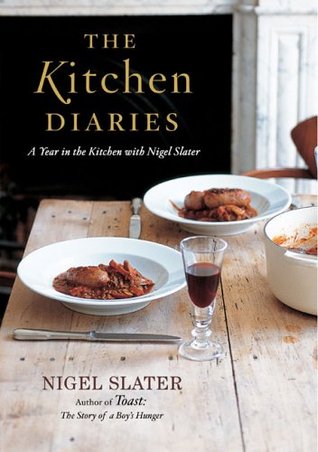
Kitchen Diaries is an account of more or less everything Nigel cooked in the course of a year, presented as an illustrated diary. The photographs are sublime, and they are done in ‘real time’; they are photos of the food he cooked and ate on that day.The book follows the seasons so you can find suggestions about what is worth eating and when – a book to dip into throughout the year and for years to come. There are recipes for Onion Soup Without Tears, Thyme and Feta Lamb, Roast Tomatoes with Anchovy and Basil, Mushroom Pappardella, Stilton, Onion and Potato Pie and many many more.

In Toast Nigel charts his way through childhood with descriptions of toast, cakes, puddings, jam tarts, pancakes, sweets and toffee, tinned ham, lamb chops – you name it and it’s in this book. It’s not just food he liked but also food he detested, in particular milk and eggs. I felt so sorry for him after reading of the way his teacher made him drink his school milk. How it brought back memories of that warm milk we had each day at school – warm because the bottles had been kept standing in the crate in the sun and the cream sat in a thick layer at the top of the bottle! I hated it too.

It’s a very frank book about a young boy’s feelings and a teenager’s sexual experiences, and his relationship with his mother whom he loved, and his father who sometimes scared him. It’s both funny and sad, unsettling and moving; the pathos when his mother no longer makes the mashed potao he loves, but gives him Cadbury’s Smash,

grainy and salty, wet but possessed of a dry, almost powdery feel in the mouth. ‘The mash tastes funny, Mummy.’ Quietly but firmly, in a tone heavy with total and utter exasperation, and with a distant rasp after the first word, she said, ‘Nigel … Just eat it.’ 

I read it quickly, almost devouring it, enjoying the remembrance of food of times past. There is so much in the book that I’m tempted to make a food index to go with it – here’s just a few I could name –

Arctic Roll, Banana Custard, Crumpets, Damson Jam, Eggs (Scrambled), Flapjack, Grilled Grapefruit, Haddock (smoked), Ice Cream, Jelly, Kraft Cheese Slices, Lemon Drops, Marshmallows, Nestle’s (pronounced Nessles) Condensed Milk, Oxtail Soup (tinned), Prawn Cocktail, Quick-Gel, Rabbit, Spinach, Tapioca, Victoria Sandwich, and Walnut Whips (my favourites).

Toast is the winner of six literary awards, including the National Book Awards British Biography of the Year. I love Nigel Slater’s TV series A Taste of My Life and I’ve just discovered he’s written another book – Eating For England: the delignts and eccentricities of the British at Table – I must read that!

An entry in the Soup’s On Challenge.

Atonement by Ian McEwan

Atonement by [McEwan, Ian]

I finished reading Atonement last week. It moved me to tears, which surprised me as I knew the story, having read it some years ago and I’d watched the film last weekend. I have written before that I am often disappointed seeing the film of a book and I think TJ  in his comment identified my problem when he said that he likes to keep his own images of characters and settings in his head, rather than some cinematographer’s. That is just how I feel. I also don’t like it when the film moves too far away from the book.

In this case the film is mostly faithful to the book, with minor alterations, except for the ending. I prefer the book’s ending. I don’t want to write too much about the plot because if you haven’t read the book or seen the film I don’t want to spoil it by giving away too much.

In my view the book is superior overall to the film. It was shortlisted for the Booker Prize in 2001, which that year was won by Peter Carey’s True History of the Kelly Gang (which I couldn’t read beyond the first chapter – maybe I should have another go?). It’s a complex story, split into four parts and told from several points of view. In both the book and the film we see different versions of the same events, which adds depth and introduces uncertainty and ambiguity about what actually happened.

It begins on a hot day in the summer of 1935 when Briony, then aged thirteen witnesses an event between her older sister Cecelia and her childhood friend Robbie that changed all three of their lives. It’s a captivating story of the use of imagination, shame and forgiveness, love, war and class-consciousness in England in the twentieth century. The depiction of the Second World War is both horrifying and emotional as British troops were withdrawn from France in 1940.

As well as being a love story and a war novel it’s also a mystery and a reflection on society and writing and writers. Briony when writing her novel based on the initial incident considers that:

The age of clear answers was over. So was the age of characters and plots. Despite her journal sketches, she no longer believed in characters. They were quaint devices that belonged to the nineteenth century. The very concept of character was founded on errors that modern pyschology had exposed. Plots too were like rusted machinery whose wheels would no longer turn. A modern novelist could no more write characters and plots than a modern composer would a Mozart symphony. It was though, perception, sensations that interested her, the conscious mind as a river through time, and how to represent its onward roll, as well as all the tributaries that would swell it, and the obstacles that would divert it. … To enter a mind and show it at work, or being worked on, and to do this within a symmetrical design – this would be an artistic triumph.

As indicated in this quotation Briony is an admirer of Virginia Woolf and stream-of-consciousness writing, and her novel is rejected by the editor who considered it “owed a little too much to the techniques of Mrs Woolf.”   Her novel draws on what she saw as a child, which she hadn’t understood. Her imagination takes over providing her with a version of events that may or may not be right. She becomes confused and as she matures begins to reflect that what she “knew” may not have been what really happened.

I like the way McEwan interweaves the story, with its vividly-drawn characters and harrowing descriptions of war with reflections on the process of writing and the interpretation of novels. I found it a thought-provoking book with several layers. I’ve read several of his books and I think this one, along with Enduring Love, is my favourite.

Keeping the World Away by Margaret Forster

Keeping the World Away

I expect a book by Margaret Forster to be good and this one is no exception. It is essentially the story of a painting, a variant of Gwen John’s The Corner of the Artist’s Room in Paris, as over the years it passes from one woman to another.

a-corner-of-the-artist-s-room-paris.jpg!Large

I knew very little about Gwen John before I read Keeping the World Away and now I want to know more. (Fortunately there is a list of books about her in the back of the book.)

The title of the book comes from a quotation from Gwen John’s Papers in the National Library of Wales:

“Rules to Keep the World away: Do not listen to people (more than is necessary); Do not look at people (ditto); Have as little intercourse with people as possible; When you come into contact with people, talk as little as possible … ” 3 March 1912

It seems from this novel that Gwen John was completely infatuated and in thrall to the artist Rodin. She became his lover and tried to please him by being tranquil and calm and striving for harmony in her life. Inwardly, however she “felt volcanic, as though burning lava filled her and would explode with the force of what was beneath it, her overwhelming passion for him.”

Her room was the image of how Rodin wished her to be and she painted a sunlit corner of it where it was “all peace and calm and serenity” in contrast to Gwen herself who “radiated energy”. She rearranged the room and painted several versions; with the window open, with an open book on the table, with flowers on the table, with and without the parasol.

I wished that the whole book had been about Gwen John. However, it’s about the painting and how its successive owners acquire it and what it means to each of them. It gets lost, is stolen, turns up on a market stall, is bought, given away and fought over. As each new owner is introduced there are links between them, but each time the painting passed to a new person I wanted to know more about each of them.

The painting is seen as expressing a yearning for something unobtainable, having an air of mystery, conveying a sense of waiting, of longing, of anticipation of someone’s arrival, painful, soothing or uplifting, empty, and symbolic of an independent, simple life free of entanglements. It becomes part of the lives of its owners. The novel starts with Gillian, the school girl reflecting that art speaks for itself, regardless of the artist’s intention. “She was convinced  that art should be looked at in a pure way, uninfluenced by any knowledge of the artist or the circumstances in which it had been painted.” It ends with Gillian, the aspiring artist, reflecting on the nature of art and the purpose of this painting – “Had that not been its purpose? To keep the world away, for a few precious moments, at least every time it was looked at?”

I can’t quite agree with Gillian. I can see that seeing a painting in isolation from the artist can be a pure experience, but I’m always filled with curiosity both about artists and authors – who they were, when they lived, what was going on in the world they lived in and how it affected their work. However, I also think that a painting is like a book in that they can both be interpreted in many ways regardless of the artist’s or author’s intentions.

This is a remarkable book, which I’m sure I shall read again and again.

(This book meets the criteria for the Celebrate the Author Challenge – Margaret Forster’s birthday is in May.)