James Herriot’s Cat Stories

In August I read a beautiful little book- it was a birthday present – James Herriot’s Cat Stories. It was a great relief to read this book after some of the books (about war and disasters) I’d been reading lately and this book with its lovely illustrations by Lesley Holmes cheered me up immensely. That’s not to say it has no drama or desperate situations of the feline type that tugged at my heart strings. (An aside the heart does have strings – I saw them on Alice Roberts’ programme Don’t Die Young.)

I must have watched all of the programmes in the TV series All Creatures Great and Small about “James Herriot’s” vet practice in Yorkshire.  There are many James Herriot books and I’ve read a few of them in the past. This book contains ten short stories, all about cats. In the Introduction James writes that cats were one of the main reasons he chose a career as a vet. They have always played a large part in his life and and now he has retired they are still there “lightening” his days. When he studied to become a vet he was astounded that he couldn’t find anything about cats in his text book Sisson’s Anatomy of Domestic Animals. Yet when he began his practice there were cats everywhere and every farm had its cats. Things have moved on since then and now “Large, prestigious books are written about them by eminent veterinarians, and indeed, some vets specialise in the species to the exclusion of all others.”

Cats have always played a large part in my life too (see here and here). 

James Herriot’s Cat Stories is not large; in fact it’s very small (158 pages) but the ten stories clearly demonstrate his love of cats. Inevitably there are some spoilers in my summaries:

  • There is Alfred the Sweet-shop Cat, “a massive, benevolent tabby”, belonging to Geoff the sweet-shop owner. When he starts to lose weight and becomes gaunt and listless, Geoff too begins to wilt and become bowed and shrunken.
  • Oscar the Socialite Cat who loves people often goes missing as he visits his human friends. Everyone loves him.
  • Boris by way of contrast lives in household full of cats taken in mainly as strays by Mrs Bond. Boris is a “malevolent bully” who regularly beats up his colleagues, so that James was always having to stitch up ears and dress gnawed limbs.
  • Three stories are about Olly and Ginger were two little strays who came to live, not with the Herriots but who sat on the wall outside the kitchen window, too wild to actually venture into the house. When they become desperately ill will they let James treat them?
  • Emily, a dainty little cat, has adopted Mr Ireson, “a gentleman of the road”. When Emily becomes pregnant, seemingly full of kittens she needs a caesarean operation.
  • Moses – Found Among the Rushes. He was rescued by James, looked after by a farmer’s wife and adopted by a large sow. 
  • Frisk the Cat with Many Lives (don’t they all). Why does Frisk, old Dick Fawcett’s faithful companion keep falling unconscious?
  • Buster the Christmas Day Kitten – the little orphan born on Christmas Day who grows up playing with dogs and behaves like a feline retriever.

Down To a Sunless Sea by Mathias B Freese

Mathias Freese kindly sent me Down To a Sunless Sea to review a while ago. It has taken me some time to read it, mainly because it’s a collection of fifteen short stories, covering a number of difficult topics and I have found it quite painful to read. I don’t know if I can really do justice to these stories. Mathias Freese has worked as a clinical social worker and psychotherapist for 25 years and these stories are full of dark and dangerous situations.

First of all I like the title – taken from Coleridge’s poem Kubla Khan, inspired by an opium induced dream. But a sunless sea is a dreary, lifeless place in contrast to the pleasure dome in Xanadu and the sacred river Alph and as soon as I started reading the title story I realised why Freese chose that title as I was plunged into the fearful world of Adam, scared of most things and living “an intensely solitary childhood”, feeling detached and

“as though he is photographing himself behind a schizoid lens, for he is never in himself observing himself – holding the cap gun, for one. Rather he is Adam staring at Adam from afar, the nether camera-work of a dream.”

As I was reading the stories I began to wonder just what it is I expect from my reading. Sometimes I just want to be entertained and I didn’t find these stories entertaining at all. Sometimes I want to be taken out of myself and on this level they definitely work – there is one story that I could relate to a little bit and that is Little Errands in which the narrator agonises over whether or not he/she (I’ll say he from now on) has posted some letters, relating this to times when he’s not been sure if he turned off the car radio and will return to find a dead car battery. I’ve done something similar (well not the car radio) only to find that I haven’t posted a letter or I didn’t set the cooker timer and the chicken is still uncooked.

Some of the other stories are so sad and haunting, such as Alabaster – a little boy meets an old woman, a survivor of the Holocaust, and her daughter sitting on a wooden bench on a sidewalk. Clearly, they are sad – he thinks of them in later life seeing them as:

“… Egyptian statuary, totemic, to be viewed and admired, but not to be engaged, as if what they were or had been exposed to precluded any real human contact. This small family endured a strange exile.”

 The old woman frightens him a little with her strangeness and he sees the number tattoed on her arm – her arms had been beautiful as a child, like alabaster. Inside she is still that beautiful girl with alabaster arms, although now she feels as though she’s living someone else’s life.

I have to say that I found these stories quite disturbing and unsettling, which is not a bad thing, but don’t expect any cosy, comforting stories.  See here for an interview with the author.

The Sunday Salon – in Egypt with Nefertiti

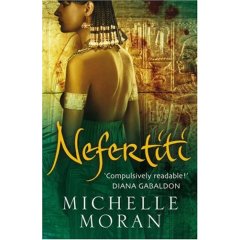
I started to read Nefertiti by Michelle Moran a bit ago and just in the last few days have picked it up again. Nefertiti is most irritating – insufferably self-confident, arrogant, demanding, lusting after power, manipulative, superior, full of her own self-importance and well, beautiful; just as you would expect her to be, a jealous selfish queen. I’m about half way through the book now and am enjoying it despite my dislike for Nefertiti, maybe she’ll become more likeable but I doubt it. As I read, ancient Egypt comes to life as Moran describes the building of the new city of Amarna, which Nefertiti boasted:

… would be a city unlike anything that had ever come before it, a jewel on the east bank of the Nile, that would write our family’s name in eternity. ‘When future generations speak of Amarna’, she vowed,’they will speak of Nefertiti and Ahkenaten the Builder.’

She was right, all these centuries later we are still fascinated with Nefertiti and this period of the 18th Dynasty. But I am more fascinated by her sister as described in this novel. I hadn’t heard of Mutnodjmet (Mutny) before, but she is presented as a much more likeable character. Younger than Nefertiti, and with a different mother, she is at first swept along as Nefertiti is chosen to marry Amunhotep, the young Prince of Egypt. However, she longs for a life of her own, with the man of her choice, Nakhtmin, a general in the army and worst of all a “commoner”. When Mutny becomes pregnant Nefertiti and Akhenaten (as he re-named himself when he renounced the god Amun in favour of Aten), by then rulers of the whole of Egypt, will not accept this, banishing Nakhtmin to fight the Hittites, and bringing about Mutny’s miscarriage. This is as far as I have read – it looks as though an immense struggle between the sisters is about to explode.

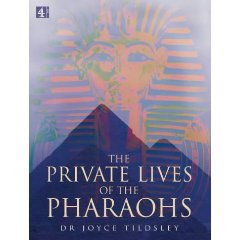
private livesReading Nefertiti reminded me of another book on Egypt: The Private Lives of the Pharoahs by Dr Joyce Tyldesley, which I bought a few years ago, only for it to sit unread on the bookshelves, until now. This book looks at the pyramids, how and why they were built; why the 18th Dynasty died out; and who was the boy-pharoah Tutankhamun. I’ve only dipped into this book so far, but it promises much and has a Further Reading section with yet more books to look out for. I see on Amazon that Tyldesley has also written, amongst many other books, Nefertiti:Egypt’s Sun-Queen . I really must read this as well.

I think I may stay in ancient Egypt for a while.

Pompeii by Robert Harris

Pompeii

Recently I’ve been going from book to book and not finishing any of them, apart from Pompeii by Richard Harris. If you’ve read my recent posts you’ll maybe understand why I’ve been unable to concentrate on reading, but even if the words have not been making much sense as I read them I find the actual process of picking up a book, turning the pages and reading the words to be therapeutic.

Somehow Pompeii made more sense than any of the other books I looked at these last few weeks. For one thing it’s so easy to read and you know the broad outcome right from the start. Vesuvius erupts destroying the town of Pompeii and killing its inhabitants as they tried to flee the pumice, ash and searing heat and flames.

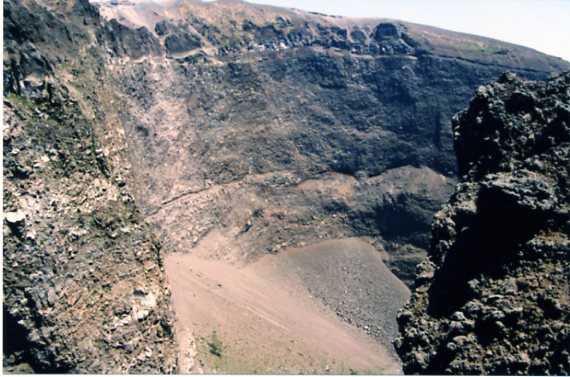
Part of the book’s appeal to me was because I visited Pompeii and had a trip up to the summit of Vesuvius some years ago and so I could picture the location. It was not only Pompeii that was affected – the whole area stretching from the town of Herculaneum in the north of the Bay down to Stabiae in the south suffered from the eruption.

Vesuvius001
Vesuvius Crater

The summit of Vesuvius, today looks flat from below and climbing to the top reveals the enormous crater as a result of the eruption.


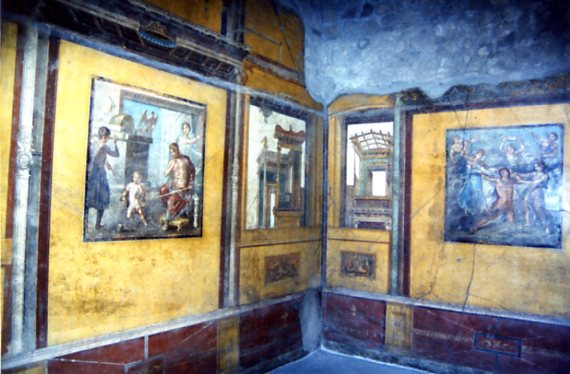
pompeii002
Frescoes at Pompeii

The remains of luxurious villas with their frescoes can still be seen and most poignantly some of the inhabitants preserved by the ash that killed them.

The story begins just two days before the eruption of Mount Vesuvius and builds up to a climax. Whilst most people are blissfully unaware of what is about to be unleashed upon them one man – the engineer Marius Attilius Primus realises the danger when the aqueduct Aqua Augusta fails to supply water to the people in the nine towns around the Bay of Naples. Attilius realise that the problem lies somewhere to the north of Pompeii, on the slopes of Vesuvius. The tension mounts as he tries to repair the aqueduct and persuade people of the danger, hindered by the disappearance of Exomnius, his predecessor and the disbelief of the town magistrates. The power behind the town officials is the former slave Ampliatus who made his fortune after the last earthquake had devasted Pompeii. Harris gives vivid descriptions of the luxury of the town – its villas and baths – the corruption of its leaders, the poor living conditions of the general population and savage cruelty shown to the slaves. Ampliatus helps Attilius but only under his own terms – to continue the financial arrangement he had with Exomnius.

Interspersed with the story are details of the ingenuity and skill of the Romans in engineering, and of the nature volcanoes. I’m not technically minded but I found this more than interesting and added to my enjoyment of the book. I particularly liked mixture of fictional and historical characters and the inclusion of Pliny, then the Admiral of the Fleet, as he watched and recorded the progress of the eruption and the account of his death. But my favourite character is the hero of the book, Attilius – incorruptible, resourceful, stubborn, determined and an expert at his job. All in all I found the book brought history to life and I could feel the danger and fear as Vesuvius inevitably destroyed Pompeii.

This is Harris’s description of the horror of the impact of the eruption:

Pompeii became a town of perfectly shaped hollow citizens – huddled together or lonely, their clothes blown off or lifted over their heads, hopelessly grasping for their favourite possession or clutching nothing – vacuums supspended in mid-air at the level of their roofs.

This is the only book I’ve read by Robert Harris, but I would like to read more of his, particularly Imperium, again set in Ancient Rome and following the career of Marcus Cicero. I’d also like to read The Last Days of Pompeii, although I suspect I may not like the melodramatic style of this book by Sir Edward Bulwer-Lytton written in 1834, but it would be an interesting comparison.

The Sunday Salon – Book of the Day

It’s been a really hot day here today, stifling in fact, and far too humid for me to be comfortable. This is the sort of weather that makes me feel limp and exhausted even if I didn’t have toothache. So I’ve taken things easy today, dosed myself with painkillers and read Paul Auster’s new book Man In The Dark. My copy is an uncorrected proof that LibraryThing sent to me in the Early Reviewers Programme, so I can’t quote from it, which is a pity as it’s full of sentences/paragraphs I’d love to include in this post. It’s due out in hardback on 21 August and the back cover of my copy reveals that Paul Auster will be making a rare visit to the UK around that time.

It’s not long – 180 pages, just right for reading in a day and it’s sufficiently complex to take my mind off things. The “man in the dark” is seventy-two year old August Brill, recovering from a car accident, who can’t sleep. He is living with his daughter Miriam and granddaughter, Katya. To take his mind off the things he doesn’t want to think about – his wife’s death and the shocking murder of Titus, his granddaughter’s boyfriend – he makes up stories in his head. At this point I had to concentrate because there are so many stories and stories within stories. He imagines a parallel America, in which there is no war with Iraq. Instead there is civil war, several states having declared their independence and formed the Independent States of America. The main character in his story is Owen Brick, who reminiscent of the man in Travels in the Scriptorium, has to discover what is happening to him as the story progresses. His confusion deepens as he thinks someone is inside his head, stealing his life, not knowing what is real and what is imagined.

Katya is a film student, training to become a film editor and she and August spend their days watching films. A point of interest here for me as August considers that the difference between films and books is that watching films is a passive activity, whereas reading books makes you use your imagination and intelligence. He thinks Katya is using the films as a sort of self-medication to anesthetise herself against the realities of her life. As in The Book of Illusions there are descriptions of the films – more stories within the story.

As August struggles with insomnia he is joined by Katya in the dark hours and questioned by her he gradually reveals the story of his marriage and his despair at the death of his wife, Sonia. She in turn tells of her relationhship with Titus. This may sound a depressing, dark book – there is much in it about loss, despair, divorce, death and disaster  – but I didn’t find it so. There is also much about the everyday, ordinary stuff of life and love, even in a dark, brutal world. I enjoyed it.

Chocolat by Joanne Harris

CelebrateTheAuthorJuly’s Birthday author is Joanne Harris (3 July), so I read Chocolat. There is so much more to this book than a simple story about a chocolaterie.

chocolat1

This is a fabulous book. I saw the film a few years ago (so I’ve forgotten the details) and loved that and amazingly the book is even better. I think for me that’s the right sequence of events if I’m going to see the film of a book at all – see the film, then read the book.

Simply told it’s a story about Vianne Rocher who arrives in Lansquenet-sous-Tannes, a place that is” no more than a blip on the fast road between Toulouse and Bordeaux” on Shrove Tuesday. She takes over the old bakery and transforms it into La Celeste Praline Chocolaterie Artisanale – in other words the most enticing, the most delicious and sensuous Chocolaterie, selling not only all sorts and types of chocolate treats but delicious chocolate drinks. Together with Anouk her daughter with her imaginary friend Pantoufle the rabbit, she also transforms everyone’s life along the way.

The story is told alternately by Vianne and Francis Renauld, the Cure of the parish. Renauld regards Vianne as the devil opposing everything he believes in and viewing her chocolate as sinful temptations designed to lure people away from the church. This is particularly provoking for him as it is Lent and the church is opposite the shop, open on Sundays and his parishioners are succombing to the temptations of Vianne and her shop.

In the weeks before Easter Vianne plans a grand festival of chocolate to take place on Easter Sunday. This infuriates Renauld:

To rail against a children’s celebration is to court ridicule. Already Narcisse has been heard to refer to my brigade anti-chocolat, amidst disloyal sniggering. But it rankles. That she should use the Church’s celebration to undermine the church – to undermine me. I dare not go further than this. And every day her influence spreads. Part of it is the shop itself. Half-cafe, half confisierie, it projects its air of cosiness, of confidences. Children love the chocolate shapes at pocket-money prices. Adults enjoy the atmosphere of subtle naughtiness, of secrets whispered, grievances aired. Several families have begun to order a chocolate cake for lunch every sunday; I watch them as they collect the beribboned boxes after Mass. The inhabitants of Lansquenet-sous-Tannes have never eaten as much chocolate. Yesterday Denise Arnauld was eating – eating! – in the confessional. I could smell it on her breath, but I had to maintain anonymity.

As the story progresses it becomes clear that Renauld has more than just a problem with Vianne. He is convinced of his own unworthiness and increases his Lenten fast in an attempt to cleanse himself. There is also something in his past which bothers him enormously. And he is not the only person in Lansquenet-sous-Tannes who has problems. Amongst others, there are Josephine, whose husband beats her up, Armande a diabetic in her eighties, whose snobbish daughter Caroline prevents her son from having any contact with her, and Guillaume a lonely old man struggling with the death of his dog, Charly. Vianne herself is fleeing from the ‘Black Man’, just like her mother did before she died. Into this mix of characters come the river gypsies and Roux causing even more angst for Renauld.

So, this book covers an enormous range of topics – fear of the outsider, prejudice against “these people” – immigrants, vagrants, and gypsies; bigotry; fear of death, old age and illness; and fear that the Church will lose its purity and that the community will be corrupted by liberal and heretic beliefs. It’s also about how so many lives intersect and interact and above all about the importance of love and understanding in everyone’s life.

Of course it’s also about food, and not just chocolate, although there are many descriptive passages extolling chocolate. The food at the party to celebrate Armande’s birthday includes:

Soupe de tomates a la gasconne, served with fresh basil and a slice of tartelette meridonle, made on biscuit-thin pate brisee and lush with the flavours of olive oil and anchovy and the rich local tomatoes garnished with olives and roasted slowly to produce a concentration of flavours which seems almost impossible. … vol-au-vents, light as a puff of summer air, then elderflower sorbet followed by plateau de fruits de mer with grilled langoustines, grey shrimps, prawns, oysters, berniques, spider-crabs … and a giant black lobster, regal on its bed of seaweed. … The dessert is a chocolate fondue … and dark-and-white- chocolate roulade bicolore. … We round off the meal with my own chocolate ice-cream, truffles and coffee in tiny demi-tasses, with a calvados chaser, drunk from a hot cup like an explosion of flowers.”

I judge a book by my desire to re-read it and to read more by the same author. This book passes both tests. I will have to re-read it to fully appreciate all its many layers and I already have The Lollipop Shoes waiting for me on my bookshelves. I believe it’s a sequel to Chocolat.