Crime Fiction Alphabet: Letter Y

There are just two letters left in Kerrie’s Crime Fiction Alphabet series. This week it is the letter Y and I’ve chosen Dead in the Morning which was first published in 1970 and is the first of Margaret Yorke’s Patrick Grant mysteries.

Set in Fennersham, an English village this is about a family dominated by old Mrs Ludlow. When Mrs Mackenzie, the housekeeper is found dead it seems that she was killed by mistake and the intended victim was in fact Mrs Ludlow.

Dr Patrick Grant, Fellow and Dean of St Mark’s College Oxford and lecturer in English  is staying in the same village with his sister Jane. Patrick is writing a book about unsolved mysteries from the past and as his sister says he

… is the most inquistive man ever to be born. … He looks for mysteries where there are none and is always poking his nose into other people’s business. (page 42)

He knows Timothy Ludlow, Mrs Ludlow’s grandson, who is a student at St Mark’s, so when he sees Phyllis Medhurst, Mrs Ludlow’s daughter in the chemist collecting her mother’s medicine his interest in the family is aroused. Jane tells him that Mrs Ludlow is a 

… regular tartar, from all accounts. … She’s  paralysed, or something, spends her days in a wheel chair and leads them all the devil of a dance, according to gossip. (pages 26-7)

The rest of the family comprise Cathy, Mrs Ludlow’s granddaughter, Gerald, Cathy’s father and his new wife Helen (Cathy’s mother died ten years earlier when Cathy was 8), and his brother Derek, his wife Betty and two sons, Timothy and Martin.

Mrs Ludlow, tired after the family get together to meet Helen, has her meal in bed, chicken fricassee and lemon meringue pie, but doesn’t eat the pie. The next morning Mrs Mackenzie is found dead in her room and the coroner’s verdict is that she died as a result of eating the portion of lemon meringue pie that Mrs Ludlow had left. It had been laced with barbiturates.

Cathy and Jane are friends and so Patrick manages to work his way into the family and discovers all sorts of family secrets. He thinks it is a question of character and wonders whether it is a crime of passion or of greed.

There are plenty of red herrings along the way but I’d worked it out before the end, which is predictable. Nevertheless I wanted to read on to find out the why rather than the who and that wasn’t so predicitable. All in all, an enjoyable book.

Raven Black by Ann Cleeves: Book Review

Raven Black is the first book I’ve read by Ann Cleeves. It’s set in Shetland and begins on New Year’s Eve with Magnus Tait seeing the new year in on his own. Magnus, a simple elderly man lives by himself, shunned by most of the other islanders.  To his delight two teenage girls knock on his door to wish him a Happy New Year. One of the girls is Sally, the daughter of the primary schoolteacher and the other is Catherine, an English girl whose father is the Head Teacher at Anderson High School.  A few days later Catherine is found dead in the snow not far from Magnus’s house, strangled with her own scarf.

Eight years earlier a young girl, Catriona, had gone missing and had never been found. At the time, although he had never been charged with anything, everyone was convinced that Magnus had killed her. When Catherine’s body is discovered the police and the locals immediately suspect that Magnus must have killed her.

Inspector Jimmy Perez, originally from Fair Isle, is in charge of the investigation until the arrival of a team from Inverness headed up by DI Roy Taylor. Whilst everyone else is convinced of Magnus’s guilt Perez doesn’t want to jump to conclusions and and feels pity for him. Perez is a fascinating character, descended from a seaman from the Spanish Armada, shipwrecked on Fair Isle. Coming from Fair Isle to Shetland he understands how it must have been for Catherine as an outsider. Catherine, though had not worried what others thought of her and had been making a film of the island, interviewing people getting them to reveal themselves to her camera.  As everyone who knew Catherine is questioned it becomes clear that several people could easily be her killer and I completely failed to identify the culprit. Thinking back over the book I could see that all the clues were there, but so skillfully planted that I failed to see them.

The tension between the islanders and the incomers is evident and also the loneliness of outsiders. Family ties, heredity and personal relationships are important themes running through the narrative.  There is also a strong sense of location and terrific atmosphere – the landscape, the sea, the weather, the circling ravens and the spectacle of Up Helly Aa (the Fire Festival), all anchor the story and bring the book to life.

Often the colours on the islands were subtle, olive green, mud brown, sea grey and all softened by mist. In the full sunlight of early morning, this picture was stark and vibrant. The harsh white of the snow. Three shapes silhouetted. Ravens. (page 28)

There are three more books set in Shetland, featuring Perez – White Nights, Red Bones and Blue Lightning. I’m looking forward to reading them all. I’m also  going to look out for her other novels set in Northumberland.

Crime Fiction Alphabet – X is for A Loyal Character Dancer by Qiu Xiaolong

Qiu Xiaolong was born in Shanghai and was a member of the Chinese Writers’ Association, publishing poetry, translations and criticism in China. Since 1989 he has lived in the United States, his work being published in many literary magazines and anthologies. His first crime novel, Death of Red Heroine, won the Anthony Award for Best First Crime Novel. A Loyal Character Dancer is his second book featuring Chief Inspector Chen Cao, of the Shanghai Police Bureau.

Like Qiu Xiaolong, Chen is a member of the Chinese Writers’ association and he writes poetry (reminding me of PD James’s Adam Dalgleish). It was not his desire to become a policeman. He is also a gourmet and the book contains many tantalising descriptions of Chinese food – for example:

He ordered a South Sea bird’s nest soup with tree ears, oysters fried in spiced egg batter, a duck stuffed with a mixture of sticky rice, dates, and lotus seed, a fish steamed live with fresh ginger, green onions, and dried pepper, … (page 120-121).

In this book he has two crimes to deal with – the murder of an unknown man found in Bund Park, a park celebrated for “its promenade of multi-colored flagstones, a long curved walkway raised above the shimmering expans of water which joined the Huangpu and Suzhou rivers.” The man was in his forties, dressed in silk pajamas and he had been hacked more than a dozen times with a sharp, heavy weapon.

His second case is to investigate the disappearance of Wen Liping, the wife of Feng Dexiang, a crucial witness in an illegal immigrant case in Washington. The American and Chinese governments have agreed to a joint investigation to find Wen and Chen is assigned to work with Inspector Catherine Rohn, of the US Marshall’s Office.

I loved this book. There is a lot in it about life in China, the impact of the Cultural Revolution and the country itself. There is a very strong sense of place and this had me reaching for my sister’s books on China (she visited a few years ago before she died) to see photos of the locations and read more about life in China.

Having to explain things to Catherine made it easy for Qiu to pack in lots of information that otherwise could have seemed intrusive. For example as well as quoting poetry he also quotes from Confucius and explains literary references. Wen was a beautiful young woman, forced to leave her home to be “re-educated” when she was only sixteen during the Cultural Revolution. She had become a Red Guard cadre and a member of the song-and-dance ensemble, dancing the loyal character dance (hence the title of the book). Chen explains to Catherine that although dancing was not then allowed in China, this was particular form of dancing was allowed :

…  dancing with a paper-cut out of the Chinese character of Loyalty or with a red paper heart bearing the character, while making every imaginable gesture of loyalty to Chairman Mao. (page 84)

Chen is an enigmatic man, skilled at working the system. As a chief inspector he is also responsible for preserving Shanghai’s image. Keeping and saving face is very important. His boss, Li, the Party Secretary is more concerned with making sure that Catherine has a satisfactory stay in China, seeing only the good things than with carrying out the investigation into Wen’s disappearance. He does not like it when Chen and Catherine discuss the living conditions of the poor, China’s birth control policy and the question of illegal immigrants to the US. However, Chen and Catherine make a good partnership and with the help of Chen’s assistant, Dectective Yu get to the bottom of the mysteries of the murder and Wen’s disappearance, despite the activity of rival triad gangs.

The Little Stranger by Sarah Waters: Book Review

The Little Stranger is the only book I’ve read by Sarah Waters. I saw the TV version of Tipping the Velvet and wasn’t impressed. It didn’t make me want to read any of her books. But, so many other bloggers have praised them that I was interested enough to borrow The Little Stranger when I saw it in the library. That’s the influence book bloggers have.

It begins very well – an old dilapidated house, Hundreds Hall, just after the end of the Second World War, a family struggling to come to terms with post-war life and lack of money, and the hint of something supernatural lurking in the background. The Hall has a major part in this book. This is how it is seen through the eyes of the narrator Dr Faraday, who had known it thirty years earlier when his mother had been a nursery maid there.

I remembered a long approach to the house through neat rhododendron and laurel, but the park was now so overgrown and untended, my small car had to fight its way down the drive. When I broke free of the bushes at last and found myself on a sweep of lumpy gravel with the Hall directly ahead of me, I put on the brake, and gasped in dismay. The house was smaller than in memory, of course – not quite the mansion I’d been recalling – but I’d been expecting that. What horrified me were the signs of decay. Sections of the lovely weathered edgings seemed to have fallen completely away, so that the house’s uncertain Georgian outline was even more tentative than before. Ivy had spread, then patchily died, and hung like rat’s-tail hair. The steps leading up to the broad front door were cracked, with weeds growing lushly up through the seams. (page 5)

Reminiscent of Rebecca, I thought. It’s not just the house that is decaying, the family too is cracking up. Dr Faraday remembered it in it’s prime – now there are just Mrs Ayres, Caroline her daughter and Roderick, her son left, living on their own in the house with help from one servant, a maid – Betty, a fourteen year old girl. Roderick was injured in the war, and Caroline is a plain young woman over-tall for a woman with thickish ankles and legs, but a ‘clever’ girl. Their mother still has a good figure, with a heart-shaped face and handsome dark eyes. As the book progresses she declines rapidly, overcome by events and it is soon revealed that she has never got over the death of her first child, Susan who was ‘her one true love’.

It begins with Dr Faraday called out to see Betty who tells him there is something bad in the house that makes wicked things happen. What follows is a sequence of terrible events. Dr Faraday is a very tedious character, dismissing all thoughts that things that are moved from one place to another and much worse events are in any way supernatural, believing there is either a rational or pscyhological explanation for it all.  He is reinforced in his beliefs when he talks to another doctor, Dr Seeley who says:

The subliminal mind has many dark corners, after all. Imagine something loosening itself from one of those corners. Let’s call it a – a germ. And let’s say conditions prove right for that germ to devlop – to grow like a child in the womb. What would this little stranger grow into? A sort of shadow-self, perhaps: a Caliban, a Mr Hyde. A creature motivated by all the nasty impulses and hungers the conscious mind had hoped to keep hidden away: things like envy, malice, and frustration … (page 380)

I got very tired of Dr Faraday and his persistence. It is all very drawn-out, no doubt to increase suspense but I felt that all the tension and spookiness that had initially been built up just drained away in the middle of the book. It did pick up towards the end with several dramatic scenes, but I think it would have been better if the book had been shorter. However, I did enjoy it – the descriptions of the house and park are vivid and I liked the social commentary. The post-war period is well defined, indicating the attitude of the upper classes towards the working classes, the coming introduction of the National Health Service and the breaking up of landed estates to build Council estates – new houses for the workers .

So, just what is the ‘ravenous frustrated energy’ at the heart of the matter? All the characters are built up as suspects and it was only towards the end that I realised what (or who) was responsible.

The Little Stranger has been shortlisted for the Orange Prize for Fiction. Will it win? Maybe not, there are some other very good books on the list, which I suspect may over shadow this one.

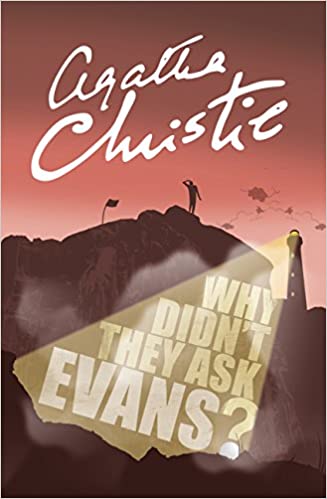
Crime Fiction Alphabet W is for Why Didn’t They Ask Evans?

I’m returning to Agatha Christie to illustrate the letter W in Kerrie’s Crime Fiction Alphabet series, with Why Didn’t They Ask Evans? The copy I read is one of the Collected Works series with the original illustrations by Patrick Couratin and Sylvia Dausset. Why Didn’t They Ask Evans? was first published in 1934.

Why didn't they ask evans

The book begins with Bobby Jones playing golf with Dr Thomas on a golf course on a misty day by the sea. They find a dying man, who had fallen off a cliff. He has no identification on him, just a photo of a young woman that Bobby finds in his pocket. At the inquest Mrs Cayman said it was a photograph of her and that she was the dead man’s sister.

Bobby tells Mr and Mrs Cayman her brother’s last words, which apparently are meaningless and of no importance.Then Bobby is drugged with enough morphia to kill him (he survives) and he realises that the photo in the dead man’s pocket was not Mrs Cayman.  Frankie, (aka Lady Frances Derwent), his aristocratic friend decides that the dead man must have been pushed over the cliff and the killer is determined to kill Bobby too. She and Bobby then set out to discover the dead man’s true identity.

Neither Poirot, nor Miss Marple feature in this book. Bobby and Frankie solve the mystery with a little help from the police in the form of Inspector Williams. The novel as a whole is light-hearted with staged accidents, as Bobby and Frankie, a self-confident and rather bossy young woman relish the adventure of it all, despite being bound and gagged by the villain. There are disguises and subterfuges throughout, drug addicts, an American heiress, a sinister doctor with a questionable sanitorium, suicides and a charming  “ne’er-do-weel”. Bobby says:

You can’t mix up too many different sorts of crimes. (page 59)

But Agatha Christie manages it admirably.

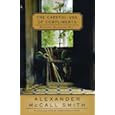
The Careful Use of Compliments by Alexander McCall Smith

I’ve resisted reading Alexander McCall Smith’s books up to now partly because I couldn’t quite believe they would live up to my expectations and partly because I don’t like the style of the book covers. This one is quite off-putting because of its colours, which is really a trivial reason not to read a book.  I am so pleased that I overcame my resistance as I thoroughly enjoyed reading this one. I’ll be looking for more.

The Careful Use of Compliments  is an Isabel Dalhousie Novel, one of the Sunday Philosophy Club series. It’s number 4 in the series, but I had no problem following it as it stands well on its own. I’ve just seen the US cover – much better. My quibble with the cover is my only criticism of this book – I loved it.

Isabel has just had a baby, Charlie, and is in a relationship with his father, Jamie (14 years her junior) who is her niece’s, ex-boyfriend. Cat (her niece)  is upset and resentful and embarrassed even though she broke up her relationship with Jamie, and despite Isabel’s best efforts to bring about a reconciliation is barely speaking to her.

Cat said nothing, and Isabel realised that she was witnessing pure envy; unspoken, inexpressible. Envy makes us hate what we ourselves want, she reminded herself. We hate it because we can’t have it. (page 4)

In addition Isabel has to deal with an attempt from Professor Dove to take over her editorship of the philosophical journal,  Review of Applied Ethics. As well as coping with these two difficult situations Isabel tries to buy a painting by Andrew McInnes at auction and fails. This is a previously unknown painting by McInnes of a scene on the isle of Jura in the Inner Hebrides, where McInnes had drowned in mysterious circumstances. She thinks there is something odd about the painting and sets out to discover more about him and his paintings, becoming convinced that this one is a forgery.

But it’s not really the mystery that captivated me. It’s the philosophical questions that are always uppermost in Isabel’s mind and conversations. It’s her way of ‘interferring’ in matters which she considers ‘helping’, and her kind hearted nature (but she suffers few qualms at getting the upperhand over Dove). It’s the little gems of wisdom scattered through the book. It’s the descriptions of Scotland and Scottishness, of Edinburgh and the islands. It’s about the nuances of understanding the use of language as expressions of general goodwill, about the meaning of money and how it should or should not be used, about late motherhood and family relationships, and about morality and justice.

There are many passages I could quote. I think this one relating to the title of the book is a good one. Here Isabel is talking to Walter, who had tried to sell her McInnes’s painting:

‘Please’, she said, impulsively reaching out to lay a hand upon his sleeve. ‘Please. That came out all wrong. I’m not suggesting that you tried to sell me a forgery.’

He seemed to be puzzling something out. Now he looked up at her. ‘I suppose you thought that because I wanted to sell it quickly.’

‘I was surprised,’ she said. ‘but I thought that there must be a perfectly reasonable explanation.’ That was a lie, she knew. I am lying as a result of having made an unfair assumption. And I lied too, when I paid a compliment to that unpleasant dog of his. But I have to lie. And what would life be like if we paid one another no compliments? (pages 222-3)