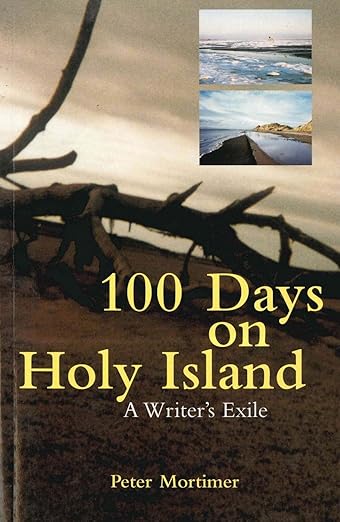
100 Days On Holy Island: a Writer’s Exile by Peter Mortimer

After I finished reading 100 Days On Holy Island the main impression it made on me was that Peter Mortimer endured his hundred days there, feeling insecure, wanting company and to be accepted. He always felt an ‘outsider’, not accepted by the locals. He recognised his paranoia:

Part of Mortimer’s paranoia while on Lindisfarne was of being constantly observed and judged, that my every act was noted and recorded by some amorphous body established purely to note down all behaviour of nosy incomers such as I. The truth, of course, was that people had their own lives to live but anyone in a similar position to mine will know what I mean. (page 199)

This sense of being an outsider pervades the book. It can’t have helped that people knew he was on the island in order to write about his experience. He wasn’t there as a tourist, nor had he gone to settle there, but he went with the intention of seeing how he coped with living there  for one hundred days and writing about it. This book is written with empathy for the island and its inhabitants but because of his sense of being an ‘incomer’ all the time I was reading it I found it uncomfortable, whether he was sitting in one of the pubs on his own, or visiting some of the people he did get to know, or spending time on St Cuthbert’s Isle alone. 

I now know a bit more about the geography of the island, and the way the tide cuts it off from the mainline (which I knew before but this book emphasises the isolation it brings). Most of all I suppose I know more about Peter Mortimer, a writer I had never heard of before. He is a playwright and a poet. His other memoirs are The Last of the Hunters about the six months he spent at sea working with North Shields fisherman, and Broke Through Britain, about his 500 mile odyssey from Plymouth to Edinburgh.

His time on Holy Island was from January to April 2001, when foot and mouth disease swept through the UK, and although it never got to Holy Island it was affected by the closure of the countryside. The islanders were hit by the threat to the tourist trade. It was freezing cold, blasted by snow storms and afflicted by power cuts. It was also a bad time for Mortimer to be away from his family, as his father died just before he went, his mother was in hospital desperate to see him, his son had his 17th birthday and his nephew was seriously ill. Although he did go and visit his mother, he couldn’t have picked a worse time, which may well be a major reason he struggled there on his own.

Holy Island (also known as Lindisfarne) is a place of pilgrimage, known as the Cradle of Christianity, a place of spiritual heritage. I don’t think Mortimer mentioned Lindisfarne Priory in his book and very little about Lindisfarne Castle, either. This is not a guide book, nor is it about the history of the island, or about Christianity. He does examine his own beliefs and went to the talks on faith at the Heritage Centre, but realised that he

was having trouble with these lecture overall; not the people so much as the basis. I wasn’t enthused. They didn’t tap into my own life passions, the things that excited and moved me, which I was becoming increasingly aware, had very little to do with religion. (page 194) 

He spent time doing jobs such as clearing the overgrown garden of one of the island pubs, painting Ray Simpson’s (who ran the society of St Aidan and St Hilda) bathroom and decorating it with a haiku, dragging a stone from one of the beaches and inscribing it with another haiku. He also helped out at the island school, went to lots of meetings, and walked around as much of the island as he could. The days he spent on St Cuthbert’s Isle are interesting. He called that his Three Tides for St Cuthbert. St Cuthbert taught at the monastery on Holy Island and when he died in 687 he was buried in the church, although eventually his bones were buried at Durham. St Cuthbert’s Isle is the place Cuthbert went for solitude and to meditate. Mortimer describes it thus:

The island was bleak terrain, tortured volcanic rock on the top of which was tufted spongy grass whose uneven surface and hidden potholes made walking difficult. The stone remains of Cuthbert’s cell were slightly sunken, offering some slight protection from the wind, which was, it appeared, on a 24-hour-a-day, 7-day-a week contract. At one end of the cell was an impressive oak cross erected 60 years previously. …

The sky seemed massive. The view back to Holy Island took in the Priory ruins, St Mary’s church and the row of desirable properties named Fiddler’s Green. Through the binoculars I could trace the progress of the Dinky-sized cars on the distant causeway. This would continue to 11.30am. To the west, across the water, lay the mass of the Northumberland mainland. (page 195)

In some ways I found it a remarkable book which kept me wanting to read it but by the end his own wish to go back home got the better of me and I was glad it ended.

His own summary of the book and his stay on Holy Island ends the book:

I wrote various small poems during my 100 days and finish with another tiddler completed soon after my return, an image that stayed in my mind and in some ways reinforces the fact that I can never belong to, yet never will be free of, that small huddled island which is simultaneously well known and yet not known at all.

On the Cullercoats carpet

My yanked-off boots

spill North Shore sand.
Take My Breath Away by Martin Edwards

Take My Breath Away by Martin Edwards is a legal mystery, featuring Nic Gabriel, a lawyer turned writer, who is investigating the death of his friend Dylan Rees. Nic is transfixed by the sight of Ella, a woman who had apparently died five years earlier, walking up to Dylan at a party and stabbing him. Dylan had already intrigued him with stories about ‘strange and sudden deaths’ and had promised to tell him the details after the party:

This was all Dylan’s fault. Dylan who had seduced him with all that talk about dead lawyers. Dylan the yarn-spinner; the myth-maker, the Celtic bard in an Armani suit. Of course he’d known that Nic could never resist a story about strange and sudden deaths.

The rich man who burned in Paradise. The giant who chopped himself in half. (page 15)

 I kept turning back to this passage in the first chapter as Nic delved into the mystery, and also this one:

There was a connection, Dylan had insisted on the phone, and not just because the dead men were lawyers in the same firm. Forget about suicide or accident. Think murder for pleasure.

‘As for the boy who died of shock’, Dylan said dreamily, ‘the real culprit wasn’t the guilty creature who killed him. Trust me.’ (page 15)

At the same time Roxanne Wake begins her new job with Creed, a firm of lawyers specialising in human rights law. She’s nervous and it’s not just the new job, because she has something to hide, something she’s not told Creed, something terrible. However, someone knows her secret and it seems she’ll go to any lengths to prevent it becoming known. Eventually the two strands of the book coincide in a dramatic conclusion.  There are many twists and turns and it kept me guessing to the end.

Like all good murder mysteries this is a complex book about good and evil, about power and manipulation, about secrets, lies and deception. It’s a stand-alone book, but I hope that some time Martin will write another book about Nic as I’d love to know his back story and what really happened to his parents.

For more details about Martin’s books see his website. He also writes an entertaining blog – Do you Write Under Your Own Name?

Faithful Unto Death by Caroline Graham


Faithful Unto Death (Misomer Murders -€¦Faithful Unto Death by Caroline Graham is a Midsomer Murder Mystery. I’ve enjoyed watching the TV series over the years. Midsomer is obviously a dangerous place to live with all those murders happening so regularly, but they are not the gory kind – it’s murder of a sanitised nature. Inspector Barnaby is a genial character, although an astute detective, one who is not quite up to date with modern police methods but relies on intuition and thinking.

So I was a bit surprised reading this book that the characters are a bit different, especially Sergeant Troy who is nothing like the TV character. On TV Troy was a bit naive and usually didn’t have much of a clue about solving the murders, but a likeable chap who got on OK with Barnaby. Troy in the book is sharper, meaner, spiteful and inwardly critical of Barnaby. He’s insecure, resentful and sees any creative or intellectual prowess in others as a criticism of his own life.

Set in Fawcett Green, an unspoilt peaceful village the book begins with the disappearance of Simone Hollingsworth, soon followed by her distraught husband’s death, apparently suicide, then the disappearance of their neighbour’s daughter. Barnaby and Troy, with the doubtful assistance of the local policeman Constable Perrot work their way through interviewing the village’s inhabitants and gradually unravel the mystery.

It’s an entertaining and satisfying book, full of detail and clues as to the eventual outcome, which I did work out before the end. The characters stand out as real people, and are described with humour and empathy. I don’t remember seeing this on TV but reading about it online it seems it’s differed from the book, so that’s not too surprising. As in the TV version Barnaby is a patient, tolerant man,  also a bit grumpy and moody, who is trying and failing to lose weight, and who loves music. So many fictional detectives seem to like music and food!

This is the first Midsomer Murder mystery I’ve read and much as I like the TV series I prefer the book version – it has more bite and more substance. I’m taking part in the Cozy Mystery Challenge and although I’m still not too sure about the classification of “cozy” murder mysteries, I think this book can count as one.

King Arthur’s Bones by The Medieval Murderers

King Arthur’s Bones is a historical mystery written by The Medieval Murderers, a group of five authors, all members of the Crime Writers’ Association. The book consists of five stories with a prologue and epilogue tracing the mystery of Arthur’s remains.

The legend is that King Arthur is not dead, but sleeping with his knights ready to return to defend his country in a time of great danger. So when monks at Glastonbury Abbey find what are thought to be his bones that causes great consternation. If these are his bones then Arthur really did die. The implications are too much for some and the bones mysteriously disappear from the Abbey.

The stories by Philip Gooden, Susanna Gregory, Bernard Knight, Michael Jecks and Ian Morson follow the bones from their discovery in 1191 at Glastonbury Abbey through to 2004 when archaeologists at Bermondsey Abbey discover a nineteenth century iron coffin containing an incomplete skeleton of what had been a large man who had probably died after a severe head injury.

Each story involves a murder, as the bones are passed down the centuries. They’re all colourful tales. I particularly liked the story (by Philip Gooden) set in the 17th century involving William Shakespeare’s brother Edmund who discovered a long thigh bone and murder in the Tower of London in one of the compartments of the Lion Tower where the king kept lions and tigers. 

Now that I was here, against my will, I could not see the beasts, but I could smell and hear them. I was in one of the compartments of the Lion Tower meant for animal use. More of a cave or a cell than a chamber it smelled rank. In the next-door cell was a body, not animal but human and supposedly murdered. (page 260)

These are entertaining tales, full of action and surprises. I liked the way the stories interlink around the central theme and the similarities and differences that contribute towards making this such an inventive story. I could believe that one day Arthur will return.

I’ll be looking out for the four earlier books The Medieval Murderers have published and for books by the individual authors as well.

Hearts and Minds by Amanda Craig: Book Review

I like novels that have an underlying  theme or themes that gradually impinge upon my mind as I read; themes that become clear often only after I’ve finished reading. There is no doubt about the theme of  Hearts and Minds by Amanda Craig. Although it begins with a murder its main focus is a passionate denunciation of the treatment of illegal immigrants, thinly disguised as a novel. The characters are mouthpieces for the condemnation of social injustice.

It is page after page of unrelenting misery. Poverty and prejudice, squalor and suffering, prostitution, racism, illegal immigrants, and life in desperate circumstances. There is no relief from the images of brutality, fear, hatred, misery, and helplessness and evil, danger, deceit and terror abound.

In the midst of all this is Polly, a single mum and a lawyer working on behalf of illegal immigrants, employing them as au-pairs, cleaners and taxi-drivers. Whatever she does she feel guilty, exhausted, oppressed and in a mess. It rubbed off on me as I read this book, long-listed for the Orange Prize for Fiction.

It begins with the murder of a young woman, whose body is dumped in a pond on Hampstead Heath, then meanders through a whole host of characters (some one-dimensional) before the relationships (in some cases it seems forced) between them become clear. The main characters, apart from Polly, are all immigrants living in London, Job an illegal taxi driver from Zimbabwe, Ian, an idealistic supply teacher, from South Africa, Katie from New York  working for a political magazine, and Anna, a teenager from the Ukraine, trafficked into sexual slavery.

It is heart-rending, but totally depressing reading. I could only read it in short bursts. It’s depiction of life in London today is harsh, and criticises the British who aren’t willing to do the work carried out by immigrants and complain that life in Britain is no longer the same with jobs are being taken from them. It asserts that it is only the immigrants who do work such as nursing and taxi-driving, teaching and cleaning. Reading this book should deter anyone from wanting to live here, particularly in London. Everything comes in for criticism from the NHS to the state school system. There are not only illegal immigrants but also asylum seekers, trafficked under-age prostitutes, suicidal Moslems, mindless journalists and the idle rich.

I can see that this is a worthy book, a serious book and yet I found I just couldn’t warm to it. I’m waiting with interest to see if it makes the Orange Prize shortlist, to be announced on 20 April.

Crime Fiction Alphabet: Z is for Pariah by Dave Zeltserman

I’ve really enjoyed taking part in Kerrie’s Crime Fiction Alphabet – many thanks Kerrie! For the last letter I’ve chosen Pariah by Dave Zeltserman.

I toyed with the idea of writing about Carlos Ruiz Zafon, but it’s been a long time since I read The Shadow of the Wind, so my memory is a bit rusty about the details and I haven’t started his latest book The Angel’s Game.

I don’t think the only other book I have by a ‘Z’  author, Gem Squash Tokoloshe by Rachel Zadok, qualifies as crime fiction and I don’t have any books with titles beginning with Z. So it was off to the library to see what they had – not a lot! But Pariah by Dave Zeltserman was sitting on the shelf and I borrowed it although the quote on the front cover made me doubt whether any book could live up to such praise:

‘The perfect pitch of reality, history, crime, celebrity, plagiarism, and sheer astounding writing.’ Ken Bruen

Now I’ve read it, in my opinion it doesn’t. I’ve recently joined the Cozy Mystery Challenge and this book just doesn’t qualify for that category – it has everything a ‘cozy’ mystery doesn’t.

As I began it I thought I wasn’t going to like this at all – too much swearing, too much gratuitous violence, too much blood and gore, just too much ‘reality’ (but not reality as I know it). So I put the book down and began another one. But somehow I found myself thinking about Pariah and wondering how it would turn out and I just had to go back and finish it.

It’s a study in evil. The narrator is Kyle Nevin, a killer without a conscience, just released from an eight-year prison sentence, determined to get revenge on Red Mahoney, South Boston’s head mobster, who had set him up with the FBI. But he needs money to track down Red and carry out his plan. He stops at nothing to get what he wants, killing, maiming, robbery, drugs, drink, sex, etc, etc – until it all goes wrong that is.

All though I wanted things to go wrong for him the irony is that it’s through writing a novel that it finally happens. He’s approached by a publisher to fictionalise his crimes:

I want this to be a tough, hard-hitting crime novel, something where there are no winners, only losers, and with the authenticity that you are more than capable of providing. (page 222)

I really enjoyed this part of the book. Dropped in between some of the chapters are Kyle’s notes to the editor, so I knew all along that this was a book he was writing, but it is onlyin the last few chapters that this comes to the fore. Part of the pleasure for me was the contrast between creative fiction writing – there is a character who has an MFA in creative writing who Kyle pays to write the book for him, until the publisher rejects his submission, telling him that it’s unacceptable because it ‘screamed MFA’ (Master of Fine Arts). He wanted writing with ‘raw energy’.

And I loved it when it came to the ‘celebrity’ interiews, the plagiarism charge and the reaction of book reviewers and book bloggers.

The papers had a field day with me, but the bloggers were the worst. Jesus they were unmerciful. During those four days I couldn’t sleep and spent my time reading all that shit written about me on those blogs. (page 267)

This is a tough tale, a dark thriller, written with confidence and fluency. Kyle is an anti-hero, a real pariah and I disliked him intensely. I may not have liked the characters, the language or the content of this story but it certainly has great impact and has lingered in my mind for days.