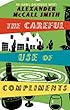
The Careful Use of Compliments by Alexander McCall Smith

I’ve resisted reading Alexander McCall Smith’s books up to now partly because I couldn’t quite believe they would live up to my expectations and partly because I don’t like the style of the book covers. This one is quite off-putting because of its colours, which is really a trivial reason not to read a book.  I am so pleased that I overcame my resistance as I thoroughly enjoyed reading this one. I’ll be looking for more.

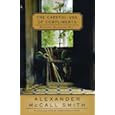
The Careful Use of Compliments  is an Isabel Dalhousie Novel, one of the Sunday Philosophy Club series. It’s number 4 in the series, but I had no problem following it as it stands well on its own. I’ve just seen the US cover – much better. My quibble with the cover is my only criticism of this book – I loved it.

Isabel has just had a baby, Charlie, and is in a relationship with his father, Jamie (14 years her junior) who is her niece’s, ex-boyfriend. Cat (her niece)  is upset and resentful and embarrassed even though she broke up her relationship with Jamie, and despite Isabel’s best efforts to bring about a reconciliation is barely speaking to her.

Cat said nothing, and Isabel realised that she was witnessing pure envy; unspoken, inexpressible. Envy makes us hate what we ourselves want, she reminded herself. We hate it because we can’t have it. (page 4)

In addition Isabel has to deal with an attempt from Professor Dove to take over her editorship of the philosophical journal,  Review of Applied Ethics. As well as coping with these two difficult situations Isabel tries to buy a painting by Andrew McInnes at auction and fails. This is a previously unknown painting by McInnes of a scene on the isle of Jura in the Inner Hebrides, where McInnes had drowned in mysterious circumstances. She thinks there is something odd about the painting and sets out to discover more about him and his paintings, becoming convinced that this one is a forgery.

But it’s not really the mystery that captivated me. It’s the philosophical questions that are always uppermost in Isabel’s mind and conversations. It’s her way of ‘interferring’ in matters which she considers ‘helping’, and her kind hearted nature (but she suffers few qualms at getting the upperhand over Dove). It’s the little gems of wisdom scattered through the book. It’s the descriptions of Scotland and Scottishness, of Edinburgh and the islands. It’s about the nuances of understanding the use of language as expressions of general goodwill, about the meaning of money and how it should or should not be used, about late motherhood and family relationships, and about morality and justice.

There are many passages I could quote. I think this one relating to the title of the book is a good one. Here Isabel is talking to Walter, who had tried to sell her McInnes’s painting:

‘Please’, she said, impulsively reaching out to lay a hand upon his sleeve. ‘Please. That came out all wrong. I’m not suggesting that you tried to sell me a forgery.’

He seemed to be puzzling something out. Now he looked up at her. ‘I suppose you thought that because I wanted to sell it quickly.’

‘I was surprised,’ she said. ‘but I thought that there must be a perfectly reasonable explanation.’ That was a lie, she knew. I am lying as a result of having made an unfair assumption. And I lied too, when I paid a compliment to that unpleasant dog of his. But I have to lie. And what would life be like if we paid one another no compliments? (pages 222-3)

Teaser Tuesdays – Heartland by John MacKay

My teaser today is from Heartland by John MacKay, which I have just finished reading.

John MacKay is a Scottish broadcast journalist, television presenter and producer, who is currently the chief anchor for the Central Scotland edition of STV News at Six.  This is his second book.

Heartland is about Iain Martin who returns to his home on the Isle of Lewis to rebuild his life after the breakup of his marriage and to reconstruct the ancient family home, a blackhouse, now in ruins. He meets his old friend Neilie and his wife Catriona, bringing back memories of their friend Rob who was lost at sea 20 years earlier. Neilie alone had survived the accident, becoming the local hero as he had piloted the boat back to shore.  Iain also discovers a skeleton under the floor in the blackhouse.

My teaser is from page 50.

The body had been laid to rest in a formal manner, on its back, the arms crossed on its breast and the legs fully extended. Over time it had settled awkwardly, twisted towards the right, with the distortion more exaggerated from the waist down.

Is it Rob’s body he has found? His suspicions are increased when Neilie confesses he had not been on Rob’s boat that night. At times the narrative stalls with lengthy descriptions of the locality and its history, all of which is interesting but it does slow down the story. I liked it well enough to look for MacKay’s other books – The Road Dance and Last of the Line.

See Should Be Reading for more ‘teasers’.

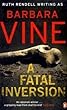
Crime Fiction Alphabet: V is for A Fatal Inversion by Barbara Vine

Kerrie’s Crime Fiction Alphabet series moves towards the end of the alphabet and has now reached the letter ‘V’.

A Fatal Inversion was first published in 1987 and was reissued in 2009 by Penguin Books.

Although about a group of not very likeable characters I was drawn into the world of this mystery. In 1976 Adam, a university student of 19 inherited Wyvis Hall from his great-uncle. He stayed there for a while that hot summer with a group of young people. Something tragic and terrible happened which led to them leaving the house and eventually Adam sold it. Then ten years later the current owners, whilst burying their pet dog in the animal cemetery in the woods, find the bones of a young woman and a baby. The police are seeking previous owners of the Hall to identify the bodies.

It’s a complicated plot told in flashbacks, seen from mainly three of the characters’ viewpoints – Adam, his friend, Rufus, a medical student, and Shiva, a British Indian. Shiva and his friend Vivian had thought they were joining a commune whereas with no money Adam was just keen to get others to contribute. They are reduced to selling his uncle’s silver for food and drugs and after Zosie’s arrival to stealing to support themselves. I thought the characterisation was good and the setting excellent – a grand old house, out in the Suffolk countryside surrounded by dark, dense and menacing pine woods, ‘the kind of place you saw in story-book illustrations or even in your dreams and out of which things were liable to come creeping.’

I wasn’t sure at first who the victims were, but the killer soon becomes obvious. I thought it a clever book, with clues dropped casually, so that I had to read it carefully. The plot covers a number of issues – family relationships, friendship, loyalty, race and class discrimination, the consequences of our actions and above all the nature of evil and guilt.  The ending is most satisfying, such a neat inversion, I thought.

The Rebecca Notebook & Other Memories by Daphne Du Maurier

Why do writers write? How do they go about it? What inspires them? The Rebecca Notebook and Other Memories gives a glimpse into the mind of Daphne Du Maurier.

Du Maurier began to write Rebecca in 1937 when she was thirty years old, living in Alexandria and feeling homesick for Cornwall. She jotted down chapter summaries in a notebook, setting the book in the mid 1920s ‘about a young wife and her slightly older husband, living in a beautiful house that had been in his family for generations.’ As she thought about it ideas sprang to her mind – a first wife – jealousy, something terrible would happen – a wreck at sea. She became immersed in the story, losing herself in the plot, as so many of us have done ever since.

One question that many people asked her was why she never gave the heroine a name and her answer is so simple – she couldn’t think of one and ‘it became a challenge in technique, the easier because I was writing in the first person.’ I thought this was quite surprising – if it had been me I would have not been able to write it without giving the heroine a name. It’s almost as if Du Maurier identified with her heroine so much that a name wasn’t necessary. It has puzzled me for years and now reading the reason she has no name I’m even more puzzled. See comments.

She made changes to the final published version of Rebecca merging the epilogue into the first chapter and changing the husband’s name from Henry, which she thought dull, to Max and making the housekeeper, Mrs Danvers, more sinister.

I enjoyed the other short pieces in this book – her ‘memories’ of her family and her own life and beliefs. The first three are about her grandfather, George Du Maurier, her father, Gerald and her cousins, the Davies boys. She wrote with nostalgia about George, who was an artist and writer – ‘a man who worshipped beauty’ and Gerald, who she described as ‘the matinee idol’, a leading actor-manager in the 1920s and early 30s.

Then there are memoirs on her thoughts entitled My Name in Lights, Romantic Love, This I Believe and Death and Widowhood. She disliked the ‘trappings of success’, thought there was no such thing as ‘romantic love’. The ‘sceptic of seven who queried the existence of God in the sky, of fairies in the woods, of Father Christmas descending every London chimney in a single magic night, remains a sceptic at fifty-seven, believing all things possible only when they can be proved by scientific fact.’

She wrote Death and Widowhood with the aim of helping others ‘who have suffered in a similar fashion’, about her husband’s death and the finality of being alone, pondering on immortality and the practicalities of daily life.

There are descriptions of finding the house she loved, Menabilly, of the upheaval of leaving it, and the move to Kilmarth (the house she wrote about in her novel The House on the Strand.)

Sunday (written in 1976) looks back on that day’s events when she was a child contrasted with the events of that day in her old age – a day for privacy and reflecting on the miracle of creation and a Creator. Finally, there are three poems, The Writer (1926), Another World (1947) and A Prayer (1967).

Mine is the silence

And the quiet gloom

Of a clock ticking

In an empty room,

The scratch of a pen,

Inkpot and paper,

And the patter of rain.

Nothing but this as long as I am able,

Firelight €“ and a chair, and a table.

(from The Writer, 1926)

The Warrior’s Princess by Barbara Erskine: Book Review

Recently, I wanted to read something other than crime fiction, but chose The Warrior’s Princess by Barbara Erskine, which just happens to include a couple of rapes, kidnappings and a murder. However, it’s really a time-slip book, switching between the present day and the first century AD in Rome and Britannia, a mix of historical fiction, fantasy and romance.

It starts dramatically as teacher, Jess is raped in her flat. She has only vague memories of her attacker. She then resigns from teaching and flees to her sister’s house in Wales, which is haunted by a young girl. She becomes interested in discovering more about the girl and her sister, Eigon, the daughters of Caratacus, the king of the Catuvellauni tribe who led the British in their fight against the Romans. He was captured and taken as a prisoner to Rome, together wife his wife and daughter. Actually she becomes obsessed to the point of absurdity, regardless of her own safety, so much so that the past and the present merge in her mind. She travels to Rome to continue her research into Eigon’s life.

There was much I enjoyed in this book – the suspense as Jess gradually begins to remember who her attacker was and the danger she finds herself in both in Wales and Rome were initially gripping.  I also liked the historical references, such as the persecutions of the Christians by Nero, and the Roman and Welsh locations. I remember walking around the Roman Forum imagining what it must have been like so I could identify the picture of ancient Rome that Jess is able to construct.

However, I thought it was too drawn out, and would have been better if the plotting had been tighter. I was also sceptical about the way Jess and Eigon “communicated” through Jess’s dreams and trances. It seemed an artificial way of telling the story. The mix of supernatural and historical however, was quite intriguing even though I had to suspend my disbelief a little too much for my liking and there were too many coincidences and contrivances. Although I thought the ending was rushed and kaleidascoped in comparison with the rest of the book, it did hold my attention to the end.

Poetic Lives:Shelley by Daniel Hahn

I didn’t know much about Shelley before I read Poetic Lives: Shelley by Daniel Hahn. This biography gives brief details of Percy Bysshe Shelley’s short but extraordinary life, from his birth in 1792 to his early death in 1822, shortly before his thirtieth birthday.

The opening paragraph caught my immediate attention in pointing out that Shelley was not that far away from the present day. Although he was born during the reign of mad King George III when there were struggles for independence in Europe – the French Revolution and then Napoleon’s rise to power, his granddaughter saw the sinking of the Titanic, the First World War and the Great Depression.

Shelley was an unhappy child, an unconventional teenager, an atheist and a radical reformer. He was expelled from Oxford University before he could complete his degree and was at odds with his father. He eloped with the daughter of a coffee-shop owner in 1811 but after three years the marriage was over when he met Mary Godwin. He was constantly in poor health and for much of the rest of his life they lived a nomadic existence travelling around Italy and France.

Hahn also quotes extracts from Shelley’s poems and prose. He also uses various sources such as Shelley’s friend Thomas Hogg, who wrote his Life of Shelley in 1857, Shelley’s cousin Tom Medwin who published a memoir of Shelley and a two-volume Life of Percy Bysshe Shelley in 1847 and another friend, Edward Trelawney who wrote Recollections of the Last Days of Shelley and Byron in 1858.

I found parts of the book moving, Shelley’s  reaction to John Keats’s death for example and the events of his own death, but on the whole it is a prosaic account of Shelley’s life. Hahn’s repetitive use of the word “would” was irritating. It has interested me enough to want to read more about Shelley and his poems. I have started reading  Ann Wroe’s book Being Shelley: the Poet’s Search for Himself, which promises to be a much fuller account and also more about him as a poet. More about that book another time.

I received Poetic Lives:Shelley from the publishers via LibraryThing’s Early Reviewers’ Programme.