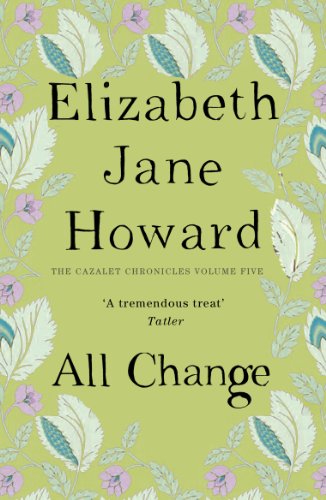
All Change by Elizabeth Jane Howard

I finished reading All Change, Elizabeth Jane Howard’s fifth book in her Cazalet Chronicles last night. I’d read the first four books years ago and loved them, so I was keen to read this last one. And it is the final volume of the Chronicles as Elizabeth Jane Howard died in January this year following the publication of All Change.

I’m not going to write very much about it because I read it straight through without marking any passages, or making any notes. I read for the pure pleasure of reading it, just as I had read the first four books, losing myself in the story of the Cazalet family. And it is a very large family by the time of this novel – 1956 – 1958. Some of the family are a bit blurry – the small children are a bit indistinguishable from each other, apart from Georgie, who loves animals and Laura who’s old before her time, both idiosyncratic little characters, and I did keep forgetting which children belonged to which parent and had to keep checking the family tree at the beginning of the book. But that is just a minor point.

It’s a lovely warm, old fashioned family saga, with both happy and sad events as the Cazalets move forward, and not successfully for all of them, in post-war England. It was a great treat! It’s made me want to re-read the early books and to read Slipstream, Elizabeth Jane Howard’s memoir.

I agree with Hilary Mantel’s quotation on the back cover:

Elizabeth Jane Howard is one of those novelists who shows, through her work, what the novel is for . . . She helps us to do the necessary thing – open our eyes and our hearts

The Cazalet Chronicles

1. The Light Years (1988)
2. Marking Time (1991)
3. Confusion (1993)
4. Casting Off (1995)
5. All Change (2013)

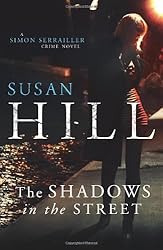
The Shadows in the Street by Susan Hill

The Shadows in the Streets is Susan Hill’s fifth Simon Serrailler crime novel. I’ve read the earlier books which I enjoyed, although I found the fourth book, The Vows of Silence rather a gloomy book not just because of the murders but also because of the unhappy state of Simon and his family. So, I decided to wait a while before moving on to the fifth book. And I am now way behind in reading the series, which will reach book 8 in October!

Susan Hill’s Serrailler novels, whilst being crime fiction, concern moral and social issues. They also follow the lives of the Serrailler family, the main characters being Simon and his sister, Dr Cat Deerbon, which is why I think it’s best to read them in order. I noticed that in this book there are references to events and characters in the earlier books and I had to look back to refresh my memory. Without knowing what happened before those incidents would not have made much sense. The books are character-driven, concentrating on the people involved in the crime rather than the police investigations, although that of course is also part of the story.

There are two major themes in this book. One concerns the murders of local prostitutes, found strangled and Susan Hill draws a sympathetic, but never a condescending or judgemental view of these women’s lives, resulting in a moving storyline of a young woman, Abi who is a single mother. Alongside this is the problem of mental illness, with Ruth Webber, who suffers from manic depression. She is the wife of the new Dean of the Cathedral and arrives full of plans to change things, which causes problems. When she too goes missing there are fears she may become one of the murder victims.

I think of these novels more as psychological studies than crime fiction – the characters and their lives predominate, whilst the police make slow progress in finding the murderer (much like real life, maybe). Anyway it’s the characters and their problems that interested me more in this book than the police procedures.

The Shadows in the Street is a complex book, but it is immensely readable and once the mystery really got under way it’s tense and full of suspense. I really enjoyed it.

Read Scotland 2014 Challenge: two books

I’ve got a bit behind with writing reviews, so here are some notes on two books I’ve recently read, both of which fit into the Read Scotland 2014 Challenge.

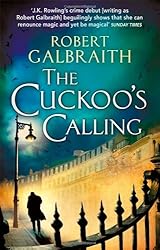
It’s common knowledge now that Robert Galbraith is J K Rowling’s pseudonym. I wish I’d read The Cuckoo’s Calling without knowing that, as although I have no problem with authors writing under pseudonyms, I found myself thinking how like the Harry Potter books it is in some ways and I doubt I’d have thought that if I’d read it ‘blind’.

Anyway, I liked The Cuckoo’s Calling. It is crime fiction, set in the world of Cormoran Strike (a Harry Potterish name, I thought), an ex-army private detective, who is struggling to get clients and pay his bills, sleeping on a camp bed in his office. Along comes Robin Ellacott, from the Temporary Solutions Agency to help out (think, Hermione Granger). She’s intelligent, efficient, remarkably resourceful, and she soon has Strike organised, which is essential as he is asked by John Bristow, a lawyer and the brother of a childhood friend to investigate the death of his sister, Lula Landry. The police are satisfied that Lula, a model, had committed suicide, but Bristow is certain that she didn’t.

What follows is at times a leisurely narrative and the plot is quite complex, but not too difficult to work out. The characters are convincing, Robin in particular soon became my favourite. She has an enquiring mind, ‘fascinated by the interior workings of other people’s minds‘ and despite her fiancé’s opposition to her job, she carries on, motivated by her fascination with investigating, and her secret ambition to be a private detective. In fact without Robin, Strike would have really struggled to get to the truth.

I’ve counted this book towards the Read Scotland 2014 Challenge because J K Rowling, although she was born in England has lived in Scotland for twenty-one years and plans to spend the rest of her life in Scotland. Whereas the author of the next book, Muriel Spark is an author who was born and grew up in Edinburgh, but who later lived in London. To qualify for this challenge books have to be by Scottish authors, either by birth or immigration, or about or set in Scotland – quite a wide brief!

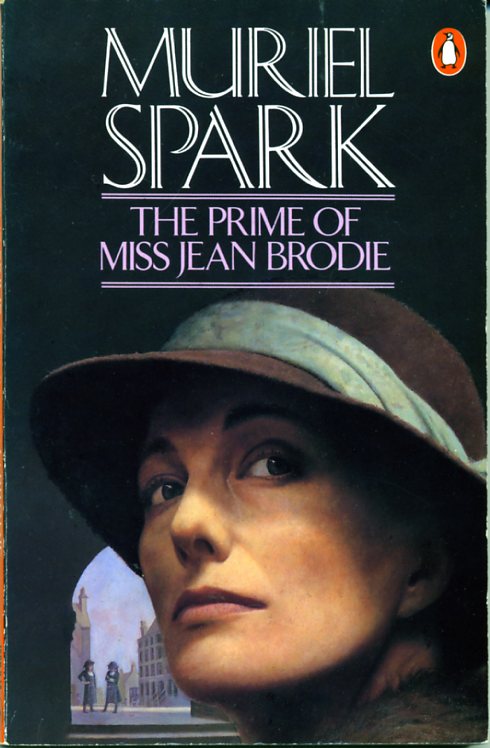
brodie001The Prime of Miss Jean Brodie is perhaps Muriel Spark’s most famous novel. I’ve read it before and seen the film, with Maggie Smith in the title role. Each time I’ve read it I’ve really enjoyed it – it’s one of those books that isn’t spoilt by knowing what happens, because part of the pleasure of reading it is the fact that I do know who betrayed Miss Brodie. Despite her declaration: ‘Give me a girl at an impressionable age and she will be mine for life‘, it is one of the ‘Brodie set’ who causes her downfall, that and her pride and self-absorption.

But what really impresses me about this book is the writing, so compact, so perceptive and so in control of the shifts in time backwards and forwards. It’s a joy to read. I’ve written more about it in this post.

I Murdered My Library by Linda Grant

Following on from yesterday’s post on books I’ve read recently and not reviewed, I have three more I have not written about and here is one of them:

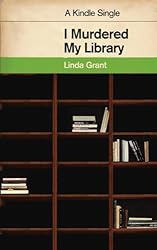
I Murdered My Library by Linda Grant. This is an essay of just 28 pages in which Linda Grant tells about moving house and downsizing her considerable book collection to fit into a small flat. She had had books everywhere:

Books multiplied, books swarmed; they were a papery population explosion. When they had exhausted the shelves, they started to take over the stairs. You cannot have a taste for minimalist decor if you seriously read books.

Well, I know all about that and all about trying to find more space for books or to reduce my book collection, so I really liked this little e-book. Linda Grant can read my mind – and those of many other book-lovers, I’m sure – as she went through her books deciding which ones could go. It could be me saying this too:

I am kidding myself if I think that I am going to reread a fraction of the books I have brought with me or a fraction of those I have never got round to reading.

In my youth, I imagined old age and retirement as the time when one sat back, relaxed and read. There would be all the time in the world for reading. Sixty was so far away, and 80 stretching out into a future not imaginable, that you might as well be talking about living forever. Now time gobbles up my life.

I have tried, but I’ve never managed to be as ruthless as she was, never seen empty bookshelves and I doubt I ever will, because there have been so many books I’ve given away only to realise later that I want to re-read/read them, or to look up a reference. So it’s made me think twice, or even ten times before I actually part with a book. And indeed as Linda Grant looks at her shelves of the books she has kept she mourns the ones she killed off!

Catching Up With My Reading

Once more I’ve been reading books and moving on without writing about them. Here are just two of the books I’ve read recently:
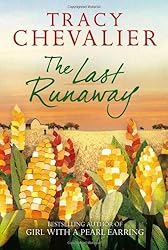
The Last Runaway by Tracy Chevalier – I really liked this book, historical fiction about the life of Honor Bright after she emigrated from Dorset to America in 1850 where she joined a Quaker community in Ohio. It intertwines her story with that of the ‘Underground Railroad’, helping the runaway slaves from the southern states to escape to Canada.

Honor is a quilter, but finds that American quilts are not the same as English ones, just as America is very different from England, both in landscape, temperature and culture. She struggles to fit in, finding it hard to adjust. I thought this was well handled and the sense of period and place is impressive, with a wealth of detail about the land and the struggles of the settlers. She can’t face the journey back across the Atlantic and marries Jack Haymaker, a young farmer whose mother and sister disapprove of her.

The slavery question caused Honor a real dilemma, as she became involved in the Underground Railroad, a network of safe houses and people willing to provide food and shelter for the runaways. Should she abide by the law, or follow her Quaker beliefs about equality, thus putting the rest of her family at risk as well as herself? This is compounded by her relationship with Belle Mills and her disreputable brother Donovan who has taken a liking to Honor, but is also a slave-catcher, ruthless in his pursuit.

I think it’s a very entertaining book, full of colourful characters, although some, like Jack are not as well developed as others. I liked the detail about quilting, even though I have never done any! But it was the account of life on the frontier and the Underground Railroad that made the book for me. Here are Honor’s thoughts about slavery:

She had begun with a clear principle born of a lifetime of sitting in silent expectation: that all people are equal in God’s eyes, and so should not be enslaved to one another. Any system of slavery must be abolished. It had seemed simple in England; yet in Ohio that principle was chipped away at, by economic arguments, by personal circumstances, by deep-seated prejudice that Honor sensed even in Quakers. …

When an abstract principle became entangled in in daily life, it lost its clarity and became compromised and weakened. (page 259)

I borrowed this book from the library.
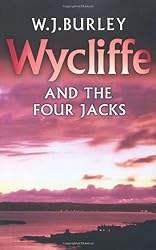
In complete contrast I moved on from The Last Runaway to Wycliffe and the Four Jacks by W J Burley, crime fiction set in Cornwall, featuring Chief Superintendent Wycliffe, who is on holiday but still gets drawn into a murder investigation.

Author David Cleeve, who writes under the pseudonym Peter Stride asks for Wycliffe’s advice about a series of sinister warnings he has received in the form of a playing card – the Jack of Diamonds. Then, a young woman is found dead, an apparently motiveless crime, but, as Wycliffe discovers, it follows a series of crimes, the clues all seeming to centre on an archaeological dig on Cleeve’s land. A further murder helps to pinpoint the culprit.

This is a quick read, with plenty of red herrings, but not too difficult to unravel. I liked it and I liked the personal touches that make Wycliffe a real person, a somewhat irritable man who likes his food, and gets on well with his wife. He is a thoughtful detective:

He was in a strange mood, suddenly everything had become unreal: the bare schoolroom with its peeling green walls, the battered tables, the scratched filing cabinets, his colleagues bending over their reports … He had known such experiences since childhood when, suddenly, everything seemed remarkable, nothing was ordinary any more. His mother would say: ‘Why aren’t you playing with your toys, Charles?’ Later, at school, it was ‘Day-dreaming again, Wycliffe!’ Now DS Lane was watching him and probably thinking, ‘Why dies he just sit there?’ (page 165)

It’s periods like this, however, that help Wycliffe focus his thoughts.

Wycliffe and the Four Jacks was first published in 1985. It’s the 12th in Burley’s series of 22 Wycliffe books.
New Additions at BooksPlease

It’s been a while since I did one of these posts about books I’ve bought/been given. I always like to have a few books on the go at any one time and I like to have some waiting to be read.

Yesterday I finished reading Pictures at an Exhibition by Camilla Macpherson, which I’ll be writing about soon. I’m in the middle of reading Mansfield Park by Jane Austen and I’m still reading Shakespeare: the Biography by Peter Ackroyd. I’ve been reading the Shakespeare book for months just a short chapter at a time – it’ll be a while before I finish it.

Here are these recent additions that I hope to get round to reading sooner or later:

He wants etcFrom top to bottom they are:

  • He Wants by Alison Moore, a proof copy for review from Lovereading. It will be published in August. Alison Moore’s debut book The Lighthouse which I haven’t read was shortlisted for the Man Booker Prize in 2012, so she is a new-to-me author. It sounds a bit different from the usual type of book I read, so I’m not sure what to expect. It’s about Lewis Sullivan, an RE teacher who is approaching retirement and wondering whether he ought to have chosen a more dramatic career. I have started reading it and am still getting used to the fact that it’s written in the present tense – not my favourite style.

The next two books in the pile are used books that I bought when I went to vote the other week in the European Election. There was a table full of books for sale – nothing to do with the election, but a bonus for me! I bought two.

  • One of the books almost leapt from the table into my hands – Miss Pym Disposes by Josephine Tey, a book I first heard about years ago and fancied reading. The  first book by Josephine Tey that I read was The Daughter of Time which I absolutely loved. In that book Detective Inspector Alan Grant looked into the death of the Princes in the Tower from his hospital bed. As far as I can tell he doesn’t feature in Miss Pym Disposes.
  • The other book  is Gone Girl by Gillian Flynn, another new-to-me author. A wife has disappeared and her husband is the suspect – what happened to her? I have been avoiding getting this as it’s one of those books that gets lots of hype and sometimes they just don’t live up to the praise. It has nearly 1,500 5-stars on Amazon UK and also 300+ 1-star reviews criticising it as disappointing and boring. But as it was on the table in front of me at a bargain price I thought I’d see for myself just how good (or otherwise) that I think it is.

And finally a hard-backed book that I bought from a local bookshop:

  • The Legacy of Elizabeth Pringle by Kirsty Wark, her debut novel. Kirsty Wark is a favourite of mine – a journalist and broadcaster, hosting programmes such as Newsnight, The Review Show and arts documentaries. I picked up the book in Mainstreet Trading whilst having lunch there and immediately thought I’d like it. It’s set on the Scottish island of Arran where Elizabeth has lived all her life. When she dies she leaves her house to someone she hardly knew. But just who was Elizabeth Pringle?