Six Degrees of Separation: From Revolutionary Road to On Chesil Beach

Six Degrees of Separation is a monthly link-up hosted by Kate at Books Are My Favourite and Best. Each month, a book is chosen as a starting point and linked to six other books to form a chain. A book doesn’t need to be connected to all the other books on the list, only to the one next to it in the chain.

revolutionary-road-chain

This month’s chain begins with:

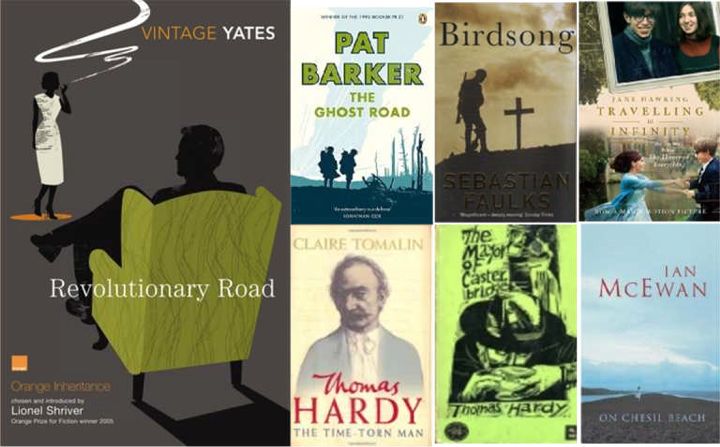
Revolutionary Road by Richard Yates, set in America in 1955, focussing on the hopes and aspirations of Frank and April Wheeler, self-assured Connecticut suburbanites.

I haven’t read Revolutionary Road, so knowing very little about it I’m using the title as the link to: The Ghost Road by Pat Barker. I haven’t read this one either but I’ve had a copy on my shelves for a few years. It’s set in 1918 during the last months of the First World War.

Birdsong by Sebastian Faulks is also set during the First World War and is yet another book I haven’t read yet. In 2012 I watched the two-part television adaptation, starring Eddie Redmayne as Stephen Wraysford, the main character. I loved the story, so I’m looking forward to reading the book.

Eddie Redmayne was also in the film The Theory of Everything. This is a beautiful film based on Jane Wilde Hawking’s memoir Travelling to Infinity: My Life with Stephen and another book I own that I haven’t read yet!

This leads me on to another biography and to another TBR that has sat partly read on my shelves for several years. It’s Thomas Hardy:The Time Torn Man by Claire Tomalin. Hardy is one of my favourite authors.

And this is one of my favourite books of his –  The Mayor of Casterbridge, which I first read at school. It’s set in Hardy’s Wessex, a fictional area covering the small area of Dorset in which Hardy grew up. Casterbridge is the name he used for Dorchester, his home town. Michael Henchard, a man of violent passions who sells his wife and child, subsequently becomes  the rich and respected Mayor, but ends his life in ruin and degradation. (the cover I’ve shown above is of the paperback I first read).

The chain ends with On Chesil Beach by Ian McEwan, a book also set in Dorset – in a hotel at Chesil Beach on the Dorset coast in 1962, where a newly married couple struggle to suppress their fears of their wedding night to come.

My chain goes from books I haven’t read to books I’ve loved and from 1950s America via the First World War and the life and work  of Stephen Hawking to that of Thomas Hardy and finally to Dorset in 1962.

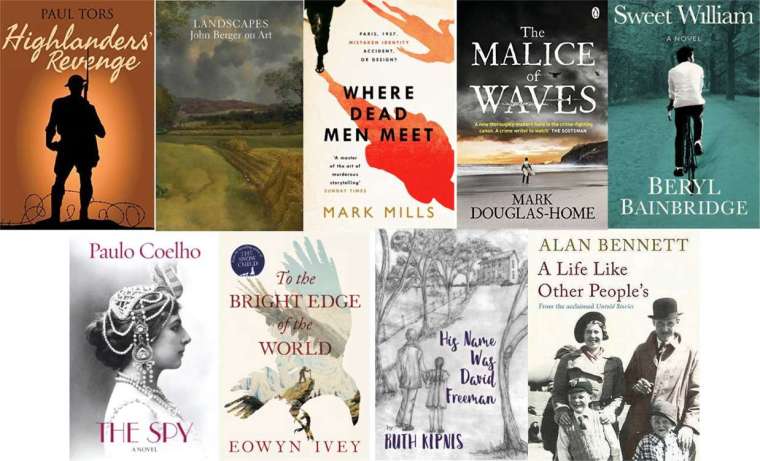
A Life Like Other People’s by Alan Bennett

A Life Like Other People's

Alan Bennett’s A Life Like Other People’s is a poignant family memoir offering a portrait of his parents’ marriage and recalling his Leeds childhood, Christmases with Grandma Peel, and the lives, loves and deaths of his unforgettable aunties Kathleen and Myra. Bennett’s powerful account of his mother’s descent into depression and later dementia comes hand in hand with the uncovering of a long-held tragic secret. A heartrending and at times irresistibly funny work of autobiography by one of the best-loved English writers alive today. (Amazon)

I really like Alan Bennett’s work and was pleased to find this little book in the mobile library recently. It’s a beautifully written book taken from his collection Untold Stories and illustrated with black and white photographs. There is drama in this memoir, but written with clarity and keen observation in quiet tones about lives that are anything but ordinary. It is a completely absorbing book as Bennett recalls his childhood. He writes about his family including his two aunties, Kathleen and Myra, two very different characters from their sister, his mother. They saw themselves as ‘dashing, adventuresome creatures, good sports and always on for what they see as a lark.‘ They wore scent and camiknickers, and had the occasional drink and smoked.

He writes of mother’s fears – ‘of being spied on, listened to, shamed and detected‘ of her dread of being ‘the centrepiece‘ especially at her wedding. His parents didn’t like ‘splother‘, his father’s word for ‘the preening and fuss invariably attendant on the presence of the aunties.‘ Then there are the sad facts about his mother’s depression and subsequent dementia as she descended into delusion, her stays in hospital and the effect that had on the family.

There are revelations of family secrets and many touching and sad (but never sentimental) episodes, for example the futile search for Aunty Kathleen, suffering from a condition similar to Alzheimer’s, after she just walked out of her hospital ward. She was found several days later in drenched undergrowth in a wood near the M6.

It is a sad book but also a heart-warming story – the love of his parents and family shines throughout the book.

  • Hardcover: 256 pages
  • Publisher: Faber & Faber; Main edition (3 Sept. 2009)
  • Language: English
  • ISBN-10: 0571248128
  • ISBN-13: 978-0571248124
  • Product Dimensions: 13.5 x 2.3 x 17.5 cm
  • Source: Library

Where Dead Men Meet by Mark Mills

I’ve been reading books so quickly this month that I am now far behind with writing about them, so this is just a short post about an excellent new book by Mark Mills, published on 17 November.

I’ve been meaning to read more of Mark Mills’ books ever since I read The Savage Garden in 2008, a book I enjoyed very much, so I was keen to read his latest book, Where Dead Men Meet. It is historical fiction set in 1937 in pre-Second World War Europe, with a fast-moving plot as Luke Hamilton, an intelligence officer at the British Embassy in Paris, tries to discover why someone wants him dead, why Sister Agnes, the nun who had been his mentor and guide at the orphanage for the first seven years of his life had been bludgeoned to death, and who his real parents were.

Although the war in Europe is imminent it is by no means the main focus of this book, but forms an excellent backdrop as the action moves from Paris across the continent. At first he assumes that the assassin has mistaken him for someone else, but the tension builds as Luke realises that he is not the victim of a mistaken identity, but that someone is determined to kill him. He finds himself on the run, helped by a number of people, including the first man who tried to kill him. It seems the answers lie in his past. It is a complicated story that had me unsure of who Luke could trust and whether he would ever escape, or find out about his real family.

I thoroughly enjoyed this brilliant book with its interesting characters and a convincing plot full of mystery and intrigue. I shall now look out for more books by Mark Mills.

I received a copy of this book from the publisher, via NetGalley, for review.

  • Format: Kindle Edition
  • File Size: 972 KB
  • Print Length: 448 pages
  • Publisher: Review (17 Nov. 2016)

The Spy by Paulo Coelho


The Spy

Synopsis:

When Mata Hari arrived in Paris she was penniless.

Soon she was feted as the most elegant woman in the city.

A dancer who shocked and delighted audiences; a confidant and courtesan who bewitched the era’s richest and most powerful men.

But as paranoia consumed a country at war, Mata Hari’s lifestyle brought her under suspicion. Until, in 1917 she was arrested in her hotel room on the Champs Elysees and accused of espionage.

Told through Mata’s final letter, THE SPY tells the unforgettable story of a woman who dared to break the conventions of her time, and paid the price.

My thoughts:

Before I read this book I didn’t know much about Mata Hari, beyond the facts that she was an exotic dancer and that she was executed as a spy during the First World War, so I was interested to know more.

The Spy is a gripping tale and one I read quickly, fascinated by the story of Mata Hari, whose real name was Margaretha Zella, a name she detested. The book begins with a prologue describing the execution of Mata Hari in Paris on 15 October 1917. It is quite remarkable; she was calm, taking care with dressing herself and with her appearance and choosing to face the firing squad neither bound nor blindfolded.

It continues with her life story told through letters and news clippings and illustrated with photographs. She was accused of being a double agent, but claimed she was innocent and the evidence against her was indeed flimsy. The whole procedure was based on deductions, extrapolations and assumptions. Whatever the truth about her innocence, she comes across as a strong-minded, independent and arrogant woman, who believed she could use her beauty and charm to allure any man to get what she wanted.

I always like to know when I’m reading fictionalised biographies how much is based on fact and what has been fictionalised, so I appreciated the author’s explanatory note at the end of the book. Coelho writes that he had based his novel on facts, but he had created some dialogue, merged certain scenes, changed the order of a few events and left out anything he thought wasn’t relative to the narrative. His opening pages, for example are from a report for the International News Service by Henry G Wales in Paris and dated October 15, 1917 and he has borrowed some verbatim language from the report. He has used various sources such as the British Intelligence Service file on Mata Hari.

  • Format: Kindle Edition
  • File Size: 3598 KB
  • Print Length: 220 pages
  • Page Numbers Source ISBN: 1524732060
  • Publisher: Cornerstone Digital; 01 edition (22 Nov. 2016)

Many thanks to NetGalley for a review copy of this book.

What’s in a Name 2017

whats-in-a-name17

Next year Charlie at The Worm Hole is hosting the tenth ‘“ yes, tenth! ‘“ annual What’s In A Name challenge, originally started by Annie, then handed to Beth Fish Reads and now continued by Charlie. For full details go to the sign-up post. I’ve been doing this challenge since Annie started it in 2007, just missing the one in 2009! So, even though I’m cutting back on challenges for 2017, I really want to take part in this one.

The basics

The challenge runs from January to December. During this time you choose a book to read from each of the following categories. (Charlie’s examples of books you could choose are in brackets ‘“ translations and other languages most definitely count!):

  • A number in numbers (84, Charing Cross Road; 12 Years A Slave; 31 Dream Street)
  • A building (The Old Curiosity Shop; I Capture The Castle; House Of Shadows; The Invisible Library; Jamaica Inn)
  • A title which has an ‘˜X’ somewhere in it (The Girl Next Door; The Running Vixen)
  • A compass direction (North and South; Guardians Of The West; The Shadow In The North; NW)
  • An item/items of cutlery (The Subtle Knife; Our Spoons Came From Woolworths)
  • A title in which at least two words share the same first letter ‘“ alliteration! (The Great Gatsby; The Luminous Life Of Lilly Aphrodite; Gone Girl; The Cuckoo’s Calling)

Charlie is asking for one review per category. Where possible I like to read from my TBRs for my challenges and I’ve found the following books on my shelves (some are e-books) for each category and will choose one from each for this challenge.

A number in numbers

  • 1066: What Fates Impose by G K Holloway
  • 1599: a Year in the life of William Shakespeare by James Shapiro
  • 1946: The Making of the Modern World by Victor Sebestyen
  • 3500: An Autistic Boy’s Ten-Year Romance with Snow White by Ron Miles

A building – lots to choose from

  • Citadel by Kate Mosse
  • The Chapel in the Woods by Susan Louineau
  • Corduroy Mansions by Alexander McCall Smith
  • Framley Parsonage by Anthony Trollope
  • Heather Farm by Dorte Hummelshoj Jakobsen
  • The House by the Churchyard by Joseph Sheridan Le Fanu
  • The House in the Attic by Helen Cardwell
  • House of the Seven Gables by Nathaniel Hawthorne
  • The House of the Spirits by Isabel Allende
  • The House on Fever Street by Celina Grace
  • Last Man in Tower by Aravind Adiga
  • The Murder at Sissingham Hall by Clara Benson
  • The Power House by John Buchan

A title which has an ‘˜X’ somewhere in it

  • Exhume by Danielle Girard
  • The Girl Next Door by Ruth Rendell
  • The Mitfords: Letters Between Six Sisters edited by Charlotte Mosley
  • Notes from an Exhibition by Patrick Gale
  • A Place of Execution by Val McDermid
  • The Sex Life of My Aunt by Mavis Cheek
  • The Taxidermist’s Daughter by Kate Mosse

A compass direction

  • The King in the North by Max Adams
  • North and South – Elizabeth Gaskell
  • South Riding by Winifred Holtby

An item/items of cutlery – I thought I must have some crime fiction in my TBRs with ‘knife/knives’ in the title – but I haven’t! I read Charlie’s suggestion of The Subtle Knife several years ago. The only book I have to read in this category is:

  • The Tiny Fork Diet by Alan Sugar

A title in which at least two words share the same first letter ‘“ alliteration!

  • Break No Bones by Kathy Reichs
  • The Child’s Child by Barbara Vine
  • A Death in the Dales by Frances Brody
  • Deja Dead by Kathy Reichs
  • Dialogues of the Dead by Reginald Hill
  • Gone Girl by Gillian Flynn
  • Hangman’s Holiday by Dorothy Sayers
  • The Pickwick Papers by Charles Dickens
  • The Repentant Rake by Edward Marston
  • The Sacred Stone: The Medieval Murderers
  • Tinker Tailor Soldier Spy by John Le Carre
  • Whitethorn Woods by Maeve Binchy

Another Day Gone by Eliza Graham


Another Day Gone

In 2007 I read Eliza Graham’s debut novel, Playing with the Moon and loved it. I fully intended to read more of her books, but although I have her fifth book, The One I Was, I somehow missed the other three! So when I saw her latest book, Another Day Gone was available I was delighted to receive an advance copy through NetGalley.

I wasn’t disappointed – in fact I think it’s amongst the best books I’ve read this year.

It’s historical fiction, one of my favourite genres, beginning in 1939 just before the outbreak of the Second World War when a bomb went off in Coventry, killing some people and injuring many others. One of those injured was a girl who had seen a man prop a bicycle outside a store just before the bomb exploded. Her description led to his conviction and execution.

The action then moves forward to 1992 with Sara and her older sister Polly living in their family home in Oxfordshire on the banks of the Thames, with their grandfather and housekeeper (formerly their childhood nanny). The sisters’ parents had been killed in a car crash when they were very young. Polly is eighteen and is just about to leave home for university. All is not well and Polly hints that she knows a secret that she is not telling Sara – and then goes away with Michael, Bridie’s nephew, without saying where they are going or for how long.

Years later, in 2005 Sara returns to her family home, taking refuge from the London 7/7 bombings. Polly has now been missing for 13 years, their grandfather has died and Bridie is in a care home. The family secrets are still buried – until Polly returns!

Another Day Gone is a book about families, relationships and realising and living with the consequences of your actions. I loved the structure of this book with its different strands and time periods and all the twists and turns that kept me guessing about the nature of the secret that had remained hidden for so many years. I particularly liked the way it is only revealed drip by drip that meant I had changed my mind about what it was several times until fairly near the end of the book. The characters are so well drawn and sympathetically portrayed that I felt I knew them as people. It’s the type of book that I can get so involved with and whilst wanting to discover its secrets I just don’t want it to end.

  • Format: Kindle Edition
  • File Size: 2182 KB
  • Print Length: 322 pages
  • Page Numbers Source ISBN: 1503940039
  • Publisher: Lake Union Publishing (22 Nov. 2016)
  • Source: review copy via NetGalley