Book Beginnings

There came Death hurtling along the Boulevard in waning sepia light.

There came Death flying as a children’s cartoon on a heavy unadorned messenger’s bicycle.

There came Death unerring. Death not to be persuaded. Death-in-a-hurry. Death furiously pedalling. Death carrying a package marked *SPECIAL DELIVERY HANDLE WITH CARE* in a sturdy wire basket behind his seat.

These are the opening lines of the Prologue, ‘Special Delivery’ in Joyce Carol Oates’s novel Blonde. The date is 3 August 1962 – the date of Marilyn Monroe’s death. It doesn’t give anything away – Marilyn’s death has been well documented even if it still remains under suspicion and speculation. Blonde tells the fictionalised story of Norma Jeane Baker, who became the beautiful ‘Fair Princess‘ of the movies.

The only difficulty I have in reading Blonde is the weight and size of the book – not ideal for reading in bed. And it has 738 pages – and I’m only on page 52.

Book Beginnings is hosted by Katy at A Few More Pages, where you can leave a link to your own post on the opening lines of a book you’re currently reading.

Murder on the Orient Express by Agatha Christie

Murder on the Orient Express must be one of Agatha Christie’s most well known books. It was first published in 1934 and it was first filmed in 1974, starring Albert Finney as Hercule Poirot, and most recently in 2010 with David Suchet as Poirot. I’ve seen both films and so knew the plot, but I’d never read the book until now.

Poirot is on the Orient Express, on a three-days journey across Europe. But after midnight the train comes to a halt, stuck in a snowdrift. In the morning the millionaire Simon Ratchett is found dead in his compartment his body stabbed a dozen times and his door locked from the inside. It is obvious from the lack of tracks in the snow that no-one has left the train and by a process of elimination Poirot establishes that one of the passengers in the Athens to Paris coach is the murderer.

Poirot interviews the passengers and the Wagon Lit conductors, none of whom appear to have a motive for killing Ratchett or to have any connection with him or each other. Poirot decides that this

… is a crime very carefully planned and staged. It is a far-sighted, long-headed crime. It is not – how shall I express it? – a Latin crime. It is a crime that shows traces of a cool, resourceful, deliberate brain – I think an Anglo-Saxon brain. (page 193)

Having interviewed all the suspects Poirot draws up a list of questions about things that need explaining. This leads him to speculation and re-interviewing some of the suspects and eventually he arrives at the truth. It’s hard to know whether I would have arrived at the same conclusion if I hadn’t seen the films, but watching the first one it did become obvious before the denouement.

I liked this book enormously. I like the way Agatha Christie divided it into three sections – The Facts, the Evidence and Hercule Poirot Sits Back and Thinks. I liked the characterisation and all the, now so non-pc, comments about nationalities, highlighting class and racial prejudice. I like the problem-solving and ingenuity of the plot.

  • Paperback: 240 pages
  • Publisher: Harper; Masterpiece edition (Reissue) edition (3 Sep 2007)
  • Language English
  • ISBN-10: 0007119313
  • ISBN-13: 978-0007119318
  • Source: Library book because I can’t find my own copy!

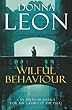
Wilful Behaviour by Donna Leon: Book Review

Wilful Behaviour begins with an explosion …

The explosion came at breakfast. Brunetti’s position as a commissario of police, though it made for the possibility of explosion more likely than it would be for the average citizen, did not make the setting any less strange. The location, however, was related to Brunetti’s personal situation as the husband of a woman of incandescent, if inconsistent, views and politics, not to his profession.

‘Why do we bother to read this disgusting piece of garbage?’ Paola exploded, slamming a folded copy of the day’s Gazzettino angrily onto the breakfast table, where it upset the sugar bowl. (page 1)

Wilful Behaviour

  • Paperback: 368 pages
  • Publisher: Arrow; First Thus edition (26 Feb 2009)
  • Language English
  • ISBN-10: 0099536625
  • ISBN-13: 978-0099536628
  • Source: Library Book

Brief Description

When one of his wife Paola’s students comes to visit him, with a strange and vague interest in investigating the possibility of a pardon for a crime committed by her grandfather many years ago, Commissario Brunetti thinks little of it, beyond being intrigued and attracted by the girl’s intelligence and moral seriousness. But when she is found murdered, clearly stabbed to death, Claudia Leonardo is suddenly no longer simply Paola’s student, but Brunetti’s case ‘¦’

My view

I’ve been reading Donna Leon’s Commissario Brunetti’s books set in Venice, completely out of order of their publication. It doesn’t  matter at all to me. Her books are crime fiction, but also discuss various social and cultural issues and Wilful Behaviour is no exception. The effects of the Second World War feature largely in this book, the different attitudes Italians had during the war – secrets of collaboration, resistance fighters, the exploitation of Italian Jews – and the way modern day Italians view the past.

I read the book quickly keen to discover who had killed Claudia and why, following the intricacies of Italian bureaucracy with interest, the planning process for example. The question of honour is also uppermost, with Paola, who had been lecturing her university students ‘on the theme of honour and honourable behaviour and the way it was central to [Edith]Wharton’s three great novels,‘  wondering ‘whether it still had the same meaning for her students; indeed whether it had any meaning for her students.’

Brunetti consults his father-in-law, Count Falier, who with his myriad connections is a source of information on the people and workings of Venice. Through him he learns more about Luca Guzzardi, Claudia’s grandfather who had been convicted of war crimes after the war. Guzzardi was ‘one of the people appointed to decide which pieces of decadent art should be disposed of by galleries and museums.’ And it is these works of art and their current whereabouts that provide the clue to why Claudia was murdered, but don’t point exactly to the culprit.

Wilful Behaviour has an intricate plot, with characters who are fallible and so believable. I like the way Brunetti works, gathering information from various sources including the ever-resourceful Signorina Elettra and the interactions with his family. The ending is not in line with the ideal of justice being seen to be done and Brunetti has to admit to himself that he is ‘helpless to effect any change in the way things would play themselves out.’ It reminds Paola of ‘Jarndyce vs Jarndyce.’

Crime Fiction Alphabet: Z is for Zouroudi

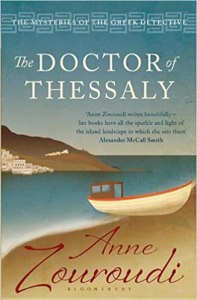
For the last letter of Kerrie’s Crime Fiction Alphabet I’ve chosen The Doctor of Thessaly by Anne Zouroudi. It’s a good book to end this round of the Alphabet, by an author whose books I’ve seen on the bookshelves but have never read before.  I enjoyed it.

Anne Zouroudi was born in England, has lived for some years on the Greek islands and now lives in the Derbyshire Peak District. The Doctor of Thessaly is the third in the series of her Mysteries of the Greek Detective, about Hermes Diaktoros, a mysterious fat man. I was never sure who he worked for, or how he knew of the mystery to solve. Each of the books in the series features one of the Seven Deadly Sins – in this one it is envy, a tale of revenge and retribution.

Set in the little Greek village of Morfi, it begins with Chrissa, a jilted bride weeping on the beach, and then moves on quickly to the discovery of the local doctor, the victim of an attack that has left him horribly scarred and blind. He is the absent bridegroom. Meanwhile Hermes has arrived in the village, waiting to be served at the kafenion:

Adonis, riding by, stared at the man – a big man, perhaps even fat, whose curly, greying hair was a little too long, and whose glasses gave him an air of academia. Beneath a beige trench-coat, he wore a suit without a tie; beside him lay a holdall of green leather. In Eva’s comfortable chair he seemed relaxed, drawing on a freshly lit cigarette, one foot crossed over the other; and it was the stranger’s feet that drew Adonis’s eyes. The fat man was wearing tennis shoes – old fashioned, canvas shoes, pristinely white. (page 9)

Hermes involves himself with the mystery of who attacked the doctor, made more puzzling because the doctor doesn’t want his attacker to be found. At the same time the village is expecting a visit from a government minister, an event that not all the locals want to be successful, and the family of the garage owner is going through some traumatic experiences. Hermes helps out in some unorthodox ways.

Just who is Hermes Diaktoros, I wondered as I read this book? My knowledge of Greek mythology is very rusty, but the clue is in his name, I think – Hermes, the messenger of the gods. He wore shoes with wings, and this Hermes is indeed fleet of foot in his pristine tennis shoes.

There are many things I like about this book, not just the mystery and the references to mythology, but also the characters and the setting which evoke the scenes of a little Greek village so well and the close-knit almost claustrophobic relationship of its inhabitants. And there is a map of the area and a list of characters.

I really must read the other books in the series:

  • The Messenger of Athens
  • The Taint of Midas
  • The Lady of Sorrows
  • The Whispers of Nemesis

Thanks to Kerrie for organising the Crime Fiction Alphabet.

Saturday Snapshot: The Birds Have Flown

I’ve posted a few photos and videos of the collared doves’ nest – first the empty nest, then the eggs were laid, the chicks hatched and now we have an empty nest again. On Thursday evening the second young collared dove left the nest and has not returned. I do feel a little sad – empty nest syndrome!

Empty Nest!

Here is a video showing the final moments as the young bird left the confines of the nest behind the satellite dish for the last time and flew off into the wide world beyond. It looks quite big in the video but in reality it is still very small.

To participate in Alyce’s Saturday Snapshot meme post a photo (new or old) that you (or a friend or family member) have taken, but make sure it’s not one that you found online.

Book Beginnings

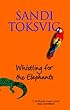
Whistling for the Elephants by Sandi Toksvig, first published in1999 is my book group’s choice for July. It begins:

There are two basic types of creature in Nature’s kingdom. The first, like frogs and turtles, produce many offspring and simply hope that some will survive. The second, like elephants and people, produce one or two, at long intervals, and make great efforts to rear them. My mother belonged in a class of her own. She produced two at short intervals and made no effort to rear them whatsoever. Some people agonize over these things but I thank God. A hint more attention from my own family and things might never have turned out the way they did. (page 11)

This is Sandi Toksvig’s first novel and I haven’t read much more than the first few pages. I’m expecting it to be an amusing book, if not laugh-out-loud humour, from seeing Sandi Toksvig on programmes like QI. She is a Danish born comedian, broadcaster and author, who studied law, archaeology, and anthropology at Girton College, Cambridge, where she was a member of the Footlights at the same time as Stephen Fry, Hugh Laurie, Tony Slattery, and Emma Thompson. As well as Whistling for the Elephants she has also written books for children and Flying Under Bridges, The Travels of Lady ‘Bulldog’Burton, and Gladys Reunited: A Personal American Journey (none of which I’ve read).

From the back cover I gleaned that Whistling for the Elephants is a novel about Dorothy, aged ten, living with her English parents in Sassapaneck, New York in 1968. She comes across a small faded zoo and gets to know an eccentric group of women and ‘begins to discover a world way beyond the one she has glimpsed so far.’

Book Beginnings is hosted by Katy at A Few More Pages, where you can leave a link to your own post on the opening lines of a book you’re currently reading.