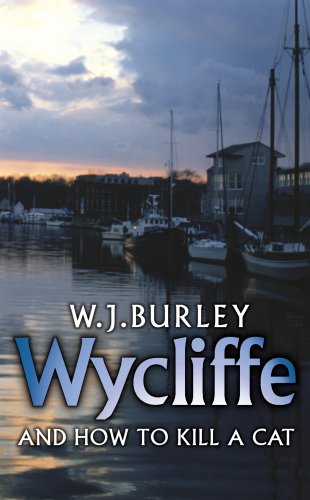
Wycliffe and How To Kill a Cat by W J Burley

W.J. Burley (1914 – 2002) was first an engineer, and later went to Balliol to read zoology as a mature student. On leaving Oxford he went into teaching and, until his retirement, was senior biology master in a large mixed grammar school in Newquay. He created Wycliffe in 1966 and the series was televised in the 1990s with Jack Shepherd starring in the title role. But I’ve never watched any of them. Set in Cornwall, they have a strong sense of place, and Wycliffe is a quiet, thoughtful detective.

Wycliffe and How to Kill a Cat is the second book in the series and is the 7th one I’ve read. It was first published in 1970 as To Kill a Cat. It’s well written, with descriptions of the coast of Cornwall, firmly set in the late 1960s, specifically at the time of the astronauts first moon landing in July 1969. At one point Wycliffe reflects on the fact that a quarter of a million miles away men were walking on the moon.

Superintendent Wycliffe, despite being on holiday can’t help getting involved when a young woman is found murdered in her seedy hotel bedroom. She’d been strangled and her face had been savagely smashed in. A thousand pounds was still in a drawer, hidden beneath her clothes, so the motive wasn’t theft.

It’s a complex story that kept me guessing to the end. Once Wycliffe had established the young woman’s identity, there were several suspects he investigated, including her husband, a meek man whose mother dominated him and his aunt who doted on him, or maybe it was the owner of the nightclub, the Voodoo where she’d worked, or one of its patrons. I kept thinking it was this person and then that person …

I like Wycliffe, a quiet man who works on instinct, but I did feel sorry for his wife, left very much on her own as he occupied himself on investigating the murder – after all they were supposed to be on holiday. She doesn’t complain. Instead she made friends with some local people and went out with them in their motor launch to explore a bit of Du Maurier country.

Wycliffe is a comparative newcomer to the area and the divisional inspector, Inspector Fehling’s first impression of him was not favourable. He thought that Wycliffe did not look like a policeman. He didn’t look ‘tall enough and he seemed almost frail. A teacher, some kind of academic, perhaps a parson, but never a policeman.’ This reminded me that there used to be a minimum height requirement for policemen of 5ft 8in tall.

These two extracts describe how Wycliffe worked:

“Wycliffe stood for a while, apparently lost in thought. Actually, though ideas chased each other through his mind they could hardly be said to have any pattern of rational consecutive thought.”

“It was when he made an effort to think in a disciplined way about anything that he was most conscious of his shortcomings. And this reflection brought him back to the case. Not only did he find sus­tained logical thought difficult but he was always short of written data. He had the official reports but these were so full as to be almost useless. Any other detective would have a sheaf of private notes, but he rarely wrote anything down and if he did he either lost it or threw it away. Notes were repugnant to him. Even now he ought to be sitting at a desk with a notepad in front of him, jotting down his ideas, transposing and relating facts like a jig-saw.”

This is police procedural, reflecting the social values and attitudes of the 1960s. It’s an early book in the series, but I think it clearly shows Wycliffe’s character and the way he worked. I’ve read the books in the series totally out of order, so it was good to read the second one. I’m still wondering about the title as there are no details in it about how to kill a cat! I’m hoping to read the first one – Wycliffe and the Three Toed Pussy, which despite its title is not about an actual cat either, but about a young woman with a deformed foot.

Wycliffe and the Quiet Virgin by W J Burley

It’s that time of year again when I have less time for blogging – summer when the grass and the weeds grow in abundance. So what with that and a host of other things this post is shorter than I would like it to be.

I like W J Burley’s Wycliffe books. I’ve read several of them up to now and enjoyed each one. Set in Cornwall, they have a strong sense of place, and Wycliffe is a quiet, thoughtful detective.

In Wycliffe and the Quiet Virgin Chief Superintendent Wycliffe is staying with a Penzance lawyer, Ernest Bishop and his family for a few days over Christmas at the Bishops’ hill-top house. With his wife away in Kenya, Wycliffe is not looking forward to Christmas, and the welcome from the family is polite rather than welcoming. The situation only gets worse when a young girl goes missing after playing the part of the Virgin Mary in the local nativity play, and then her father also goes missing and her mother is found dead in their cottage. Wycliffe moves out of the Bishops’ house as it appears they may be suspects.

What follows is Wycliffe’s investigation which goes back to a crime committed five years earlier, involving many twists and turns. It was a quick and entertaining read with a lot of characters, but all are clearly distinguishable. The plot is complex and it was only as I was getting near the end that I began to have an inkling about the identity of the murderer.

W J Burley (1914 – 2002) lived near Newquay in Cornwall and was a teacher until he retired to concentrate on his writing. He wrote 22 Wycliffe novels. Wycliffe and the Quiet Virgin was the 13th, first published in 1986 and as such fits into Bev’s Vintage Mystery Cover Scavenger Hunt in the Silver Age (Vintage Mysteries first published any time from 1960 to 1989) in the category of ‘Spooky/House’ on its cover. It is also one of my 20 Books of Summer 2016.

My Week in Books: 30 March 2016

This Week in Books is a weekly round-up hosted by Lypsyy Lost & Found, about what I’ve been reading Now, Then & Next.

IMG_1384-0

A similar meme,  WWW Wednesday is run by Taking on a World of Words.

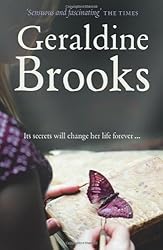
Now:  I’ve decided to concentrate on books from my to-be-read shelves and picked People of the Book by Geraldine Brooks, a book I’ve owned for nearly eight years. I can’t think why I haven’t read it before as so far I’m loving it.
Blurb:

People of the Book takes place in the aftermath of the Bosnian War, as a young book conservator arrives in Sarajevo to restore a lost treasure.

When Hannah Heath gets a call in the middle of the night in her Sydney home about a precious medieval manuscript which has been recovered from the smouldering ruins of wartorn Sarajevo, she knows she is on the brink of the experience of a lifetime. A renowned book conservator, she must now make her way to Bosnia to start work on restoring The Sarajevo Haggadah, a Jewish prayer book ‘“ to discover its secrets and piece together the story of its miraculous survival. But the trip will also set in motion a series of events that threaten to rock Hannah’s orderly life, including her encounter with Ozren Karamen, the young librarian who risked his life to save the book.

Then: I’ve recently finished Wycliffe and the Tangled Web by W J Burley, another book from my to-be-read shelves.

Blurb:

A beautiful schoolgirl goes missing from a Cornish village on the day she has told her boyfriend and sister she is pregnant. The possibility that she has been raped or murdered – or both – grows with every passing hour, and Chief Superintendent Wycliffe is brought in on the case.

The investigation reveals a complex network of family relationships and rivalries centred on the girl; and then Wycliffe finds a body – but not the one he expects. Have there been two murders? And if so, are they connected?

Wycliffe digs deeper, and soon realises that just beneath the normal, day-to-day surface of the community lies a web of hatred and resentment – a web he will have to untangle if he is to find the key to the mystery . . .

My post will follow soon.

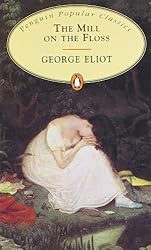
Next: I’m reluctant to say what I’ll be reading next because I usually change my mind when the time comes. But, I shall be reading The Mill on the Floss by George Eliot for the Classics Club Spin some time in April – yet another book I’ve owned for years.

Blurb:

George Eliot drew on her own anguished childhood when she depicted the stormy relationship between Maggie and Tom Tulliver. Maggie’s often tormented battle to do her duty and belong on the one hand, and to be  herself, wild and natural, on the other, propels her from one crisis to another. As the Tulliver fortunes decline and fall, the rift between Maggie and her family becomes almost irreconcilable. But Maggie’s biggest mistake of all is to fall in love with Stephen Guest who is engaged to another woman.

Both a sharp and observant picture of English rural life and a profoundly convincing analysis of a woman’s psychology, The Mill on the Floss is a novel that tackles the complexities of morality versus desire.

What about you? What are you reading this week?

My Friday Post: Book Beginnings & The Friday 56

Friday is book excerpts day on two blogs:

Book Beginnings ButtonBook Beginnings on Fridays hosted by Rose City Reader, where bloggers share the first sentence or more of a current read, as well as initial thoughts about the sentence(s), impressions of the book, or anything else that the opening inspires.  Friday 56

The Friday 56 hosted by Freda’s Voice, where you grab a book and turn to page 56 (or 56% of an ebook), find one or more sentences (no spoilers), and post them.

I’ve just started to read Wycliffe and the Tangled Web by W. J.  Burley. It begins:

The fair girl looked out of place in a doctor’s waiting room: she seemed to glow with health.

From page 56:

‘Alice has just come down from the village; she says the police are questioning Ralph Martin again; they’ve got him in their van on the quay.

After reading a few long books I fancied something shorter – this book has just 191 pages. It’s set in Cornwall where Chief Superintendent Wycliffe is investigating the case of a schoolgirl who went missing on the day that she told her boyfriend and sister she was pregnant. As he digs deeper Wycliffe finds a web of hatred and resentment – a web he will have to untangle.

It promises to be both easy reading and a satisfying mystery. I’ve read a few of Burley’s Wycliffe books and enjoyed them.

Wycliffe in Paul's Court by W J Burley

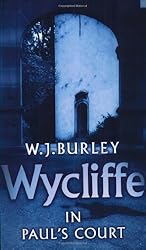
We had to spend nearly 4 hours yesterday in the Newcastle Emergency Eye Department as D has a corneal abrasion. As my Kindle needed charging I picked up a lightweight paperback to slip into my bag to while away the time – and I nearly finished it whilst we were there! It was Wycliffe in Paul’s Court by W J Burley.

Synopsis from the back cover:

Paul’s Court is a quiet corner in the heart of the city: an oasis of peace and safety – until the night when there are two violent deaths. Willy Goppel, an émigré from Germany, is found hanging from a beam in his home; and fifteen-year-old Yvette Cole, who may or may not have lived up to her wild reputation, is strangled and thrown half naked over the churchyard hedge.

Chief Superintendent Wycliffe has the aid of a shrewd local sergeant, Kersey, but they still find this a difficult case to crack. Did Willy assault the girl and then hang himself? Or was his death not suicide after all? As Wycliffe and Kersey dig deeper they gradually untangle a complex network of secrets in the quiet of Paul’s Court …

My thoughts

Although there are plenty of suspects, all from the five houses in Paul’s Court I could easily distinguish them, even with the distractions of a hospital waiting room from children crying that they wanted to go home and people talking loudly next to me. On the other hand, I wasn’t able to concentrate enough to follow all the clues and it was only just before the culprit was revealed that I had any idea who it was. But it was still an enjoyable read.

Wycliffe is a quiet, thoughtful detective who doesn’t let himself become desk-bound and gets very involved with the investigation. This is the first time he has worked with Kersey, who sized him up thus:

He saw a man with a clear view of right and wrong who was not a bigot; he recognised a close-grained moral toughness with a hint of old-fashioned puritan zeal, but no wish to burn heretics. A man of compassion but no sentimentalist, a reformer but not a do-gooder. (page 70)

Wycliffe and Kersey make a good team; Kersey knows not just the area very well but also the local people and is able to give Wycliffe ‘vivid thumb-nail sketches of the inhabitants of Paul’s Court’. They are ordinary people, living ordinary lives but who find themselves in the middle of a murder investigation. W J Burley was very good at creating believable people caught up in extraordinary situations. I’ve read just a few of his 22 Wycliffe books – plenty more to read yet!

W.J. Burley (1914 – 20020 was first an engineer, and later went to Balliol to read zoology as a mature student. On leaving Oxford he went into teaching and, until his retirement, was senior biology master in a large mixed grammar school in Newquay. He created Inspector Wycliffe in 1966 and the series has been televised with Jack Shepherd starring in the title role. Wycliffe in Paul’s Court was first published in 1980.

Two R.I.P. IX Books

So far I’ve read five books that fit into the R.I.P. Challenge categories of Mystery, Suspense, Thriller, Dark Fantasy, Gothic, Horror, or Supernatural. As I’m behind with writing about these books here are just a few notes on two of them:

Wycliffe and the House of Fear by W J Burley. Like the other Wycliffe books this is set in Cornwall. Detective Superintendent Wycliffe is on holiday recuperating from an illness when he meets the intriguing Kemp family and visits Kellycoryk, their decaying ancestral home.  The Kemps’ behaviour is odd to say the least and when Roger Kemp’s second wife, Bridget disappears people remember  that his first wife had also disappeared in what had been assumed was a boating accident. Wycliffe is inevitably drawn into the investigation.

I have yet to read a Wycliffe book and be disappointed and this one is no exception. It’s a complex story with sinister undercurrents and good depiction of a dysfunctional family. It kept me guessing almost to the end. This fits into the ‘Mystery’ category.

The next one I read is the short story (just 27 pages), The Yellow Wallpaper by Charlotte Perkins Gilman, which is definitely a suspense story of a young woman slowly but surely losing her mind – or is it a case of a woman suffering from post-natal depression most cruelly treated by her doctor husband? Her husband believes she has just a ‘slight hysterical tendency‘ and prescribes rest and sleep, scoffing at what he considers are her fantasies.

The un-named woman has just had a baby, which she is unable to bear to be near her. She spends most of her time in an attic bedroom, with barred windows and a bed fixed to the floor. The walls are covered in a hideous yellow wallpaper which has been torn off in places. It’s not a beautiful yellow like buttercups but it makes her think of old, foul bad yellow things – and it smells.  The pattern is tortuous and she sees a woman trapped behind the wallpaper as though behind bars, crawling and shaking the pattern attempting to escape. Definitely a creepy and disturbing story!

It reminded me of Marghanita Laski’s The Victorian Chaise-Longue with a similar sense of claustrophobia and helplessness. But The Yellow Wallpaper is much more horrific and by the end I began to question just what was real and what was imagination – it’s psychologically scary!

These two are both books from my to-be-read piles.