Six Degrees of Separation from All Fours to Sausage Hall

It’s time again for Six Degrees of Separation, a monthly link-up hosted by Kate at Books Are My Favourite and Best. Each month a book is chosen as a starting point and linked to six other books to form a chain. A book doesn’t need to be connected to all the other books on the list, only to the one next to it in the chain.

This month we start with All Fours by Miranda July, shortlisted for the Women’s Prize for Fiction 2025 and several other awards. I haven’t read it and probably won’t. This is Amazon’s description:
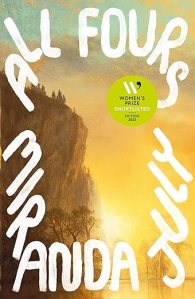
A semi-famous artist turns forty-five and gives herself a gift – a cross-country road trip from LA to New York, without her husband and child. But thirty minutes after setting off, she spontaneously exits the freeway, beds down in a nondescript motel – and embarks on the journey of a lifetime.

Miranda July’s second novel confirms the brilliance of her unique approach to fiction. With July’s wry voice, perfect comic timing, unabashed curiosity about human intimacy, and palpable delight in pushing boundaries, All Fours tells the story of one woman’s quest for a new kind of freedom. Part absurd entertainment, part tender reinvention of the sexual, romantic, and domestic life of a forty-five-year-old female artist, All Fours transcends expectation while excavating our beliefs about life lived as a woman. Once again, July hijacks the familiar and turns it into something new and thrillingly, profoundly alive.
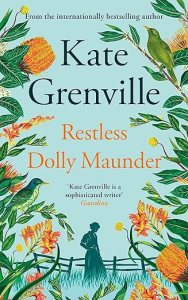
First link: I have read another book that was shortlisted for the previous year’s Women’s Prize for Fiction – Restless Dolly Maunder by Kate Grenville.

Dolly Maunder is born at the end of the 19th century, when society’s long-locked doors are just starting to creak ajar for determined women. Growing up in a poor farming family in rural New South Wales, Dolly spends her life doggedly pushing at those doors. A husband and two children do not deter her from searching for love and independence.

This is the fictionalised life story of Kate Grenville’s maternal grandmother, Sarah Catherine Maunder, known as Dolly. She was not only restless but also clever and determined – she knew what she wanted and she did her best to achieve it.
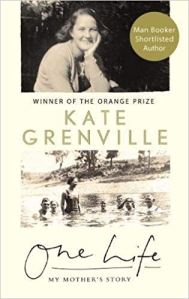
Second link: One of my favourite books by Kate Grenville is One Life: My Mother’s Story, her biography of Nance Russell, based on Nance’s memories, making it much more than a factual account of a person’s life. It’s a book that casts light not only on Nance’s life but also on life in Australia for most of the 20th century. Nance was born in 1912 and died in 2002, so she lived through two World Wars, an economic depression and a period of great social change. Nance wasn’t famous, the daughter of a rural working-class couple who became pub-keepers, but she was a remarkable woman.

It’s a vivid portrait of a real woman, a woman of great strength and determination, who had had a difficult childhood, who persevered, went to University, became a pharmacist, opened her own pharmacy, brought up her children, and helped build the family home. She faced sex discrimination and had to sell her pharmacy in order to look after her children at home.
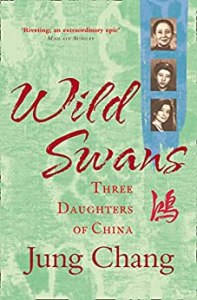
Third link: Wild Swans: Three Daughters of China by Jung Chang, a family memoir – the story of three generations of women in Jung Chang’s family – her grandmother, mother and herself, telling of their lives in China up to and during the years of the violent Cultural Revolution. Her family suffered atrociously, her father and grandmother both dying painful deaths and both her mother and father were imprisoned and tortured. She casts light on why and how Mao was able to exercise such paralysing control over the Chinese people. His magnetism and power was so strong and coupled with his immense skill at manipulation and his ability to inspire fear, it proved enough to subdue the spirit of most of the population; not to mention the absolute cruelty, torture and hardships they had to endure.
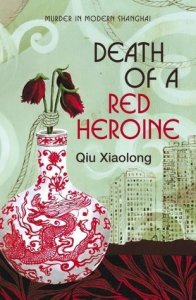
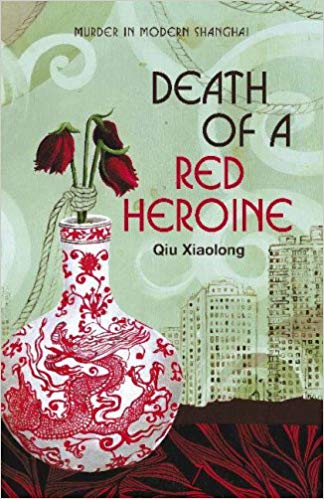
My fourth link moves from a memoir to crime fiction in Death of a Red Heroine by Qiu Xiaolong, the first book featuring Chief Inspector Chen. Chen is a reluctant policeman, he has a degree in  English literature and is a published poet and translator. This is as much historical fiction as it is crime fiction. There is so much in it about China, its culture and its history before 1990 – the Communist regime and then the Cultural Revolution in the 1960s – as well as the changes brought about in the 1990s after the massacre of Tiananmen Square. This does interfere with the progress of the murder investigation as Chen has to cope with the political ramifications and consequently there are several digressions and the pace is slow and lacking tension. As Chen is a poet as well as a policeman there are also references to Chinese literature.
Fifth link: Another fictional Chief Inspector who writes poetry is Adam Dalgleish in The Murder Room by P D James. The Murder Room itself is in the Dupayne Museum, displaying the most notorious murder cases of the 1920s and 30s, with contemporary newspaper reports of the crimes and trials, photographs and actual exhibits from the scenes of the murders. These were actual crimes and not fictional cases made up by P D James.

The novel  begins, as Adam Dalgleish visits the Dupayne in the company of his friend Conrad Ackroyd who is writing a series of articles on murder as a symbol of its age. A week later the first body is discovered at the Museum and Adam and his colleagues in Scotland Yard’s Special Investigation Squad are called in to investigate the killing, which appears to be a copycat murder of one of the 1930s’ crimes.
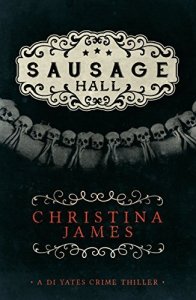
Another crime fiction writer with the surname James is my sixth link: Sausage Hall by Christina James, the third novel in the DI Yates series. It has a sinister undercurrent exploring the murky world of illegal immigrants, and a well researched historical element. It’s set in the South Lincolnshire Fens and is an intricately plotted crime mystery, uncovering a crime from the past whilst investigating a modern day murder. Sausage Hall is home to millionaire Kevan de Vries, grandson of a Dutch immigrant farmer.  I liked the historical elements of the plot and the way Christina James connects the modern and historical crimes, interwoven with the history of Kevan’s home, Laurieston House, known to the locals as ‘Sausage Hall’ and the secrets of its cellar.

My chain is made up of novels shortlisted for the Women’s Prize for Fiction, a biography, a memoir and three murder mysteries. It travels from New York to the UK via Australia and China.

Where does your chain end up, I wonder?

Next month (July 5, 2025), we’ll start with the 2025 Stella Prize winner, Michelle de Kretser’s work of autofiction, Theory & Practice.
Crime Fiction Alphabet: Q

For the letter Q in Kerrie’s Crime Fiction Alphabet I’ve chosen Death of a Red Heroine by Qiu Xiaolong.

Death of a red heroineQX

I  ‘discovered’ Qiu Xiaolong in 2010 during a previous series of the Crime Fiction Alphabet when I wrote about his second book, A Loyal Character Dancer. Death of Red Heroine is his first book featuring Chief Inspector Chen. It won the Anthony Award for Best First Crime Novel in 2001.

Synopsis from the back cover

Shanghai in 1990. An ancient city in a Communist country: looking to the future for its survival. Chief Inspector Chen, a poet with a sound instinct for self-preservation, knows the city like few others. 

When the body of a prominent Communist Party member is found, Chen is told to keep the party authorities informed about every lead. And he must keep the young woman’s murder out of the papers at all costs. When his investigation leads him to the decadent offspring of high-ranking officials, he finds himself instantly removed from the case and reassigned to another area.

Chen has a choice: bend to the party’s wishes and sacrifice his morals, or continue his investigation and risk dismissal from his job and from the party. Or worse . . .

My thoughts:

I think this is as much historical fiction as it is crime fiction. There is so much in it about China, its culture and its history before 1990 – the Communist regime and then the Cultural Revolution in the 1960s – as well as the changes brought about in the 1990s after the massacre of Tiananmen Square. This does interfere with the progress of the murder investigation as Chen has to cope with the political ramifications and consequently there are several digressions and the pace is slow and lacking tension. As Chen is a poet as well as a policeman there are also references to Chinese literature which although interesting, don’t move the murder mystery forward. A fair amount of concentration is needed both to understand the background and work out the plot.

Chen is a reluctant policeman, he has a degree in  English literature and is a published poet and translator. However, he is a good detective and helped by Detective Yu begins to unravel the mystery. Having found a suspect it is really the motive that provides a stumbling block, that and the constant need to keep in mind the ‘interests of the Party’ that prevents a quick resolution.

I like the characterisation, Chen and Yu in particular are clearly drawn, distinctive characters, and the setting is superb. I also like the many descriptions of food (as there are in A Loyal Character Dancer), such as this dinner menu Chen lays on for a party in his new apartment:

For the main dishes, there were chunks of pork stomach on a bed of green napa, thin slices of smoked carp spread on fragile leaves of jicai, and steamed peeled shrimp with tomato sauce. There was also a plate of eels with scallions and ginger, which he had ordered from a restaurant. He had opened a can of Meiling steamed pork and added some green vegetables to make it another dish. On the side, he placed a small dish of sliced tomatoes, and another of cucumbers. When the guests arrived, a soup would be made from the juice of the canned pork and canned pickle. (page 12)

It’s a fascinating book on several levels and one I enjoyed reading. I’m a bit late catching up with reading Qiu Xiaolong’s books as there are now seven Inspector Chen books:

1. Death of a Red Heroine (2000)
2. A Loyal Character Dancer (2002)
3. When Red Is Black (2004)
4. A Case of Two Cities (2006)
5. Red Mandarin Dress (2007)
6. The Mao Case (2009)
7. Don’t Cry, Tai Lake (2012)

Crime Fiction Alphabet – X is for A Loyal Character Dancer by Qiu Xiaolong

Qiu Xiaolong was born in Shanghai and was a member of the Chinese Writers’ Association, publishing poetry, translations and criticism in China. Since 1989 he has lived in the United States, his work being published in many literary magazines and anthologies. His first crime novel, Death of Red Heroine, won the Anthony Award for Best First Crime Novel. A Loyal Character Dancer is his second book featuring Chief Inspector Chen Cao, of the Shanghai Police Bureau.

Like Qiu Xiaolong, Chen is a member of the Chinese Writers’ association and he writes poetry (reminding me of PD James’s Adam Dalgleish). It was not his desire to become a policeman. He is also a gourmet and the book contains many tantalising descriptions of Chinese food – for example:

He ordered a South Sea bird’s nest soup with tree ears, oysters fried in spiced egg batter, a duck stuffed with a mixture of sticky rice, dates, and lotus seed, a fish steamed live with fresh ginger, green onions, and dried pepper, … (page 120-121).

In this book he has two crimes to deal with – the murder of an unknown man found in Bund Park, a park celebrated for “its promenade of multi-colored flagstones, a long curved walkway raised above the shimmering expans of water which joined the Huangpu and Suzhou rivers.” The man was in his forties, dressed in silk pajamas and he had been hacked more than a dozen times with a sharp, heavy weapon.

His second case is to investigate the disappearance of Wen Liping, the wife of Feng Dexiang, a crucial witness in an illegal immigrant case in Washington. The American and Chinese governments have agreed to a joint investigation to find Wen and Chen is assigned to work with Inspector Catherine Rohn, of the US Marshall’s Office.

I loved this book. There is a lot in it about life in China, the impact of the Cultural Revolution and the country itself. There is a very strong sense of place and this had me reaching for my sister’s books on China (she visited a few years ago before she died) to see photos of the locations and read more about life in China.

Having to explain things to Catherine made it easy for Qiu to pack in lots of information that otherwise could have seemed intrusive. For example as well as quoting poetry he also quotes from Confucius and explains literary references. Wen was a beautiful young woman, forced to leave her home to be “re-educated” when she was only sixteen during the Cultural Revolution. She had become a Red Guard cadre and a member of the song-and-dance ensemble, dancing the loyal character dance (hence the title of the book). Chen explains to Catherine that although dancing was not then allowed in China, this was particular form of dancing was allowed :

…  dancing with a paper-cut out of the Chinese character of Loyalty or with a red paper heart bearing the character, while making every imaginable gesture of loyalty to Chairman Mao. (page 84)

Chen is an enigmatic man, skilled at working the system. As a chief inspector he is also responsible for preserving Shanghai’s image. Keeping and saving face is very important. His boss, Li, the Party Secretary is more concerned with making sure that Catherine has a satisfactory stay in China, seeing only the good things than with carrying out the investigation into Wen’s disappearance. He does not like it when Chen and Catherine discuss the living conditions of the poor, China’s birth control policy and the question of illegal immigrants to the US. However, Chen and Catherine make a good partnership and with the help of Chen’s assistant, Dectective Yu get to the bottom of the mysteries of the murder and Wen’s disappearance, despite the activity of rival triad gangs.