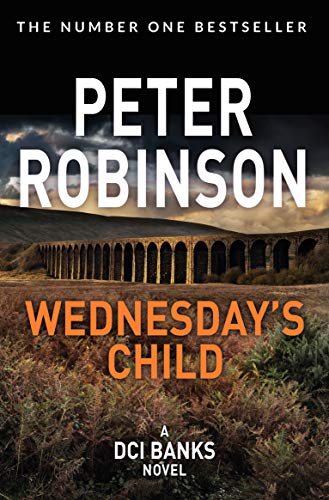
Book Beginnings & The Friday 56: Wednesday’s Child by Peter Robinson

Every Friday Book Beginnings on Friday is hosted by Gillion at Rose City Reader where you can share the first sentence (or so) of the book you are reading. You can also share from a book you want to highlight just because it caught your fancy.

My book this week is Wednesday’s Child by Peter Robinson. I began reading his Inspector Banks books years ago and have read 11 of the 26 books in the series, mostly out of order, so I’ve been reading the earlier books to fill in the gaps, as it were. This morning reading Margot’s post I remembered that the next book in the series I have to read is the 6th book, Wednesday’s Child.

The room was a tip, the woman was a slattern. On the floor, near the door to the kitchen, a child’s doll with one eye missing lay naked on its back, right arm raised above its head. The carpet around it was so stained with ground-in mud and food it was hard to tell what shade of brown it had originally been. High in one corner, by the front window, pale flowered wallpaper had peeled away from a damp patch. The windows were streaked with grime, and the flimsy orange curtains needed washing.

Also every Friday there is The Friday 56, hosted by Freda at Freda’s Voice, where you grab a book and turn to page 56 (or 56% of an eBook), find one or more interesting sentences (no spoilers), and post them.

Page 56:

‘The superintendent mentioned the Moors Murderers, Brady and Hindley,’ said Banks. I know he’s got a bee in his bonnet about that case, but you have to admit there are parallels.’

Synopsis from Amazon

When two social workers, investigating reports of child abuse, appear at Brenda Scupham’s door, her fear of authority leads her to comply meekly with their requests. Even when they say that they must take her seven-year old daughter Gemma away for tests . . .

It is only when they fail to return Gemma the following day that Brenda realizes something has gone terribly wrong.

At the same time, Banks is investigating a particularly unpleasant murder at the site of an abandoned mine. Gradually, the leads in the two cases converge, guiding Banks to one of the most truly terrifying criminals he will ever meet . . .

Mmm … It sounds very grim! What do you think? Have you read this book – or any of the Inspector Banks books?

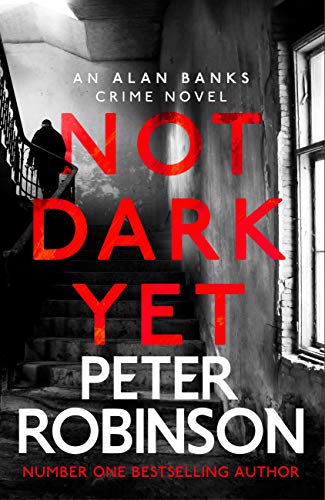
My Friday Post: Not Dark Yet by Peter Robinson

Yesterday Peter Robinson’s latest Inspector Banks book, Not Dark Yet was published and once I’d read the opening pages I decided to abandon any plans I had for what to read next and started to read it properly. So this is my choice this week for Book Beginnings on Friday and the Friday 56.

Every Friday Book Beginnings on Friday is hosted by Gillion at Rose City Reader where you can share the first sentence (or so) of the book you are reading, along with your initial thoughts about the sentence, impressions of the book, or anything else the opener inspires.

The book begins in Moldova:

Zelda hadn’t visited Chișinău since she had been abducted outside the orphanage at the age of seventeen. And now she was back. She wasn’t sure how she was going to find the man she wanted – she had no contacts in the city – but she did have one or two vague ideas where to begin.

Also every Friday there is The Friday 56, hosted by Freda at Freda’s Voice.

  1. Grab a book, any book.
  2. Turn to page 56, or 56% on your eReader. If you have to improvise, that is okay.
  3. Find any sentence (or a few, just don’t spoil it) that grabs you.
  4. Post it.
  5. Add the URL to your post in the link on Freda’s most recent Friday 56 post.

Page 56:

Banks found himself with a lot to think about as he made his way back to Vauxhall Underground station. He had originally intended to do some shopping while he was in London, check out the big Waterstones in Piccadilly, visit FOPP in Cambridge Circus, but decided he couldn’t face it. Like everyone else, he did most of his shopping online these days. London was too hot and too crowded today; he just wanted to go home.

My thoughts exactly each time I’ve been to London – I can’t stand crowds.

This is the 27th Inspector Banks books and I’ve read I’ve several of them, totally out of order, which doesn’t seem to matter – they work well as stand alone books. I’ve also watched the TV series, which I enjoy even though they are different from the books and my vision of Banks is nothing like Stephen Tompkinson who plays him. In fact, the characters are clearly meant to be different versions of the same person; they look different, have different personalities and meet different fates in different worlds.

Looking Forward to Reading …

Some of my favourite authors have new books coming out this year! Here they are in order of publication:

26 July 2018

Careless Love by Peter Robinson – the twenty fifth in his DCI Banks series.

Careless Love (Inspector Banks, #25)


‘With a deceptively unspectacular language, [Robinson] sets about the process of unsettling the reader.’ Independent

A young local student has apparently committed suicide. Her body is found in an abandoned car on a lonely country road. She didn’t own a car. Didn’t even drive. How did she get there? Where did she die? Who moved her, and why?

Meanwhile a man in his sixties is found dead in a gully up on the wild moorland. He is wearing an expensive suit and carrying no identification. Post-mortem findings indicate he died from injuries sustained during the fall. But what was he doing up there? And why are there no signs of a car in the vicinity?

As the inconsistencies multiply and the mysteries proliferate, Annie’s father’s new partner, Zelda, comes up with a shocking piece of information that alerts Banks and Annie to the return of an old enemy in a new guise. This is someone who will stop at nothing, not even murder, to get what he wants – and suddenly the stakes are raised and the hunt is on.

6 September 2018

Wild Fire (Shetland Island, #8)

Wild Fire by Ann Cleeves –  the eighth, and final book,  in her Shetland series featuring Detective Jimmy Perez.

Shetland: Welcoming. Wild. Remote.

Drawn in by the reputation of the islands, an English family move to the area, eager to give their autistic son a better life.

But when a young nanny’s body is found hanging in the barn of their home, rumours of her affair with the husband begin to spread like wild fire.

With suspicion raining down on the family, DI Jimmy Perez is called in to investigate, knowing that it will mean the return to the islands of his on-off lover and boss Willow Reeves, who will run the case.

Perez is facing the most disturbing investigation of his career. Is he ready for what is to come?

18 October 2018
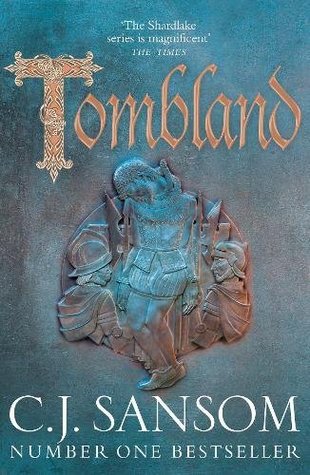
Tombland (Matthew Shardlake, #7)

Tombland is the seventh novel in C. J. Sansom’s Shardlake series.

Spring, 1549.

Two years after the death of Henry VIII, England is sliding into chaos . . .

The nominal king, Edward VI, is eleven years old. His uncle Edward Seymour, Lord Hertford, rules as Protector. The extirpation of the old religion by radical Protestants is stirring discontent among the populace while the Protector’s prolonged war with Scotland is proving a disastrous failure and threatens to involve France. Worst of all, the economy is in collapse, inflation rages and rebellion is stirring among the peasantry.

Since the old King’s death, Matthew Shardlake has been working as a lawyer in the service of Henry’s younger daughter, the Lady Elizabeth. The gruesome murder of Edith Boleyn, the wife of John Boleyn – a distant Norfolk relation of Elizabeth’s mother – which could have political implications for Elizabeth, brings Shardlake and his assistant Nicholas Overton to the summer assizes at Norwich. There they are reunited with Shardlake’s former assistant Jack Barak. The three find layers of mystery and danger surrounding Edith’s death, as a second murder is committed.

And then East Anglia explodes, as peasant rebellion breaks out across the country. The yeoman Robert Kett leads a force of thousands in overthrowing the landlords and establishing a vast camp outside Norwich. Soon the rebels have taken over the city, England’s second largest.

Barak throws in his lot with the rebels; Nicholas, opposed to them, becomes a prisoner in Norwich Castle; while Shardlake has to decide where his ultimate loyalties lie, as government forces in London prepare to march north and destroy the rebels. Meanwhile he discovers that the murder of Edith Boleyn may have connections reaching into both the heart of the rebel camp and of the Norfolk gentry . . .

Also 18 October 2018

A new Detective John Rebus novel – In a House of Lies – the 22 in his Rebus series.

In a House of Lies by [Rankin, Ian]

IN A HOUSE OF LIES

Everyone has something to hide
A missing private investigator is found, locked in a car hidden deep in the woods. Worse still – both for his family and the police – is that his body was in an area that had already been searched.

Everyone has secrets
Detective Inspector Siobhan Clarke is part of a new inquiry, combing through the mistakes of the original case. There were always suspicions over how the investigation was handled and now – after a decade without answers – it’s time for the truth.

Nobody is innocent
Every officer involved must be questioned, and it seems everyone on the case has something to hide, and everything to lose. But there is one man who knows where the trail may lead – and that it could be the end of him: John Rebus.

~~~

I am really looking forward to reading all these books!
Catching Up with Inspector Banks

Last month I read A Necessary End and Past Reason Hated by Peter Robinson, books 3 and 5 in his Inspector Banks series. I’ve read a few of his books out of order and I’m now filling in the gaps in my reading.

In A Necessary End a policeman is killed at an anti-nuclear demonstration in Eastvale. With over a hundred people at the demonstration at first there are plenty of suspects, but it soon becomes apparent that the main suspects are the organisers of the demonstration and the people living at Maggie’s Farm, an old Dales farmhouse set on the moors above the dales, the home of Seth Cotton.

To complicate matters Banks’ friend, Jenny Fuller is in a relationship with Dennis Osmond, a social worker and one of the main organisers of the demonstration. Jenny can’t believe that Dennis could be the culprit as he’d told he the last thing they had wanted was a violent confrontation.

This is the first book to introduce Detective Superintendent Richard ‘Dirty Dick’ Burgess, a troubleshooter from London called in to help with the investigations. Banks had worked with him a couple of times when was working in London and is not happy to see him. Because of this Banks works independently of Burgess and eventually gets to the bottom of the mystery.

Past Reason Hated is set just before Christmas when Caroline Hartley is found brutally murdered in her home she shared with Veronica Shildon. Three people had been seen visiting the house separately that evening. Nobody could describe them clearly – it had been dark and snowing and the street was not well lit and the investigation into her death centres on identifying them.

There are a number of suspects, among them is Charles Ivers, Caroline’s ex-husband, whom she had left to live with Veronica. There are also the members of the Eastvale amateur dramatic society who are rehearsing for a performance of Twelfth Night at the community centre. Caroline had a small part. But Banks is also interested in the music that was playing  when Caroline was found – the Laudate pueri – and in identifying the woman whose photo was found in Caroline’s belongings.

Both of these books are enjoyable but I preferred Past Reason Hated, because it has so many strands, which of course all interlinked and because of Robinson’s descriptions of the scenery in a snowy December. I also liked the focus on Susan Gay, newly promoted to Detective Constable as she stumbles to find her way in the team.

I am now addicted to the Banks books, which I enjoy more than the TV series. Both these books are from my TBRs.

Catching Up: three crime fiction books

I’m following the example of my blogging friend, Cath at Read Warbler, by writing a ‘catch up’ post as I am behind with writing reviews. That’s what going away for two weeks and then having an awful cold afterwards does for you!

So here are three crime fiction books, all very enjoyable 4 star books, that I read earlier this year:

A Dedicated Man by Peter Robinson, the second novel in Peter Robinson’s Inspector Banks series, first published in 1988, and my 17th book for  Bev’s Mount TBR 2017 challenge. I’ve been reading these books totally out of order and have gone back to the first ones to fill in the gaps in my reading.

Banks is now more settled in Yorkshire after the events described in the first book, Gallows View. I was struck as I read the books how unlike the TV version of Banks they are. Banks, himself, is nothing like Stephen Tompkinson (who plays his role). Robinson’s Banks is ‘a small dark man, in appearance rather like the old Celtic strain of Welshman, and his physique certainly didn’t give away his profession.

The ‘dedicated man‘ is local historian, Harry Steadman, who was found half-buried under a dry-stone wall near the village of Helmthorpe, Swainsdale. It seems that nobody would have wanted to kill such a good man, but as Banks investigates his background several suspects emerge. Sally Lunn, a young teenager knows more than is good for her and sets out to beat the police in finding the culprit.

Banks is a dogged and determined police officer, also a ‘dedicated man‘ and he concentrates on Steadman’s past; after leaving Cambridge where he got a first in history, he’d taught at Leeds University where he’d developed an interest in industrial archaeology. After his father died he’d inherited a considerable fortune and left his job to concentrate on his own interests. He’d married, Emma, a plain-looking woman who Banks first mistook for the cleaning lady.

Other characters include Jack Barker, a crime fiction writer, Penny Cartwright, a folk singer and Michael Ramsden, a close friend who worked in publishing. I thought Barker’s comment about his editor was interesting – that he could spend two days working on a fine description and find his editor wants him to cut it out because it slows the action. I wondered if that was Robinson’s own experience because he does include passages of description that do slow down the action. But I like his style, which is a good balance of description and fast -paced action.

Completely different in style is my next book, also detective fiction. It’s The Hanged Man of Saint-Pholien by Georges Simenon, translated by Linda Coverdale. This is the third book in the new series of Maigret novels in new translations, published by Penguin, originally written in 1930. In this short book (144 pages) Maigret observed a shabby man, travelling on a train from Holland to Bremen, carrying a small suitcase. He replaced the man’s suitcase with another exactly like it and followed him when he left the train, only to watch him through a keyhole in hotel bedroom, place a revolver in his mouth and press the trigger.  Maigret is disturbed by the thought that he had both witnessed the tragedy and been the cause of it. Wonderfully mysterious and obscure I was baffled for most of the book, as Maigret uncovers a crime from ten years earlier, revolving around the macabre drawings of hanged men of all types. A recurrent theme was the steeple of a church – the same church, that of Saint-Pholien in Liège.

A note at the beginning of the book reveals that the book was drawn from Simenon’s experiences in Liège, when he was ‘involved with a literary set, comprised of poets and young artists. A member of the group, Joseph Jean Kleine, was  found hanging from the doorway of the church of Saint-Pholien during this period, a tragedy that left its mark on Simenon.

Moving forward to 2016 my final book is Present Tense by W H S McIntyre, a criminal defence lawyer. It’s the 7th book in his Best Defence series, featuring criminal lawyer Robbie Munro. Munro is based in Linlithgow and deals mainly with Scottish Legal Aid cases.

Billy Paris, ex-military, leaves a cardboard box with Robbie and asks him to look after it for him, without telling him what it contained, but assuring him it wasn’t guns, knives or drugs. That’s OK until two men in black suits, one a detective inspector and the other from the Ministry of Defence, ask him for the box and want to know where they can find Billy.

It’s a legal drama, a tense and complicated mystery, combined with details of Robbie’s personal life. He is a single dad with a daughter, Tina, aged four and a half, living in his dad’s house along with his brother, Malky, an ex-footballer. His dad has promised Tina a Pyxie Girl doll for Christmas, but they’re impossible to get. There’s a lot about parenthood, more specifically fatherhood, and family relationships told with dark humour, all making for an intriguing and absorbing mystery.

My Friday Post

Book Beginnings Button

Every Friday Book Beginnings on Friday is hosted by Gillion at Rose City
Reader
 where you can share the first sentence (or so) of the book you are reading, along with your initial thoughts about the sentence, impressions of the book, or anything else the opener inspires.

I’ve recently finished reading Gallows View by Peter Robinson, the first Inspector Banks book and have decided to read the series in the order they were written. The second Inspector Banks book is A Dedicated Man. A Dedicated Man

When the sun rose high enough to clear the slate roofs on the other side of the street, it crept through a chink in Sally Lumb’s curtain and lit on a strand of gold blonde hair that curled over her cheek. She was dreaming.

This opening doesn’t tell me much about the book. If I didn’t know it’s an Inspector Banks book I’d probably not bother reading much further. But reading the blurb encourages me to read on:

Blurb:

Near the village of Helmthorpe, Swainsdale, the body of a well-liked local historian is found half-buried under a dry stone wall. Harry Steadman has been brutally murdered. But who would want to kill such a thoughtful, dedicated man?

Chief Inspector Alan Banks is called in to investigate and soon discovers that disturbing secrets lie behind the apparently bucolic facade. It is clear that young Sally Lumb, locked in her lover’s arms on the night of the murder, knows more than she is letting on. And her knowledge could lead to danger . . .

Also every Friday Freda at Freda’s Voice hosts The Friday 56

Friday 56

These are the rules:

  1. Grab a book, any book.
  2. Turn to page 56, or 56% on your eReader. (If you have to improvise, that’s ok.)
  3. Find any sentence (or a few, just don’t spoil it) that grabs you.
  4. Post it.
  5. Add the URL to your post in the link on Freda’s most recent Friday 56 post.

From Page 56:

‘He was a fine man, good-tempered, even-natured. He had a sharp mind – and a tongue to match when it came to it – but he was a good man; he never hurt a soul, and I can’t think why anyone would want to kill him.’

‘Somebody obviously felt differently,’ Banks said. ‘I hear he inherited a lot of money.’

I’m pleased that page 56 provides information about the man in the title and provides an answer to the question of why anyone would want to kill such a good man. I haven’t read much more of the book so I’m still in the dark about the motive – was the man really killed for his money?

What do you think? Would you continue reading?