Six Degrees of Separation from  Prophet Song by Paul Lynch to

It’s time again for Six Degrees of Separation, a monthly link-up hosted by Kate at Books Are My Favourite and Best. Each month a book is chosen as a starting point and linked to six other books to form a chain. A book doesn’t need to be connected to all the other books on the list, only to the one next to it in the chain.
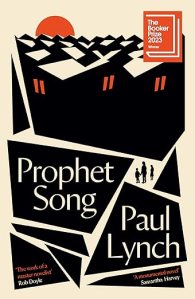
This month we start with Prophet Song by Paul Lynch, the winner of the Booker Prize in 2023. It’s set in a dystopic Ireland as it’s in the grip of a government turning towards tyranny and Eilish can only watch helplessly as the world she knew disappears. When first her husband and then her eldest son vanish, Eilish finds herself caught within the nightmare logic of a collapsing society.

I haven’t read Prophet Song so I decided to start my chain by linking to the word song in the title.
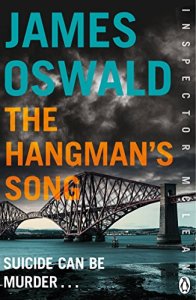
My first link is The Hangman’s Song by James Oswald, the third in his Inspector McLean series set in Edinburgh. a dark, tense book; crime fiction with elements of the supernatural  and parapsychology thrown in. McLean is working on two separate cases – one investigating a group of prostitutes and the subsequent death of their pimp, Malky Jennings, who was beaten to death – and the second, two suicides, which he and his DC, MacBride consider to be suspicious. Digging deeper, McLean finds answers something terrifying stalking the city streets.
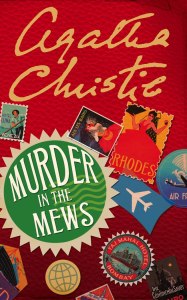
My second link is Murder in the Mews by Agatha Christie, one in a collection of short stories, featuring Hercule Poirot. At first it looks as though a young widow, Mrs Allen has committed suicide, but as the doctor pointed out the pistol is in her right hand and the wound was close to her head just above the left ear, so it’s obvious that someone else shot her and tried to make it look like suicide. The plot is tightly constructed, with a few red herrings to misguide Poirot and Inspector Japp and a moral question at the end. 
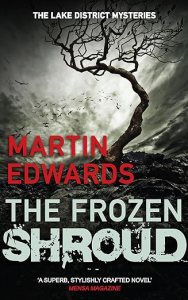
For my third link is a book I read just before Murder in the MewsThe Frozen Shroud by Martin Edwards. It’s the sixth book in his Lake District Mystery series. It begins at Halloween in Ravenbank, an isolated community on the shores of Ullswater. Gertrude Smith who was murdered on Hallowe’en, just before the First World War was found, battered to death, her face reduced to a pulp and covered with a woollen blanket like a shroud. Her murderer wasn’t hanged and the story goes that her tormented spirit 

I enjoyed the previous five, featuring historian Daniel Kind and DCI Hannah Scarlett, head of the Cold Case Review Team and this one is no exception; it kept me guessing almost to the end.
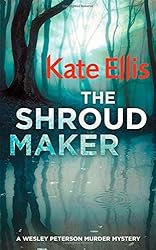
My fourth link is The Shroud Maker by Kate Ellis, the 18th Wesley Peterson Mystery.

It’s the Palkin Festival in Tradmouth, a town in Devon, when the body of a strangled women is discovered floating out to sea in a dinghy. A year earlier Jenny Bercival had disappeared from the festival and her mother returns to look for her bringing with her anonymous letters claiming she is still alive. DI Wesley Peterson and his boss DCI Gerry Heffernan are investigating the two cases. Are they connected and is there a link to a fantasy website called ‘Shipworld’ which features the 14th century mayor and privateer of Tradmouth, Palkin as a supernatural hero with a sinister, faceless nemesis called the ‘Shroud Maker’?
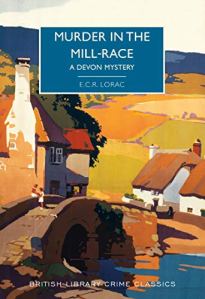
My fifth link is to another book set in Devon, Murder in the Mill Race by E R C Lorac, a Chief Inspector Robert Macdonald book.

A few months after the Dr Raymond Ferens’ arrival at Milham in the Moor in North Devon Sister Monica, the warden of a children’s home, is found drowned in the mill race, the stream leading into the water mill. Everyone says that Sister Monica is a saint – but is she? Chief Inspector Macdonald faces one of his most difficult cases in a village determined not to betray its dark secrets to a stranger.
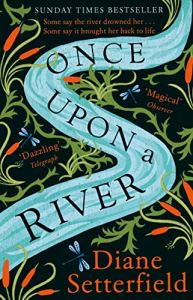
My final link is to Once Upon a River by Dianne Setterfield, in which a drowned body is also found, this time it’s that of a little child in the River Thames.It’s mystifying as hours later the dead child, miraculously it seems, takes a breath, and returns to life. The mystery is enhanced by folklore, by science that appears to be magic, and by romance and superstition. It is a beautifully and lyrically told story, and cleverly plotted so that I was not completely sure at times what it was that I was reading. It’s historical fiction with a touch of magic that completely beguiled me.

What is in your chain, I wonder?

Next month (April 5, 2025), we’ll start with Salman Rushdie’s memoir, Knife.
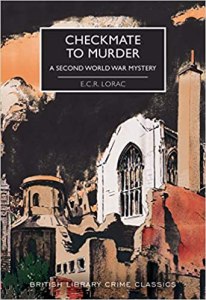
Two Chief Inspector Macdonald Books by E C R Lorac

E C R Lorac was a pen name of Edith Caroline Rivett (1894-1958) who was a prolific writer of crime fiction from the 1930s to the 1950s, and a member of the prestigious Detection Club. She formed her pseudonym by using her initials and for the surname, the first part of her middle name spelled backwards. She also wrote under the name of Carol Carnac.

I’ve read just a few of her Chief Inspector Robert Macdonald books., written under the name E C R Lorac – Bats in the Belfry (1937) , Fell Murder (1944), Murder by Matchlight (1945) and Fire in the Thatch (1946).

And recently I’ve read two more : Checkmate to Murder, first published in 1944 and Murder in the Mill Race, first published in 1952. These have been recently re-published by the British Library as part of the British Library Crime Classics, with introductions by Martin Edwards.

On a dismally foggy night in Hampstead, London, a curious party has gathered in an artist’s studio to weather the wartime blackout. A civil servant and a government scientist match wits in a game of chess, while Bruce Manaton paints the portrait of his characterful sitter, bedecked in Cardinal’s robes at the other end of the room. In the kitchen, Rosanne Manaton prepares tea for the charlady of Mr. Folliner, the secretive miser next door.

When the brutal murder of ‘Old Mr. F’ is discovered by his Canadian infantryman nephew, it’s not long before Inspector Macdonald of Scotland Yard is called to the scene to take the young soldier away. But even at first glance the case looks far from black-and-white. Faced with a bevy of perplexing alibis and suspicious circumstances, Macdonald and the C.I.D. set to work separating the players from the pawns to shed light on this toppling of a lonely king in the dead of night.

What I found fascinating in this book is the insight into what life was like in wartime London, complete with the London fog and the details of the blackout and although the Blitz was over there were still plenty of bangs and noise so that a gunshot wasn’t easily heard. The setting in a large studio that opens the book is a quiet scene as Bruce paints his sitter dressed as Cardinal Richelieu and two friends play a game of chess. Roseanne, Bruce’s sister is busy in the kitchen cooking their supper.Their evening is disrupted when a Special Constable bursts in with a young soldier in tow, claiming that he had killed his great-uncle in the next door building. This turns out to be more complicated than it first seemed. Even with just a limited number of suspects I couldn’t didn’t work out who the murderer was, nor how the murder had been committed. Macdonald explains it all at the end, having worked out ‘a reconstruction of the possibilities.’

~~~

When Dr Raymond Ferens moves to a practice at Milham in the Moor in North Devon, he and his wife are enchanted with the beautiful hilltop village lying so close to moor and sky. At first they see only its charm, but soon they begin to uncover its secrets – envy, hatred and malice.

Everyone says that Sister Monica, warden of a children’s home, is a saint – but is she? A few months after the Ferens’ arrival her body is found drowned in the mill race. Chief Inspector Macdonald faces one of his most difficult cases in a village determined not to betray its dark secrets to a stranger.

One of the things I think that Lorac excelled in was her settings. Each one is described so that you can easily picture the scenery and the landscape. And that is important in this book as Sister Monica drowned in the mill race, the stream leading into the water mill. She sets out through Macdonald exactly how that could have happened. She also conveys the atmosphere and the social interactions of an isolated village in Devon in the years just after the end of the Second World War. On the surface this is an idyllic village, but it is just like any other community, with a cross-section of personalities, and a mix of neighbourliness and an undercurrent of envy, hatred and malice. Sister Monica, a formidable woman, revered by some, is in charge of a children’s home, which she rules with a rod of iron and knows everything about everybody. Others regard her with caution, as the bailiff, Sanderson tells Anne Ferens, the doctor’s wife:

She is one of those people who can not only lie plausibly and with conviction, but she can tell a lie to your face without batting an eyelid, knowing that you know it’s a lie, and it’s very hard to bowl her out. (page 34)

But the village close ranks when she is found dead in the mill race and it is hard for Macdonald and Detective Inspector Reeeve to get the villagers to open up and and talk about what she was really like. It appears to be suicide, but is it?