This is my third short post to catch up with reviewing books I’ve read recently.
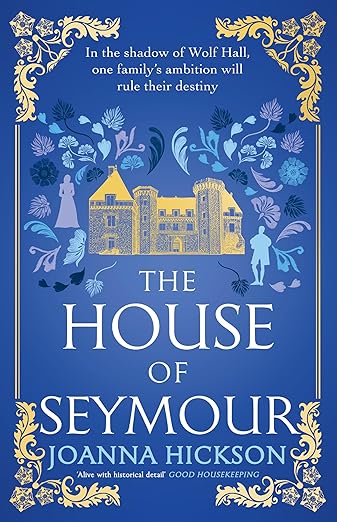
HarperCollins |22 May 2025| 406 pages| e-book| Review book| 3.5*
When Isabel Williams is betrothed to John Seymour, Lord of Wolf Hall Manor, she hopes that love and respect will come, despite his cold streak of ruthless ambition.
Jess the shepherdess tends her flock on the wild spaces of Avebury close by, dismissing those who believe it is work for men. Forced to flee after falling under suspicion for the disappearance of a young man, Isabel’s offer of life with the growing Seymour family is the only refuge available to her.
As John’s ambition draws them into the orbit of the divided court of the young King Henry VI, his hunger to succeed takes on a darker edge. Isabel realises her husband will pay any price to get what he wants, even if it means destroying those he has sworn to protect…
I’ve read some of Joanna Hickson’s historical fiction novels so I was hoping I’d enjoy The House of Seymour, the first in a new trilogy. However, even though it is entertaining reading I felt it’s rather underwhelming, but maybe my expectations were too high.
It opens with a Prologue set in 1537 with Jane Seymour towards the end of her pregnancy looking at a proposed new Seymour coat of arms. She was upset that it didn’t include the badges of her mother and grandmother who were commoners.
The story then goes back over a hundred years to 1424 where we meet Isabel Williams, Jane’s great great grandmother, the daughter of a wealthy merchant. She married John Seymour (c. 1395/1402 – 20 December 1464) Lord of Wulf (Wolf) Hall in Savernake Forest, Wiltshire. Isabel and John’s marriage was not an easy one. John was ambitious, cruel and ruthless, determined to gain the support of Humphrey, the Duke of Gloucester and Protector of the boy king Henry VI. Alongside Isabel’s story is that of Jess, a young shepherdess, who left her home at Avebury, accused of witchcraft. She and Isabel had met at the Easton Priory and after hearing her story Isabel offered her a place in her household to look after her young son.
I really liked the settings, Wolf Hall, close to Savernake Forest, a remnant of primeval forest which became a royal forest soon after the Norman Conquest, and the village of Avebury with its henge and stone circles and the Long Barrow on Silbury Hill, a Neolithic burial site. I enjoyed the details of family life in the fifteenth century at Wolf Hall, and the details about hunting wolves and sheep farming. But overall I think this is very light historical fiction.
At the end of the book there is a useful glossary of words, such as ‘manchet‘, which is the best ‘white-flour’ bread served in wealthy homes, and also a section containing the author’s notes, giving information about the places mentioned, which I think are well worth reading.
Many thanks to Netgalley/Joanna Hickson/HarperCollins UK for a digital review copy of this title.




 BooksPlease