Spell the Month in Books – April 2025

Spell the Month in Books is a linkup hosted by Jana on Reviews From the Stacks on the first Saturday of each month. The goal is to spell the current month with the first letter of book titles, excluding articles such as ‘the’ and ‘a’ as needed. That’s all there is to it! Some months there are optional theme challenges, such as “books with an orange cover” or books of a particular genre, but for the most part, any book you want to use is fair game!

This option this month is Animal on the Cover or in the Title, which I found much easier to do than some of the previous options. These are all books I’ve read, apart from Inchworm.
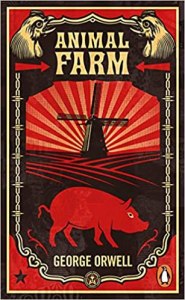
A is for Animal Farm by George Orwell is an allegorical novella, of the Russian Revolution and the rise of the Soviet Union. It tells the story of a farm where the animals rebel against the farmer, Mr Jones, and throw him off the land. They hope to create a society where they are all equal, free and happy. Ultimately, the farm ends up in a state that is as bad, if not worse than it was before, under the dictatorship of a pig named Napoleon. It begins as the old boar Major tells the animals about his dream of overthrowing the human race when the produce of their labour would then be their own and he incites them to rebel. In the story that follows the Major is based on Marx, Farmer Jones on the Tsar, the pigs Napoleon and Snowball are based on Stalin and Trotsky respectively. Their revolution began by declaring that all animals are equal and ended with the added phrase but some animals are more equal than others.
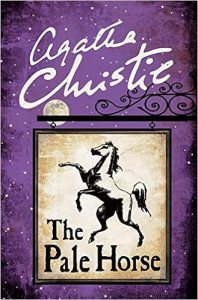
P is for The Pale Horse by Agatha Christie. Neither Hercule Poirot, nor Miss Marple feature in this novel and Mrs Ariadne Oliver has only a small part. Detective Inspector Lejeune is in charge of the investigation into the murder of Father Gorman who was killed one night on his way home. A list of names is found on Father Gorman’s body, seemingly unconnected in any way. The title,  a reference from the Book of Revelation  to a pale horse ridden by Death suggested to me from the beginning that what they had in common was death.

The Pale Horse is an old house  which was formerly an inn in the village and is now the home of three weird women, thought by the locals to be witches. The Pale Horse is also the name of a sinister organisation that arranges murders based on black magic. It’s a fascinating book conveying a feeling of real menace.
R is for The Raven’s Head by Karen Maitland. Set in 1224 in France and England this is a dark book. I found parts of it very uncomfortable and disturbing to read and yet also very compelling. Life in the medieval world was cruel and brutal and The Raven’s Head describes that world in minute detail, evoking the superstitious fear of the period.

The story is told from the three main characters point of view – Vincent, Wilky, a young boy taken from his family to live in a monastery in Norfolk where unspeakable terrors await him and the other young boys, and Gisa also living in Norfolk, working in her uncle’s apothecary’s shop. Their lives are connected through Lord Sylvain who is trying to find a way to bring the dead back to life and the abbot, trying to find the elixir of life – both experimenting with alchemy.
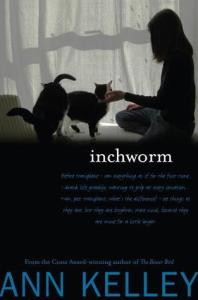
I is for Inchworm by Ann Kelly. Gussie is a twelve year old girl from St. Ives in Cornwall. She is passionate about learning, wildlife, poetry, literature, and she wants to be a photographer when she grows up. But her dreams were put on hold as she struggled with a serious heart condition. Now she has got what she needed: a heart and lung transplant. But it isn’t working out quite the way she thought. Firstly she has to leave her beloved Cornwall to live in London and in the months following her operation she is unable to do very much except read and adopt a stray kitten, but she could do that when she was sick. She craves adventure and experience beyond her four walls, until, that is, she hits upon a plan – she is going to get her divorced parents to fall in love again. It’s not going to be easy, her mum is still dating her doctor boyfriend and despises Gussie’s father, who happens to be living with his new girlfriend – the Snow Queen. But Gussie is a determined girl and there is only one thing that could stop her now.

L is for Lion by Conn Iggluden. This is the first book in Conn Iggulden’s Golden Age series set in Amcient Greece in the 5th century BCE. I thoroughly enjoyed it which surprised me as generally speaking I’m not keen on reading battle scenes and the book starts and ends with battles. But I had no problem with following the action of the battles between the Greeks and the Persians, and was able to visualise what was going on without any difficulty. The characters’ names took me a little while to get clear in my mind but I soon got used to them. The two main characters are both young men, Cimon the older of the two has more authority than Pericles, the younger man. Lion is the story of their early careers.

The next link up will be on May 3, 2025 when the theme will be: Freebie

The Road to Wigan Pier by George Orwell

Synopsis:

In the 1930s, commissioned by a left-wing book club, Orwell went to the industrial areas of northern England to investigate and record the real situation of the working class. Orwell did more than just investigate; he went down to the deepest part of the mine, lived in dilapidated and filthy workers’ houses, and used the tip of his pen to vividly reveal every aspect of the coal miners’ lives. Reading today, 80 years later, Still shockingly true. The despair and poverty conveyed by this picture have a terrifying power that transcends time and national boundaries. At the same time, the Road to Wigan Pier is also Orwell’s road to socialism as he examines his own inner self. Born in the British middle class, he recalled how he gradually began to doubt and then hate the strict class barriers that divided British society at that time. Because in his mind, socialism ultimately means only one concept: “justice and freedom.” (Goodreads)

The Road to Wigan Pier, written in 1936 and published in 1937, is a book of two halves. Orwell’s graphically unforgettable descriptions of social injustice, cramped slum housing, dangerous mining conditions, squalor, hunger and growing unemployment remains a powerful portrait of poverty, injustice and class divisions in Britain. I loved Part One, Part Two less so. I was much more interested in the social and economic conditions than in Orwell’s political views on socialism and fascism.

I knew very little about the 1930s, so I was fascinated and appalled by Orwell’s descriptions in Part One of the working conditions in the coal mines in three towns in the industrial north of England in 1936. His experience of working in a coal mine convinced him that could never have been a coal miner:

I am not a manual labourer and please God I shall never be one, but there are some kinds of manual work that i could do if I had to. At a pinch I could be a tolerable road-sweeper or an inefficient gardener or even a tenth-rate farm hand. But by no conceivable amount of effort or training could I become a coal-miner; the work would kill me in a few weeks.

Yet as bad as the conditions in the mines were in 1936, Orwell stated that it was not long since conditions had been even worse, and he went on to describe how women used to have to work underground, crawling on all fours with a harness round their waists and a chain that passed between their legs dragging tubs of coal even when they were pregnant.

The slag heaps were just ‘dumped on the earth like the emptying of a giant’s dust-bin’ on the outskirts of the mining towns and often they were on fire. At night they could be seen as ‘rivulets of fire winding this way and that, and also the slow-moving blue flames of sulphur’.

Orwell states that

… the majority of these houses are old, fifty or sixty years old at least, and great numbers of them are by any ordinary standard not fit for human habitation. They go on being tenanted simply because there are no others to be had. And that is the central fact about housing in the industrial areas: not that the houses are poky and ugly, and insanitary and comfortless, or that they are distributed in incredibly filthy slums round belching foundries and stinking canals and slag heaps that deluge them with sulphurous smoke – though all this is perfectly true – but simply that there are not enough houses to go round.

Given that the living and working conditions were so appalling it was no surprise to read Orwell’s descriptions of the miners’ health – the most distinctive thing about them were the blue scars on their noses. The coal dust entered every cut and then their skin grew over it and formed the blue stain like tattooing. Only the largest pits had pithead baths, so the miners could only wash when they got home, where it was impossible to wash all over but they could only wash in a bowl of water – and that was only the top half of their bodies. This was because none of the miners’ houses had hot water and at the time they were built no one had imagined that the miners wanted baths!

Before he’d looked into the real situation of the working class, Orwell had thought that the miners were comparatively well paid having heard that a miner was paid ten or eleven shillings a shift, concluding that every one was earning round about £2 a week or £150 a year. However the actual average earnings were only £115 11s 6d. He included a list of weekly stoppages that were given to him as typical in one Lancashire district and also a comprehensive account of their expenses, all of which reduced their earnings considerably.

He then went on to describe the rate of accidents and of those miners killed and injured – if a miner’s working life was forty years the chances were nearly seven to one against his escaping injury and not much more that twenty to one of his being killed outright, giving horrifying accounts of being buried by rock falls when a roof came down. The most understandable cause of accidents was gas explosions, but there were also ‘pot-holes’, circular holes that shot out lumps of stone big enough to kill a man and large stretches of roof were left unpropped because of the increased speed at which the coal was extracted. No other trade was this dangerous.

I struggled to keep my attention focused whilst reading Part Two. He wrote about class divisions, class prejudice and the struggle towards a liberation from the constrictions of class. He pondered whether he had been born into the lower-upper middle class or the upper middle class, or whether it was better to define the class division in terms of money – that is, a layer of society lying between £2000 ad £300 a year. In any case he thought it was not entirely explicable in terms of money as there was also a sort of shadowy caste-system involved. But a lot of Part Two just went over my head.

I was curious about the title, because there is no ‘road to Wigan Pier’ in Orwell’s book and also because I’d grown up knowing that ‘Wigan Pier’ was not a pleasure pier at the seaside – Wigan is not near the sea. It’s inland and part of Greater Manchester!

In a broadcast radio interview of 1943 Orwell elaborated on the name Wigan Pier:

Wigan is in the middle of the mining areas. The landscape is mostly slag-heaps – Wigan has always been picked on as a symbol of the ugliness of the industrial areas. At one time, on one of the muddy little canals that run round the town, there used to be a tumble-down wooden jetty; and by way of a joke some nicknamed this Wigan Pier. The joke caught on locally, and then the music-hall comedians got hold of it, and they are the ones who have succeeded in keeping Wigan Pier alive as a byword.” (Wikipedia)

For more information about the current ‘Wigan Pier’ area see this article about a proposal to redevelop the disused 18th century industrial buildings that is being led by Step Places, The Old Courts, Wigan Council and the Canal and River Trust with the aim of creating a new cultural destination.

I read this book as part of The 1936 Club hosted by Karen at Kaggsy’s Bookish Ramblings and Simon from Stuck in a Book blogs, but was too late to enter my post with the other bloggers’ links during the club event.

Nineteen Eighty-Four by George Orwell

3*

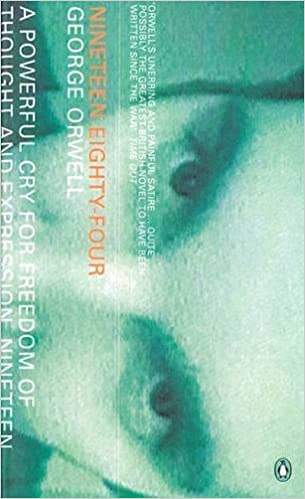
I bought a paperback copy of Nineteen Eighty-Four (its original title) in 2008, but have only just read it. It is George Orwell’s last novel, written in 1948 and presents his vision of a dystopian society, a totalitarian state complete with mass surveillance, where individuality is brutally suppressed.

Synopsis from the back cover:

In Orwell’s frightening vision of the future, society is under the control of Big Brother. Every aspect of life is closely monitored, whilst any hint of unorthodoxy is ruthlessly suppressed by the Thought Police. The Ministry of Truth, where Winston Smith works, is the Party’s Propaganda Machine. A secret rebel, Winston yearns for liberty and finds new hope when he falls in love with the earthy, uncomplicated Julia. Instead he discovers a nightmare world of terror where the price of freedom is betrayal.

Winston Smith’s attempt to find liberty and individuality plunges him into a truly horrific version of hell. The world is ravaged by war with three superstates, Oceania, Eurasia and Eastasia battling for total control. Winston lives in Airstrip One (Britain) in Oceania. His job is to rewrite history and destroy the old records, in accordance with the current circumstances. He secretly opposes the Party’s rule, led by the mysterious Big Brother, and dreams of rebellion. But faced with the Thought Police, the Hate Week sessions the surveillance through the television screens, cameras and hidden microphones monitoring his every move and thought, he realises it is a futile hope and that he is likely to be caught.

This really is the most depressing book and in places it is boring, especially in the middle section of the book devoted to Goldstein’s book. Goldstein, the leader of the Opposition Party to Big Brother, is always the subject of hatred at the Hate Week sessions. There are also passages that I could hardly bear to read – torture scenes that I did not want to visualise – it is a harrowing book. But it was interesting to see where the terms, Big Brother is Watching You, Room 101 (you do not want to be sent there!) Thought Police, Newspeak, Doublethink, holding two contradictory thoughts at the same time, and Thoughtcrime originated.

Nineteen Eighty -Four has received very many accolades and 94% of the people who have rated it on Goodreads ‘liked’ it – 79% giving it 5 or 4 stars .This is possibly the least enjoyable book I’ve read, horrific in content, lacking in convincing characterisation, and has a poor plot. It is depressing and dreary in the extreme, but I can see why it can be considered a brilliant book in its depiction of a dystopian society. It is seriously thought provoking!

‘George Orwell’ was the pen name of Eric Arthur Blair (25 June 1903 – 21 January 1950). He ‘was an English author and journalist. His work is marked by keen intelligence and wit, a profound awareness of social injustice, an intense opposition to totalitarianism, a passion for clarity in language, and a belief in democratic socialism.’ (Goodreads)

Book Beginnings & The Friday 56: 1984 by George Orwell

Every Friday Book Beginnings on Friday is hosted by Gillion at Rose City Reader where you can share the first sentence (or so) of the book you are reading. You can also share from a book you want to highlight just because it caught your fancy.

1984 is one of the books I’m currently reading. It’s one of those books I’ve had for years and never read.

The Book Begins:

It was a bright cold day in April, and the clocks were striking thirteen,

Also every Friday there is The Friday 56, hosted by Freda at Freda’s Voice. *Grab a book, any book. *Turn to Page 56 or 56% on your  ereader . If you have to improvise, that is okay. *Find a snippet, short and sweet, but no spoilers!

These are the rules:

  1. Grab a book, any book.
  2. Turn to page 56, or 56% on your eReader. If you have to improvise, that is okay.
  3. Find any sentence (or a few, just don’t spoil it) that grabs you.
  4. Post it.
  5. Add the URL to your post in the link on Freda’s most recent Friday 56 post.

Page 56:

‘By 2050 – earlier, probably – all real knowledge of Oldspeak will have disappeared. The whole literature of the past will have been destroyed. Chaucer, Shakespeare, Milton, Byron – they’ll exist only in Newspwak versions, not merely changed into something different, but actually changed into something contradictory of what they used to be.

Summary:

The year 1984 has come and gone, but George Orwell’s prophetic, nightmarish vision in 1949 of the world we were becoming is timelier than ever. 1984 is still the great modern classic of “negative utopia”—a startlingly original and haunting novel that creates an imaginary world that is completely convincing, from the first sentence to the last four words. No one can deny the novel’s hold on the imaginations of whole generations, or the power of its admonitions—a power that seems to grow, not lessen, with the passage of time. (Goodreads)

~~~

What have you been reading lately?